Figure 7From “BANT vs MEDDIC: a qualification checklist is a hypothesis”
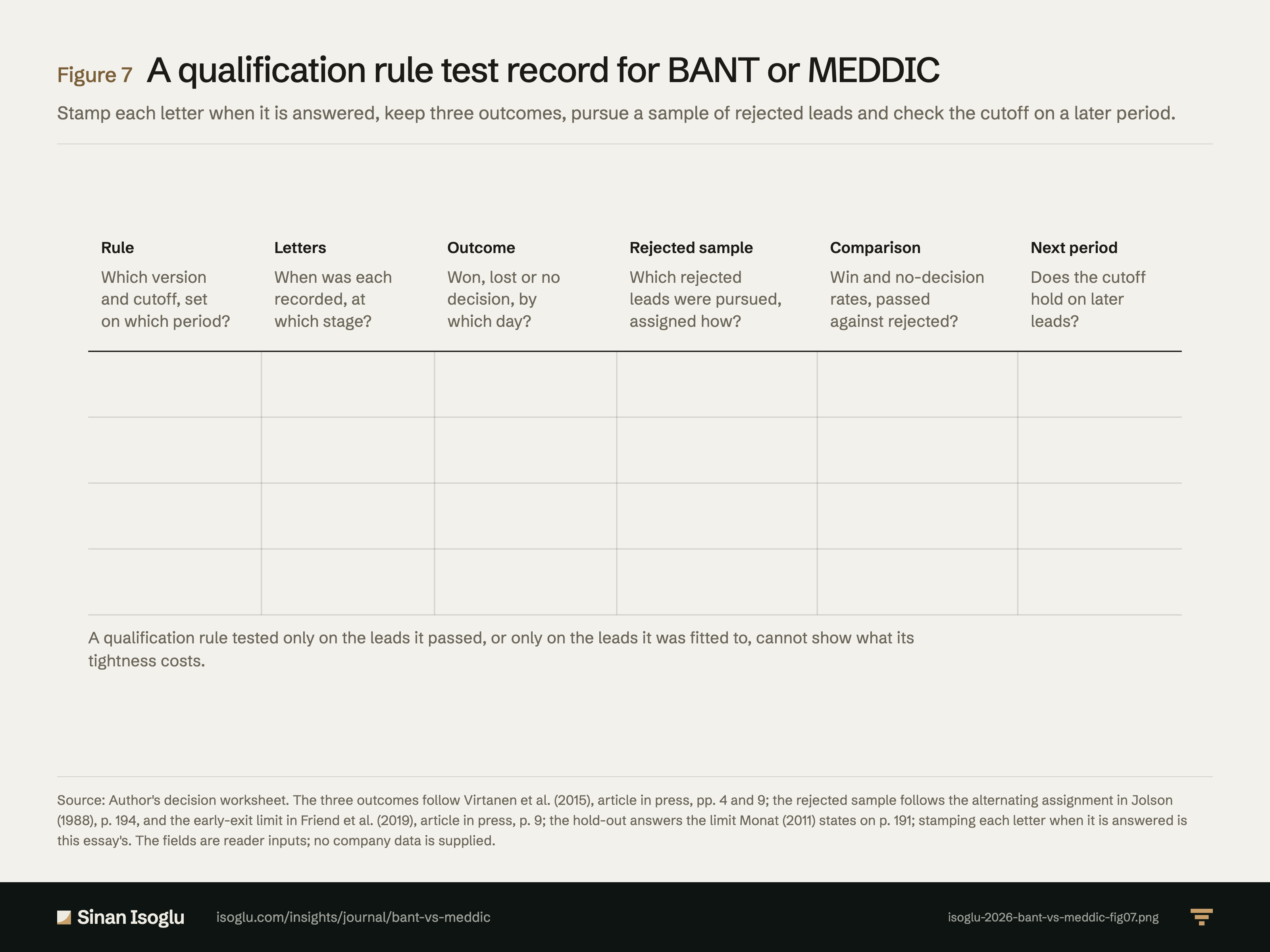
A qualification rule test record for BANT or MEDDIC
Stamp each letter when it is answered, keep three outcomes, pursue a sample of rejected leads and check the cutoff on a later period.
Figure 7A qualification rule test record for BANT or MEDDIC
Source: Author's decision worksheet. The three outcomes follow Virtanen et al. (2015), article in press, pp. 4 and 9; the rejected sample follows the alternating assignment in Jolson (1988), p. 194, and the early-exit limit in Friend et al. (2019), article in press, p. 9; the hold-out answers the limit Monat (2011) states on p. 191; stamping each letter when it is answered is this essay's. The fields are reader inputs; no company data is supplied.
Source and evidence
Each line names a claim related to this exhibit, its source, and how it was checked.
- B A verified against the printed page of the primary sourceB primary source, text layer onlyC authoritative secondaryD reported The test record (Figure 7) and illustration: stamp each letter when answered, recording when and at which stage, not by whom; three outcomes judged on a fixed day; a sample of rejected leads pursued, assigned alternately or by lot as in Jolson's interlacing; the cutoff set on one period and checked on the next, the hold-out Monat lacked; comparison by letter and of rejected against passed, repeated each quarter as D'Haen and Van den Poel ask; a hypothetical software team qualifying inbound demo requests with BANT for one quarter, judged on day 180, every tenth rejected request passed to a seller; if the rejected sample wins nearly as often as the passed requests the rule does not separate buyers, if less often but enough to pay for follow-up it is too tight, and rejected wins are counted and quarters pooled while counts are small. In the German twin: per-person breakdowns raise the § 87 Abs. 1 Nr. 6 BetrVG question, and the rule-level comparison does not need one. Author's proposal, not run, no company data. Figure 6 (EN and DE, a Mermaid flow) branches on who decides, so a team uses one screen, BANT for one contact who can buy soon or MEDDIC for a buying group deciding over months; each screen's rejected branch records no outcome unless a test sample is pursued by lot or every nth lead or deal (closure C-N7), and every pursued lead ends on a fixed day as won, lost or canceled (the last including seller no-go); the flow is the essay's framing.Author worksheet
From the essay
Revenue operations & AI
BANT vs MEDDIC: a qualification checklist is a hypothesis
BANT checks budget, authority, need and timing; MEDDIC maps how a buying group decides. In a 1988 field test, tight leads converted better and sold less.
Read the essayThis exhibit belongs to an essay: the numbers live here, the argument lives there.
Cite or embed
Related exhibits
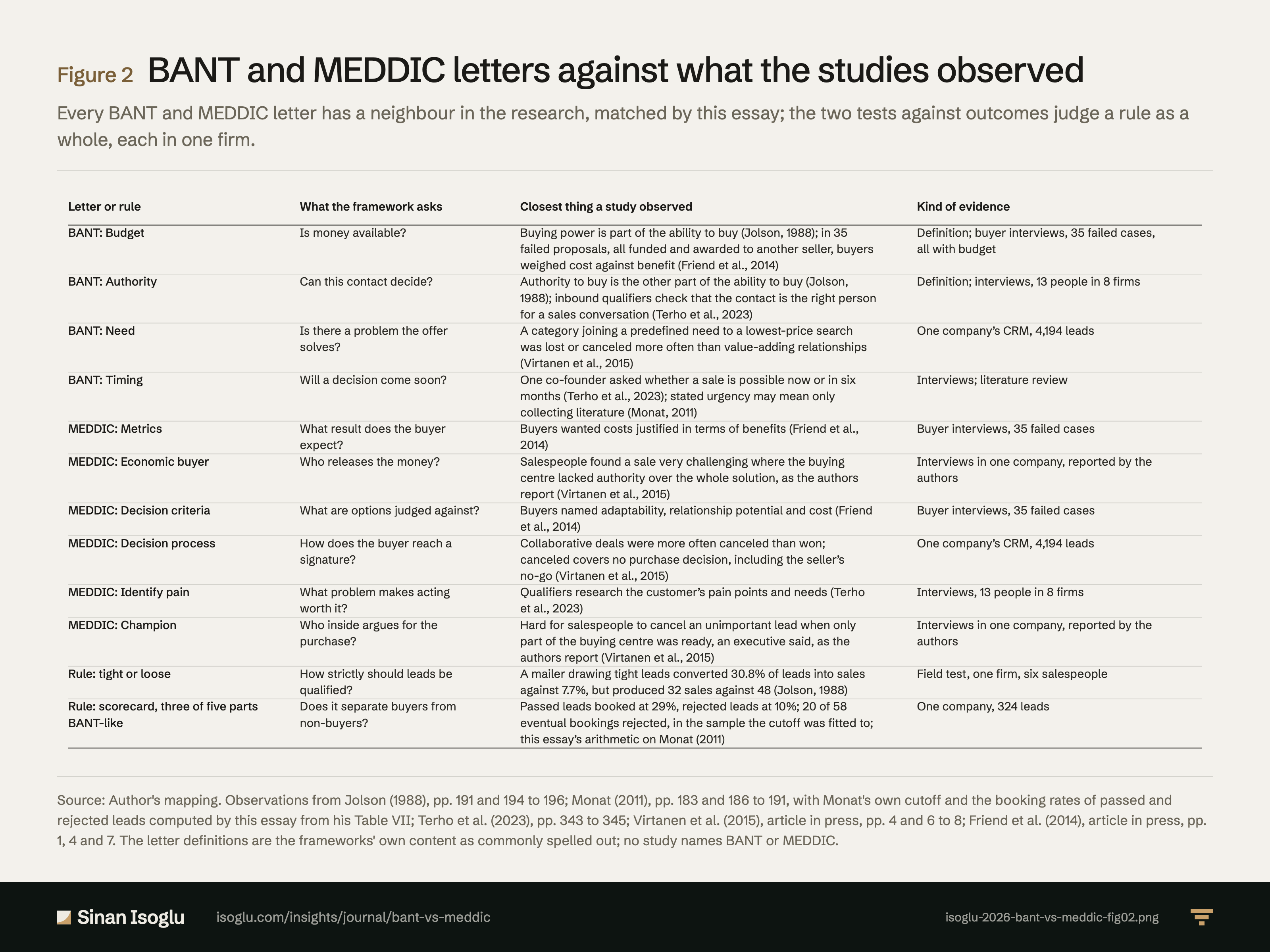
Figure 2Figure
BANT and MEDDIC letters against what the studies observed
BANT vs MEDDIC: a qualification checklist is a hypothesis
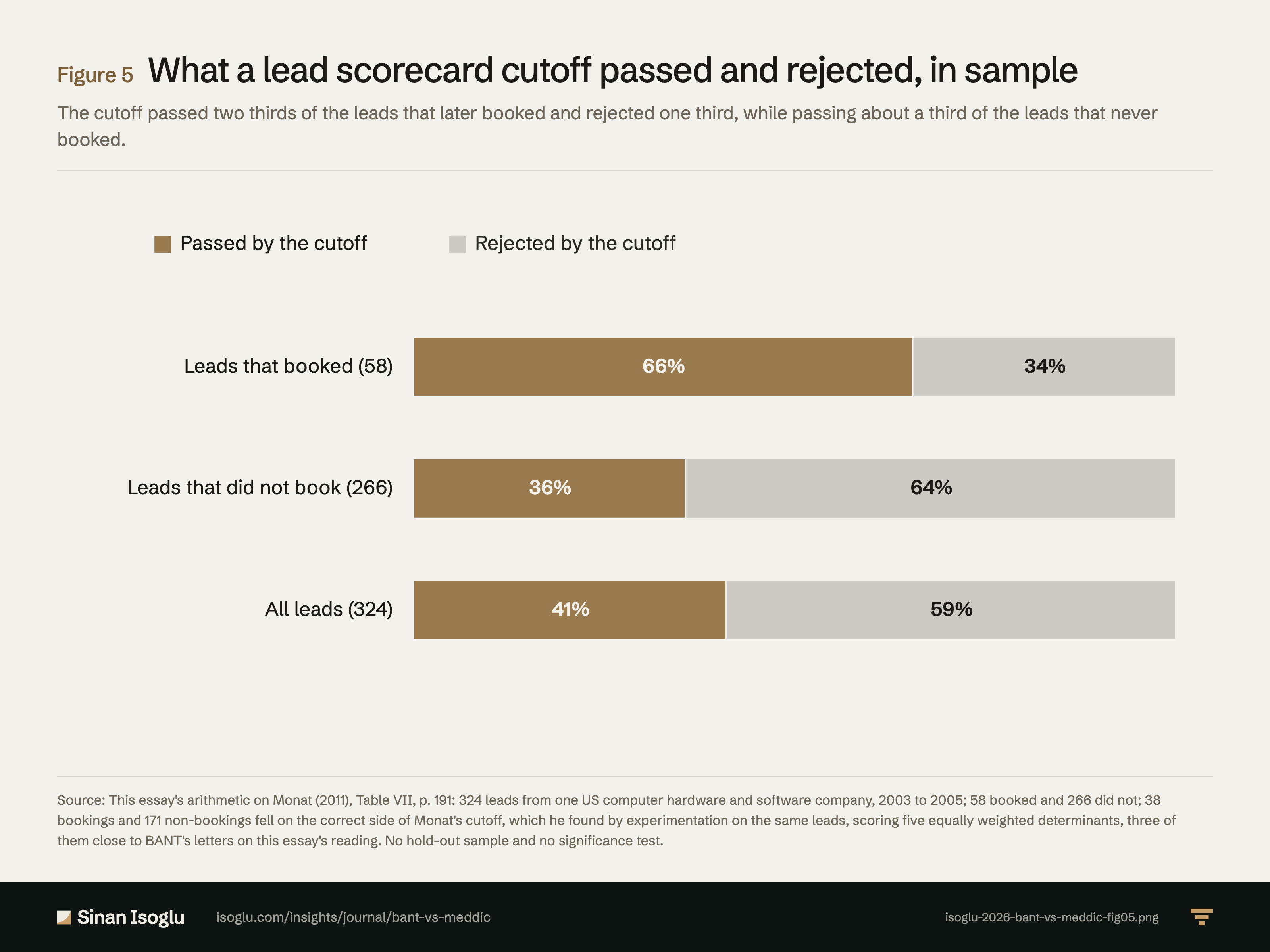
Figure 5Figure
What a lead scorecard cutoff passed and rejected, in sample
BANT vs MEDDIC: a qualification checklist is a hypothesis
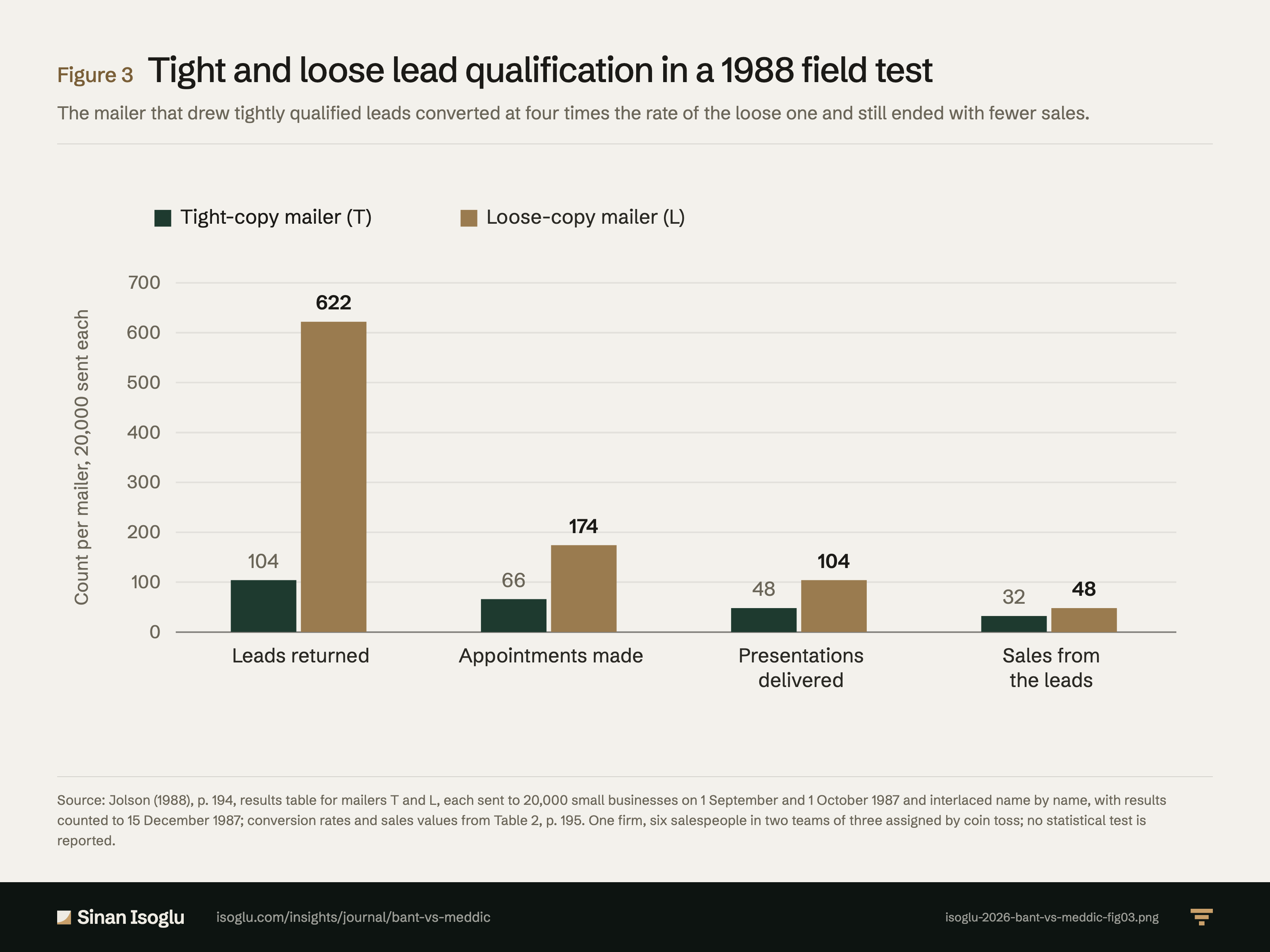
Figure 3Figure
Tight and loose lead qualification in a 1988 field test
BANT vs MEDDIC: a qualification checklist is a hypothesis
Contact
Bring the question you're working on.
Research, a guest lecture, or a commercial question.