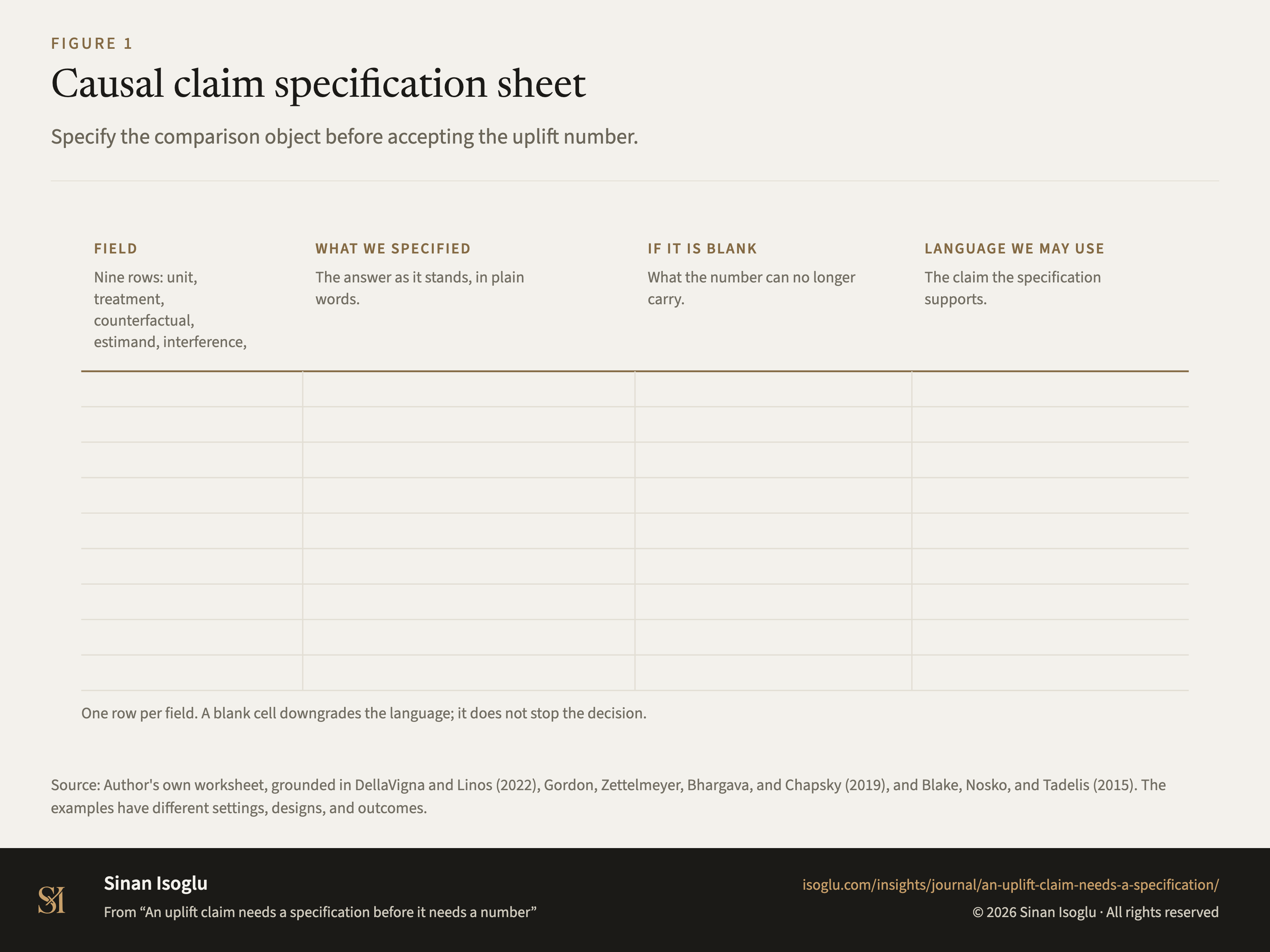
Abbildung 1Aus „Ein Uplift braucht zuerst eine Spezifikation“
Spezifikationsblatt für kausale Aussagen
Spezifizieren Sie das Vergleichsobjekt, bevor die Uplift-Zahl akzeptiert wird.
Abbildung 1Spezifikationsblatt für kausale Aussagen
Quelle: Eigenes Arbeitsblatt auf Basis von DellaVigna und Linos (2022), Gordon, Zettelmeyer, Bhargava und Chapsky (2019) sowie Blake, Nosko und Tadelis (2015). Die Beispiele haben unterschiedliche Kontexte, Designs und Ergebnisse.
Quelle und Evidenz
Jede Zeile nennt eine Aussage zu dieser Abbildung, ihre Quelle und die Art ihrer Prüfung.
- A DELLAVIGNA22-C1 The published-sample figure, verbatim: "an 8.7 percentage point take-up effect, which is a 33.4% increase over the average control", where "the average impact of a nudge is very large"DellaVigna & Linos (2022), Econometrica 90(1), 81–116, abstract
- A DELLAVIGNA22-C2 The decomposition, verbatim: "selective publication in the Academic Journals sample, exacerbated by low statistical power, explains about 70 percent of the difference in effect sizes between the two samples. Different nudge characteristics account for most of the residual difference." A model result, never a raw measurementDellaVigna & Linos (2022), Econometrica 90(1), 81–116, abstract
- A DELLAVIGNA22-C3 The at-scale average, verbatim: "still sizable and highly statistically significant, but smaller at 1.4 percentage points, an 8.0% increase"DellaVigna & Linos (2022), Econometrica 90(1), 81–116, abstract
- A DELLAVIGNA22-C4 The census, verbatim: "We assemble a unique data set of 126 RCTs covering 23 million individuals, including all trials run by two of the largest Nudge Units in the United States"DellaVigna & Linos (2022), Econometrica 90(1), 81–116, abstract
- B GORDON19-C6 The randomized benchmark, with its interval: "this implies the ATT lift was 73%", and "the 95% bootstrapped confidence interval for this lift is [49%, 103%]"Gordon et al. (2019), section 7.1
- B GORDON19-C7 The naive comparison, and the authors' own reading of it: exposed and unexposed conversion of 0.061% against 0.019%, "implying an ATT lift of 316%. This estimate represents the combined lift due to treatment and selection and is more than four times the lift due to treatment of 73%"Gordon et al. (2019), section 7.2
- B GORDON19-C8 Matching on demographics is not enough: "exact matching on age and gender alone performs poorly, yielding a lift of 222%"Gordon et al. (2019), section 7.2.1
- B GORDON19-C9 The count, and the qualification the authors attach to it: "the point estimates in 7 of the 14 studies with a checkout-conversion outcome are consistently off by more than a factor of three", while "observational methods do a better job of approximating RCT outcomes for registration and page"-view outcomesGordon et al. (2019), section 7.3
- B BNT15-C2 The strongest result is stated as an extreme case, not a rule: "as an extreme case, we show that brand keyword ads have no measurable short-term bene"fitsBlake, Nosko & Tadelis (2015), abstract
- B BNT15-C4 And the half usually dropped: "for non-brand keywords, we find that new and infrequent users are positively influenced by ads"Blake, Nosko & Tadelis (2015), abstract
- B BNT15-C5 The experimental non-brand ROI, and the contrast that makes it worth quoting: OLS "which result in a ROI of over 4,100% without time and geographic controls", while "We then used our experimental methods to control for endogeneity and found a ROI of" -63%, "rejecting the hypothesis that the channel yields any short-run positive returns"Blake, Nosko & Tadelis (2015), section 3.1
- B B11-C1 An uplift claim is incomplete until treatment, counterfactual, estimand, interference boundary, outcome window, and measurement object are specifiedAuthor framework grounded in DellaVigna and Linos, Gordon et al., and Blake et al.
- B B11-C2 A large exposed-versus-unexposed difference can be a selection or measurement contrast rather than a treatment effectAuthor framework grounded in the observational-versus-RCT comparisons above
Prüfgrade: A, gegen die gedruckte Seite der Primärquelle geprüft · B, Primärquelle, nur Textebene · C, belastbare Sekundärquelle · D, berichtet.
Aus dem Beitrag
Aus der Forschung
Ein Uplift braucht zuerst eine Spezifikation
Ein Uplift ist unvollständig, solange Behandlung, Gegenfaktum, Schätzgröße, Interferenz, Zeitraum und Ergebnismessung nicht vor der Zahl feststehen.
Den Beitrag lesenDiese Abbildung gehört zu einem Essay: Die Zahlen stehen hier, das Argument dort.
Zitieren oder einbetten
Verwandte Abbildungen
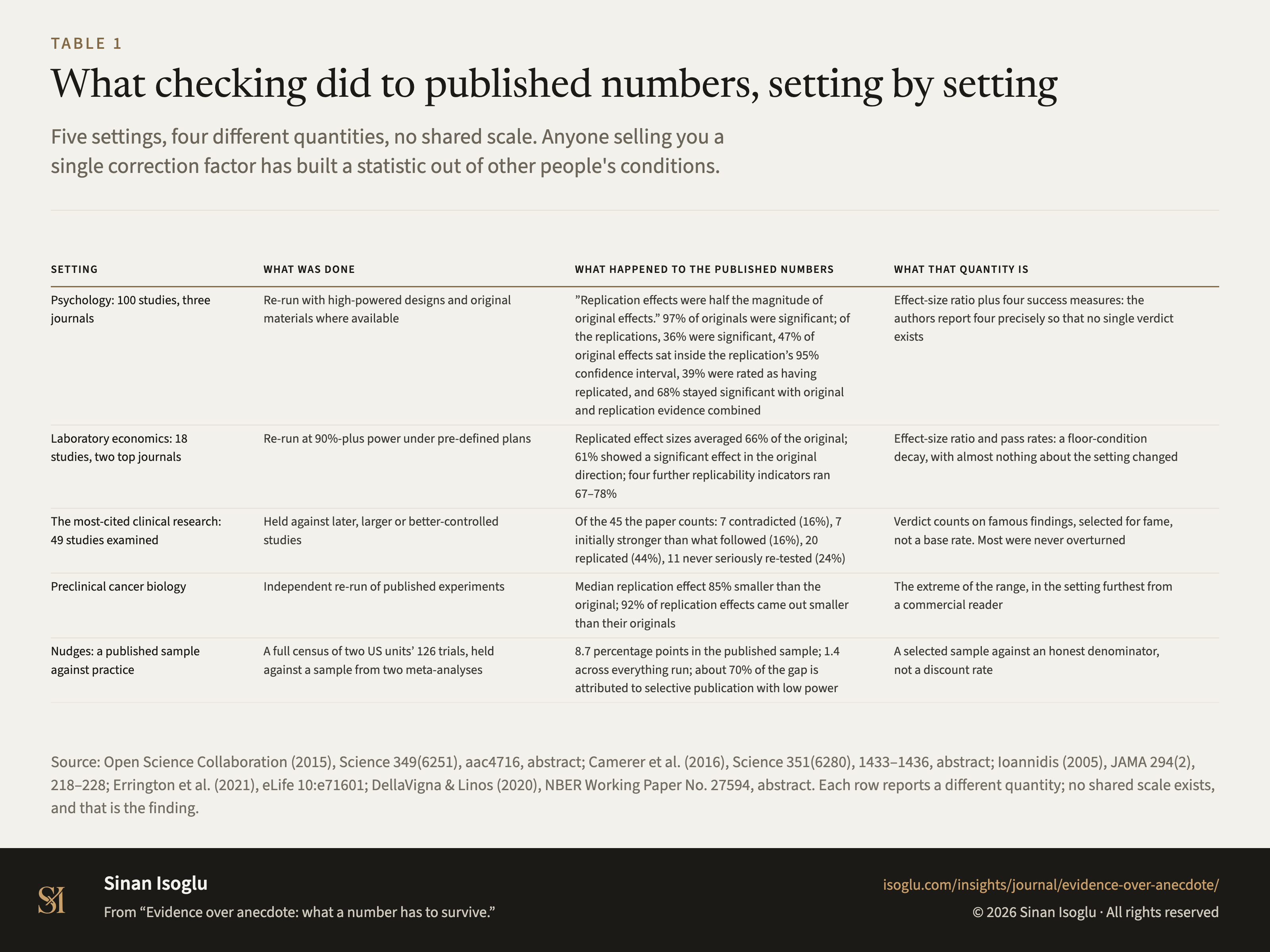
Tabelle 1Tabelle
Was das Nachprüfen mit publizierten Zahlen getan hat, je Feld
Evidenz statt Anekdote – was eine Zahl überstanden haben muss.
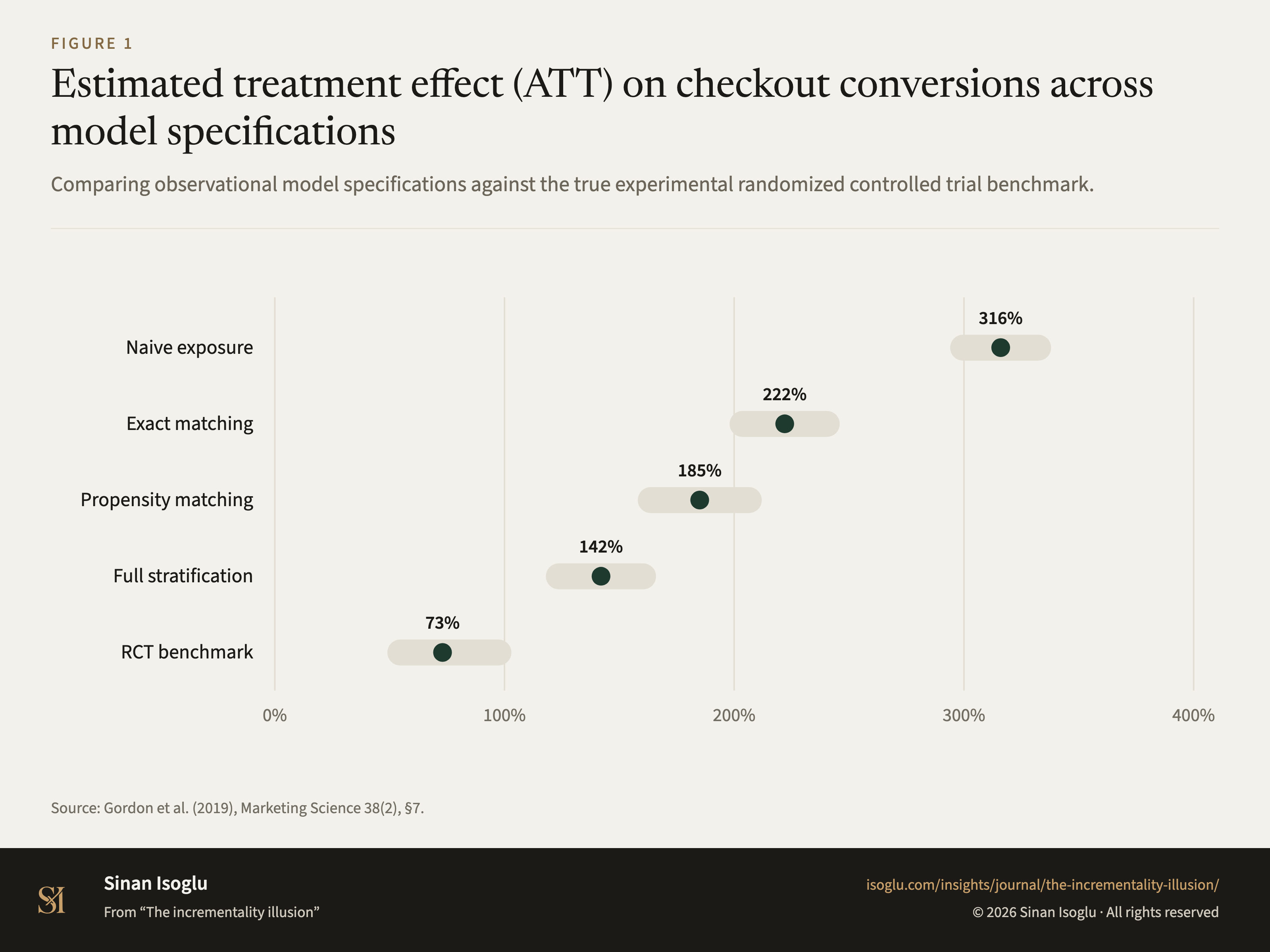
Abbildung 1Grafik
Geschätzter Behandlungseffekt (ATT) auf Checkout-Konversionen in Studie 4, nach Verfahren
Die Inkrementalitäts-Illusion
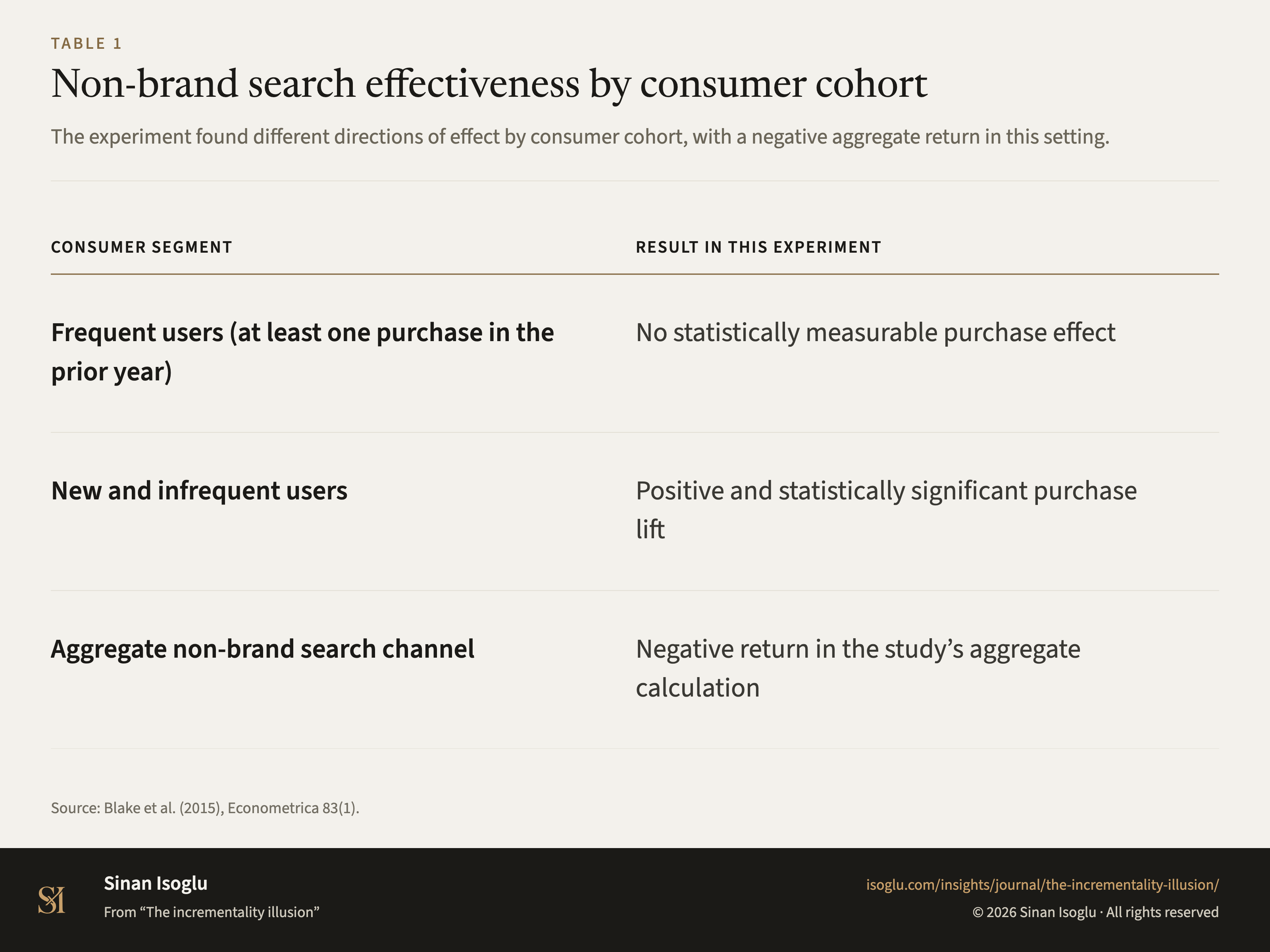
Tabelle 1Tabelle
Effektivität von Non-Brand-Search nach Nutzerkohorten
Die Inkrementalitäts-Illusion
Kontakt
Schicken Sie die Frage, an der Sie arbeiten.
Forschung, ein Gastvortrag oder eine Frage aus der Praxis.