Tabelle 1Aus „Ein belastbares Evidenzreview braucht eine Abbruchregel“
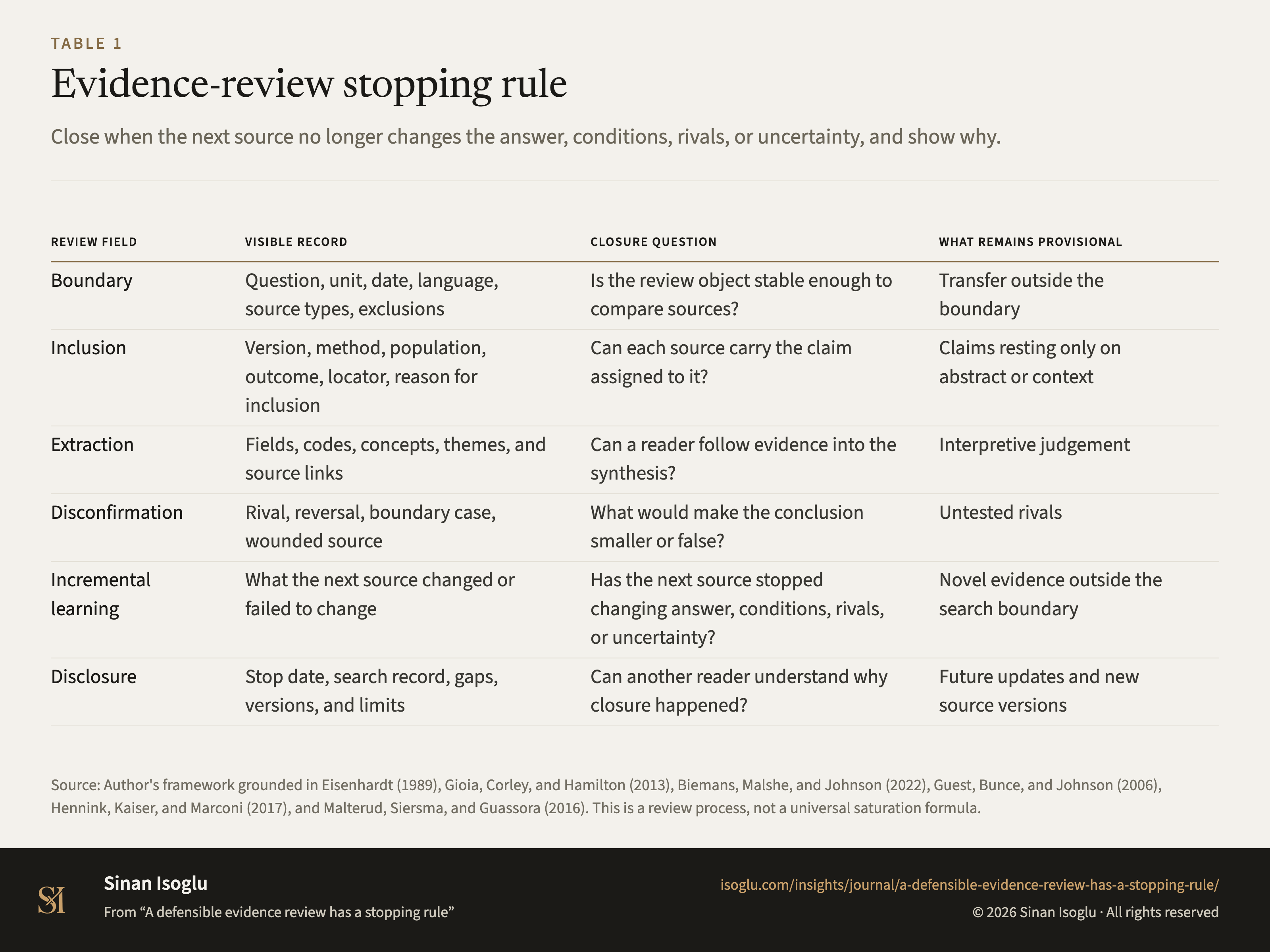
Abbruchregel für Evidenzreviews
Schließen Sie, wenn die nächste Quelle Antwort, Bedingungen, Gegenargumente oder Unsicherheit nicht mehr verändert, und zeigen Sie, warum.
Tabelle 1Abbruchregel für Evidenzreviews
| Reviewfeld | Sichtbarer Datensatz | Abschlussfrage | Vorläufig bleibt |
|---|---|---|---|
| Grenze | Frage, Einheit, Datum, Sprache, Quellentypen, Ausschlüsse | Ist das Reviewobjekt stabil genug für Vergleiche? | Übertragung außerhalb der Grenze |
| Einschluss | Version, Methode, Population, Ergebnis, Locator, Grund | Kann jede Quelle den zugewiesenen Anspruch tragen? | Ansprüche aus Abstract oder Kontext allein |
| Extraktion | Felder, Codes, Konzepte, Themen und Quelllinks | Kann der Weg von Evidenz zur Synthese verfolgt werden? | Interpretationsurteil |
| Gegenprüfung | Rivale, Umkehrung, Grenzfall, verwundende Quelle | Was würde die Schlussfolgerung kleiner oder falsch machen? | Ungeprüfte Gegenargumente |
| Lernzuwachs | Was die nächste Quelle geändert oder nicht geändert hat | Ändert die nächste Quelle Antwort, Bedingungen, Rivalen oder Unsicherheit noch? | Neue Evidenz außerhalb der Suchgrenze |
| Offenlegung | Stichtag, Suchprotokoll, Lücken, Versionen und Grenzen | Versteht ein anderer Leser den Grund des Abschlusses? | Künftige Updates und neue Versionen |
Bei breiten Tabellen horizontal wischen oder scrollen.
Quelle: Eigener Rahmen auf Basis von Eisenhardt (1989), Gioia, Corley und Hamilton (2013), Biemans, Malshe und Johnson (2022), Guest, Bunce und Johnson (2006), Hennink, Kaiser und Marconi (2017) sowie Malterud, Siersma und Guassora (2016). Dies ist ein Reviewprozess und keine universelle Sättigungsformel.
Quelle und Evidenz
Jede Zeile nennt eine Aussage zu dieser Abbildung, ihre Quelle und die Art ihrer Prüfung.
- B EISEN89-C1 The paper describes a process, not a result: "This paper describes the process of inducting theory using case stud"ies, from specifying the research questions to reaching closureEisenhardt. (1989). Building theories from case study research
- B EISEN89-C2 Sampling is theoretical rather than statistical: "Such research relies on theo""retical sampling (i.e., cases are chosen for theo"retical reasons, including polar typesEisenhardt. (1989). Building theories from case study research
- B EISEN89-C4 Within-case first, then across: the framework names "case and cross-case analyses, and the role of" existing literature as separate stepsEisenhardt. (1989). Building theories from case study research
- B EISEN89-C5 Closure is a judgement, and the table says so: "Theoretical saturation when possible Ends process when marginal improvement becomes small"Eisenhardt. (1989). Building theories from case study research
- B EISEN89-C6 Case-based theory should be evaluated for evidence fit, testability, logical coherence, rival explanations, and bounded noveltyEisenhardt. (1989). Building theories from case study research
- B GIOIA13-C1 The two orders are the paper's own device: "a systematic presentation of both a" first-"order analysis (i.e., an analysis using informant-centric terms and codes)" and a second-order one, distilled into "aggregate dimensions"Gioia, Corley & Hamilton. (2013)
- B GIOIA13-C2 And the authors refuse the template reading: "we see it as a flexible orientation toward qualitative, inductive research that is open to innovation", rather than a cookbookGioia, Corley & Hamilton. (2013)
- A BMJ22-C1 The review's own count: "we identify 73 articles" about the sales-marketing interface, published 1990 through 2021Biemans, Malshe & Johnson. (2022)
- A BMJ22-C2 The coding scheme, in the review's words: "structural linkages refer to the horizontal platforms or interaction" channels established for interdepartmental activity, alongside role linkages, interactions and perceptionsBiemans, Malshe & Johnson. (2022)
- B GUEST06-C2 The 12-interview result is conditional and not a universal rule, and the authors bound it themselves: saturation occurred within the first twelve interviews, "at least based on the codebook we devel"oped, in a study of relatively homogeneous respondentsGuest, Bunce & Johnson. (2006)
- B HENN17-C2 Code saturation and meaning saturation answer different questions, and the paper reports different sample sizes for each: more interviews "were needed to reach meaning saturation where we developed a richly textured understanding of issues", and the authors present the finding as conditions rather than a number, since "We used our results to develop parameters that influence saturation"Hennink, Kaiser & Marconi. (2017)
- B MAL16-C2 Higher information power can support a smaller sample, but the concept is an appraisal and not a formula: "Information power indicates that the more information the sample holds, relevant" for the study, the lower the number of participants neededMalterud, Siersma & Guassora. (2016)
- B B12-C1 An evidence review can close when its search boundary, inclusion logic, extraction structure, rival check, and incremental-learning judgement are visibleAuthor framework grounded in Eisenhardt, Gioia, Hennink, and Biemans et al.
- B B12-C2 Saturation is a purpose- and design-dependent judgement, not a universal number of sources or interviewsAuthor framework grounded in Guest, Hennink, Hagaman, and Malterud
Prüfgrade: A, gegen die gedruckte Seite der Primärquelle geprüft · B, Primärquelle, nur Textebene · C, belastbare Sekundärquelle · D, berichtet.
Aus dem Beitrag
Aus der Forschung
Ein belastbares Evidenzreview braucht eine Abbruchregel
Ein Evidenzreview ist belastbar, wenn Suchgrenze, Einschlusslogik, Extraktion, Gegenprüfung und Abbruchurteil für Leser sichtbar sind.
Den Beitrag lesenDiese Abbildung gehört zu einem Essay: Die Zahlen stehen hier, das Argument dort.
Zitieren oder einbetten
Verwandte Abbildungen
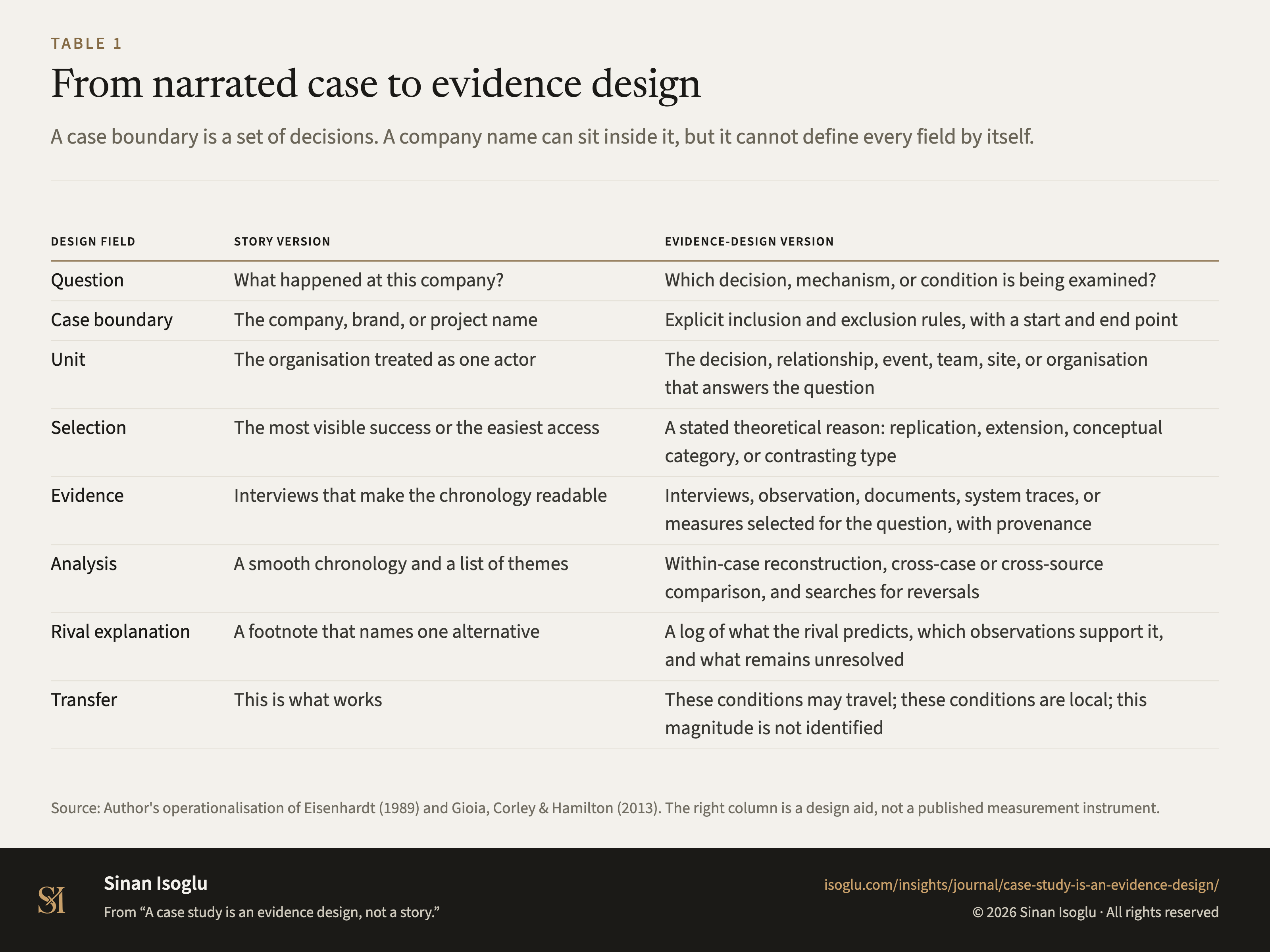
Table 1Tabelle
Vom Erzählfall zum Evidenzdesign
Eine Fallstudie ist ein Evidenzdesign, keine Geschichte.
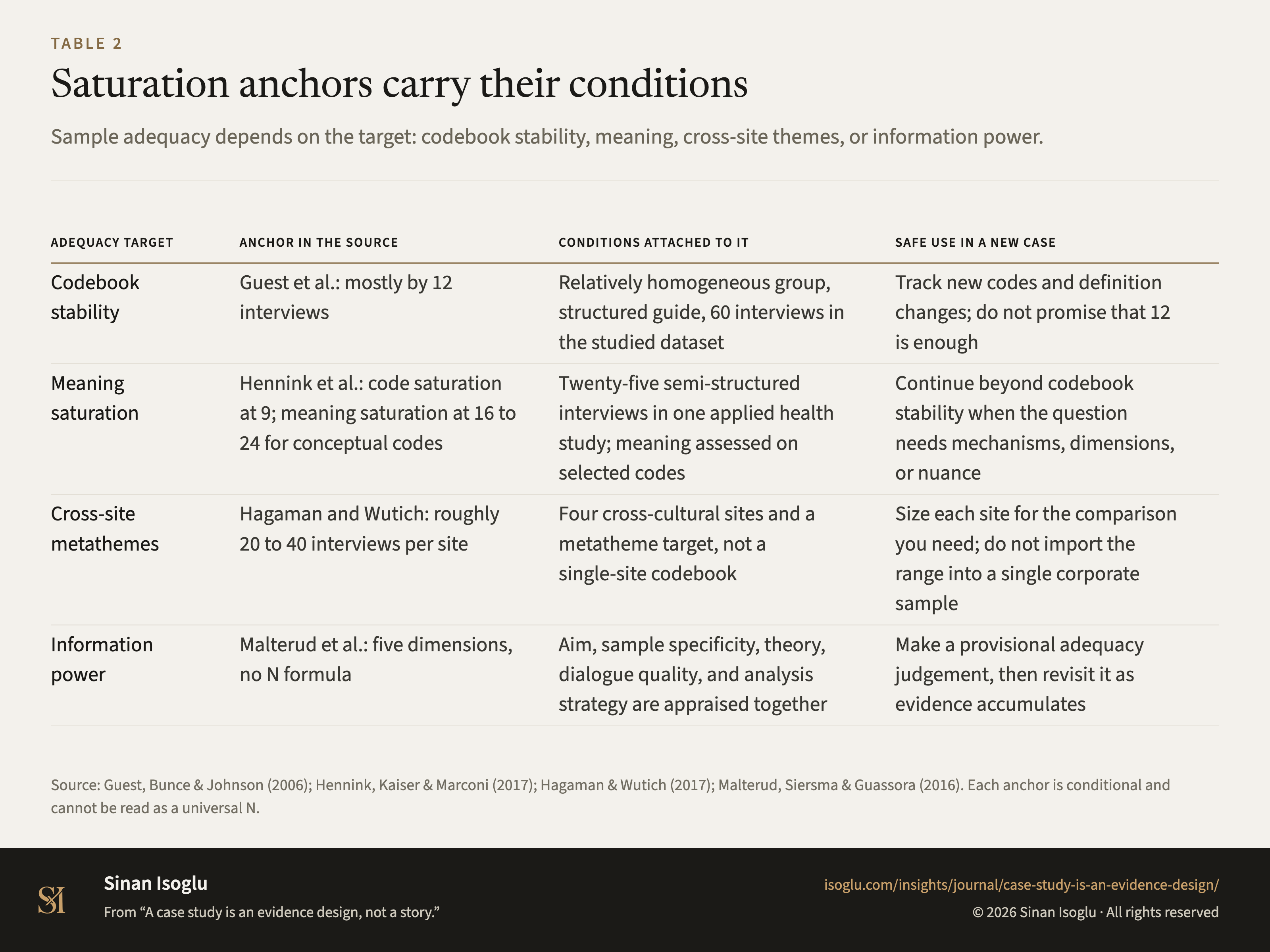
Table 2Tabelle
Sättigungsanker tragen ihre Bedingungen
Eine Fallstudie ist ein Evidenzdesign, keine Geschichte.
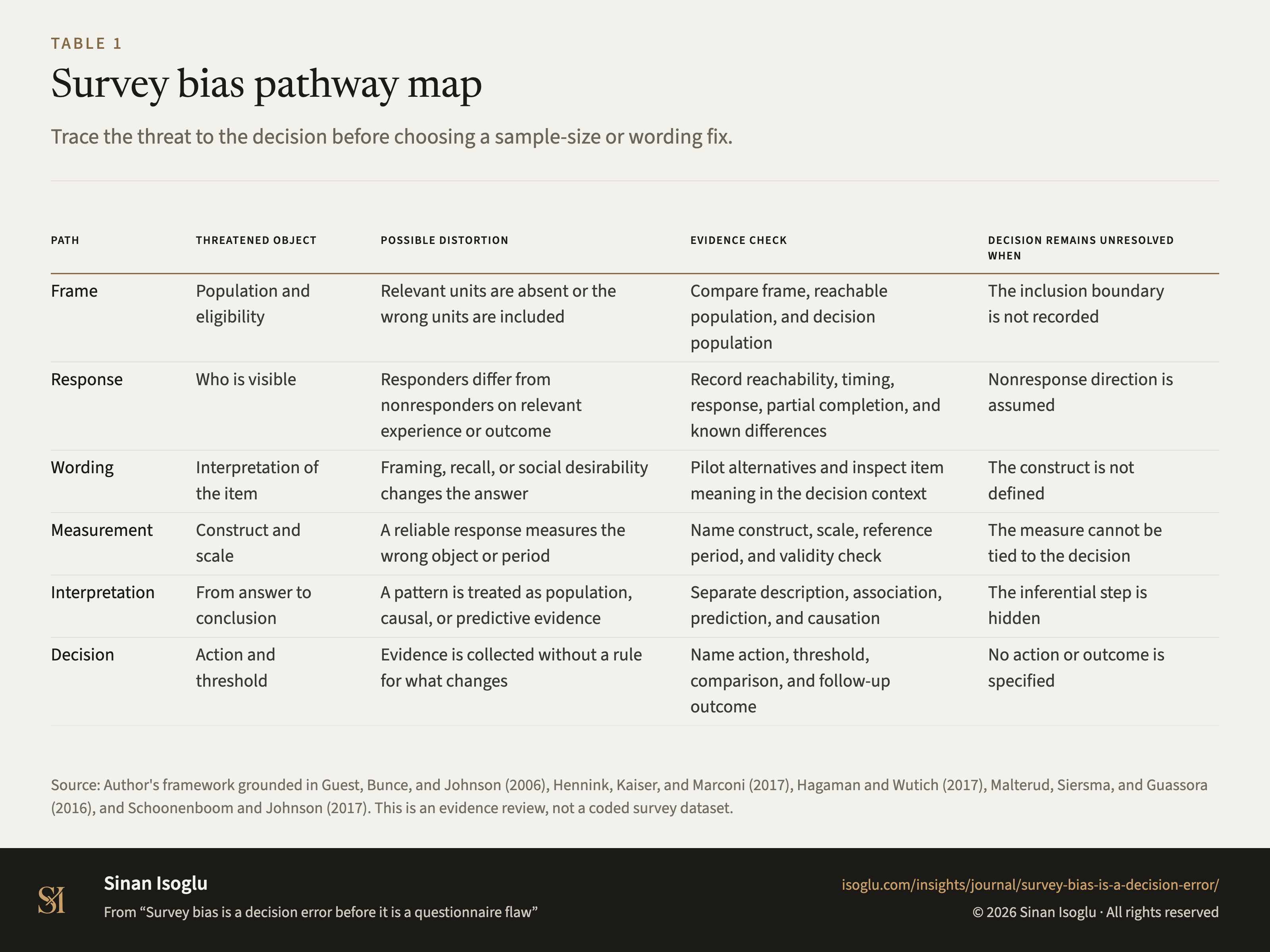
Tabelle 1Tabelle
Bias-Pfadkarte für Umfragen
Survey-Bias ist zuerst ein Entscheidungsfehler
Kontakt
Schicken Sie die Frage, an der Sie arbeiten.
Forschung, ein Gastvortrag oder eine Frage aus der Praxis.