Table 1From “Win-loss analysis needs an outcome before it needs a reason”
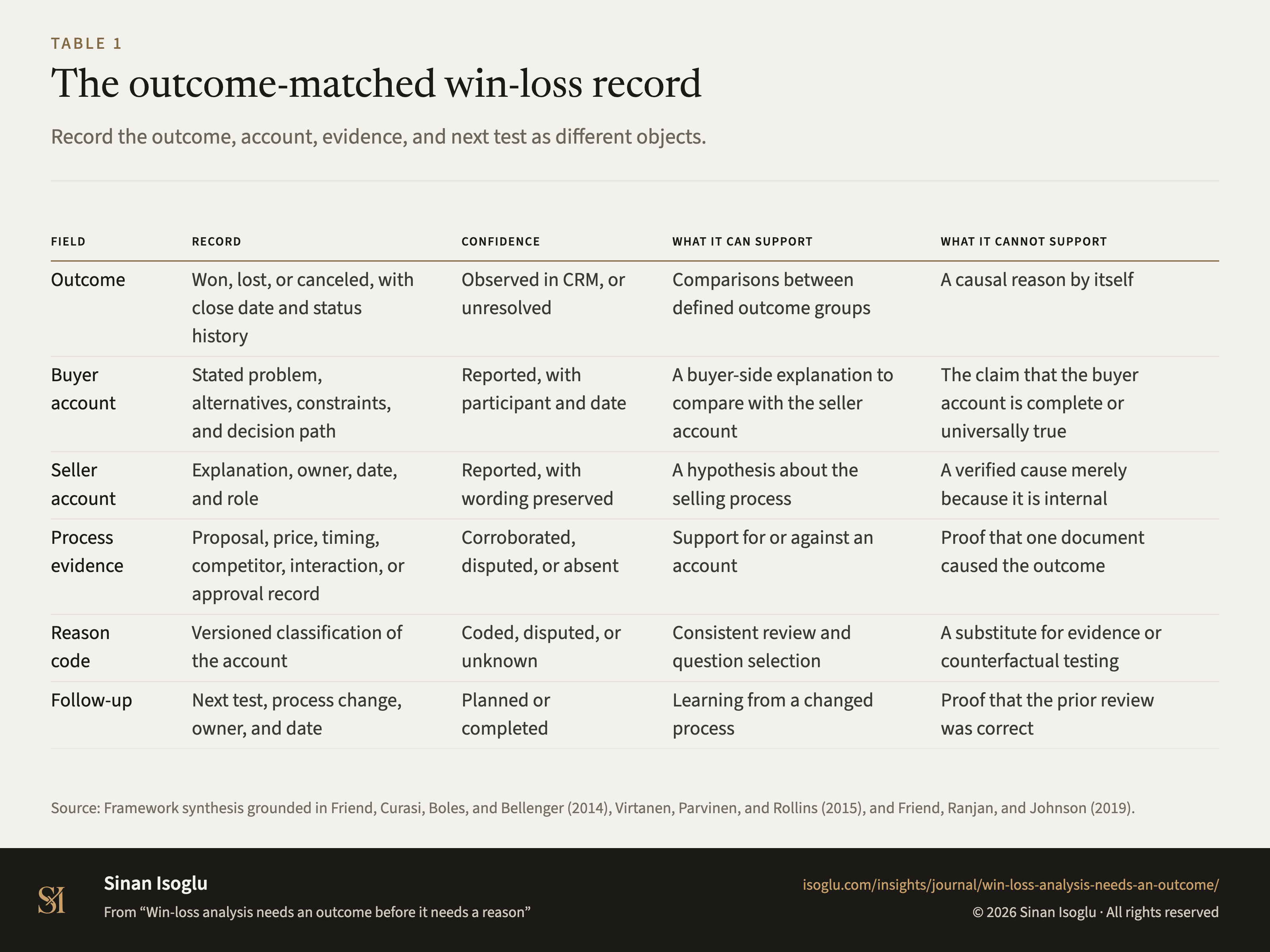
The outcome-matched win-loss record
Record the outcome, account, evidence, and next test as different objects.
Table 1The outcome-matched win-loss record
| Field | Record | Confidence | What it can support | What it cannot support |
|---|---|---|---|---|
| Outcome | Won, lost, or canceled, with close date and status history | Observed in CRM, or unresolved | Comparisons between defined outcome groups | A causal reason by itself |
| Buyer account | Stated problem, alternatives, constraints, and decision path | Reported, with participant and date | A buyer-side explanation to compare with the seller account | The claim that the buyer account is complete or universally true |
| Seller account | Explanation, owner, date, and role | Reported, with wording preserved | A hypothesis about the selling process | A verified cause merely because it is internal |
| Process evidence | Proposal, price, timing, competitor, interaction, or approval record | Corroborated, disputed, or absent | Support for or against an account | Proof that one document caused the outcome |
| Reason code | Versioned classification of the account | Coded, disputed, or unknown | Consistent review and question selection | A substitute for evidence or counterfactual testing |
| Follow-up | Next test, process change, owner, and date | Planned or completed | Learning from a changed process | Proof that the prior review was correct |
Swipe or scroll horizontally if the table is wider than your screen.
Source: Framework synthesis grounded in Friend, Curasi, Boles, and Bellenger (2014), Virtanen, Parvinen, and Rollins (2015), and Friend, Ranjan, and Johnson (2019).
Source and evidence
Each line names a claim related to this exhibit, its source, and how it was checked.
- B WLA27-C1 A three-state outcome design can keep won, lost, and canceled leads visible in a B2B CRM reviewAuthor translation grounded in Virtanen, Parvinen and Rollins (2015)
- B WLA27-C2 A buyer-side post-mortem can add evidence that is distinct from the seller's account of a failed proposalAuthor translation grounded in Friend, Curasi, Boles and Bellenger (2014)
- B WLA27-C3 Failing fast is a resource-allocation decision, not a guaranteed performance improvementAuthor translation grounded in Friend, Ranjan and Johnson (2019)
- B WLA27-C4 A CRM outcome is an observation, while a reason needs a source and confidence state before interpretationAuthor framework
- B WLA27-C5 Buyer and seller accounts should be preserved as separate evidence layersAuthor framework grounded in Friend et al. (2014)
- B WLA27-C6 Canceled opportunities should not be folded into competitive losses without a defined rule and evidenceAuthor translation grounded in Virtanen et al. (2015)
- B WLA27-C7 A review needs a stopping rule covering outcome, perspective, support, confidence, and next testAuthor framework
Grades: A, verified against the printed page of the primary source · B, primary source, text layer only · C, authoritative secondary · D, reported.
From the essay
Revenue operations & AI
Win-loss analysis needs an outcome before it needs a reason
A lost deal is not a reason code. Separate won, lost, and canceled outcomes from buyer and seller accounts before learning from the review.
Read the essayThis exhibit belongs to an essay: the numbers live here, the argument lives there.
Cite or embed
Contact
Bring the question you're working on.
Research, a guest lecture, or a commercial question.