← Every exhibit
Table 1From “What is willingness to pay?”
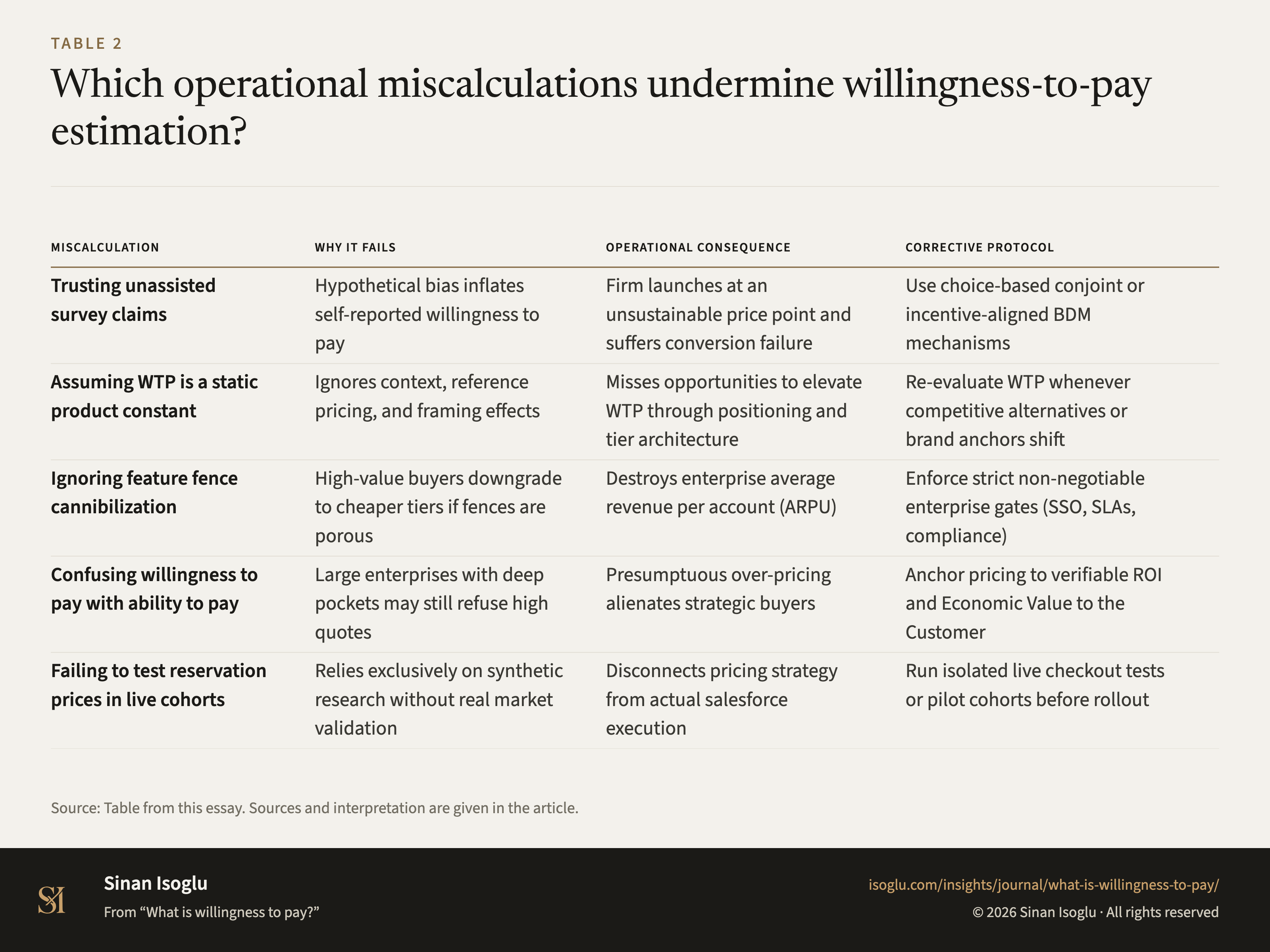
Which operational miscalculations undermine willingness-to-pay estimation?
Table 1Which operational miscalculations undermine willingness-to-pay estimation?
| Miscalculation | Why it fails | Operational consequence | Corrective protocol |
|---|---|---|---|
| Trusting unassisted survey claims | Hypothetical bias inflates self-reported willingness to pay | Firm launches at an unsustainable price point and suffers conversion failure | Use choice-based conjoint or incentive-aligned BDM mechanisms |
| Assuming WTP is a static product constant | Ignores context, reference pricing, and framing effects | Misses opportunities to elevate WTP through positioning and tier architecture | Re-evaluate WTP whenever competitive alternatives or brand anchors shift |
| Ignoring feature fence cannibilization | High-value buyers downgrade to cheaper tiers if fences are porous | Destroys enterprise average revenue per account (ARPU) | Enforce strict non-negotiable enterprise gates (SSO, SLAs, compliance) |
| Confusing willingness to pay with ability to pay | Large enterprises with deep pockets may still refuse high quotes | Presumptuous over-pricing alienates strategic buyers | Anchor pricing to verifiable ROI and Economic Value to the Customer |
| Failing to test reservation prices in live cohorts | Relies exclusively on synthetic research without real market validation | Disconnects pricing strategy from actual salesforce execution | Run isolated live checkout tests or pilot cohorts before rollout |
Swipe or scroll horizontally if the table is wider than your screen.
Source: Table from this essay. Sources and interpretation are given in the article.
PNG4:3, 1600 × 1200, with the title, the source line and the attribution set in the image isoglu-2026-what-is-willingness-to-pay-fig02.png
From the essay
Pricing & revenue architecture
What is willingness to pay?
Willingness to pay measures the maximum monetary sacrifice a buyer will exchange for an offering, bounding pricing power, surplus, and conversion.
Read the essayThis exhibit belongs to an essay: the numbers live here, the argument lives there.
Cite or embed
Related exhibits
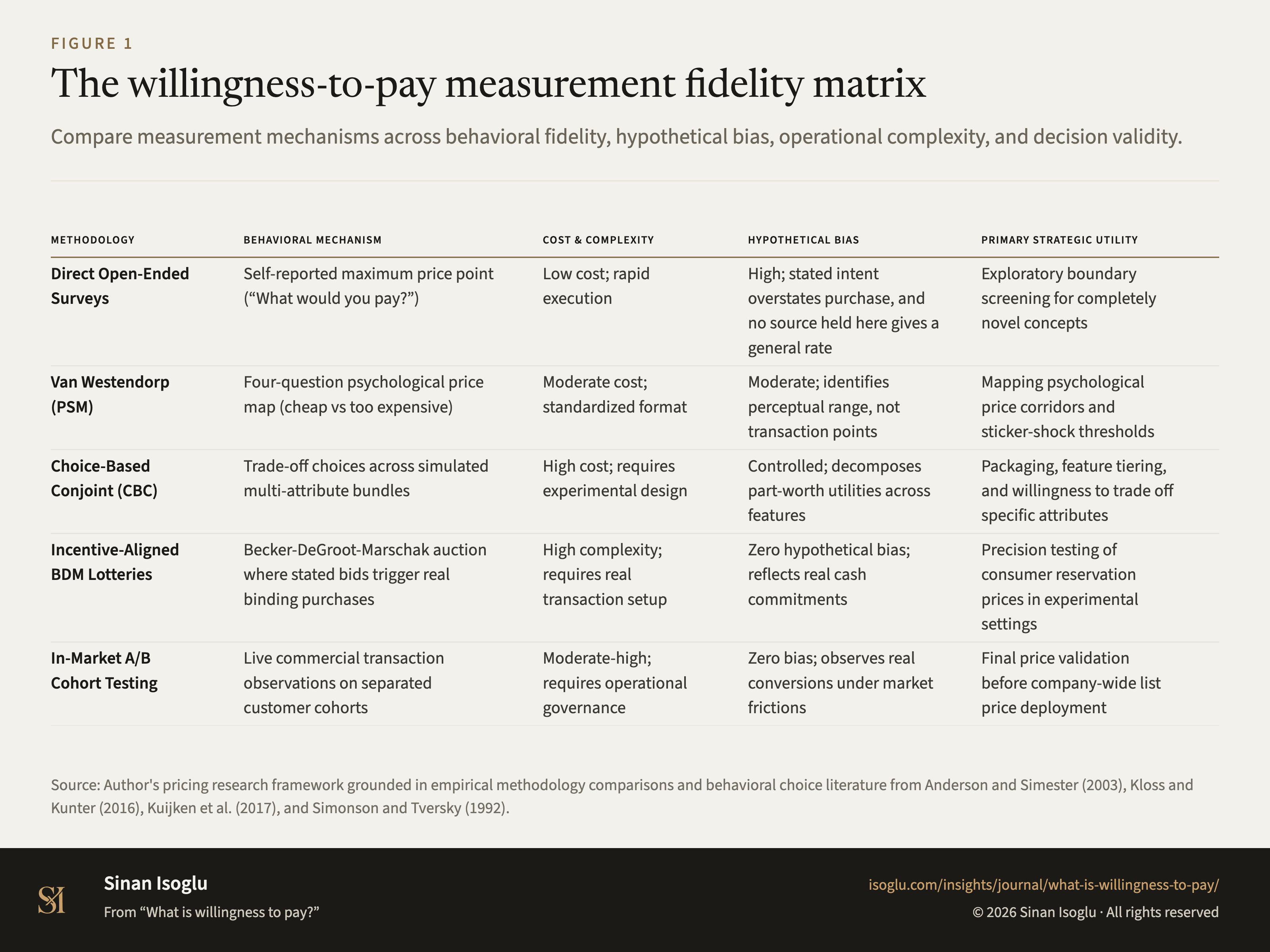
Figure 1Figure
The willingness-to-pay measurement fidelity matrix
What is willingness to pay?
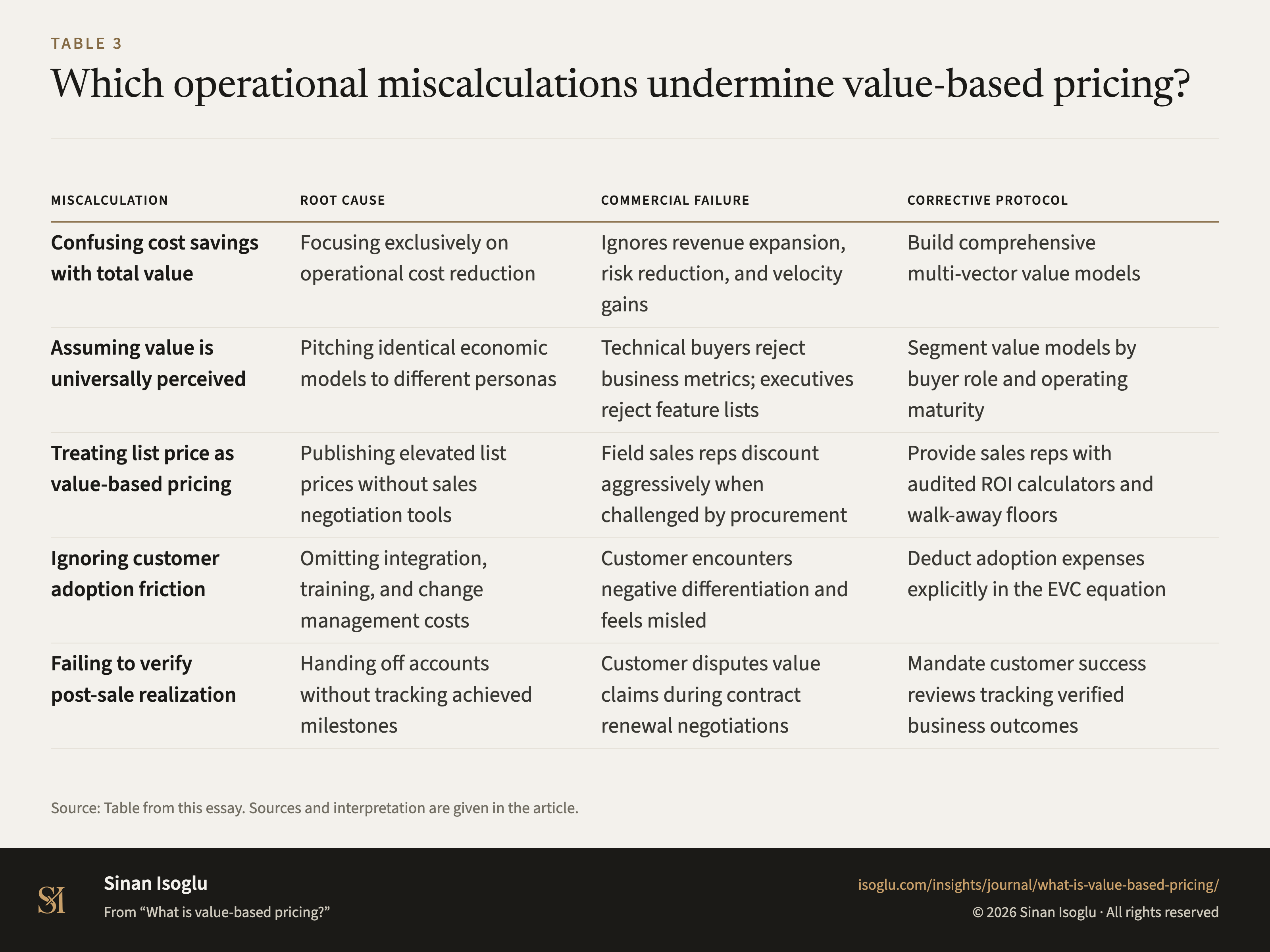
Table 2Table
Which operational miscalculations undermine value-based pricing?
What is value-based pricing?
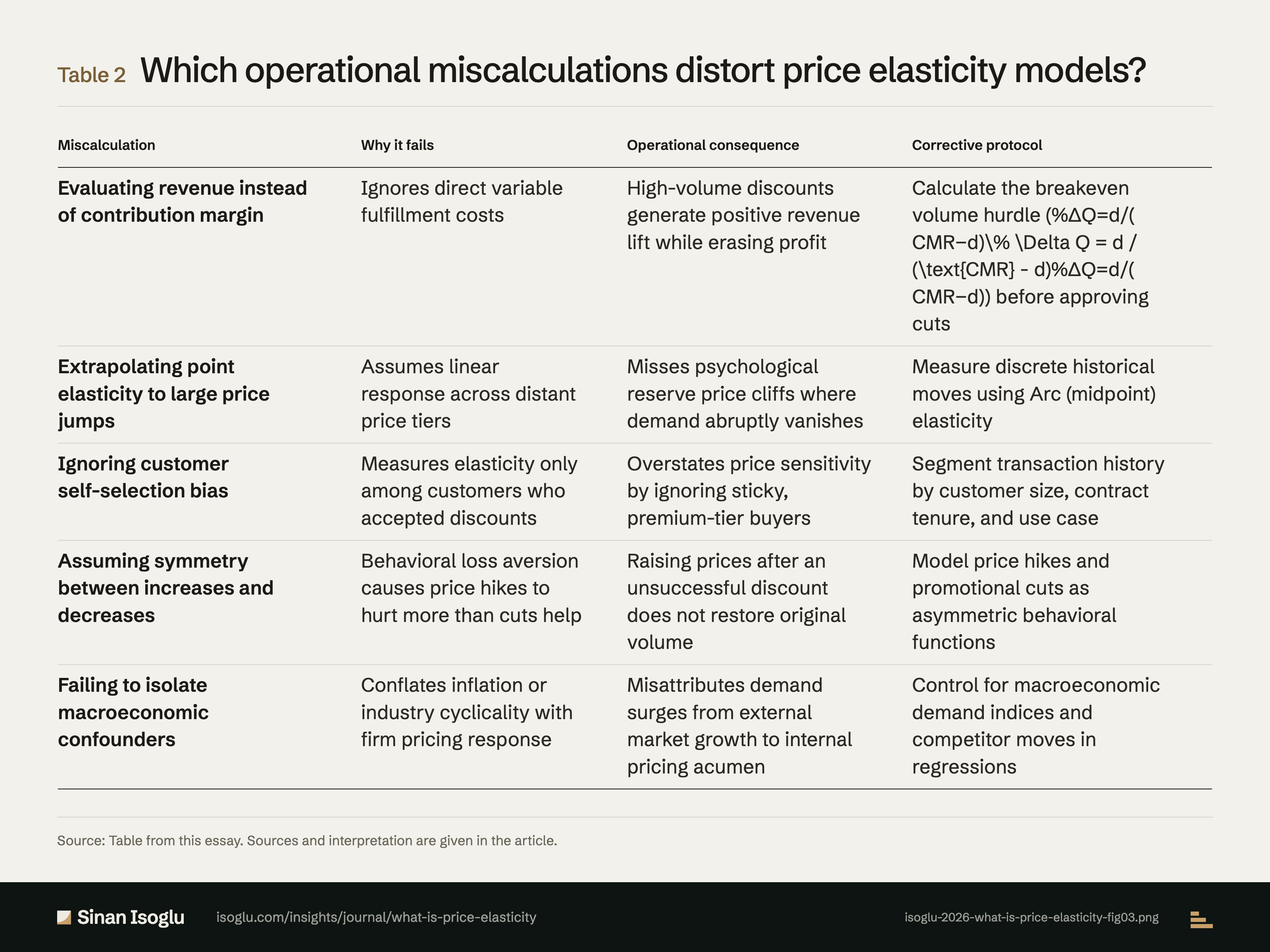
Table 2Table
Which operational miscalculations distort price elasticity models?
What is price elasticity of demand?
Contact
Bring the question you're working on.
Research, a guest lecture, or a commercial question.