← Every exhibit
Table 1From “What is value-based pricing?”
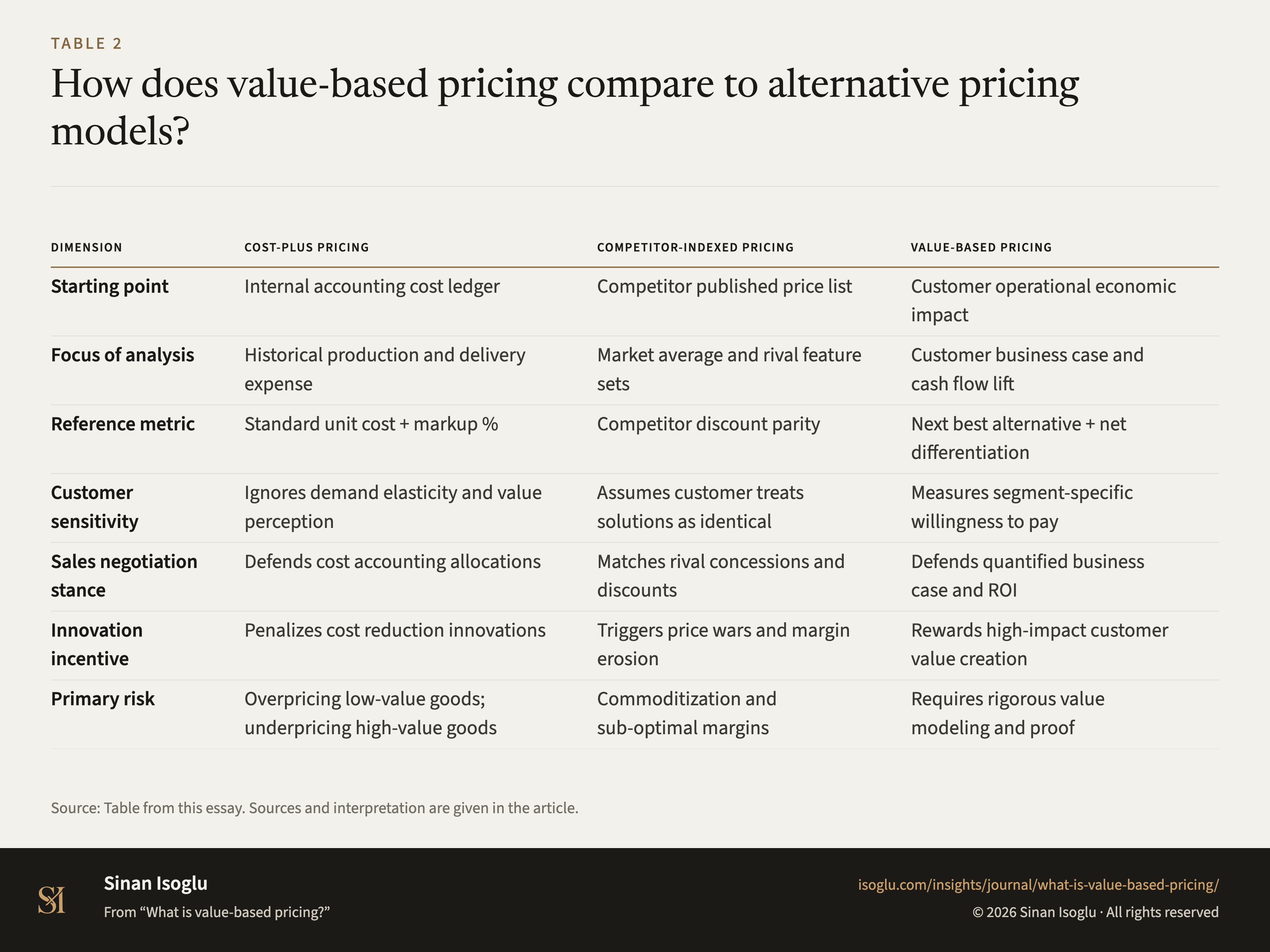
How does value-based pricing compare to alternative pricing models?
Table 1How does value-based pricing compare to alternative pricing models?
| Dimension | Cost-Plus Pricing | Competitor-Indexed Pricing | Value-Based Pricing |
|---|---|---|---|
| Starting point | Internal accounting cost ledger | Competitor published price list | Customer operational economic impact |
| Focus of analysis | Historical production and delivery expense | Market average and rival feature sets | Customer business case and cash flow lift |
| Reference metric | Standard unit cost + markup % | Competitor discount parity | Next best alternative + net differentiation |
| Customer sensitivity | Ignores demand elasticity and value perception | Assumes customer treats solutions as identical | Measures segment-specific willingness to pay |
| Sales negotiation stance | Defends cost accounting allocations | Matches rival concessions and discounts | Defends quantified business case and ROI |
| Innovation incentive | Penalizes cost reduction innovations | Triggers price wars and margin erosion | Rewards high-impact customer value creation |
| Primary risk | Overpricing low-value goods; underpricing high-value goods | Commoditization and sub-optimal margins | Requires rigorous value modeling and proof |
Swipe or scroll horizontally if the table is wider than your screen.
Source: Table from this essay. Sources and interpretation are given in the article.
PNG4:3, 1600 × 1200, with the title, the source line and the attribution set in the image isoglu-2026-what-is-value-based-pricing-fig02.png
From the essay
Pricing & revenue architecture
What is value-based pricing?
Value-based pricing aligns transaction prices with quantified customer economic value and willingness to pay rather than cost or competitor parity.
Read the essayThis exhibit belongs to an essay: the numbers live here, the argument lives there.
Cite or embed
Related exhibits
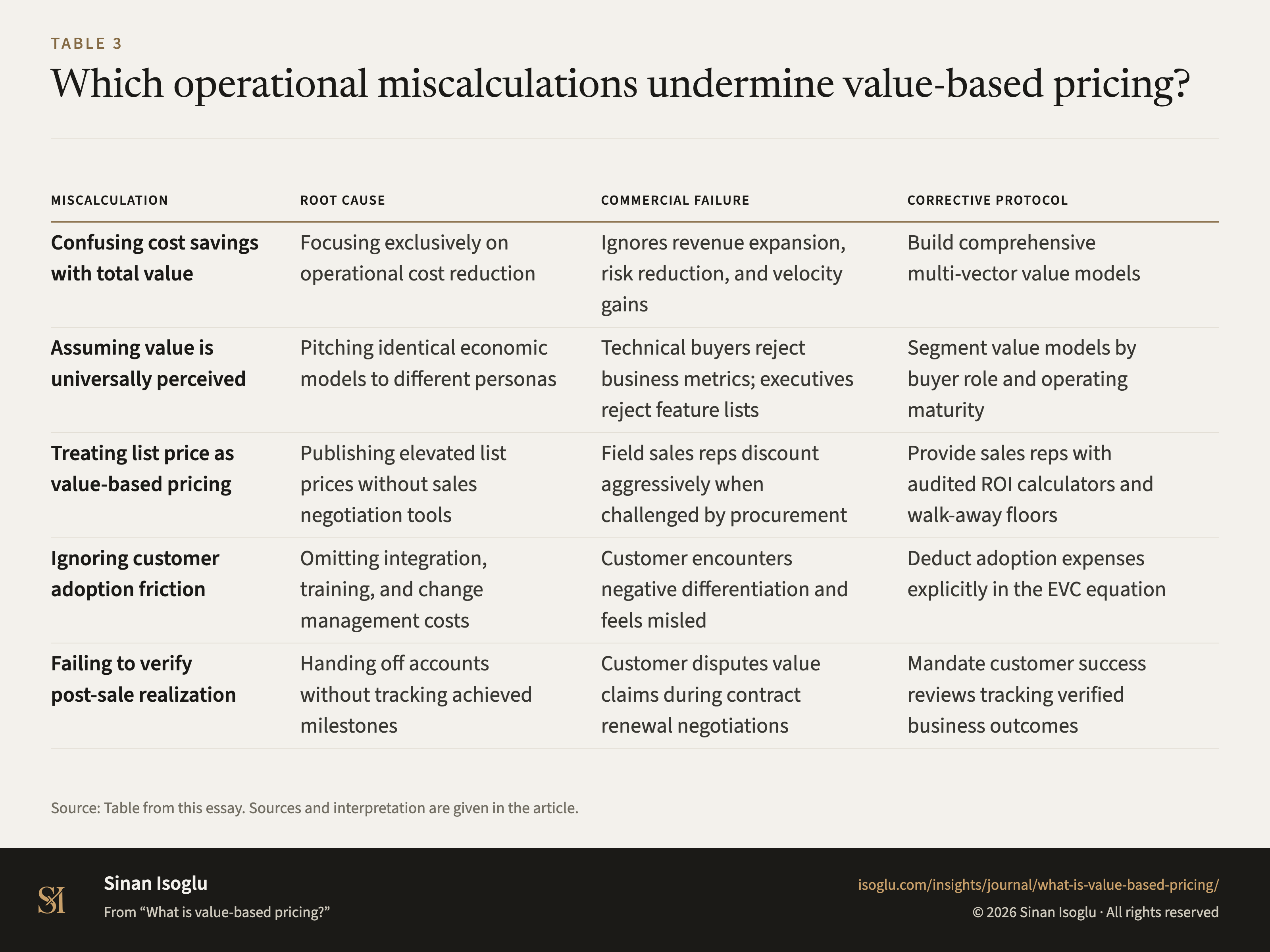
Table 2Table
Which operational miscalculations undermine value-based pricing?
What is value-based pricing?
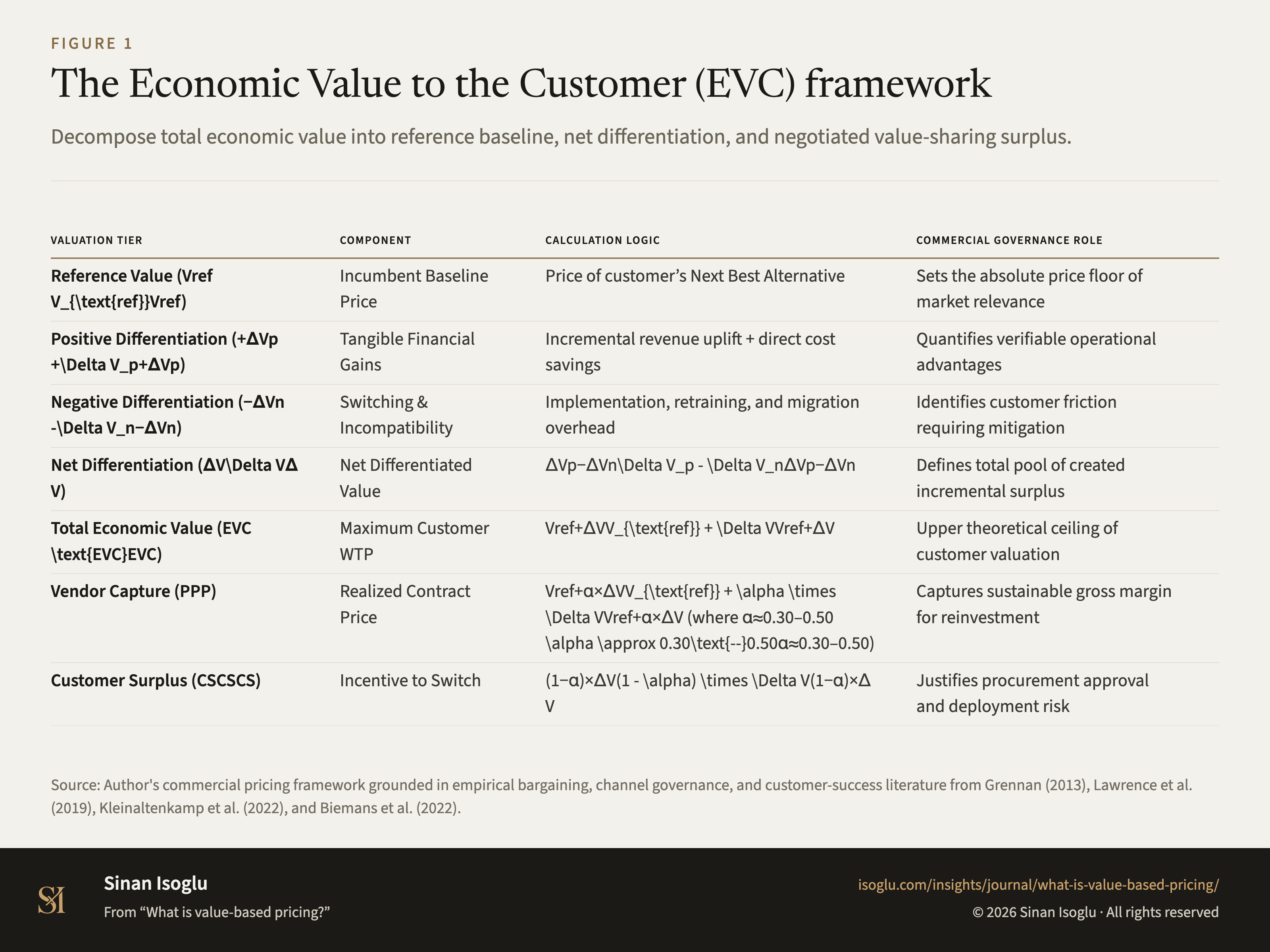
Figure 1Figure
The Economic Value to the Customer (EVC) framework
What is value-based pricing?
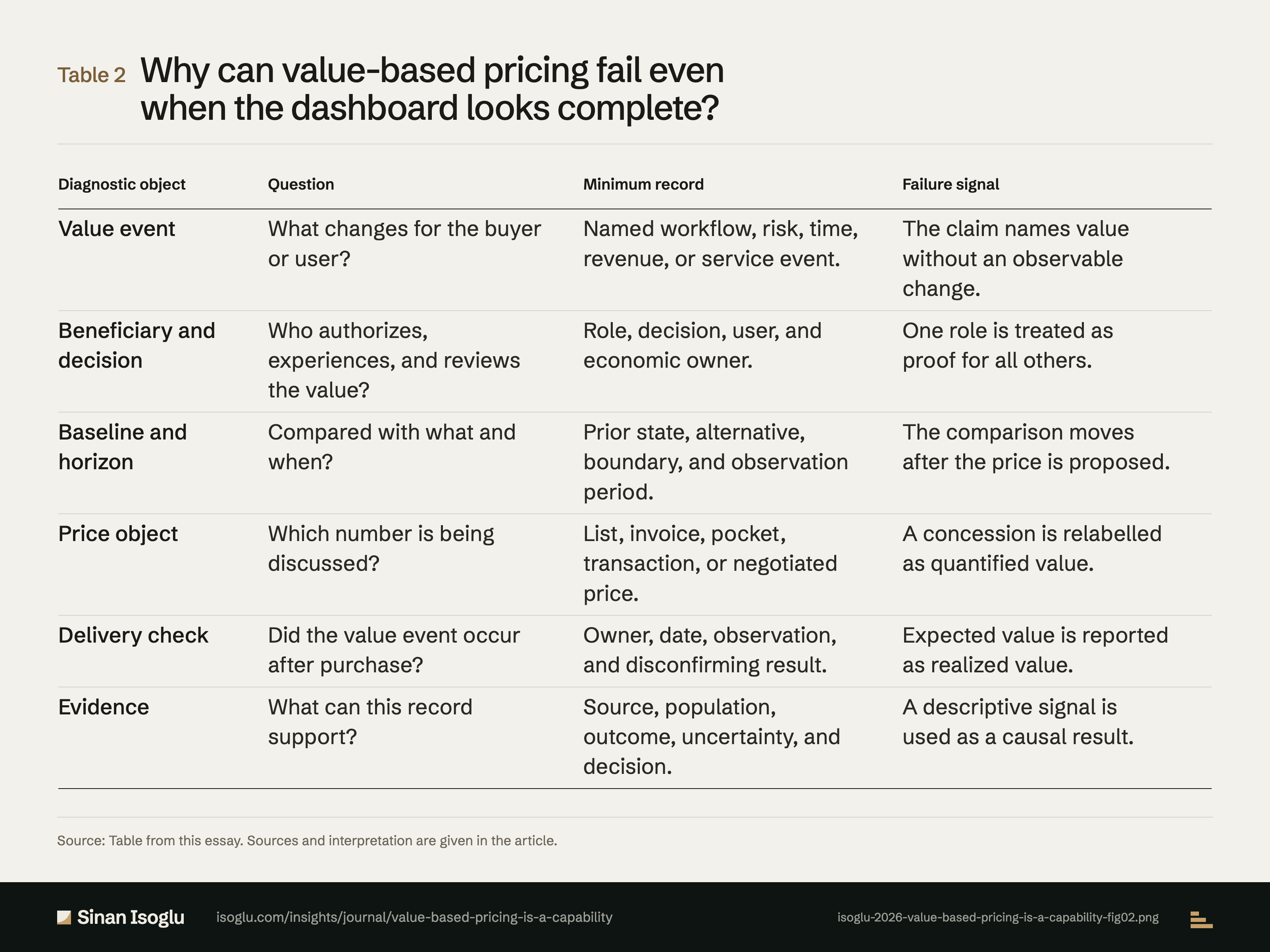
Table 2Table
Why can value-based pricing fail even when the dashboard looks complete?
Value-based pricing is a capability before it is a number
Contact
Bring the question you're working on.
Research, a guest lecture, or a commercial question.