Figure 1From “A flat rate buys your customer’s worst month.”
The preference at equal money, and what a premium does to it
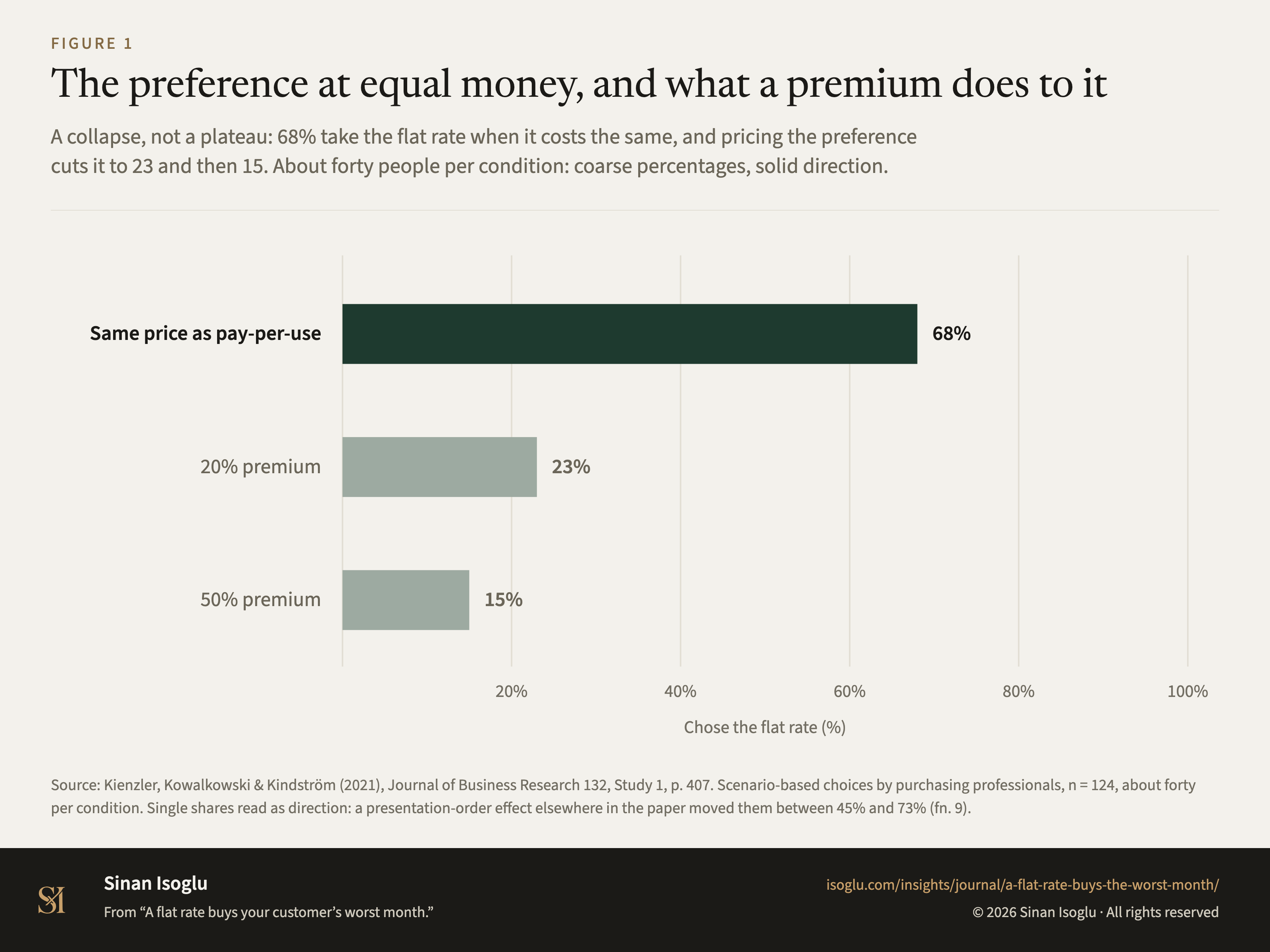
A collapse, not a plateau: 68% take the flat rate when it costs the same, and pricing the preference cuts it to 23 and then 15. About forty people per condition: coarse percentages, solid direction.
Figure 1The preference at equal money, and what a premium does to it
Source: Kienzler, Kowalkowski & Kindström (2021), Journal of Business Research 132, Study 1, p. 407. Scenario-based choices by purchasing professionals, n = 124, about forty per condition. Single shares read as direction: a presentation-order effect elsewhere in the paper moved them between 45% and 73% (fn. 9).
Source and evidence
Each line names a claim related to this exhibit, its source, and how it was checked.
- A KKK21-C1 At equal cost, 68% of purchasing professionals chose the flat rate (Study 1, n = 124, ~40 per condition, cloud analytics). The design is scenario-based: "A series of four experiments showed that experienced purchasing professionals tend to exhibit a flat-rate bias in their price plan choices", and "they preferred the flat-rate over the pay-per-use option" in the equal conditionKienzler, Kowalkowski & Kindström (2021), Journal of Business Research 132, 403–415 · VoR held
- A KKK21-C2 At a 20% premium 23% still chose the flat rate; at 50%, 15% (p. 407). The authors' benchmark is that absent the bias none would in the premium conditions, since "The flat-rate bias is defined as customers" "preference for flat rates rather than pay-per-use options"Kienzler, Kowalkowski & Kindström (2021), Journal of Business Research 132, 403–415 · VoR held
Grades: A, verified against the printed page of the primary source · B, primary source, text layer only · C, authoritative secondary · D, reported.
From the essay
Pricing & revenue architecture
A flat rate buys your customer’s worst month.
Flat pricing for software rested on two conditions, and inference cost broke one. The buyers who most want a flat rate are the ones with the biggest tail.
Read the essayThis exhibit belongs to an essay: the numbers live here, the argument lives there.
Cite or embed
Related exhibits
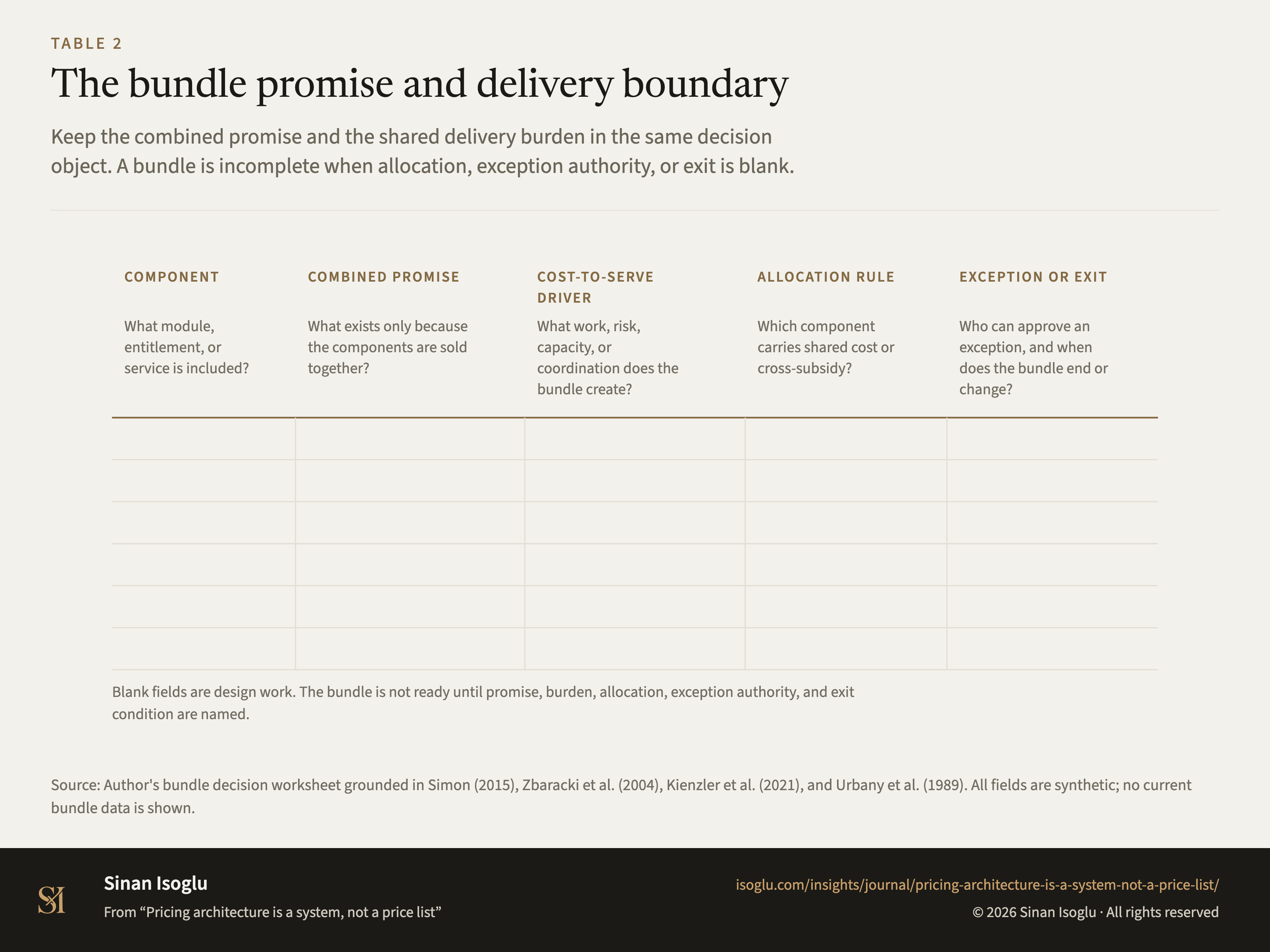
Table 2Table
The bundle promise and delivery boundary
Pricing architecture is a system, not a price list
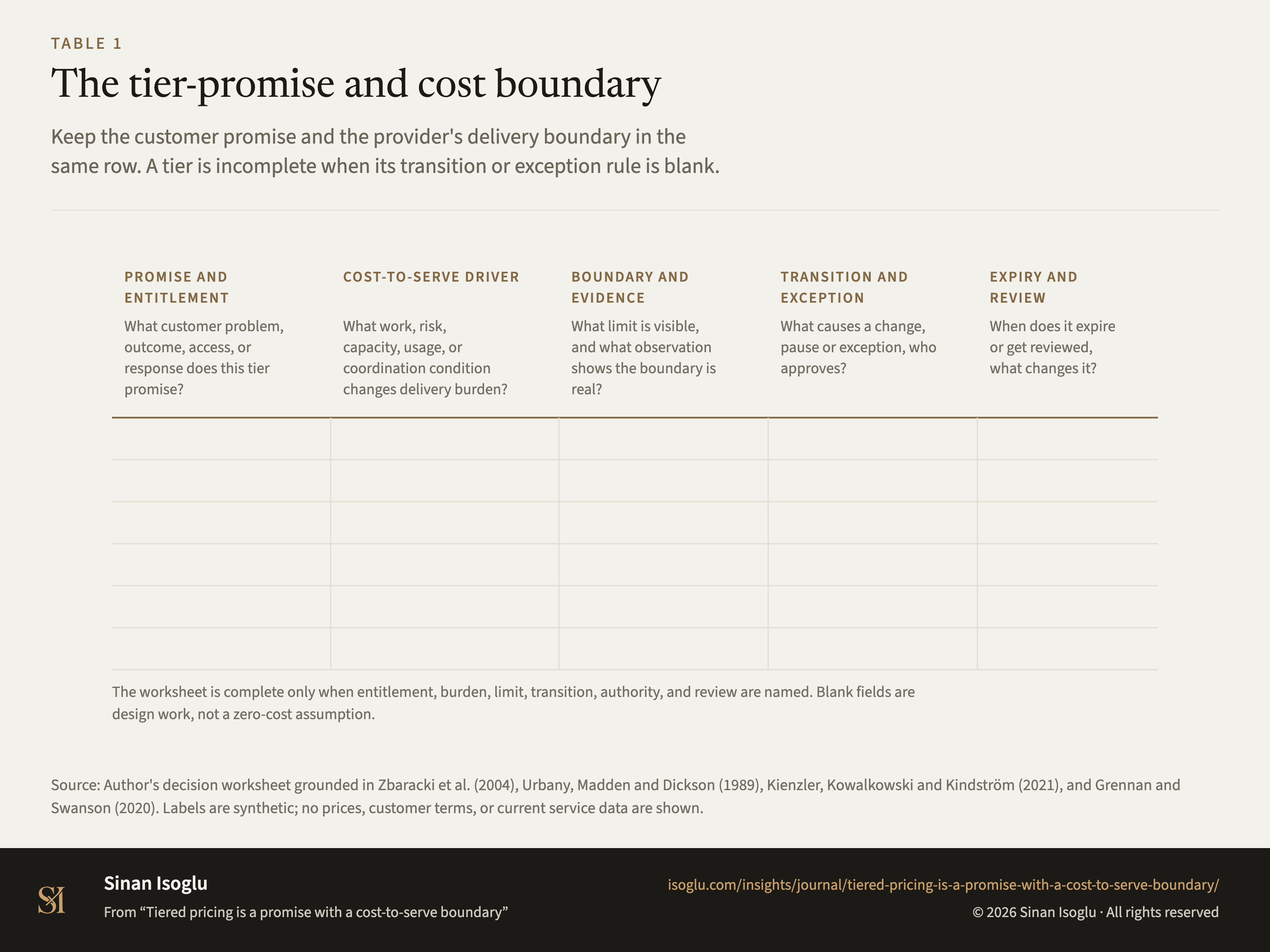
Table 1Table
The tier-promise and cost boundary
Tiered pricing is a promise with a cost-to-serve boundary
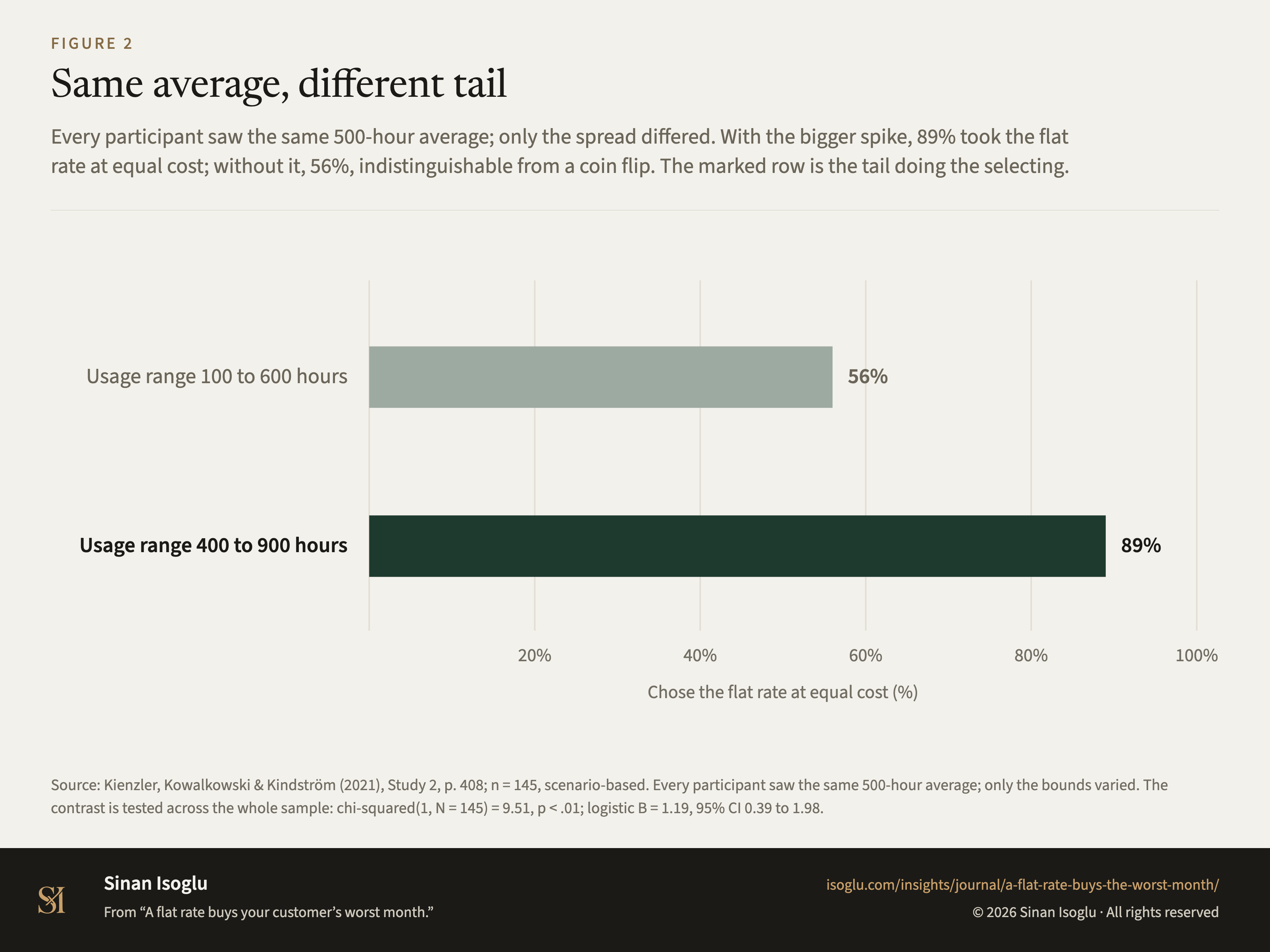
Figure 2Figure
Same average, different tail
A flat rate buys your customer’s worst month.
Contact
Bring the question you're working on.
Research, a guest lecture, or a commercial question.