Figure 1From “What is tiered pricing?”
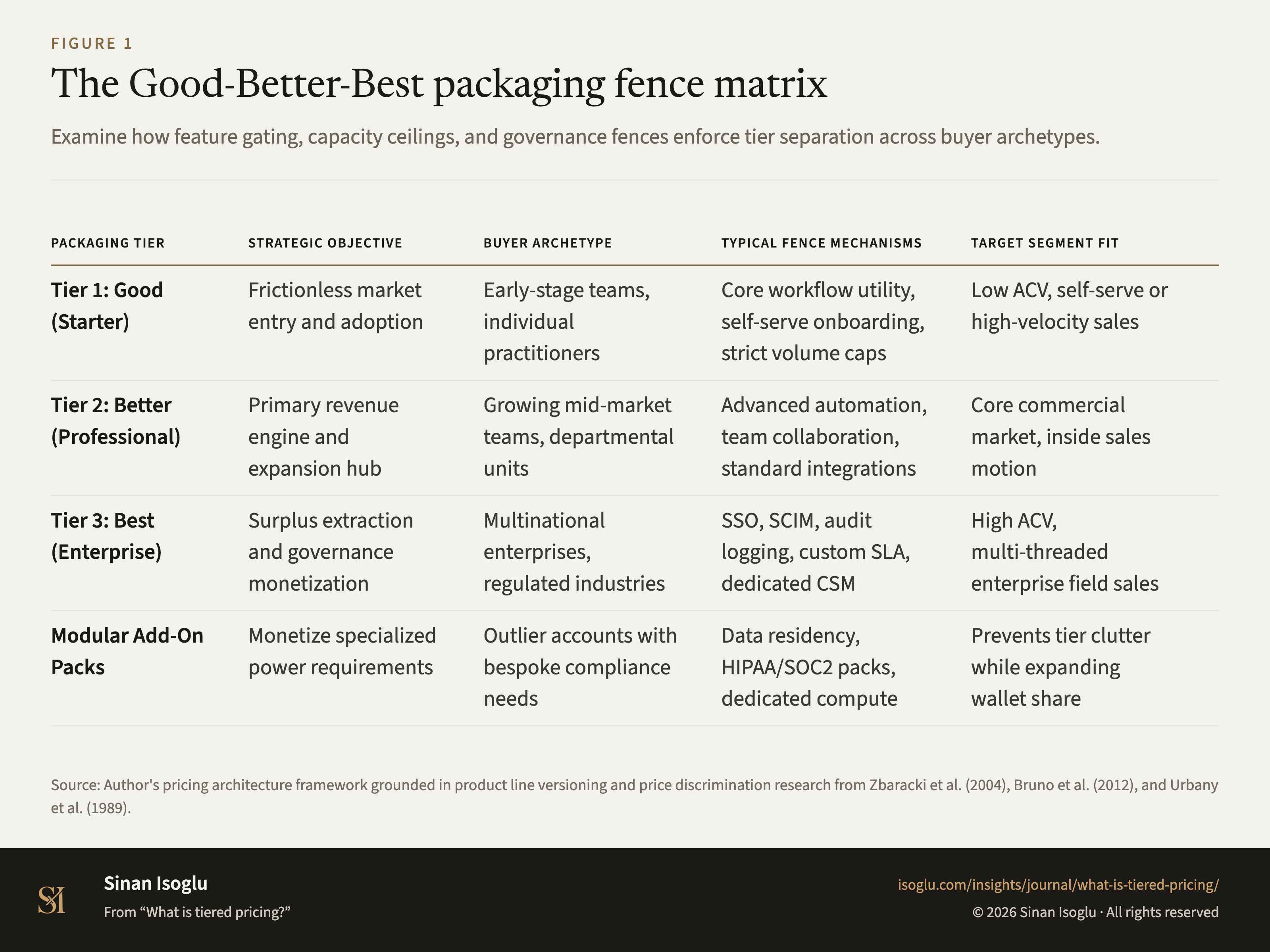
The Good-Better-Best packaging fence matrix
Examine how feature gating, capacity ceilings, and governance fences enforce tier separation across buyer archetypes.
Figure 1The Good-Better-Best packaging fence matrix
| Packaging tier | Strategic objective | Buyer archetype | Typical fence mechanisms | Target Segment Fit |
|---|---|---|---|---|
| Tier 1: Good (Starter) | Frictionless market entry and adoption | Early-stage teams, individual practitioners | Core workflow utility, self-serve onboarding, strict volume caps | Low ACV, self-serve or high-velocity sales |
| Tier 2: Better (Professional) | Primary revenue engine and expansion hub | Growing mid-market teams, departmental units | Advanced automation, team collaboration, standard integrations | Core commercial market, inside sales motion |
| Tier 3: Best (Enterprise) | Surplus extraction and governance monetization | Multinational enterprises, regulated industries | SSO, SCIM, audit logging, custom SLA, dedicated CSM | High ACV, multi-threaded enterprise field sales |
| Modular Add-On Packs | Monetize specialized power requirements | Outlier accounts with bespoke compliance needs | Data residency, HIPAA/SOC2 packs, dedicated compute | Prevents tier clutter while expanding wallet share |
Swipe or scroll horizontally if the table is wider than your screen.
Source: Author's pricing architecture framework grounded in product line versioning and price discrimination research from Zbaracki et al. (2004), Bruno et al. (2012), and Urbany et al. (1989).
From the essay
Pricing & revenue architecture
What is tiered pricing?
Tiered pricing bundles features into distinct packages with clear boundaries. Design fences that prevent downgrades and protect willingness to pay.
Read the essayThis exhibit belongs to an essay: the numbers live here, the argument lives there.
Cite or embed
Contact
Bring the question you're working on.
Research, a guest lecture, or a commercial question.