← Every exhibit

Figure 2From “What is social desirability bias?”

A sensitive-question plan

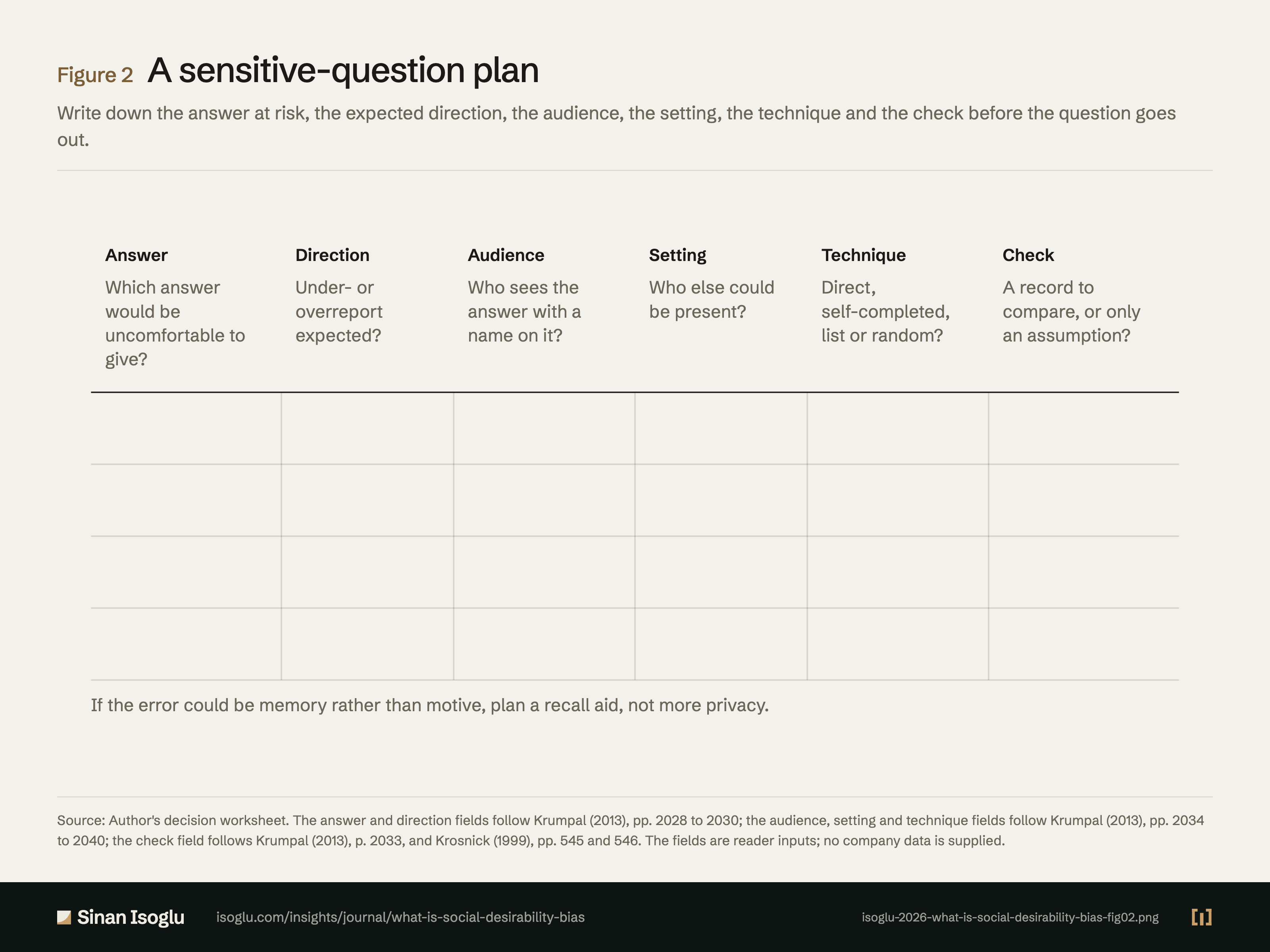
Write down the answer at risk, the expected direction, the audience, the setting, the technique and the check before the question goes out.

Cite Embed

Figure 2A sensitive-question plan

A six-column worksheet for a sensitive survey question: the answer that would be uncomfortable to give, the expected direction of error, who sees the answer with a name attached, who else could be present, the asking technique, and the check against a record or an assumption.AnswerWhich answerwould beuncomfortable togive?DirectionUnder- oroverreportexpected?AudienceWho sees theanswer with aname on it?SettingWho else couldbe present?TechniqueDirect,self-completed,list or random?CheckA record tocompare, or onlyan assumption?If the error could be memory rather than motive, plan a recall aid, not more privacy.

Source: Author's decision worksheet. The answer and direction fields follow Krumpal (2013), pp. 2028 to 2030; the audience, setting and technique fields follow Krumpal (2013), pp. 2034 to 2040; the check field follows Krumpal (2013), p. 2033, and Krosnick (1999), pp. 545 and 546. The fields are reader inputs; no company data is supplied.
PNG4:3, 1600 × 1200, with the title, the source line and the attribution set in the image isoglu-2026-what-is-social-desirability-bias-fig02.png

Source and evidence

Each line names a claim related to this exhibit, its source, and how it was checked.

  • B SDB-OWN-C3 A sensitive question is planned in one row: the answer at risk, the expected direction, who sees the answer, who else is present, the technique, and the check against a record or an assumption; illustrated with a hypothetical B2B software firm comparing, account by account and without linking any answer to a person, the reported share with the account's own records of calls made and logged.Author worksheet grounded in KRU13-C6, KRU13-C7, KRU13-C9 and KRO99-C2

Grades: A, verified against the printed page of the primary source · B, primary source, text layer only · C, authoritative secondary · D, reported.

Cite or embed

APA 7

Isoglu, S. (2026). A sensitive-question plan [Figure]. isoglu.com. https://isoglu.com/insights/exhibits/isoglu-2026-what-is-social-desirability-bias-fig02/

BibTeX
@misc{isoglu-2026-what-is-social-desirability-bias-fig02,
  author = {Isoglu, Sinan},
  title = {{A sensitive-question plan}},
  year = {2026},
  howpublished = {Figure 2, isoglu.com},
  url = {https://isoglu.com/insights/exhibits/isoglu-2026-what-is-social-desirability-bias-fig02/},
  note = {From the essay {What is social desirability bias?}}
}
Embed this exhibit

Copy this HTML to use the PNG exhibit on your site with its source line and a link back to the exhibit page.

<figure>
  <a href="https://isoglu.com/insights/exhibits/isoglu-2026-what-is-social-desirability-bias-fig02/">
    <img src="https://isoglu.com/social/isoglu-2026-what-is-social-desirability-bias-fig02.png" alt="Figure 2: A sensitive-question plan" width="3200" height="2400">
  </a>
  <figcaption>Figure 2: A sensitive-question plan. Source: Author&#39;s decision worksheet. The answer and direction fields follow Krumpal (2013), pp. 2028 to 2030; the audience, setting and technique fields follow Krumpal (2013), pp. 2034 to 2040; the check field follows Krumpal (2013), p. 2033, and Krosnick (1999), pp. 545 and 546. The fields are reader inputs; no company data is supplied. <a href="https://isoglu.com/insights/exhibits/isoglu-2026-what-is-social-desirability-bias-fig02/">View exhibit</a>.</figcaption>
</figure>