Figure 2From “What is Simpson's paradox?”
A pooling decision record
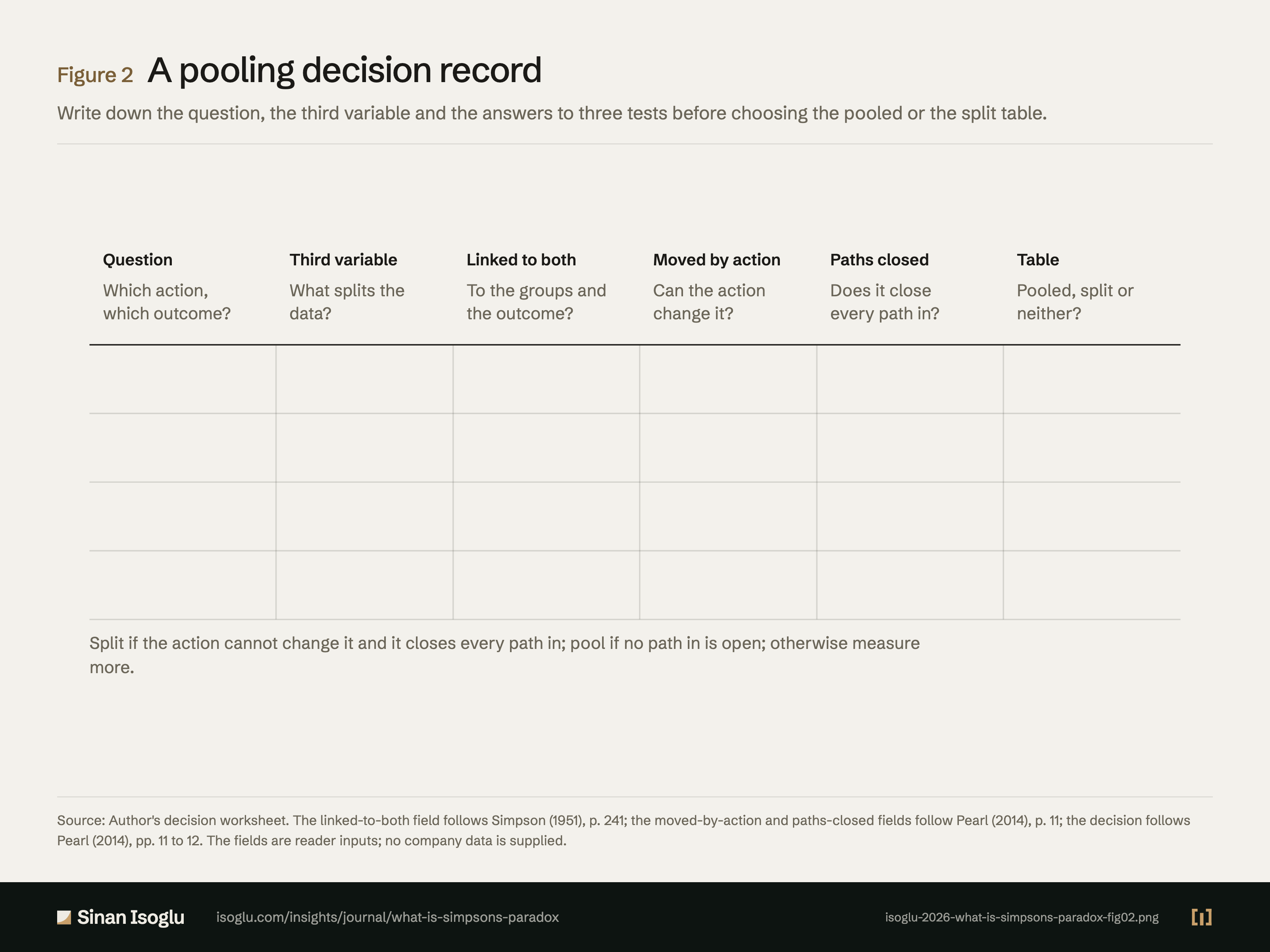
Write down the question, the third variable and the answers to three tests before choosing the pooled or the split table.
Figure 2A pooling decision record
Source: Author's decision worksheet. The linked-to-both field follows Simpson (1951), p. 241; the moved-by-action and paths-closed fields follow Pearl (2014), p. 11; the decision follows Pearl (2014), pp. 11 to 12. The fields are reader inputs; no company data is supplied.
Source and evidence
Each line names a claim related to this exhibit, its source, and how it was checked.
- B SPX-OWN-C3 A pooling decision record: the question (action and outcome), the third variable, whether it is linked to both the groups compared and the outcome, whether the action can change it, whether it closes every path into the action, and the table to read; split if the action cannot change it and it closes every path in, pool if no path in is open, otherwise measure more. Illustrated with invented discounts for two sales teams (team A 10% on 30 small and 20% on 70 large deals, 17% overall; team B 12% on 80 small and 22% on 20 large, 14% overall), routing by deal size, and a team that enlarges deals so that deal size becomes partly downstream of the team (wording after G5 N9); the author's examples, untested.Author worksheet grounded in SIM51-C4, PRL14-C6 and PRL14-C7; untested
Grades: A, verified against the printed page of the primary source · B, primary source, text layer only · C, authoritative secondary · D, reported.
From the essay
From the research bench
What is Simpson's paradox?
Simpson's paradox: an association that holds in every subgroup reverses when the groups are pooled. Which table to trust is a causal question.
Read the essayThis exhibit belongs to an essay: the numbers live here, the argument lives there.
Cite or embed
Contact
Bring the question you're working on.
Research, a guest lecture, or a commercial question.