Figure 1From “What is sales productivity? Activity is not productive selling time”
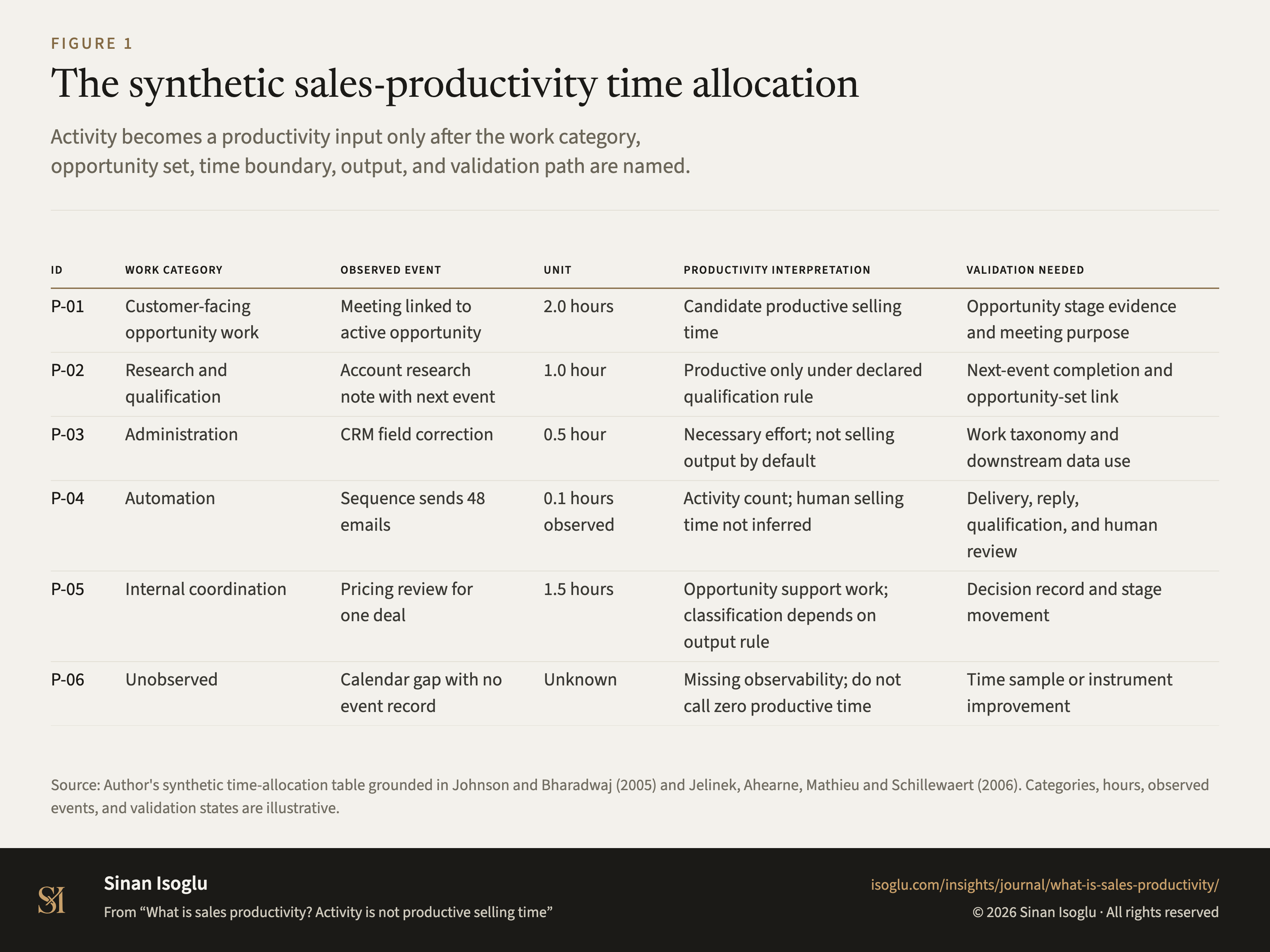
The synthetic sales-productivity time allocation
Activity becomes a productivity input only after the work category, opportunity set, time boundary, output, and validation path are named.
Figure 1The synthetic sales-productivity time allocation
| ID | Work category | Observed event | Unit | Productivity interpretation | Validation needed |
|---|---|---|---|---|---|
| P-01 | Customer-facing opportunity work | Meeting linked to active opportunity | 2.0 hours | Candidate productive selling time | Opportunity stage evidence and meeting purpose |
| P-02 | Research and qualification | Account research note with next event | 1.0 hour | Productive only under declared qualification rule | Next-event completion and opportunity-set link |
| P-03 | Administration | CRM field correction | 0.5 hour | Necessary effort; not selling output by default | Work taxonomy and downstream data use |
| P-04 | Automation | Sequence sends 48 emails | 0.1 hours observed | Activity count; human selling time not inferred | Delivery, reply, qualification, and human review |
| P-05 | Internal coordination | Pricing review for one deal | 1.5 hours | Opportunity support work; classification depends on output rule | Decision record and stage movement |
| P-06 | Unobserved | Calendar gap with no event record | Unknown | Missing observability; do not call zero productive time | Time sample or instrument improvement |
Swipe or scroll horizontally if the table is wider than your screen.
Source: Author's synthetic time-allocation table grounded in Johnson and Bharadwaj (2005) and Jelinek, Ahearne, Mathieu and Schillewaert (2006). Categories, hours, observed events, and validation states are illustrative.
Source and evidence
Each line names a claim related to this exhibit, its source, and how it was checked.
- A JB05-C1 The sample, verbatim: "using data from salespeople in 168firms they assess the moderating effects of environmentallevel motivational factors and firm level ability factors"Johnson & Bharadwaj. (2005)
- A JB05-C2 The finding is called paradoxical by the authors themselves: "digitization has the paradoxical effect of improving salesperson effectiveness and heightening job insecurity concerns"Johnson & Bharadwaj. (2005)
- A JAMS06-C1 The design is in the title: "a longitudinal examination of individual organizational and contextual factors on sales technology adoption and job performance"Jelinek, Ahearne, Mathieu & Schillewaert. (2006)
- A JAMS06-C3 Adoption and performance are linked in the same design: "sales technology adoption and job performance", longitudinally rather than cross-sectionallyJelinek, Ahearne, Mathieu & Schillewaert. (2006)
- B V06-OWN-C1 Sales productivity is a declared relationship between productive selling output or time, an opportunity set, and a time boundaryAuthor framework grounded in JB05-C1 and JAMS06-C1
- B V06-OWN-C3 Productive selling time is time classified as customer or opportunity work under an explicit rule, not every logged activityAuthor framework
- B V06-OWN-C6 The six-row time-allocation table is illustrative and includes no employee record, time-tracking export, quota, or sales resultAuthor synthetic object
- B V06-OWN-C9 Technology adoption or activity logging does not by itself establish productive time, output, causality, or a universal productivity gainAuthor negative boundary grounded in JB05-C2 and JAMS06-C3
Grades: A, verified against the printed page of the primary source · B, primary source, text layer only · C, authoritative secondary · D, reported.
From the essay
Revenue operations & AI
What is sales productivity? Activity is not productive selling time
Sales productivity needs a declared output, opportunity set, and time boundary. Email counts and logged activity are not productive selling by default.
Read the essayThis exhibit belongs to an essay: the numbers live here, the argument lives there.
Cite or embed
Related exhibits
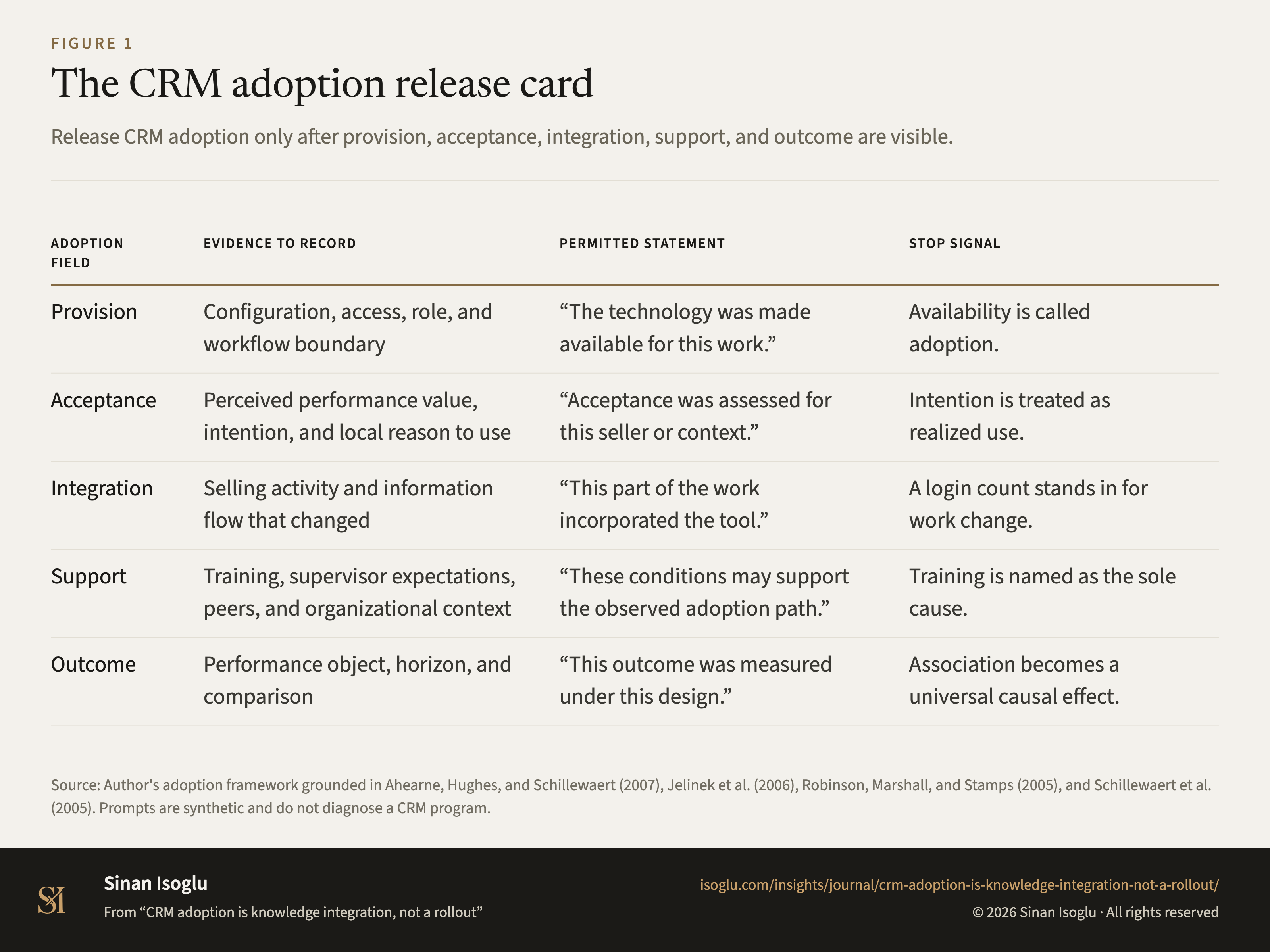
Figure 1Figure
The CRM adoption release card
CRM adoption is knowledge integration, not a rollout
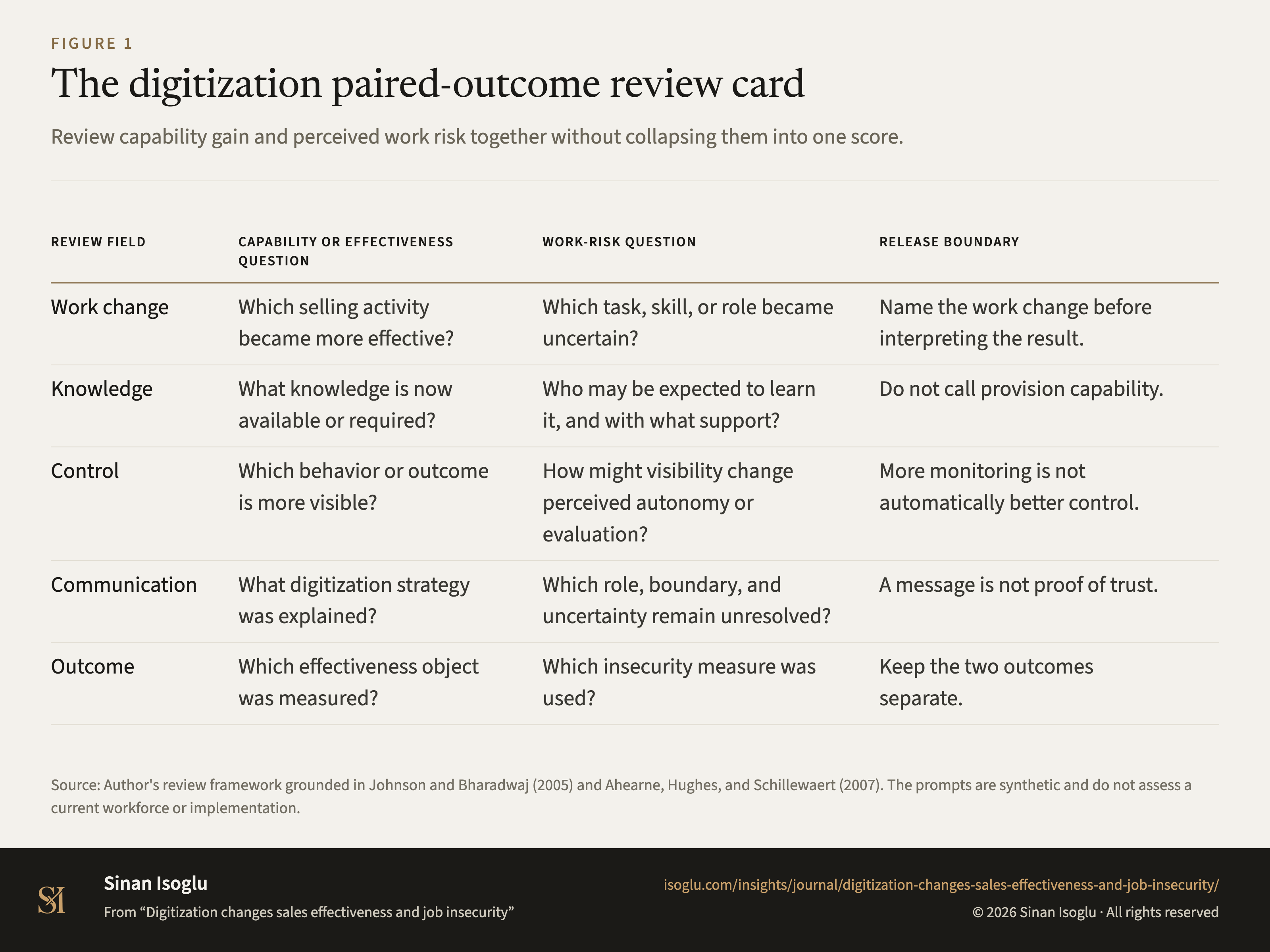
Figure 1Figure
The digitization paired-outcome review card
Digitization changes sales effectiveness and job insecurity
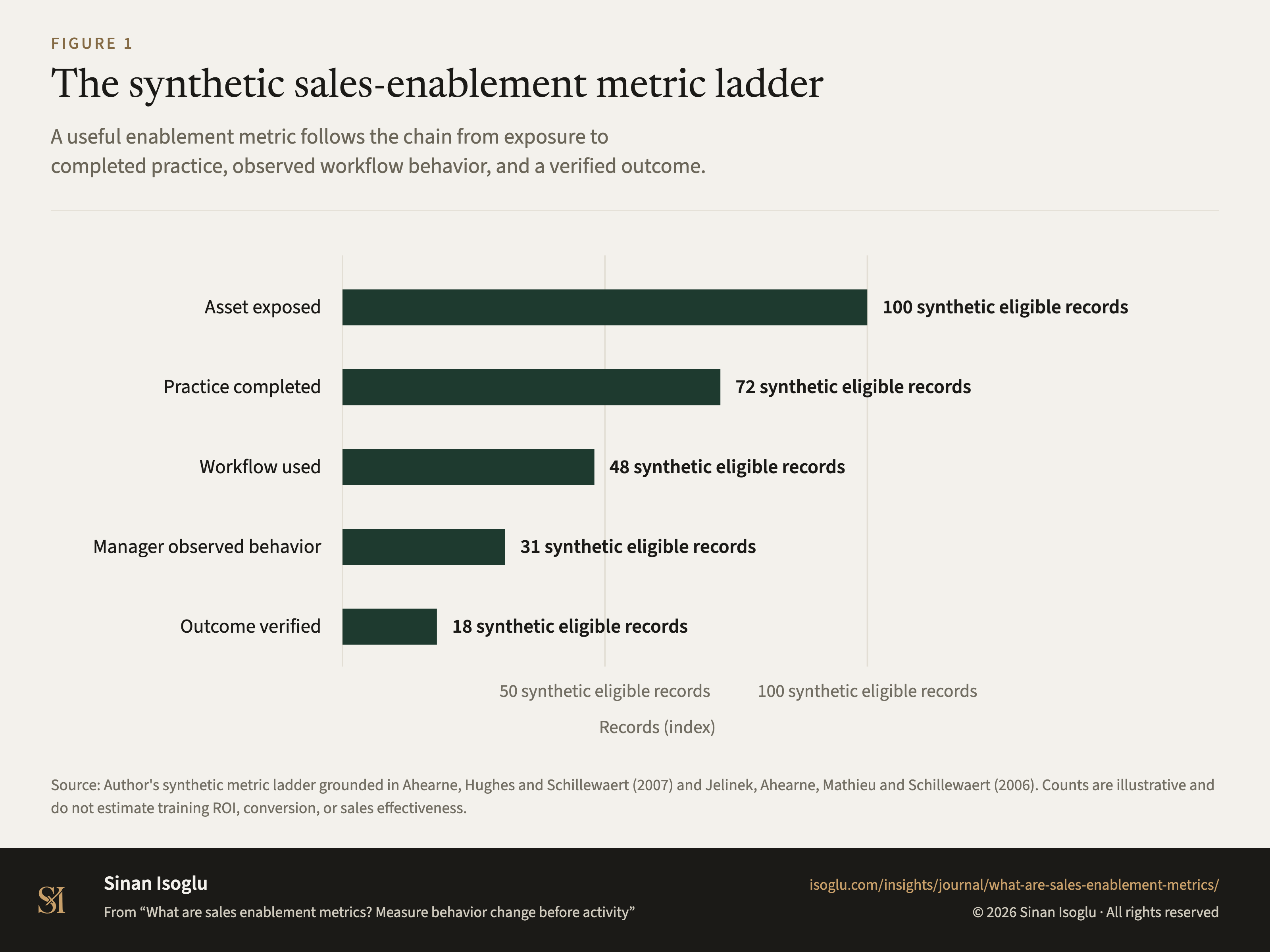
Figure 1Figure
The synthetic sales-enablement metric ladder
What are sales enablement metrics? Measure behavior change before activity
Contact
Bring the question you're working on.
Research, a guest lecture, or a commercial question.