Figure 1From “What is reproducibility? Can another analyst reconstruct the result?”
The synthetic reconstruction worksheet
A result is ready for reconstruction only when its question, inputs, operations, environment, expected output, and mismatch state are visible.
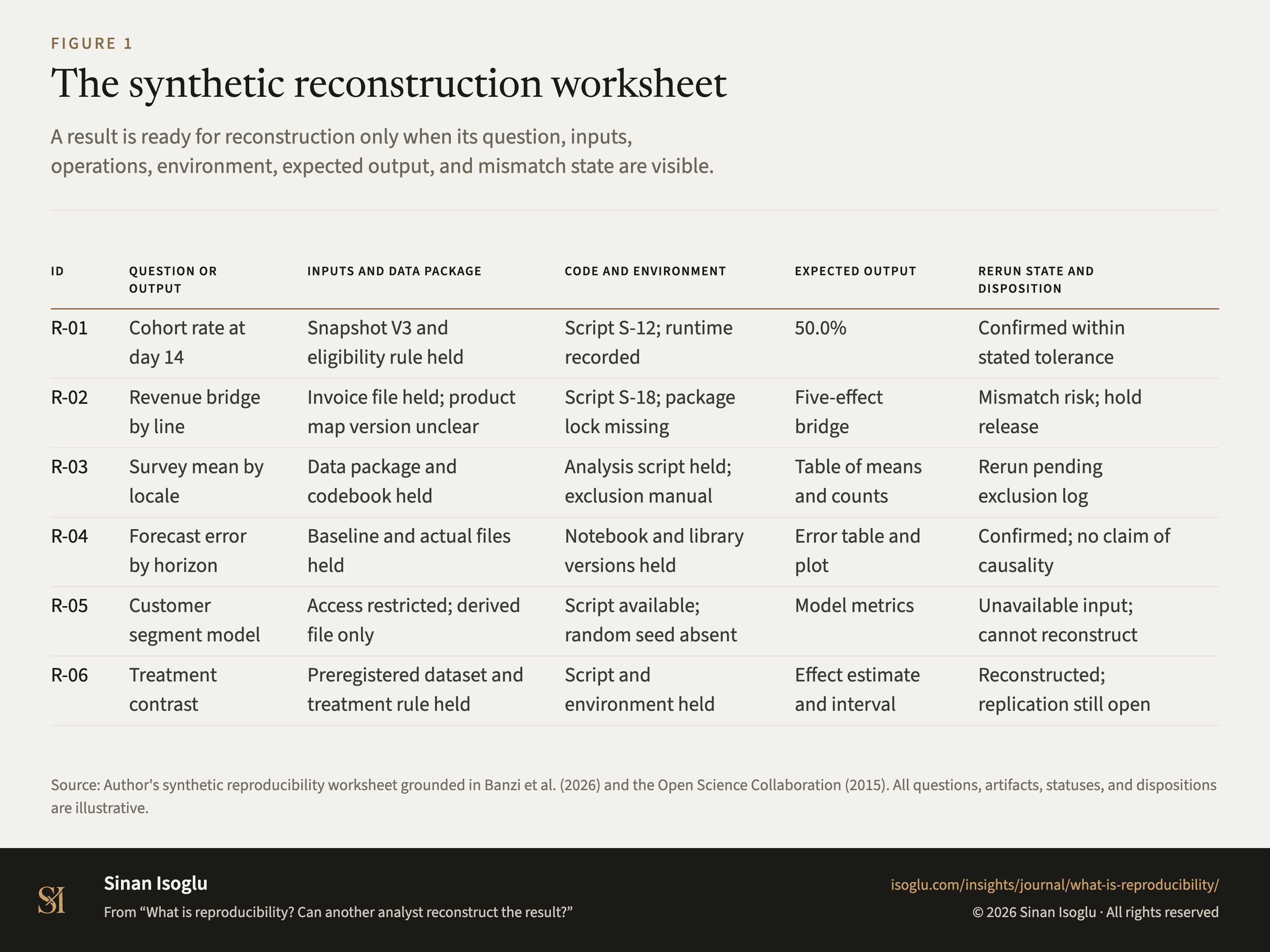
Figure 1The synthetic reconstruction worksheet
| ID | Question or output | Inputs and data package | Code and environment | Expected output | Rerun state and disposition |
|---|---|---|---|---|---|
| R-01 | Cohort rate at day 14 | Snapshot V3 and eligibility rule held | Script S-12; runtime recorded | 50.0% | Confirmed within stated tolerance |
| R-02 | Revenue bridge by line | Invoice file held; product map version unclear | Script S-18; package lock missing | Five-effect bridge | Mismatch risk; hold release |
| R-03 | Survey mean by locale | Data package and codebook held | Analysis script held; exclusion manual | Table of means and counts | Rerun pending exclusion log |
| R-04 | Forecast error by horizon | Baseline and actual files held | Notebook and library versions held | Error table and plot | Confirmed; no claim of causality |
| R-05 | Customer segment model | Access restricted; derived file only | Script available; random seed absent | Model metrics | Unavailable input; cannot reconstruct |
| R-06 | Treatment contrast | Preregistered dataset and treatment rule held | Script and environment held | Effect estimate and interval | Reconstructed; replication still open |
Swipe or scroll horizontally if the table is wider than your screen.
Source: Author's synthetic reproducibility worksheet grounded in Banzi et al. (2026) and the Open Science Collaboration (2015). All questions, artifacts, statuses, and dispositions are illustrative.
Source and evidence
Each line names a claim related to this exhibit, its source, and how it was checked.
- A BNZ26-C1 A multidisciplinary consensus, in its own words: developed "by a multidisciplinary group interested in research open science and reproducibility"Banzi et al. (2026)
- A BNZ26-C2 The span of the list: "core expectations regarding planning methods data col lection management and analysis and dissemination"Banzi et al. (2026)
- B OSC15-C1 Ninety-seven percent of the originals were significant: "ninety sevenpercent of original studies had significant results p 05", against "thirty six percent of replications"Open Science Collaboration (2015), abstract
- B OSC15-C4 Four measures, not one, and they disagree: "thirty six percent of replications had significant results", "47 of original effect sizes were in the 95 confidence interval of the replication effect size", "39 of effects were subjectively rated to have replicated the original result", and combining both "left 68 with statistically significant effects"Open Science Collaboration (2015), abstract
- B R06-OWN-C1 Reproducibility asks whether another analyst can reconstruct a result from the specified question, inputs, procedures, code, environment, and outputsAuthor framework grounded in BNZ26-C1 and BNZ26-C2
- B R06-OWN-C3 A reproducible workflow declares the estimand or question, input versions, transformations, analysis script, environment, random state where relevant, and expected outputAuthor framework grounded in BNZ26-C2
- B R06-OWN-C6 The reconstruction worksheet should distinguish unavailable, ambiguous, rerun, mismatch, and confirmed statesAuthor operating framework
- B R06-OWN-C7 The six-row worksheet is an illustrative control object and does not report a reproducibility rate for a field, company, or research communityAuthor synthetic object
Grades: A, verified against the printed page of the primary source · B, primary source, text layer only · C, authoritative secondary · D, reported.
From the essay
From the research bench
What is reproducibility? Can another analyst reconstruct the result?
Reproducibility asks whether another analyst can rebuild a result from its inputs, code, environment, and procedure. It is not replication.
Read the essayThis exhibit belongs to an essay: the numbers live here, the argument lives there.
Cite or embed
Related exhibits
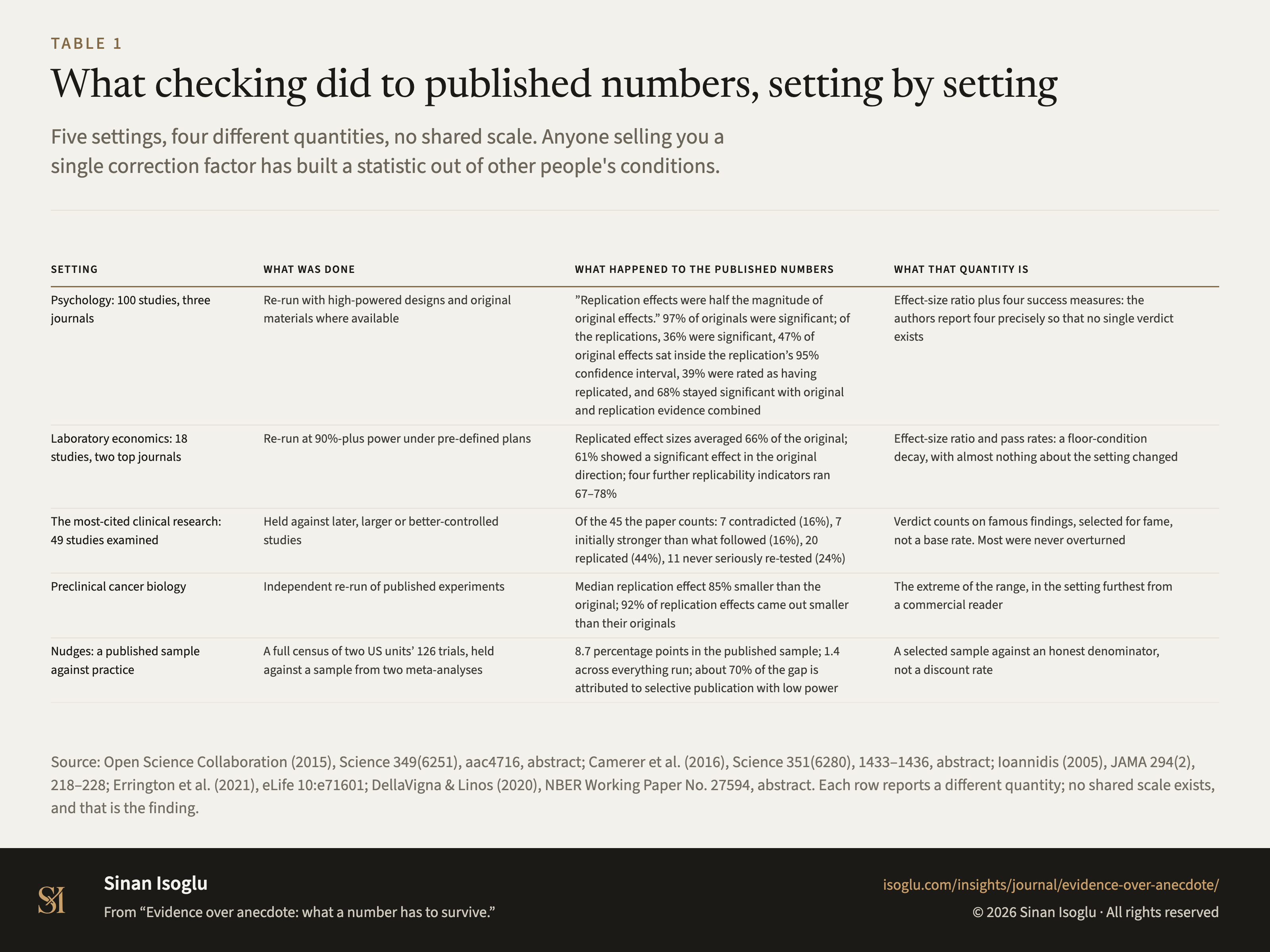
Table 1Table
What checking did to published numbers, setting by setting
Evidence over anecdote: what a number has to survive.
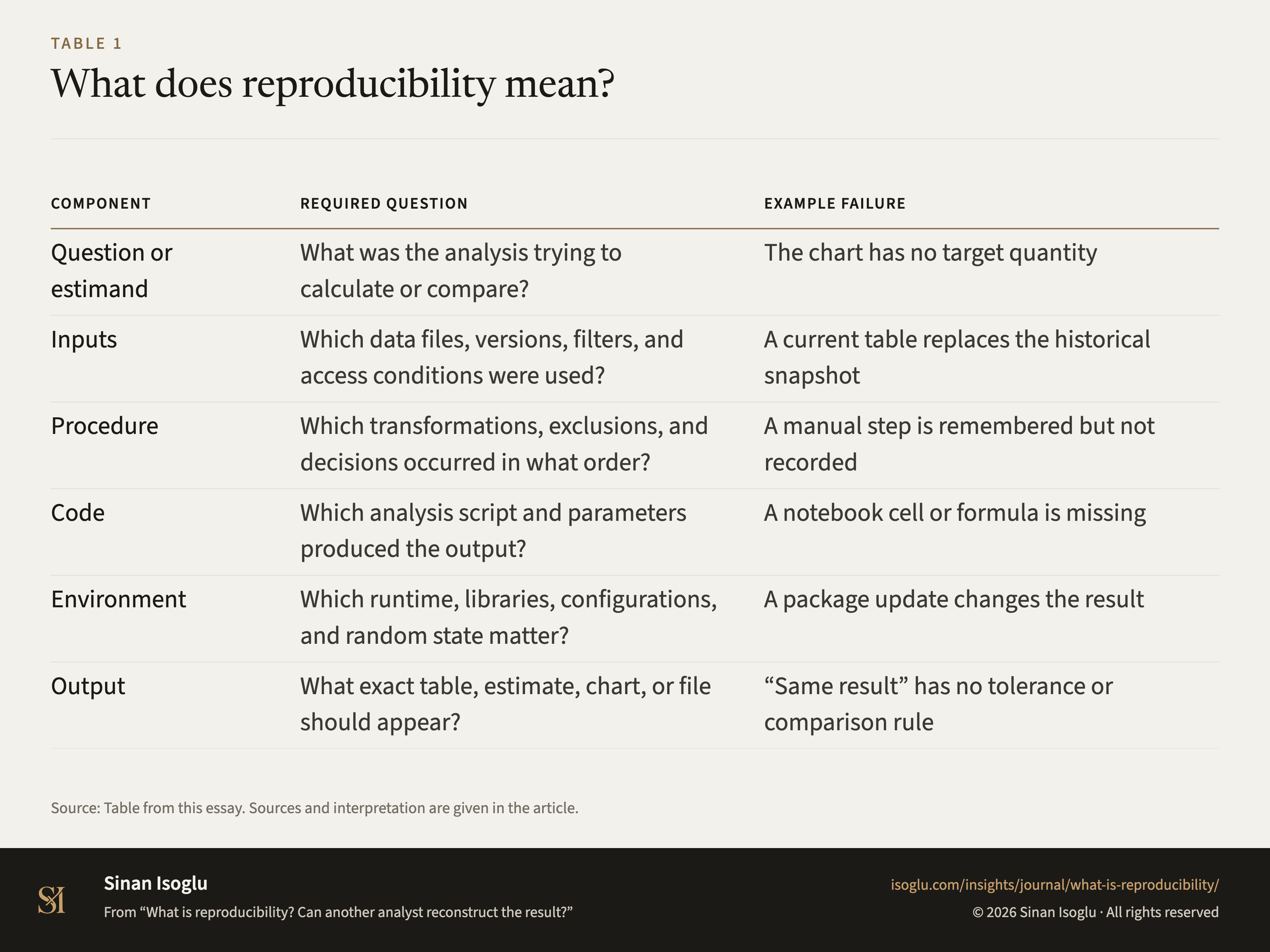
Table 1Table
What does reproducibility mean?
What is reproducibility? Can another analyst reconstruct the result?
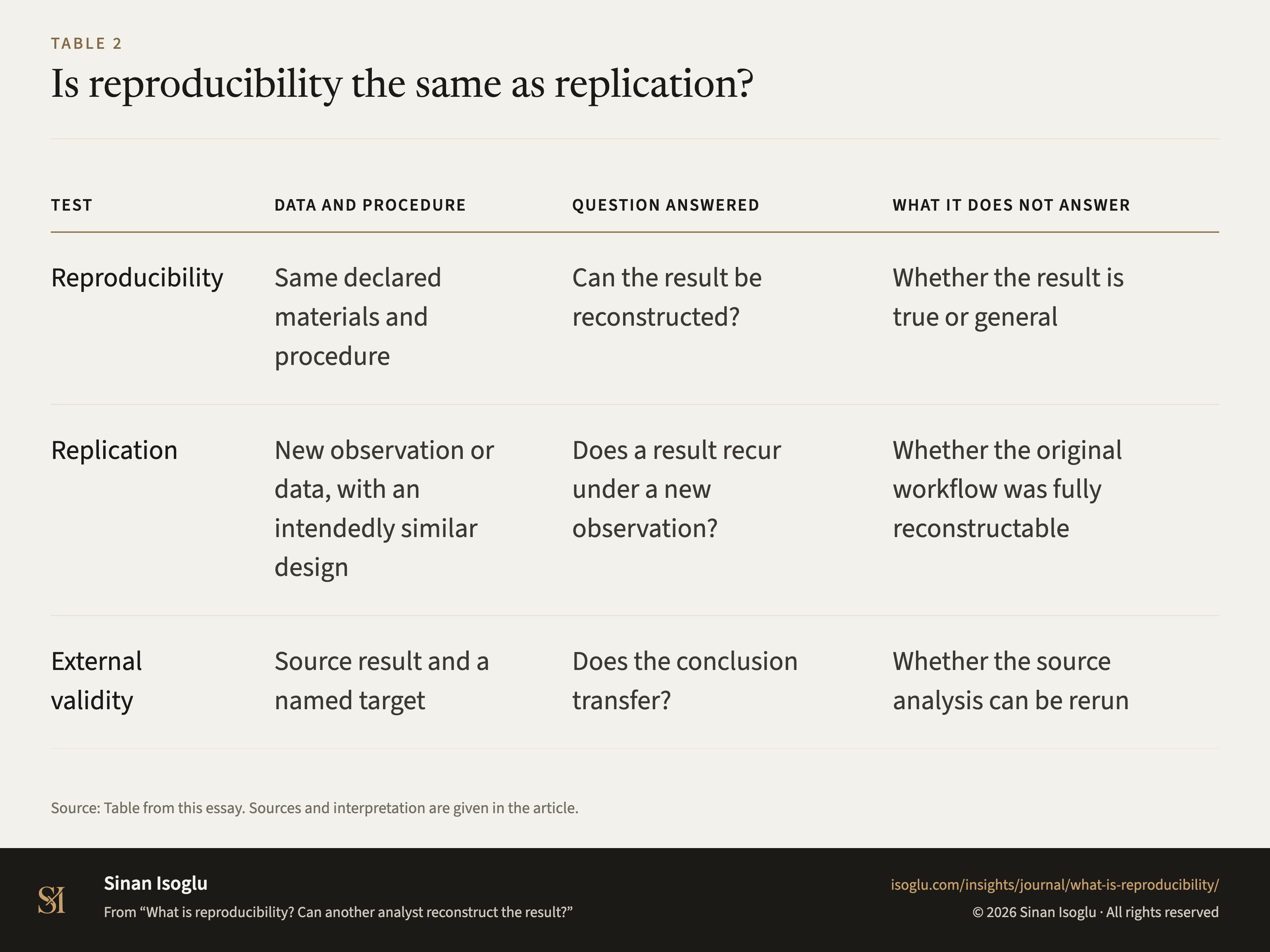
Table 2Table
Is reproducibility the same as replication?
What is reproducibility? Can another analyst reconstruct the result?
Contact
Bring the question you're working on.
Research, a guest lecture, or a commercial question.