Figure 1From “What is price fairness? A reference and process problem”
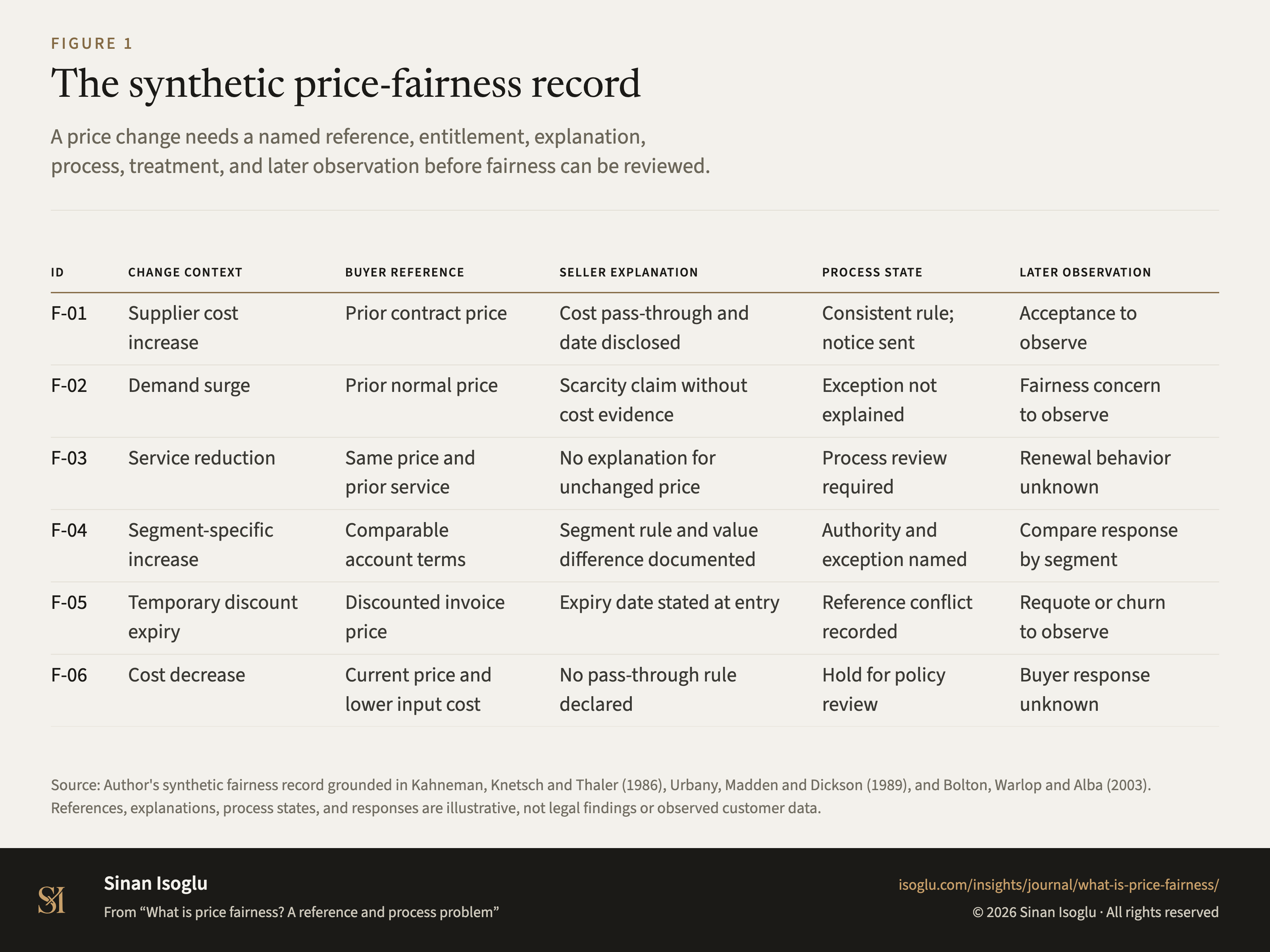
The synthetic price-fairness record
A price change needs a named reference, entitlement, explanation, process, treatment, and later observation before fairness can be reviewed.
Figure 1The synthetic price-fairness record
| ID | Change context | Buyer reference | Seller explanation | Process state | Later observation |
|---|---|---|---|---|---|
| F-01 | Supplier cost increase | Prior contract price | Cost pass-through and date disclosed | Consistent rule; notice sent | Acceptance to observe |
| F-02 | Demand surge | Prior normal price | Scarcity claim without cost evidence | Exception not explained | Fairness concern to observe |
| F-03 | Service reduction | Same price and prior service | No explanation for unchanged price | Process review required | Renewal behavior unknown |
| F-04 | Segment-specific increase | Comparable account terms | Segment rule and value difference documented | Authority and exception named | Compare response by segment |
| F-05 | Temporary discount expiry | Discounted invoice price | Expiry date stated at entry | Reference conflict recorded | Requote or churn to observe |
| F-06 | Cost decrease | Current price and lower input cost | No pass-through rule declared | Hold for policy review | Buyer response unknown |
Swipe or scroll horizontally if the table is wider than your screen.
Source: Author's synthetic fairness record grounded in Kahneman, Knetsch and Thaler (1986), Urbany, Madden and Dickson (1989), and Bolton, Warlop and Alba (2003). References, explanations, process states, and responses are illustrative, not legal findings or observed customer data.
Source and evidence
Each line names a claim related to this exhibit, its source, and how it was checked.
- A KKT86-C1 "it is acceptable for a firm to raise prices or cut wages when profits are threatened and to maintain prices when costs diminish it is unfair to exploit shifts in demand by raising prices or cutting wages"kahneman-knetsch-thaler-1986-fairness
- A KKT86-C2 Dual entitlement, defined: "transactors have an entitlement to the terms of the reference transaction and firms are entitled to their reference profit"kahneman-knetsch-thaler-1986-fairness
- A KKT86-C7 The Okun lineage is explicit: "arthur okun 1981 went further in arguing that fairness also alters the outcomes in what he called customer markets"kahneman-knetsch-thaler-1986-fairness
- A URB89-C1 The KKT prediction held: "we obtain empirical support for kkt s prediction that unjustified price increases are perceived as unfair while cost justification legitimates a price increase in consumers eyes"urbany-madden-dickson-1989-dual-entitlement
- A URB89-C2 And the part usually dropped: "we also find however that fairness perceptions are not significantly related to behavioral intentions as the theory would suggest"urbany-madden-dickson-1989-dual-entitlement
- A BWA03-C1 Three specific errors, verbatim: buyers "underestimate the effects of inflation overattribute price differences to profit and fail to take into account the full range of vendor costs"bolton-warlop-alba-2003-price-unfairness
- B T04-OWN-C1 Price fairness is a judgment about an exchange relative to a reference, outcome, procedure, or comparison groupAuthor framework grounded in KKT86-C1, KKT86-C2, and URB89-C1
- B T04-OWN-C2 Distributive fairness, procedural fairness, interactional treatment, and price realization are different objectsAuthor taxonomy
- B T04-OWN-C4 The same price can be judged differently when the reference price, reason, process, or comparison changesAuthor framework grounded in KKT86-C7 and URB89-C2
- B T04-OWN-C5 A lower price is not automatically fair, and a higher price is not automatically unfair without the relevant reference and processAuthor negative boundary
Grades: A, verified against the printed page of the primary source · B, primary source, text layer only · C, authoritative secondary · D, reported.
From the essay
Pricing & revenue architecture
What is price fairness? A reference and process problem
Price fairness depends on reference, cost or value explanation, process, and treatment. It is a perception object, not a legal verdict.
Read the essayThis exhibit belongs to an essay: the numbers live here, the argument lives there.
Cite or embed
Related exhibits
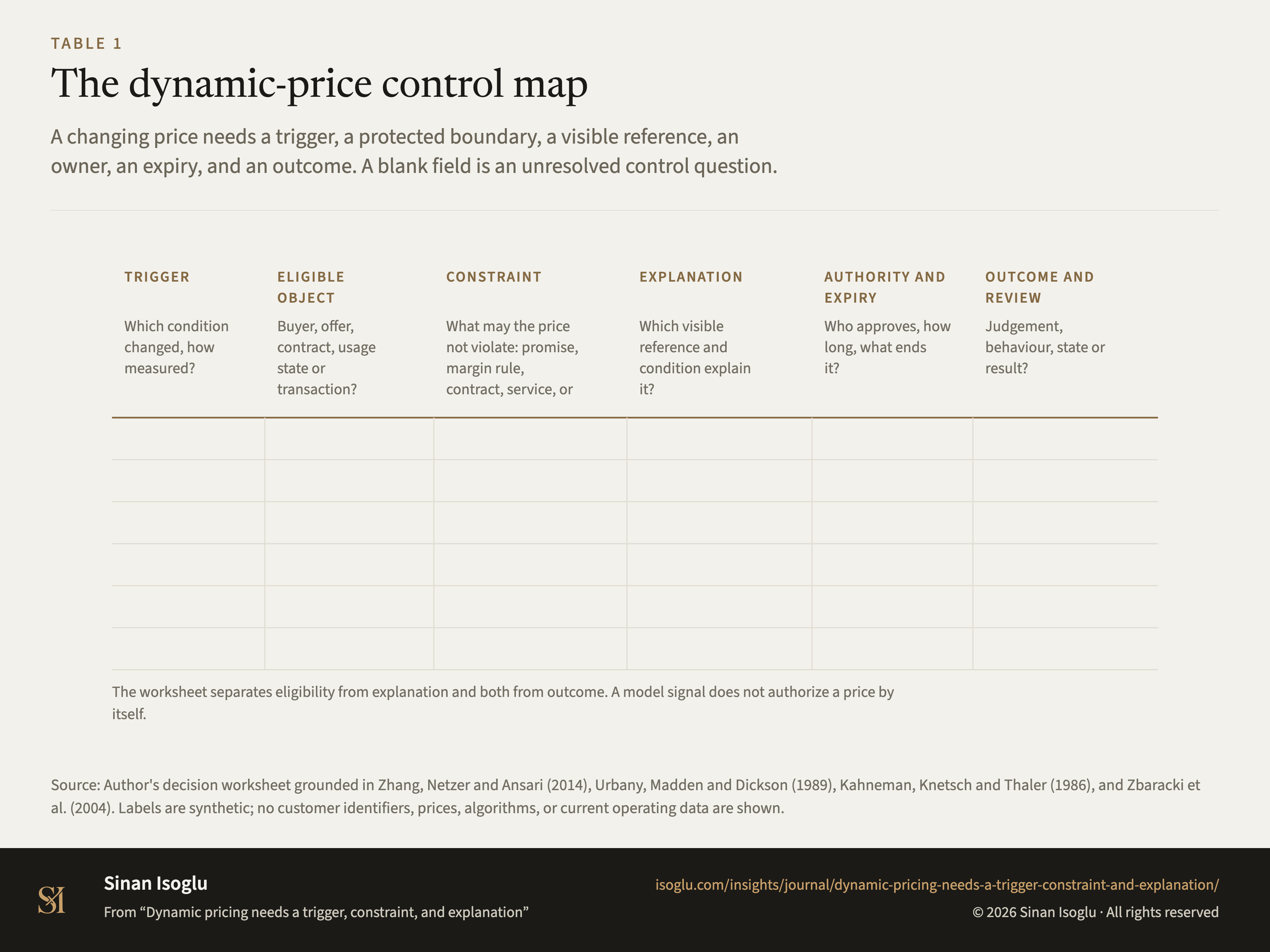
Table 1Table
The dynamic-price control map
Dynamic pricing needs a trigger, constraint, and explanation
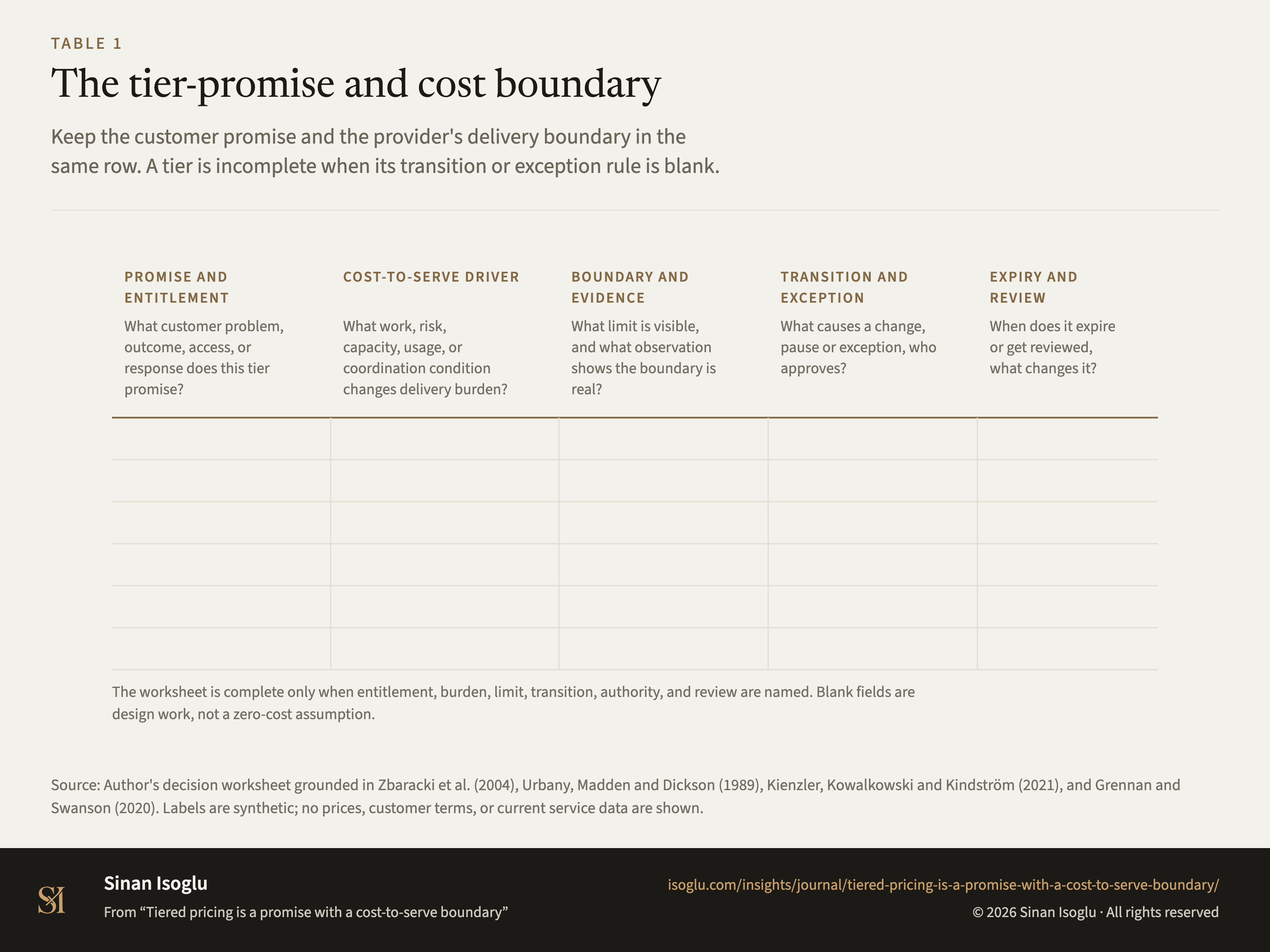
Table 1Table
The tier-promise and cost boundary
Tiered pricing is a promise with a cost-to-serve boundary
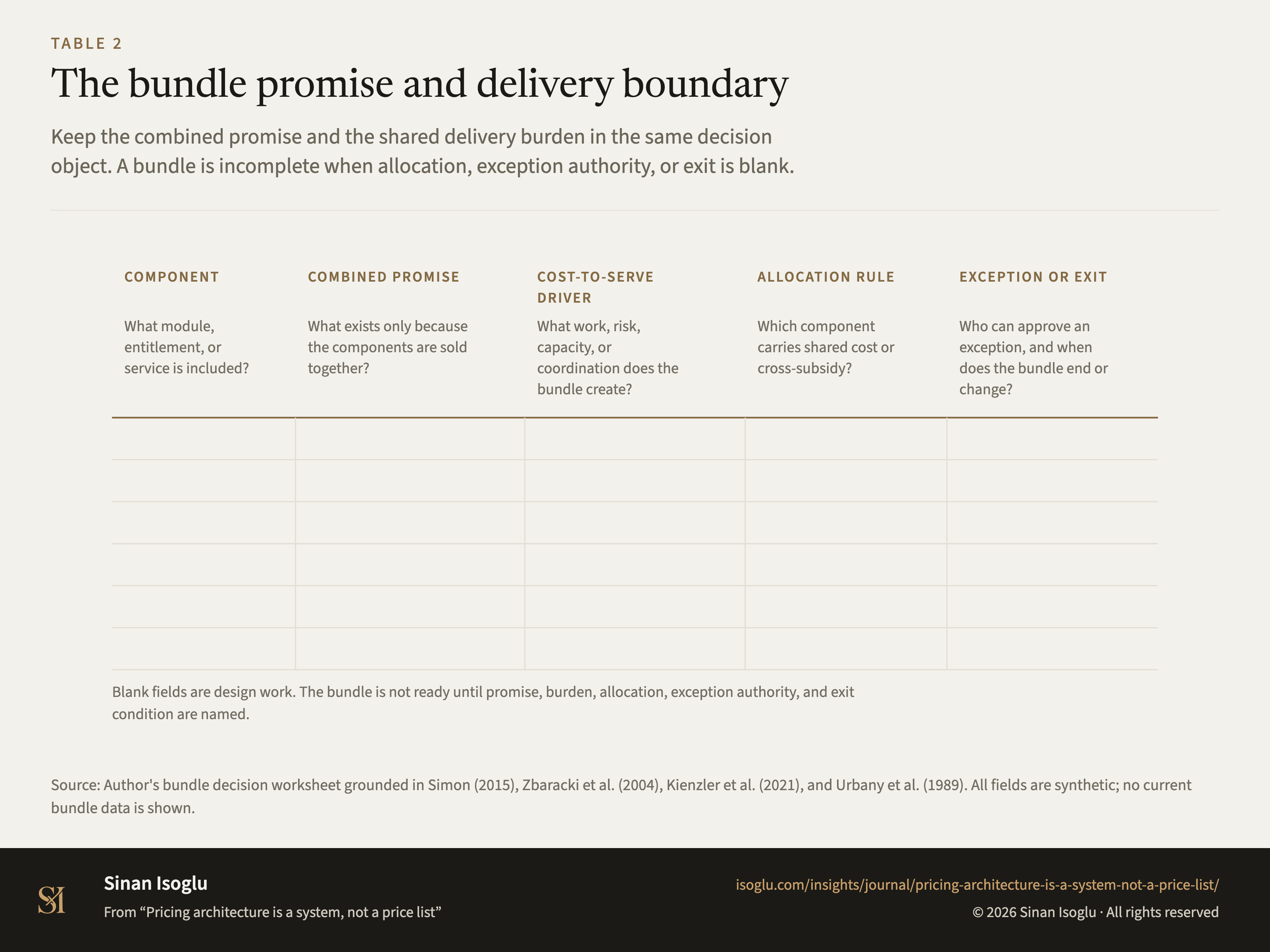
Table 2Table
The bundle promise and delivery boundary
Pricing architecture is a system, not a price list
Contact
Bring the question you're working on.
Research, a guest lecture, or a commercial question.