Figure 1From “What is price elasticity of demand?”
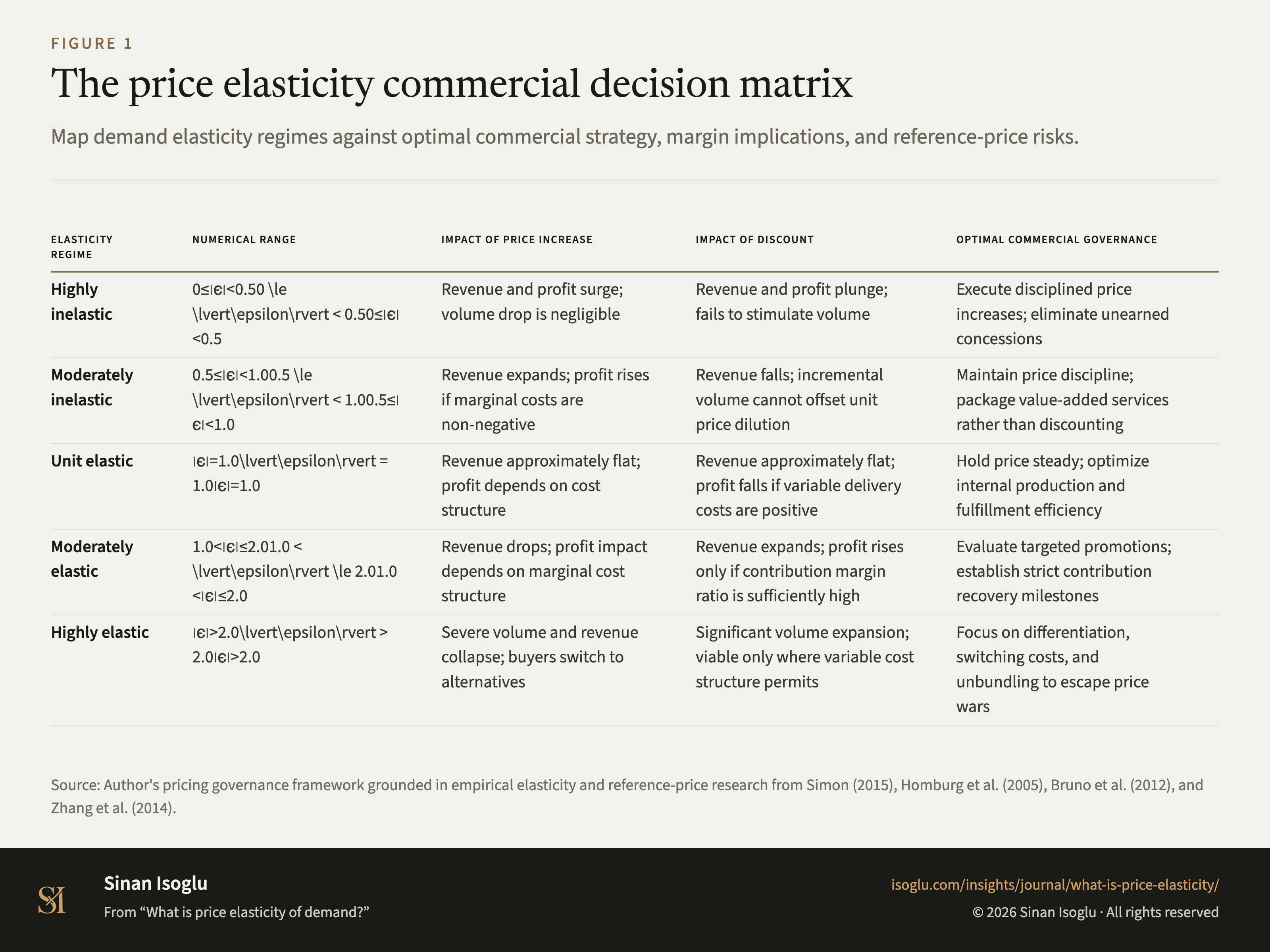
The price elasticity commercial decision matrix
Map demand elasticity regimes against optimal commercial strategy, margin implications, and reference-price risks.
Figure 1The price elasticity commercial decision matrix
| Elasticity regime | Numerical range | Impact of price increase | Impact of discount | Optimal commercial governance |
|---|---|---|---|---|
| Highly inelastic | $0 \le \lvert\epsilon\rvert < 0.5$ | Revenue and profit surge; volume drop is negligible | Revenue and profit plunge; fails to stimulate volume | Execute disciplined price increases; eliminate unearned concessions |
| Moderately inelastic | $0.5 \le \lvert\epsilon\rvert < 1.0$ | Revenue expands; profit rises if marginal costs are non-negative | Revenue falls; incremental volume cannot offset unit price dilution | Maintain price discipline; package value-added services rather than discounting |
| Unit elastic | $\lvert\epsilon\rvert = 1.0$ | Revenue approximately flat; profit depends on cost structure | Revenue approximately flat; profit falls if variable delivery costs are positive | Hold price steady; optimize internal production and fulfillment efficiency |
| Moderately elastic | $1.0 < \lvert\epsilon\rvert \le 2.0$ | Revenue drops; profit impact depends on marginal cost structure | Revenue expands; profit rises only if contribution margin ratio is sufficiently high | Evaluate targeted promotions; establish strict contribution recovery milestones |
| Highly elastic | $\lvert\epsilon\rvert > 2.0$ | Severe volume and revenue collapse; buyers switch to alternatives | Significant volume expansion; viable only where variable cost structure permits | Focus on differentiation, switching costs, and unbundling to escape price wars |
Swipe or scroll horizontally if the table is wider than your screen.
Source: Author's pricing governance framework grounded in empirical elasticity and reference-price research from Simon (2015), Homburg et al. (2005), Bruno et al. (2012), and Zhang et al. (2014).
Source and evidence
Each line names a claim related to this exhibit, its source, and how it was checked.
- A BCD12-C1 Three findings, verbatim from the PDF (the extract warns it is mangled): "reference price effects exist on quantity purchased and on the transaction pricing outcome in business to business market transactions", "business customers react asymmetrically to price increases and price decreases", and "salespeople have their own reference prices that affect the transaction price"bruno-che-dutta-2012-reference-price-b2b
- A HHK05-C1 The two drivers, in the authors' words: reactions to price increases "are strongly driven by two factors: the magnitude of the price increase and the perceived fair"ness of the motive for it, and satisfaction moderates the magnitude effecthomburg-hoyer-koschate-2005-price-increase-reactions
- A ZNA14-C1 Two latent states, named in the paper: "a “vigilant” state that is characterized by heightened price sensitivity and a cautious approach to ordering and a “relaxed” state with purchase behaviors that are consistent with high relational trust", and "the seller's pricing decisions can transition buyers between these two states". One industrial-consumables retailer, longitudinal transactionszhang-netzer-ansari-2014-dynamic-targeted-pricing
Grades: A, verified against the printed page of the primary source · B, primary source, text layer only · C, authoritative secondary · D, reported.
From the essay
Pricing & revenue architecture
What is price elasticity of demand?
Price elasticity measures percentage quantity response to a percentage price change, revealing how pricing power shapes revenue and contribution margin.
Read the essayThis exhibit belongs to an essay: the numbers live here, the argument lives there.
Cite or embed
Related exhibits
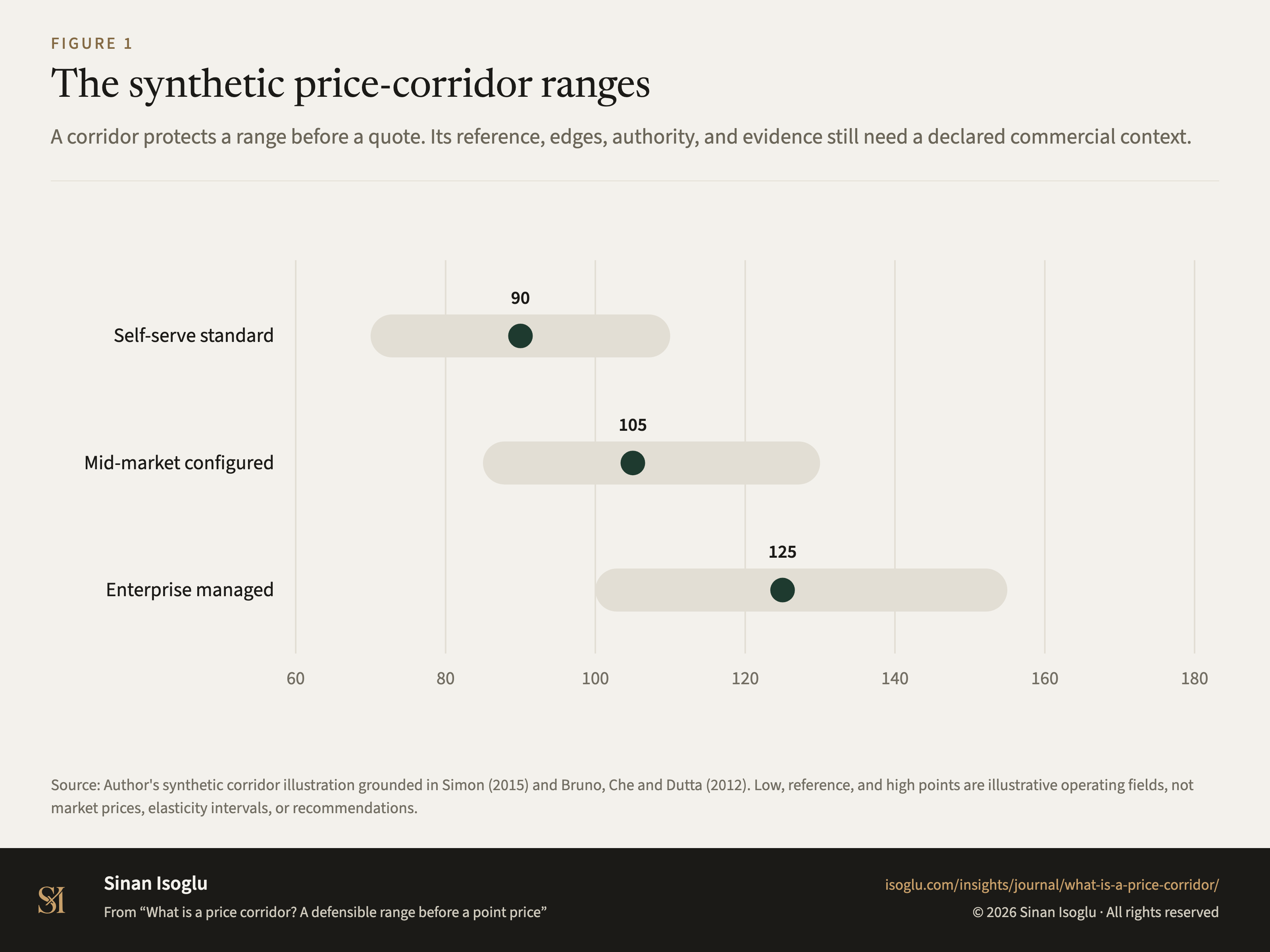
Figure 1Figure
The synthetic price-corridor ranges
What is a price corridor? A defensible range before a point price
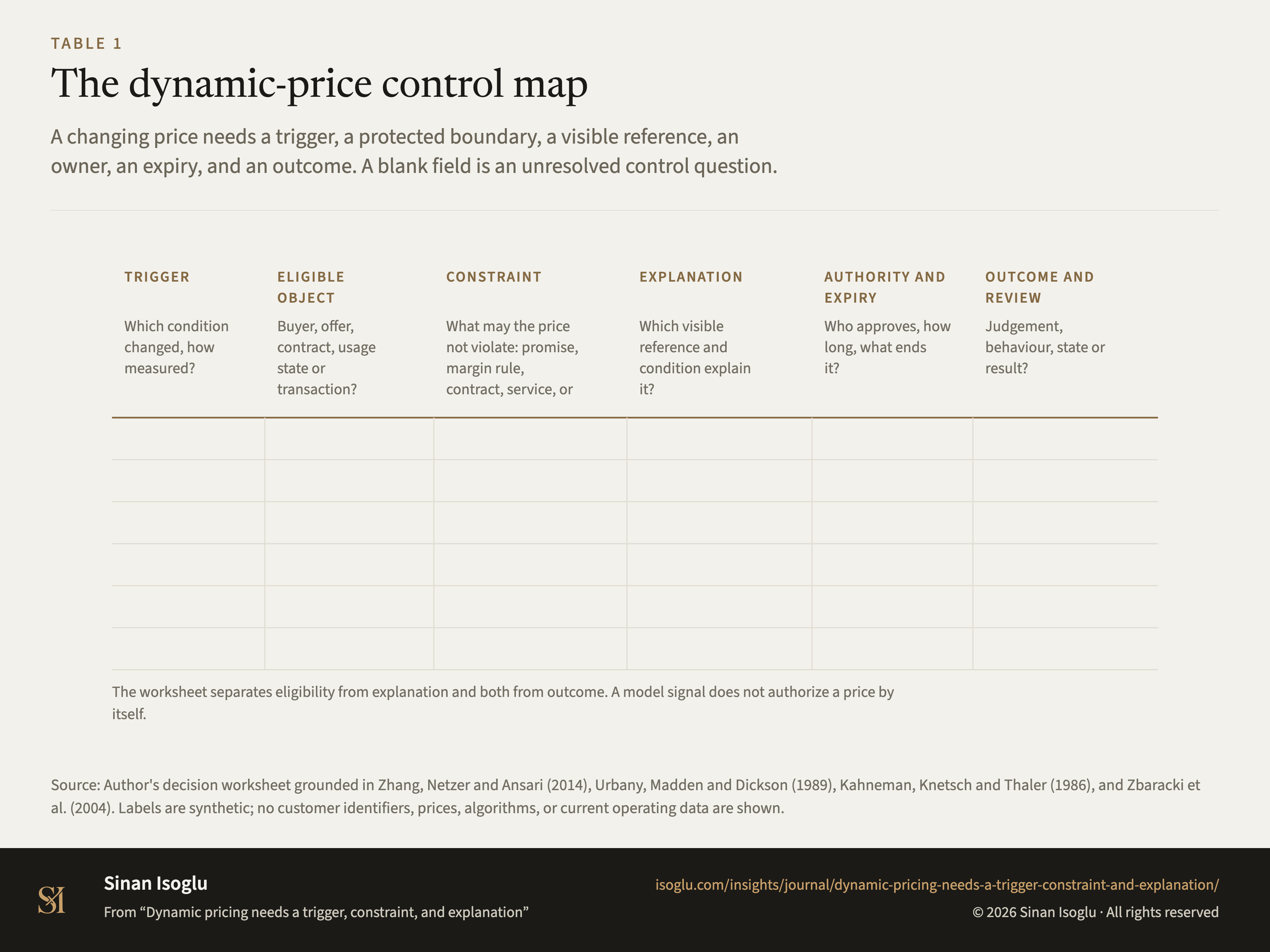
Table 1Table
The dynamic-price control map
Dynamic pricing needs a trigger, constraint, and explanation
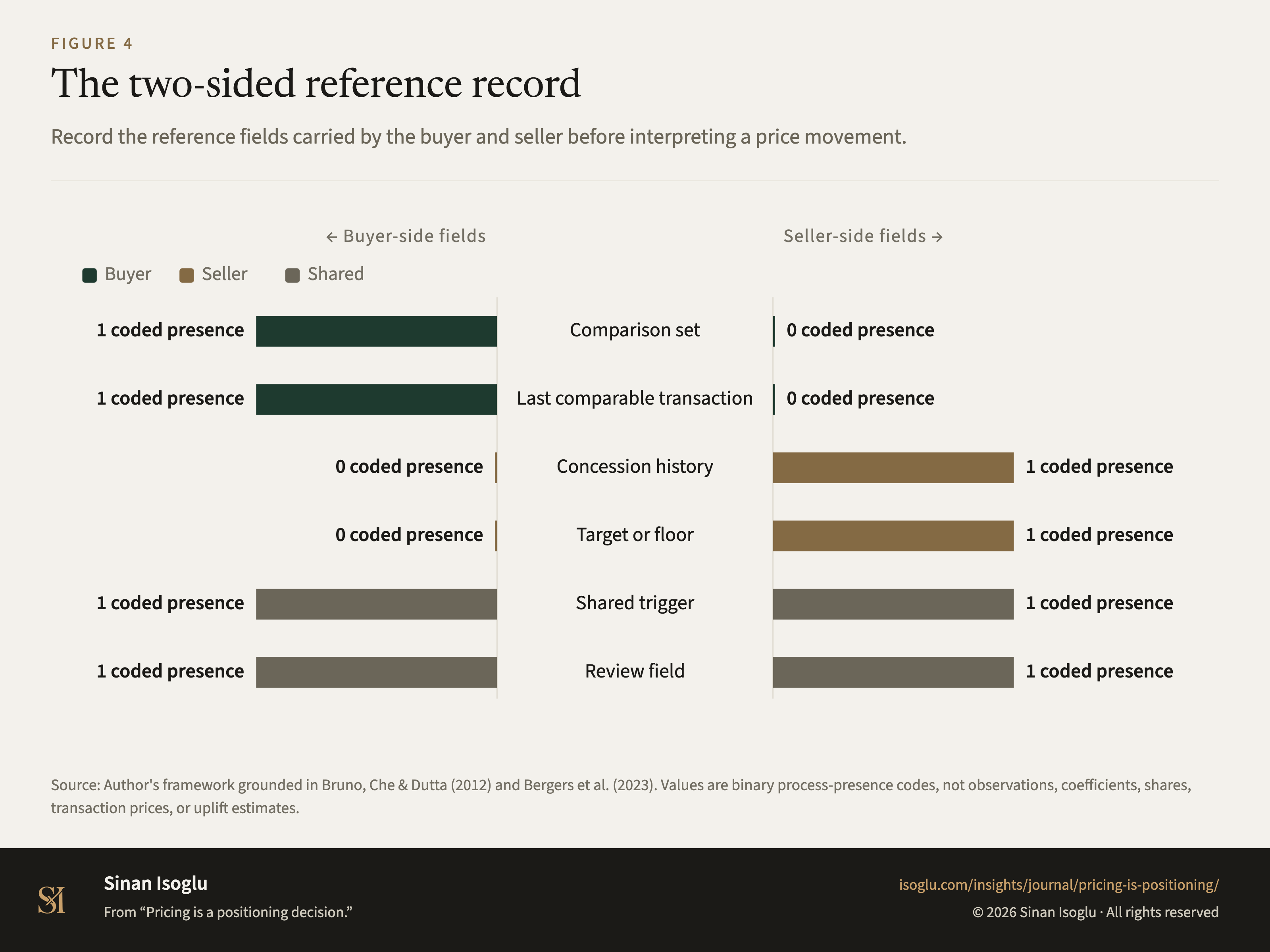
Figure 4Figure
The two-sided reference record
Pricing is a positioning decision.
Contact
Bring the question you're working on.
Research, a guest lecture, or a commercial question.