Figure 4From “Pricing is a positioning decision.”
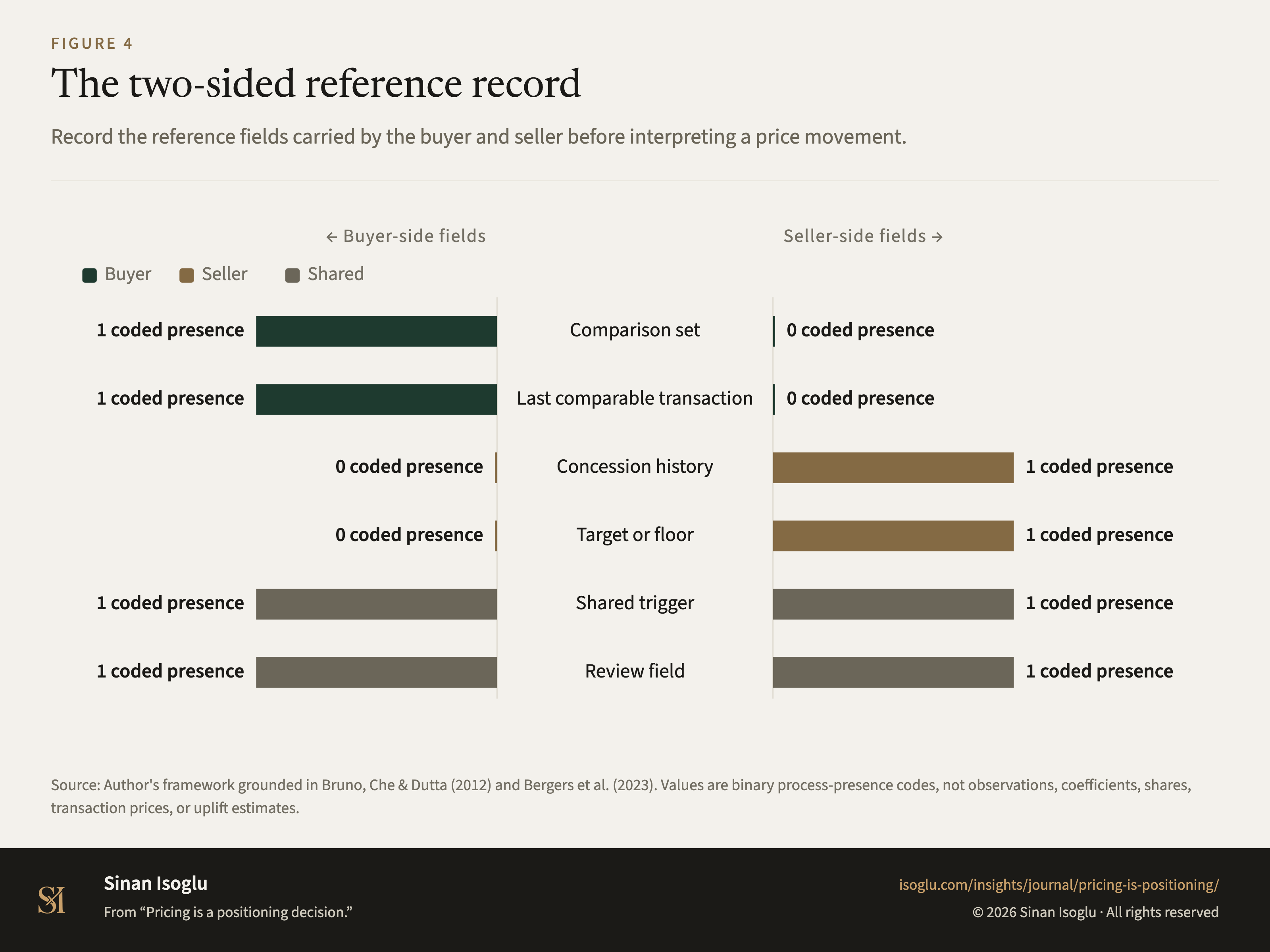
The two-sided reference record
Record the reference fields carried by the buyer and seller before interpreting a price movement.
Figure 4The two-sided reference record
Source: Author's framework grounded in Bruno, Che & Dutta (2012) and Bergers et al. (2023). Values are binary process-presence codes, not observations, coefficients, shares, transaction prices, or uplift estimates.
Source and evidence
Each line names a claim related to this exhibit, its source, and how it was checked.
- A BCD12-C1 Three findings, verbatim from the PDF (the extract warns it is mangled): "reference price effects exist on quantity purchased and on the transaction pricing outcome in business to business market transactions", "business customers react asymmetrically to price increases and price decreases", and "salespeople have their own reference prices that affect the transaction price"bruno-che-dutta-2012-reference-price-b2b
- B BGVF23-C3 A salesperson's reference discount shapes the discount granted to a new customer; incentives reduce the effectbergers-ghaffari-viglia-filieri-2023-discount-size
Grades: A, verified against the printed page of the primary source · B, primary source, text layer only · C, authoritative secondary · D, reported.
From the essay
Pricing & revenue architecture
Pricing is a positioning decision.
Willingness to pay is not decided at the price page. It is built from what the buyer compares you against: so the set, not the number, is the lever.
Read the essayThis exhibit belongs to an essay: the numbers live here, the argument lives there.
Cite or embed
Related exhibits
Contact
Bring the question you're working on.
Research, a guest lecture, or a commercial question.