Abbildung 1Aus „Was ist die Übergabe von Marketing an Vertrieb? Die Schnittstelle, an der Attribution bricht“
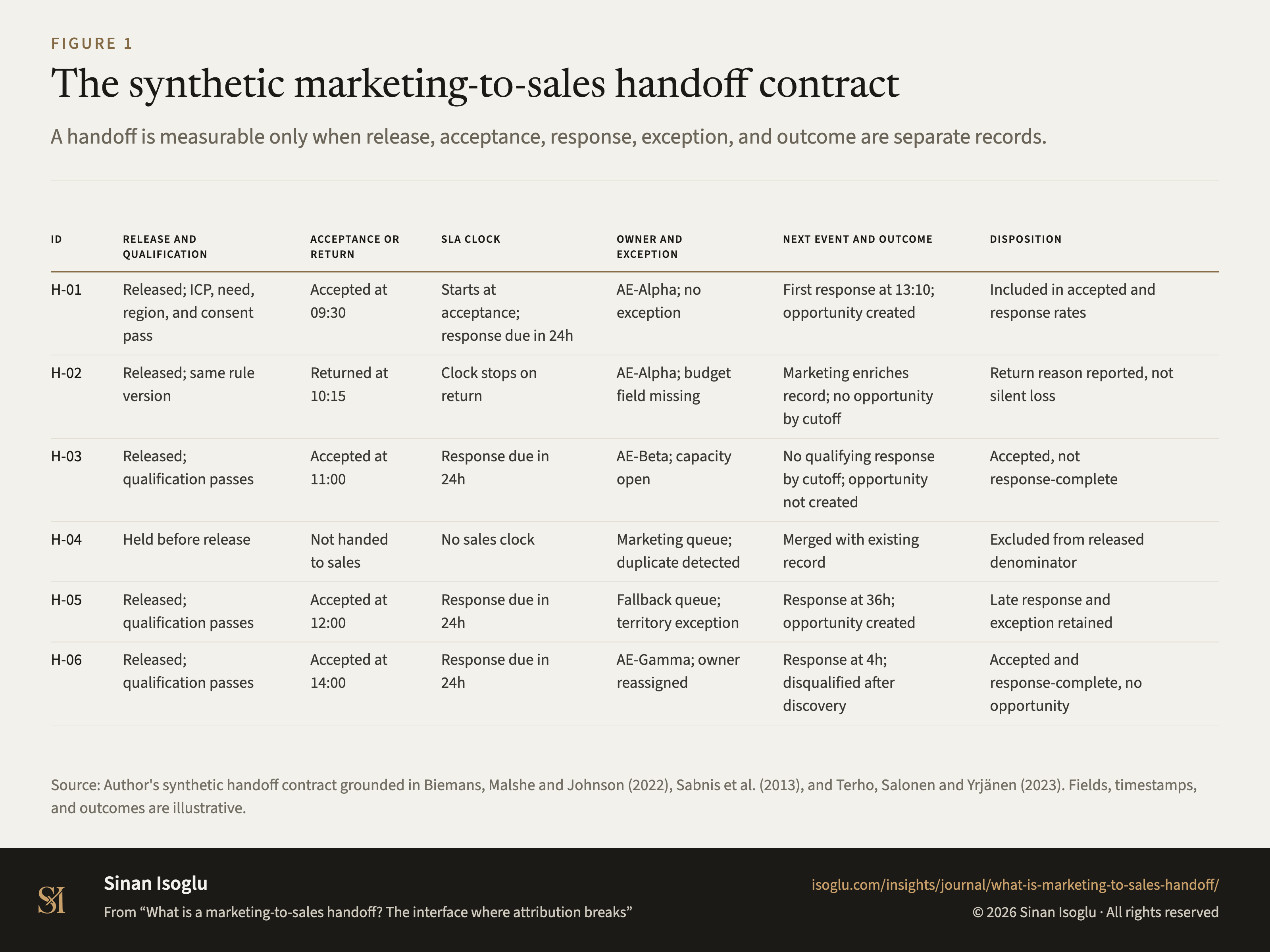
Der synthetische Übergabevertrag von Marketing an Vertrieb
Eine Übergabe ist erst messbar, wenn Freigabe, Annahme, Reaktion, Ausnahme und Ergebnis getrennt dokumentiert sind.
Abbildung 1Der synthetische Übergabevertrag von Marketing an Vertrieb
| ID | Freigabe und Qualifikation | Annahme oder Rückgabe | SLA-Uhr | Verantwortlicher und Ausnahme | Folgeereignis und Ergebnis | Einordnung |
|---|---|---|---|---|---|---|
| H-01 | Freigegeben; ICP, Bedarf, Region und Einwilligung erfüllt | Um 09:30 angenommen | Beginn bei Annahme; Reaktion in 24 h | AE-Alpha; keine Ausnahme | Erstreaktion um 13:10; Opportunity erstellt | In Annahme- und Reaktionsrate enthalten |
| H-02 | Freigegeben; gleiche Regelversion | Um 10:15 zurückgegeben | Uhr stoppt bei Rückgabe | AE-Alpha; Budgetfeld fehlt | Marketing ergänzt Datensatz; bis Stichtag keine Opportunity | Rückgabegrund berichtet, kein stiller Verlust |
| H-03 | Freigegeben; Qualifikation erfüllt | Um 11:00 angenommen | Reaktion in 24 h | AE-Beta; Kapazität offen | Bis Stichtag keine qualifizierende Reaktion; keine Opportunity | Angenommen, nicht reaktionsvollständig |
| H-04 | Vor Freigabe gehalten | Nicht an Vertrieb übergeben | Keine Vertriebsuhr | Marketing-Queue; Duplikat erkannt | Mit bestehendem Datensatz zusammengeführt | Aus dem Freigabenenner ausgeschlossen |
| H-05 | Freigegeben; Qualifikation erfüllt | Um 12:00 angenommen | Reaktion in 24 h | Fallback-Queue; Gebiets-Ausnahme | Reaktion nach 36 h; Opportunity erstellt | Späte Reaktion und Ausnahme bleiben sichtbar |
| H-06 | Freigegeben; Qualifikation erfüllt | Um 14:00 angenommen | Reaktion in 24 h | AE-Gamma; Verantwortlicher gewechselt | Reaktion nach 4 h; nach Prüfung disqualifiziert | Angenommen und reaktionsvollständig, keine Opportunity |
Bei breiten Tabellen horizontal wischen oder scrollen.
Quelle: Synthetische Übergabetabelle des Autors, begrenzt durch Biemans, Malshe und Johnson (2022), Sabnis et al. (2013) sowie Terho, Salonen und Yrjänen (2023). Felder, Zeitstempel und Ergebnisse sind illustrativ.
Quelle und Evidenz
Jede Zeile nennt eine Aussage zu dieser Abbildung, ihre Quelle und die Art ihrer Prüfung.
- A BMJ22-C1 The review's own count: "we identify 73 articles" about the sales-marketing interface, published 1990 through 2021Biemans, Malshe & Johnson. (2022)
- A BMJ22-C2 The coding scheme, in the review's words: "structural linkages refer to the horizontal platforms or interaction" channels established for interdepartmental activity, alongside role linkages, interactions and perceptionsBiemans, Malshe & Johnson. (2022)
- A SCCL13-C1 The sample, from the paper: "we received 562 surveys for a response rate of" 21.08%, "we retained 500 usable responses", and the analysis uses "data from 461 sales reps from four firms". The 70% in the same abstract is guarded by FUN-X1 and never travels with this rowSabnis et al. (2013)
- A SCCL13-C5 Time allocation is the mechanism: "the proportion of time that sales reps devote to marketing leads depends on organizational lead prequalification"Sabnis et al. (2013)
- A TSY23-C1 "the sales development processes relating to lead research engagement and handover are conducted in four distinct application contexts" to qualify leads for the outside salesforceTerho, Salonen & Yrjänen. (2023)
- A TSY23-C3 The four contexts are named: "sales development processes can be applied in outbound prospect focused outbound account based inbound prospect focused and inbound account based lead management contexts", and the processes "vary depending on the nature of the l"eadTerho, Salonen & Yrjänen. (2023)
- B V08-OWN-C1 A marketing-to-sales handoff is a dated interface where one owner releases a qualified work object and another owner accepts, returns, or holds itAuthor framework grounded in BMJ22-C1, SCCL13-C1, and TSY23-C1
- B V08-OWN-C3 Handoff acceptance is accepted released records divided by released records under the declared scopeAuthor formula set
- B V08-OWN-C6 Handoff latency and response completion describe interface operation and do not by themselves prove attribution or conversion causalityAuthor negative boundary
- A V08-OWN-C9 Sabnis et al. analyze marketing-lead follow-up in relation to lead quality, volume, tracking, experience, performance, and compensation contextSCCL13-C1 to SCCL13-C5
Prüfgrade: A, gegen die gedruckte Seite der Primärquelle geprüft · B, Primärquelle, nur Textebene · C, belastbare Sekundärquelle · D, berichtet.
Aus dem Beitrag
Revenue Operations & KI
Was ist die Übergabe von Marketing an Vertrieb? Die Schnittstelle, an der Attribution bricht
Eine Übergabe von Marketing an Vertrieb ist eine datierte Release- und Annahmeschnittstelle. Benennen Sie Qualifikation, SLA, Ausnahme und Ergebnis.
Den Beitrag lesenDiese Abbildung gehört zu einem Essay: Die Zahlen stehen hier, das Argument dort.
Zitieren oder einbetten
Verwandte Abbildungen
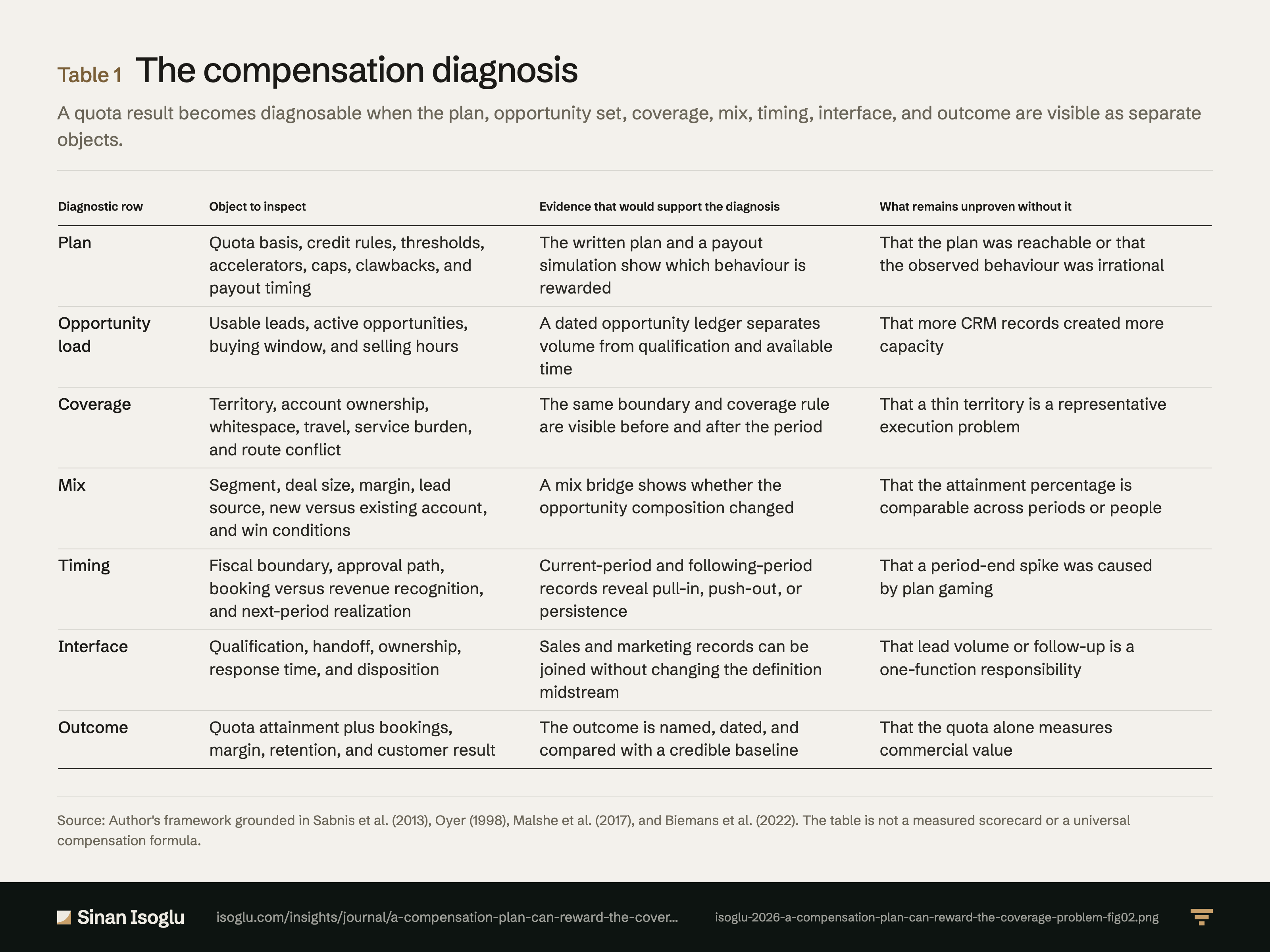
Tabelle 1Tabelle
Die Vergütungsdiagnose
Ein Vergütungsplan kann das Abdeckungsproblem belohnen, das er erzeugt hat
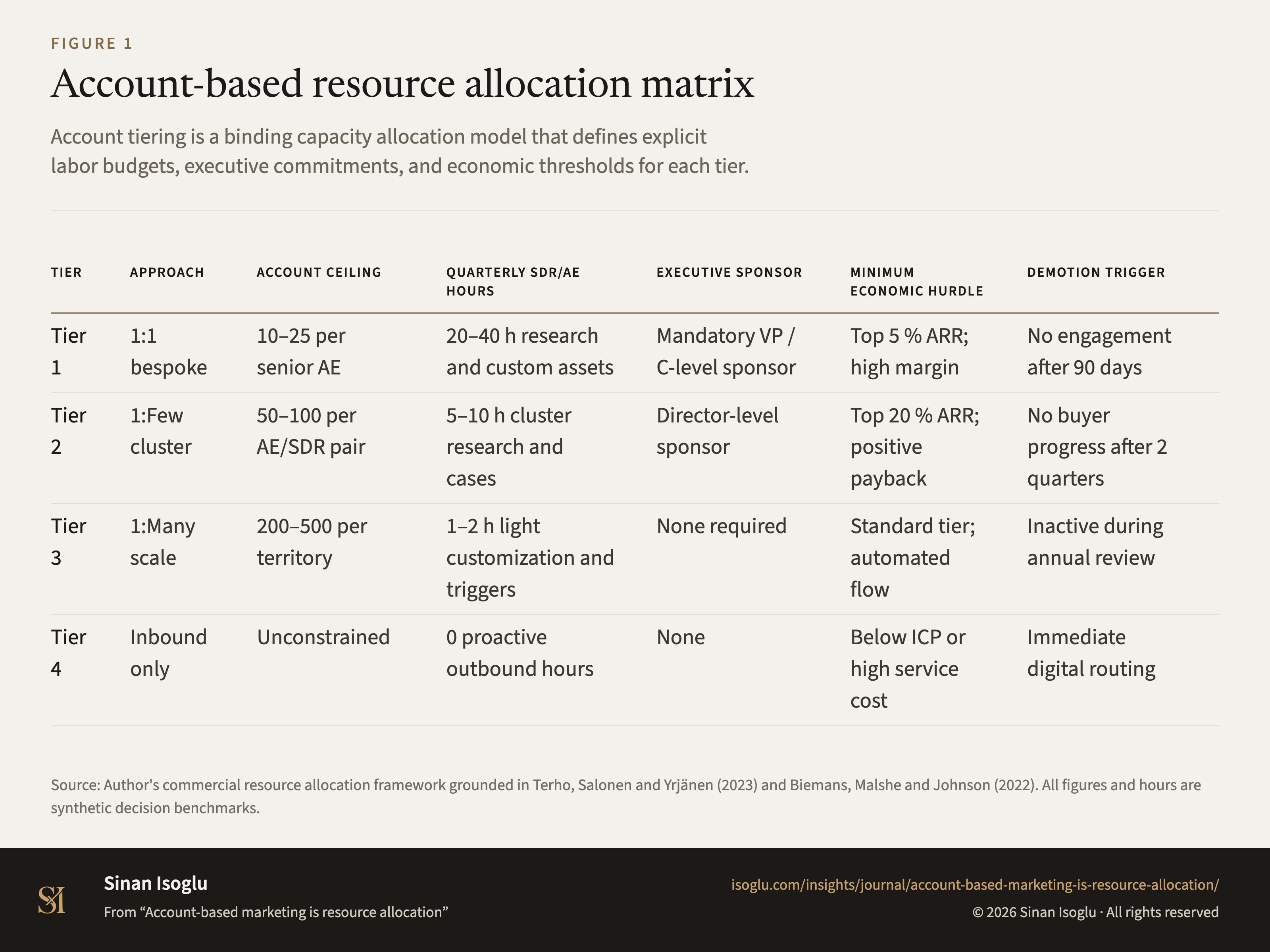
Abbildung 1Grafik
Ressourcenallokationsmatrix für Account-based Marketing
Account-based Marketing ist Ressourcenallokation

Tabelle 1Tabelle
Die Ursachenmatrix der Quotenerreichung
Quotenerreichung hat mehr als eine Ursache
Kontakt
Schicken Sie die Frage, an der Sie arbeiten.
Forschung, ein Gastvortrag oder eine Frage aus der Praxis.