Figure 1From “What is a nudge?”
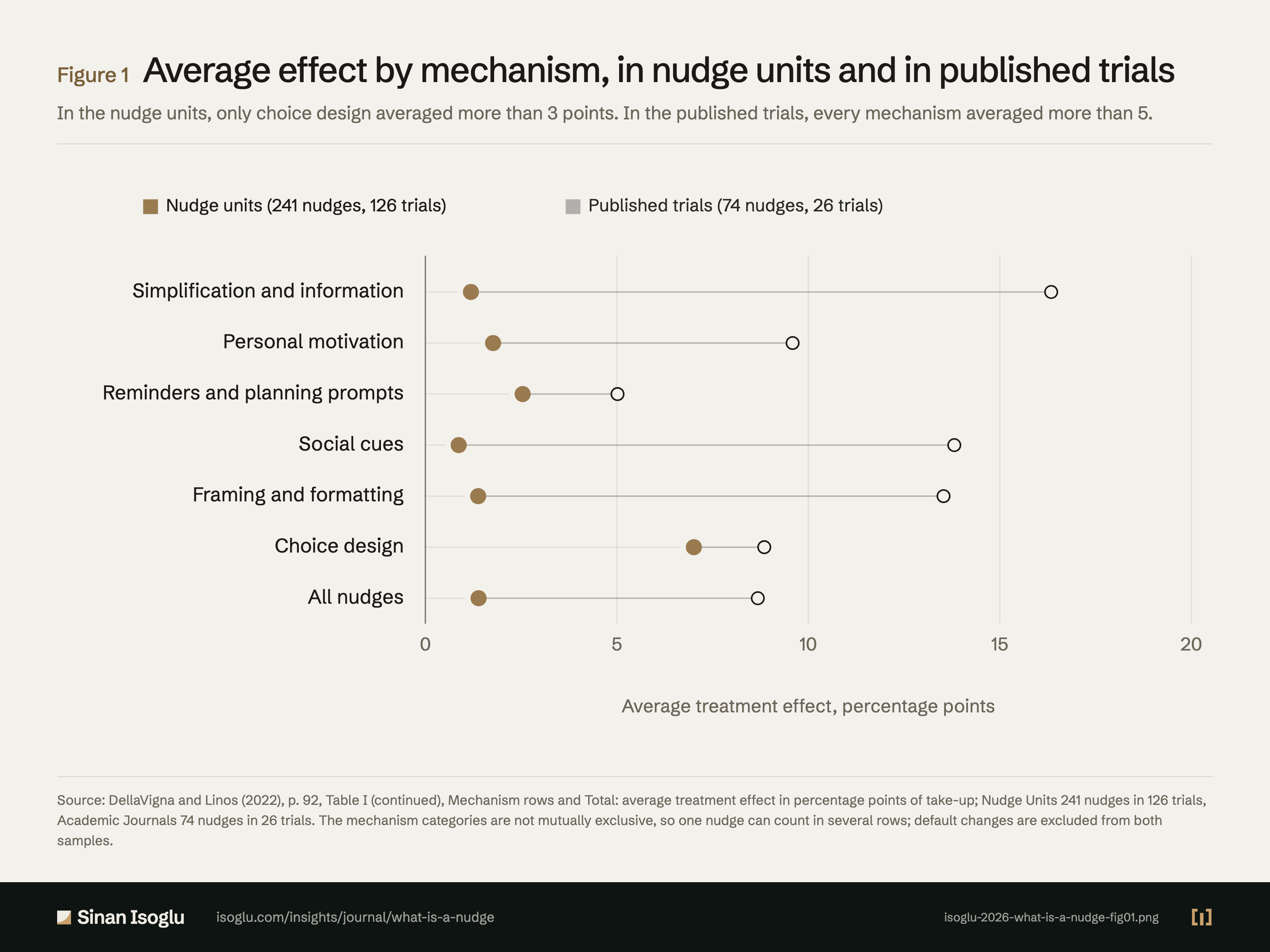
Average effect by mechanism, in nudge units and in published trials
In the nudge units, only choice design averaged more than 3 points. In the published trials, every mechanism averaged more than 5.
Figure 1Average effect by mechanism, in nudge units and in published trials
Source: DellaVigna and Linos (2022), p. 92, Table I (continued), Mechanism rows and Total: average treatment effect in percentage points of take-up; Nudge Units 241 nudges in 126 trials, Academic Journals 74 nudges in 26 trials. The mechanism categories are not mutually exclusive, so one nudge can count in several rows; default changes are excluded from both samples.
Source and evidence
Each line names a claim related to this exhibit, its source, and how it was checked.
- A DELLAVIGNA22-C7 Nudges coded by policy area, communication channel and behavioural mechanism; six mechanisms at the units (simplification of a letter or notice; personal motivation, such as personalizing or loss aversion; implementation intentions or planning prompts; social cues or norms; framing or formatting; active choice or salience), filed in Table I as simplification and information, personal motivation, reminders and planning prompts, social cues, framing and formatting, choice design; mechanism frequencies not mutually exclusive; 1.5 mechanisms per arm in the published sample against 2.2 at the units; units' contact mostly by email, letter or postcard, in-person contact common in the published sample; examples: a simplified, personalized re-enrolment email with loss framing and clear action steps, enrolment in AutoPay and e-bill, payment of utility fines and sewer bills. Table I (p. 92, read from the page image), average treatment effect in percentage points, Nudge Units then Academic Journals, nudges (trials) in brackets: simplification and information 1.19 (141, 73) and 16.34 (4, 2); personal motivation 1.77 (138, 76) and 9.59 (24, 9); reminders and planning prompts 2.54 (76, 49) and 5.02 (26, 11); social cues 0.87 (88, 58) and 13.81 (16, 7); framing and formatting 1.38 (77, 47) and 13.53 (24, 8); choice design 7.01 (15, 12) and 8.85 (15, 9); total 1.39 (241, 126) and 8.68 (74, 26); no standard errors printed (pp. 86, 89, 90, 92, 97): "We categorize each nudge by its policy area, communication channel, and behavioral mechanisms"; "simplification of a letter or notice"; "drawing on personal motivation such as personalizing the communication or using loss aversion to motivate action"; "using implementation intentions or planning prompts"; "exploiting social cues or building social norms into the communication"; "adjusting framing or formatting of existing communication"; "people towards an active choice or making some choices more salient"; "Frequencies for Medium and Mechanism are not mutually exclusive"; "an average of 1.5, compared to an average of 2.2 in Nudge Unit trials"; "The medium of communication with the treatment group tends to be through email, letter, or postcard in the Nudge Units sample, as opposed to in-person interactions, which are common in the Academic Journals sample."; "the treatment group received a simplified, personalized email with loss framing and clear action steps"; "encouraging utilities customers to enroll in AutoPay and e-bill"; "nudging people to pay fines after being delinquent on a utility payment"; "Among the positive outliers are treatments with reminders for a sewer bill payment and emails prompting online AutoPay registration for city bills."DellaVigna & Linos (2022), Econometrica 90(1), 81-116
Grades: A, verified against the printed page of the primary source · B, primary source, text layer only · C, authoritative secondary · D, reported.
From the essay
From the research bench
What is a nudge?
A nudge changes how a choice is presented without removing options or significantly changing incentives. In two US nudge units it averaged 1.4 points.
Read the essayThis exhibit belongs to an essay: the numbers live here, the argument lives there.
Cite or embed
Contact
Bring the question you're working on.
Research, a guest lecture, or a commercial question.