Table 16From “What is growth accounting? Separate new, retained, expanded, and lost revenue”
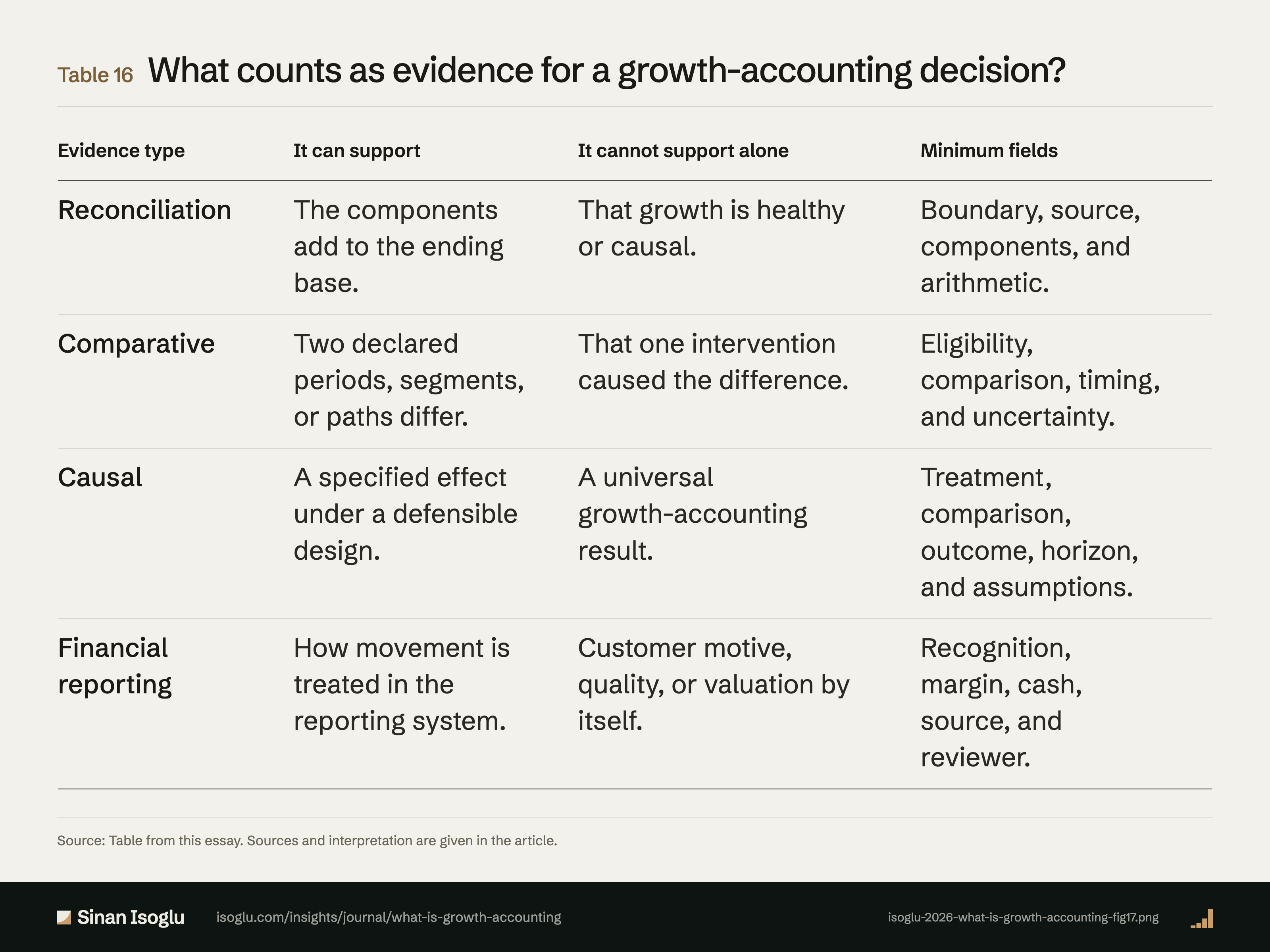
What counts as evidence for a growth-accounting decision?
Table 16What counts as evidence for a growth-accounting decision?
| Evidence type | It can support | It cannot support alone | Minimum fields |
|---|---|---|---|
| Reconciliation | The components add to the ending base. | That growth is healthy or causal. | Boundary, source, components, and arithmetic. |
| Comparative | Two declared periods, segments, or paths differ. | That one intervention caused the difference. | Eligibility, comparison, timing, and uncertainty. |
| Causal | A specified effect under a defensible design. | A universal growth-accounting result. | Treatment, comparison, outcome, horizon, and assumptions. |
| Financial reporting | How movement is treated in the reporting system. | Customer motive, quality, or valuation by itself. | Recognition, margin, cash, source, and reviewer. |
Swipe or scroll horizontally if the table is wider than your screen.
Source: Table from this essay. Sources and interpretation are given in the article.
From the essay
Growth that compounds
What is growth accounting? Separate new, retained, expanded, and lost revenue
Growth accounting reconciles recurring revenue through new, expanded, contracted, and lost components. Keep revenue and customer counts separate.
Read the essayThis exhibit belongs to an essay: the numbers live here, the argument lives there.
Cite or embed
Related exhibits
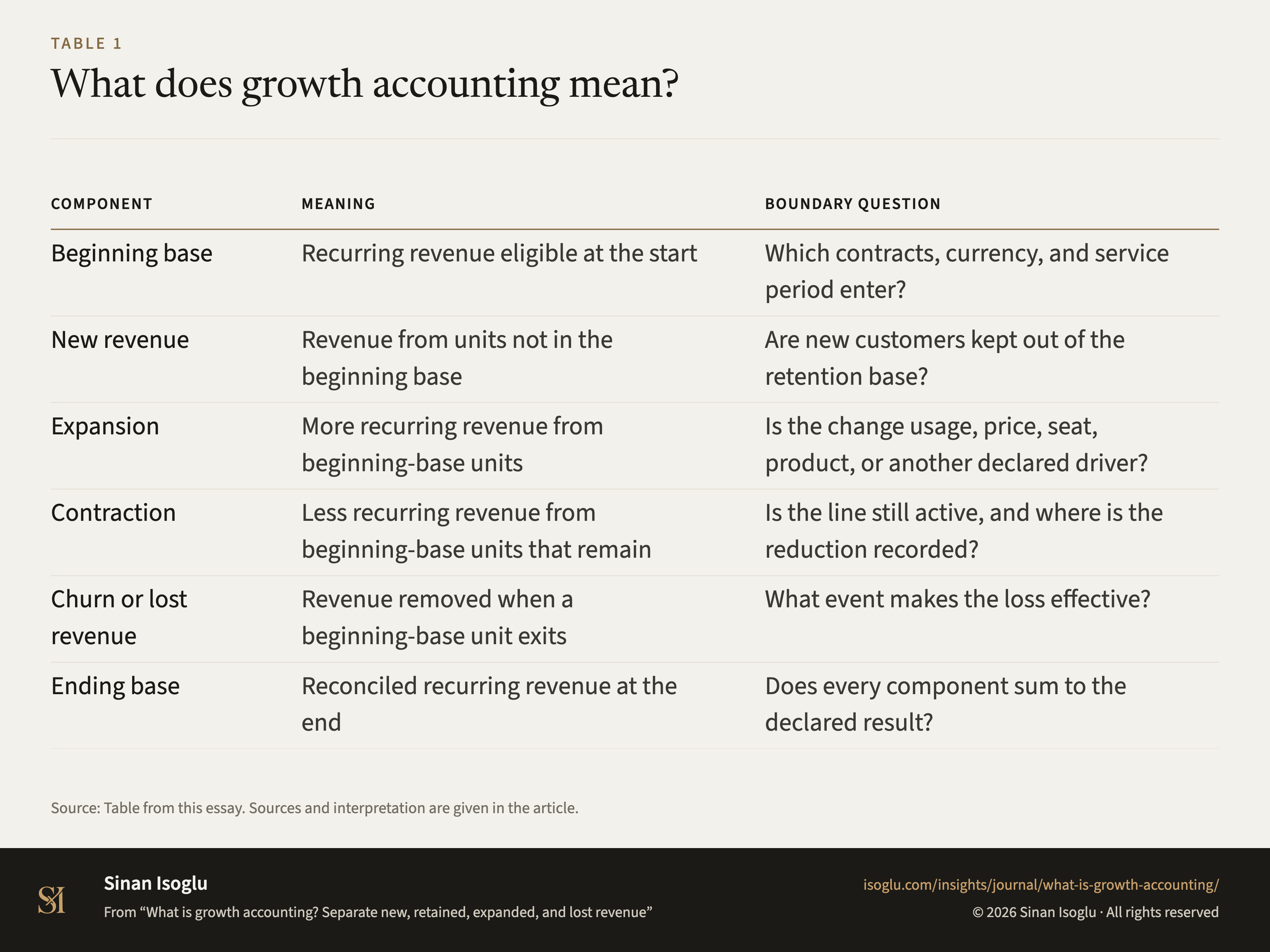
Table 1Table
What does growth accounting mean?
What is growth accounting? Separate new, retained, expanded, and lost revenue
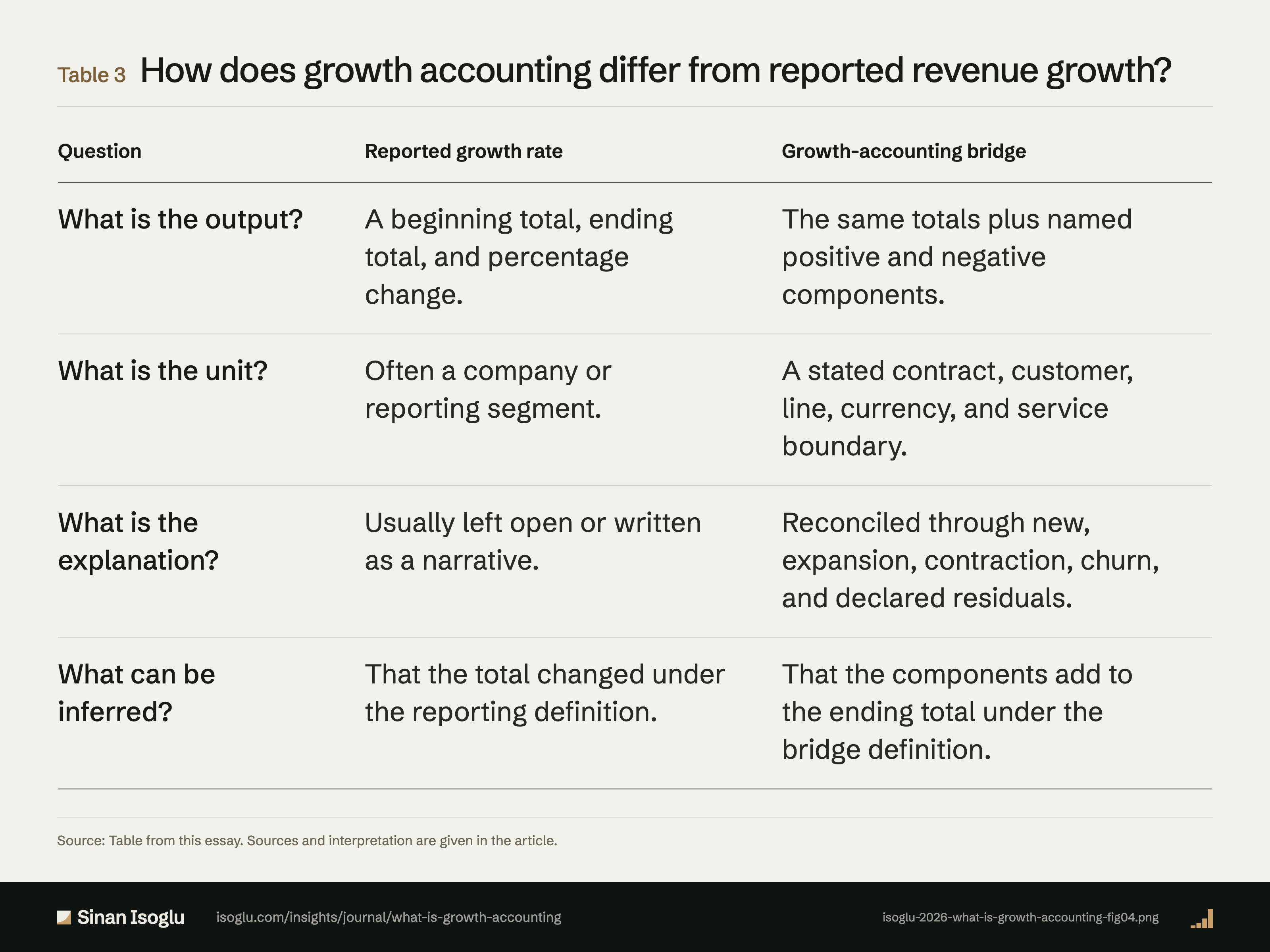
Table 3Table
How does growth accounting differ from reported revenue growth?
What is growth accounting? Separate new, retained, expanded, and lost revenue
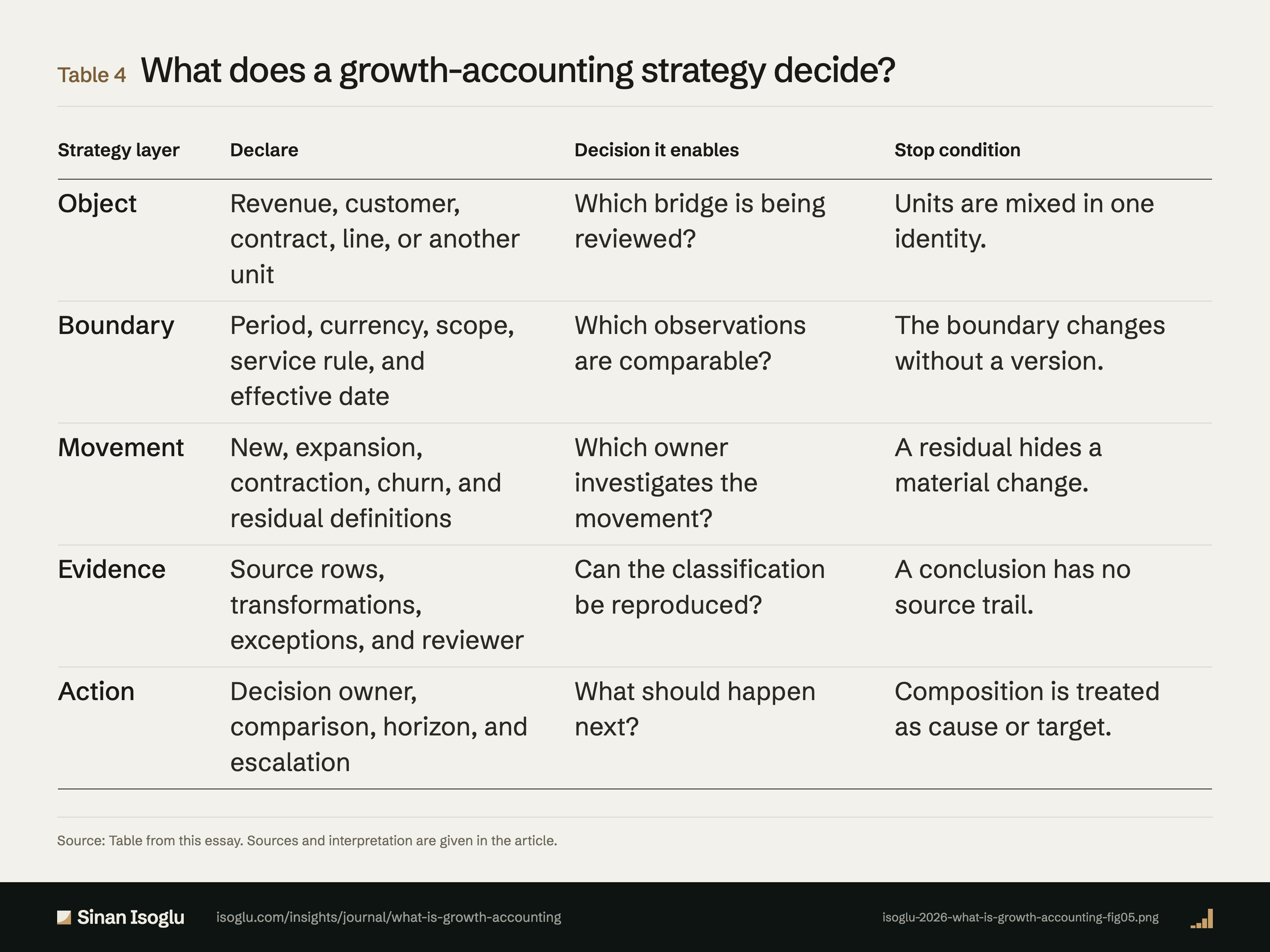
Table 4Table
What does a growth-accounting strategy decide?
What is growth accounting? Separate new, retained, expanded, and lost revenue
Contact
Bring the question you're working on.
Research, a guest lecture, or a commercial question.