Table 4From “What is growth accounting? Separate new, retained, expanded, and lost revenue”
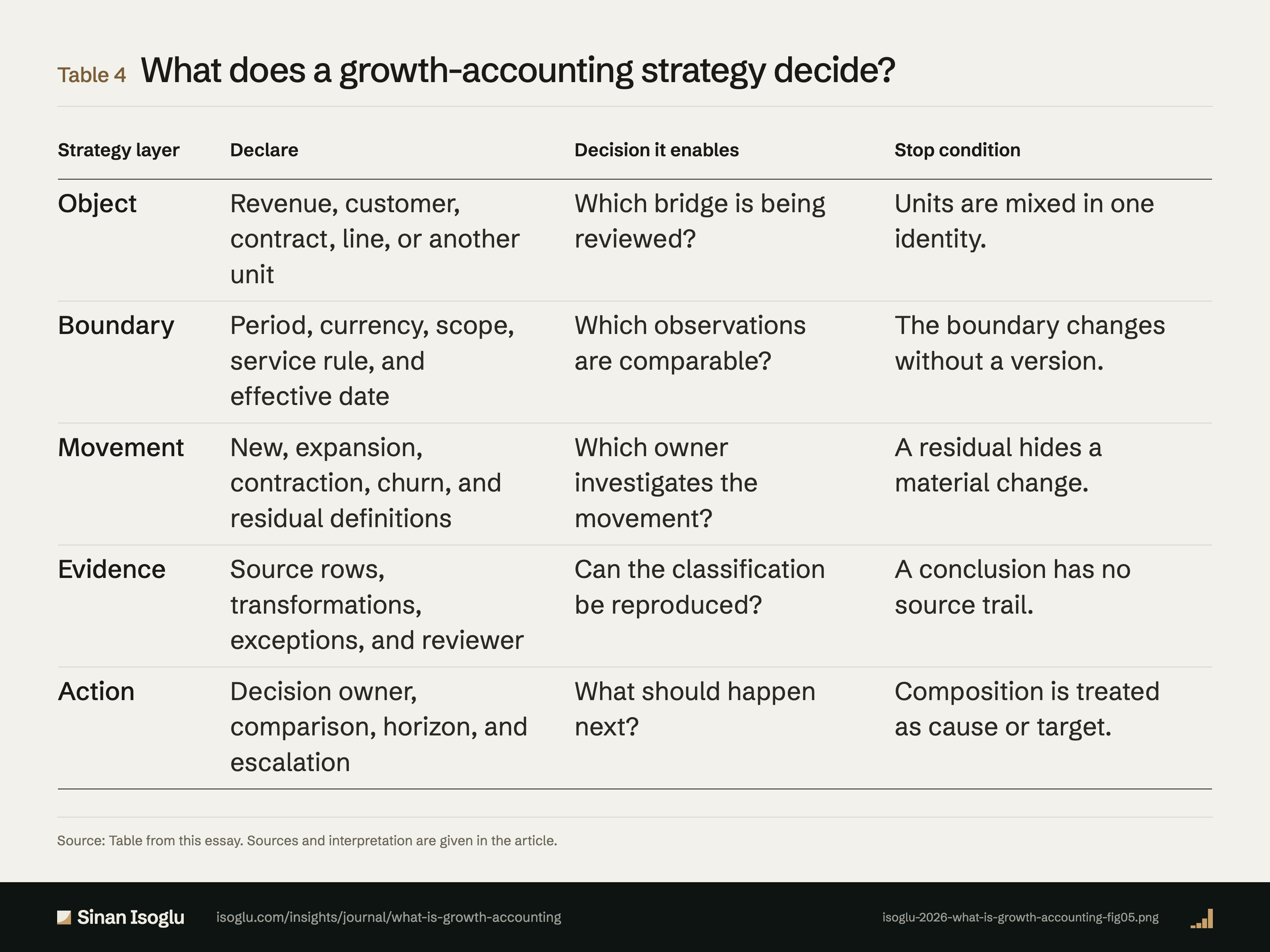
What does a growth-accounting strategy decide?
Table 4What does a growth-accounting strategy decide?
| Strategy layer | Declare | Decision it enables | Stop condition |
|---|---|---|---|
| Object | Revenue, customer, contract, line, or another unit | Which bridge is being reviewed? | Units are mixed in one identity. |
| Boundary | Period, currency, scope, service rule, and effective date | Which observations are comparable? | The boundary changes without a version. |
| Movement | New, expansion, contraction, churn, and residual definitions | Which owner investigates the movement? | A residual hides a material change. |
| Evidence | Source rows, transformations, exceptions, and reviewer | Can the classification be reproduced? | A conclusion has no source trail. |
| Action | Decision owner, comparison, horizon, and escalation | What should happen next? | Composition is treated as cause or target. |
Swipe or scroll horizontally if the table is wider than your screen.
Source: Table from this essay. Sources and interpretation are given in the article.
From the essay
Growth that compounds
What is growth accounting? Separate new, retained, expanded, and lost revenue
Growth accounting reconciles recurring revenue through new, expanded, contracted, and lost components. Keep revenue and customer counts separate.
Read the essayThis exhibit belongs to an essay: the numbers live here, the argument lives there.
Cite or embed
Related exhibits
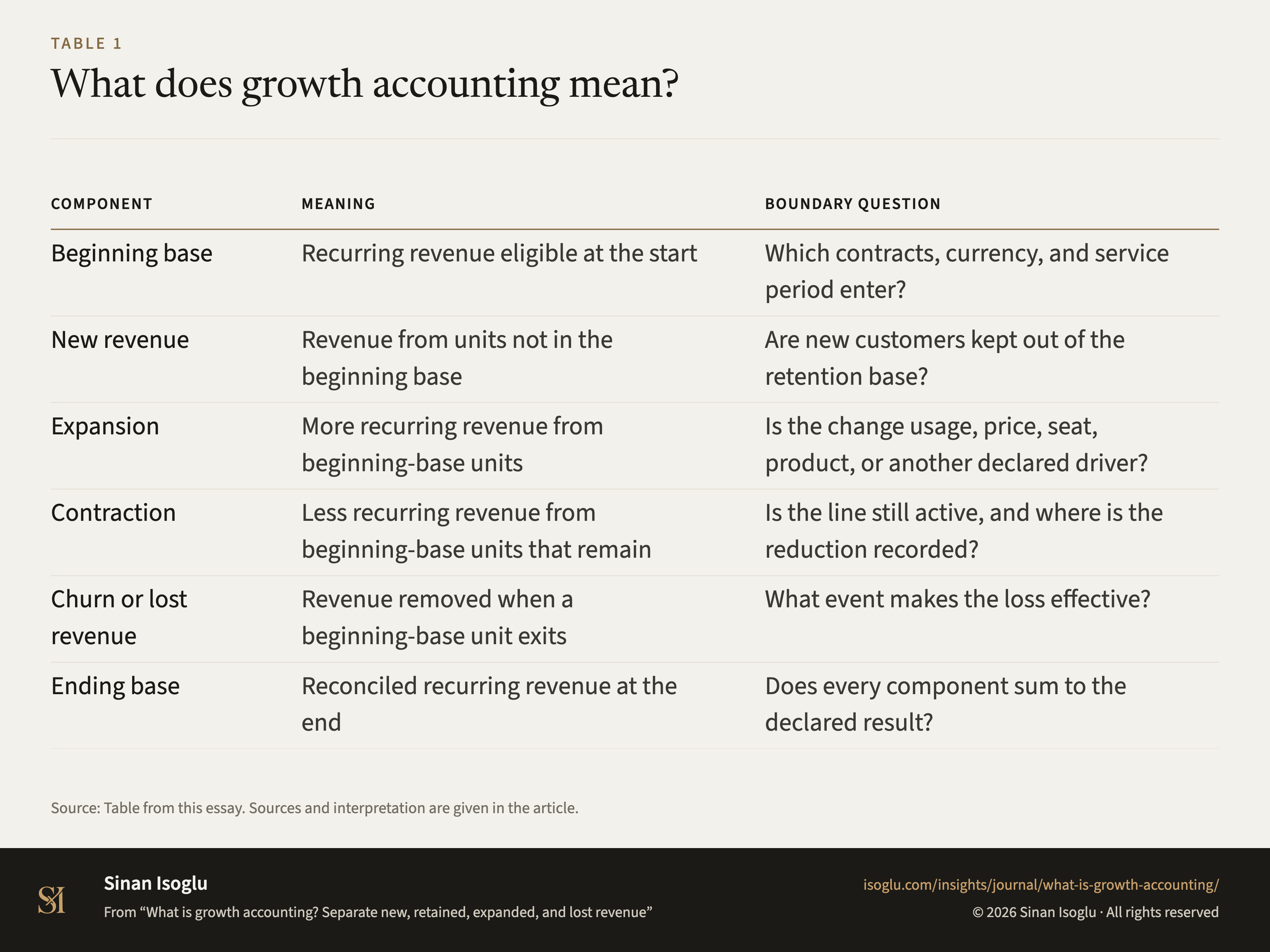
Table 1Table
What does growth accounting mean?
What is growth accounting? Separate new, retained, expanded, and lost revenue
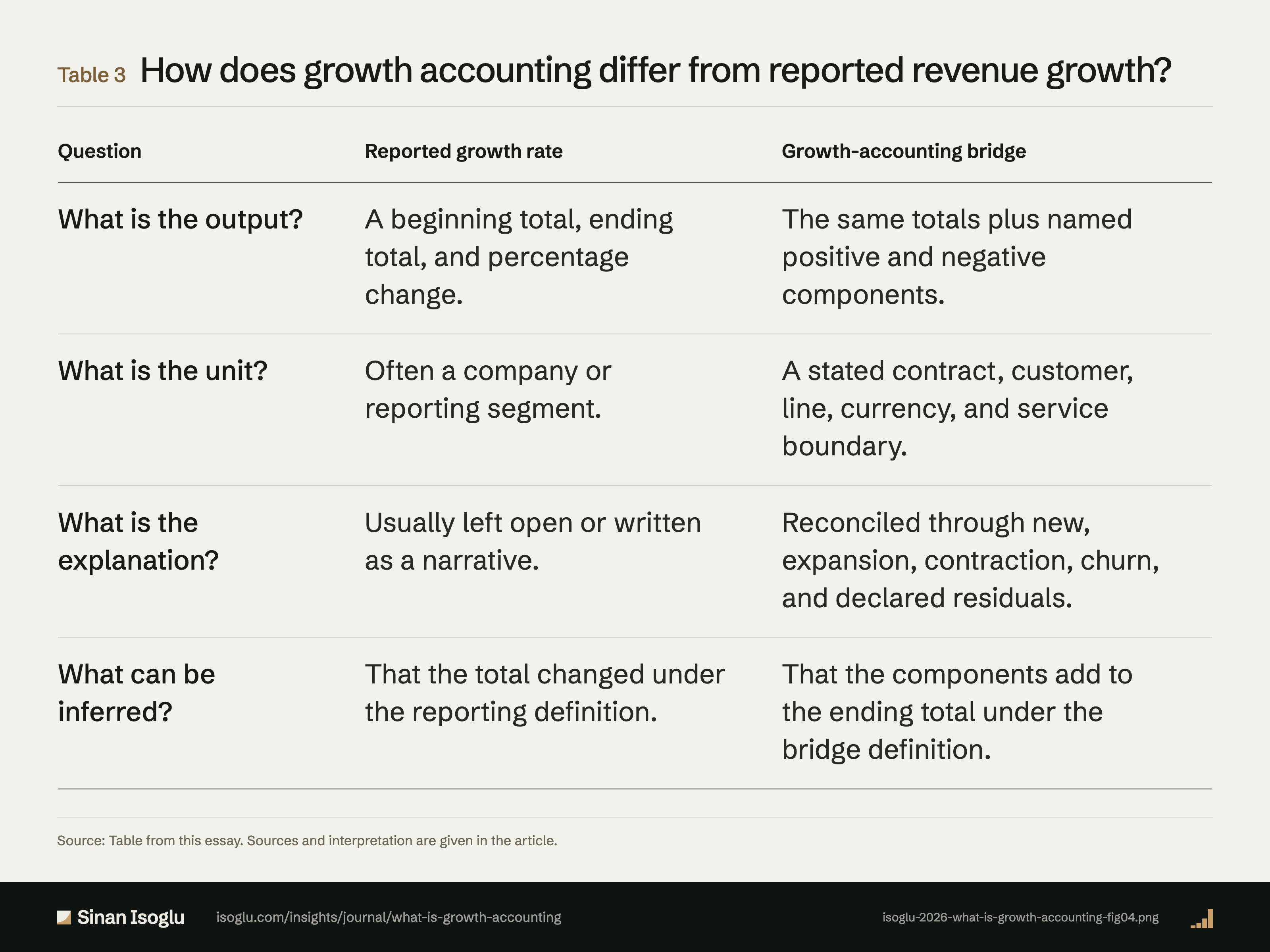
Table 3Table
How does growth accounting differ from reported revenue growth?
What is growth accounting? Separate new, retained, expanded, and lost revenue
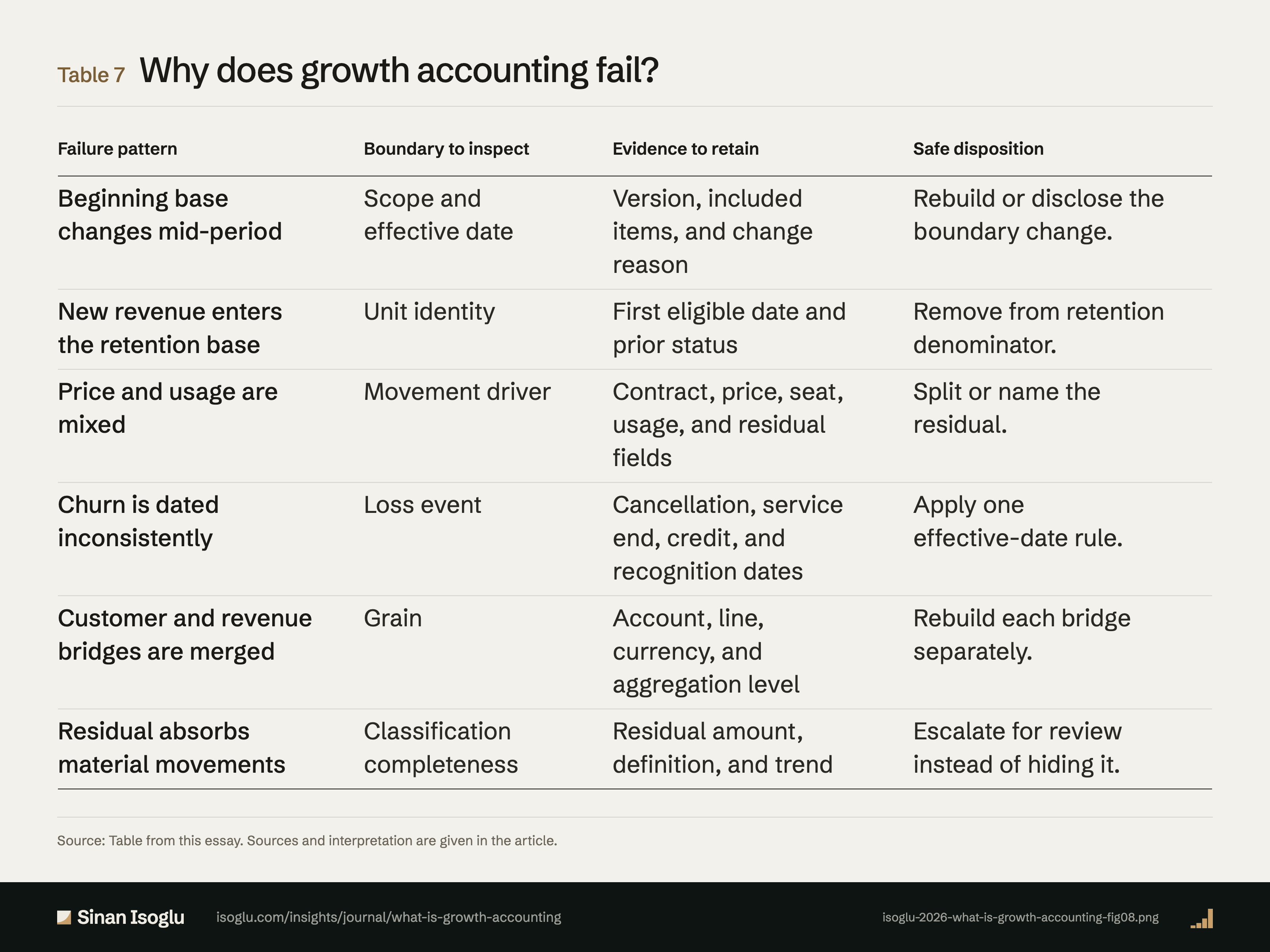
Table 7Table
Why does growth accounting fail?
What is growth accounting? Separate new, retained, expanded, and lost revenue
Contact
Bring the question you're working on.
Research, a guest lecture, or a commercial question.