Table 10From “What is growth accounting? Separate new, retained, expanded, and lost revenue”
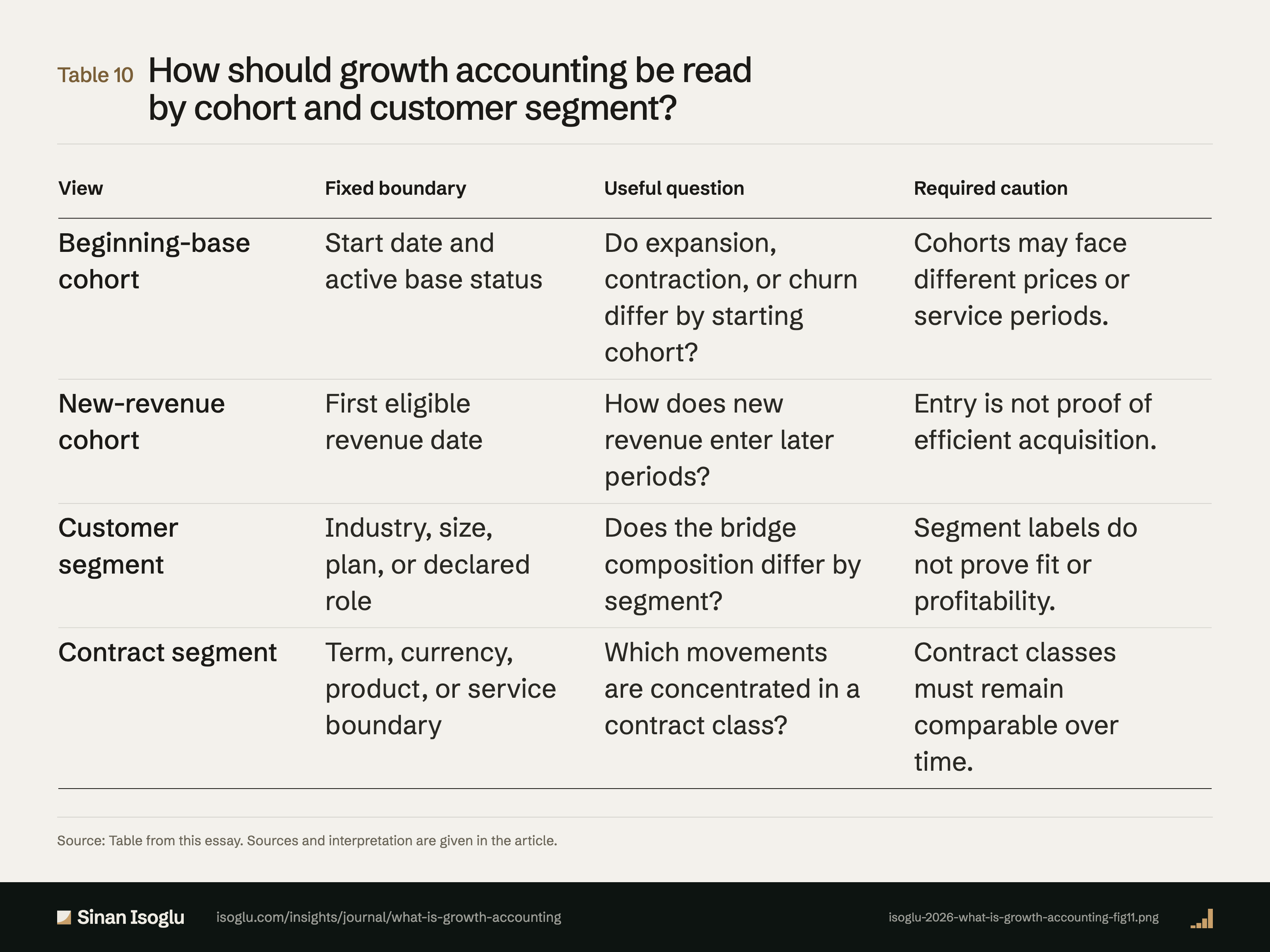
How should growth accounting be read by cohort and customer segment?
Table 10How should growth accounting be read by cohort and customer segment?
| View | Fixed boundary | Useful question | Required caution |
|---|---|---|---|
| Beginning-base cohort | Start date and active base status | Do expansion, contraction, or churn differ by starting cohort? | Cohorts may face different prices or service periods. |
| New-revenue cohort | First eligible revenue date | How does new revenue enter later periods? | Entry is not proof of efficient acquisition. |
| Customer segment | Industry, size, plan, or declared role | Does the bridge composition differ by segment? | Segment labels do not prove fit or profitability. |
| Contract segment | Term, currency, product, or service boundary | Which movements are concentrated in a contract class? | Contract classes must remain comparable over time. |
Swipe or scroll horizontally if the table is wider than your screen.
Source: Table from this essay. Sources and interpretation are given in the article.
From the essay
Growth that compounds
What is growth accounting? Separate new, retained, expanded, and lost revenue
Growth accounting reconciles recurring revenue through new, expanded, contracted, and lost components. Keep revenue and customer counts separate.
Read the essayThis exhibit belongs to an essay: the numbers live here, the argument lives there.
Cite or embed
Related exhibits
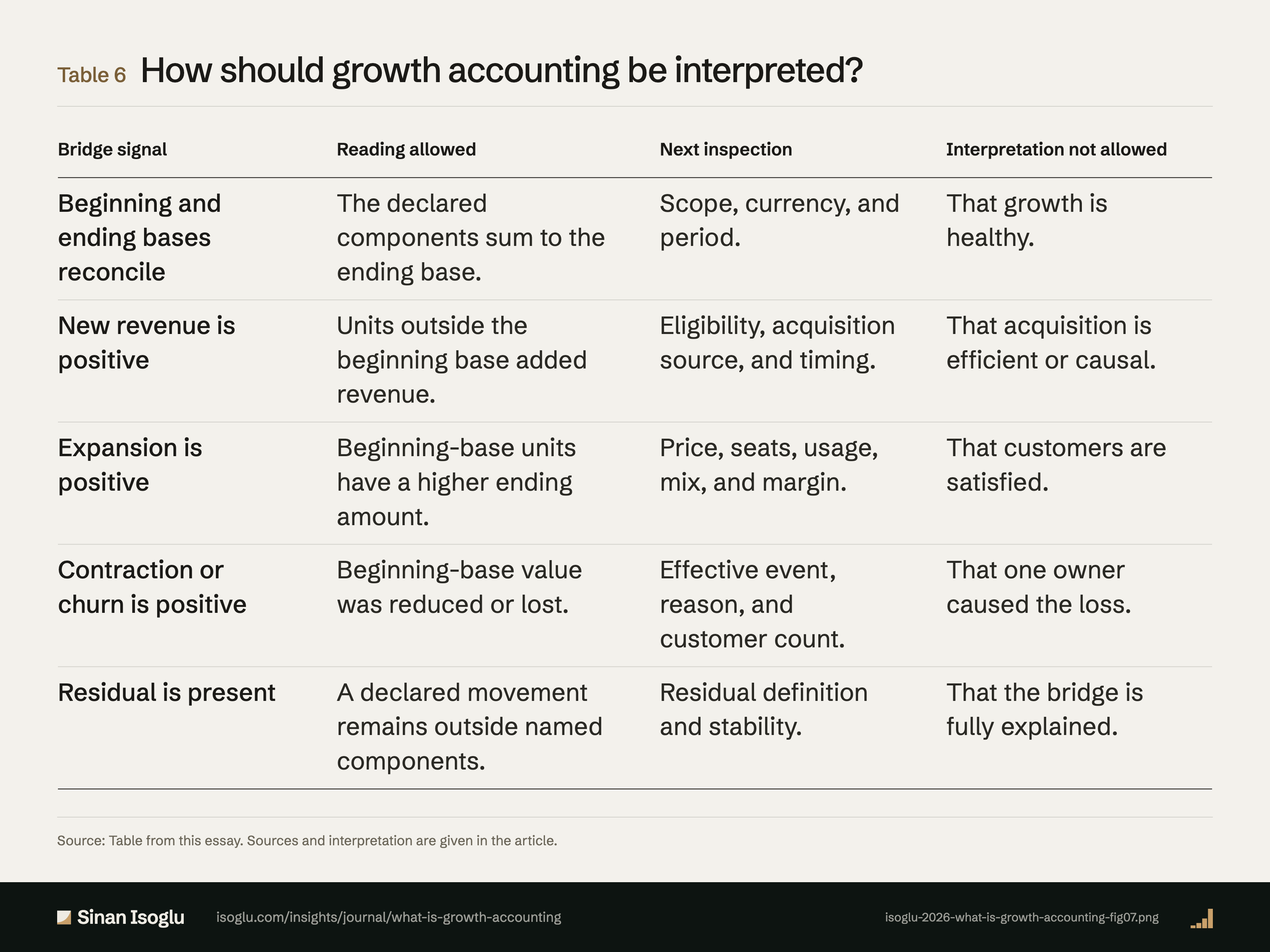
Table 6Table
How should growth accounting be interpreted?
What is growth accounting? Separate new, retained, expanded, and lost revenue
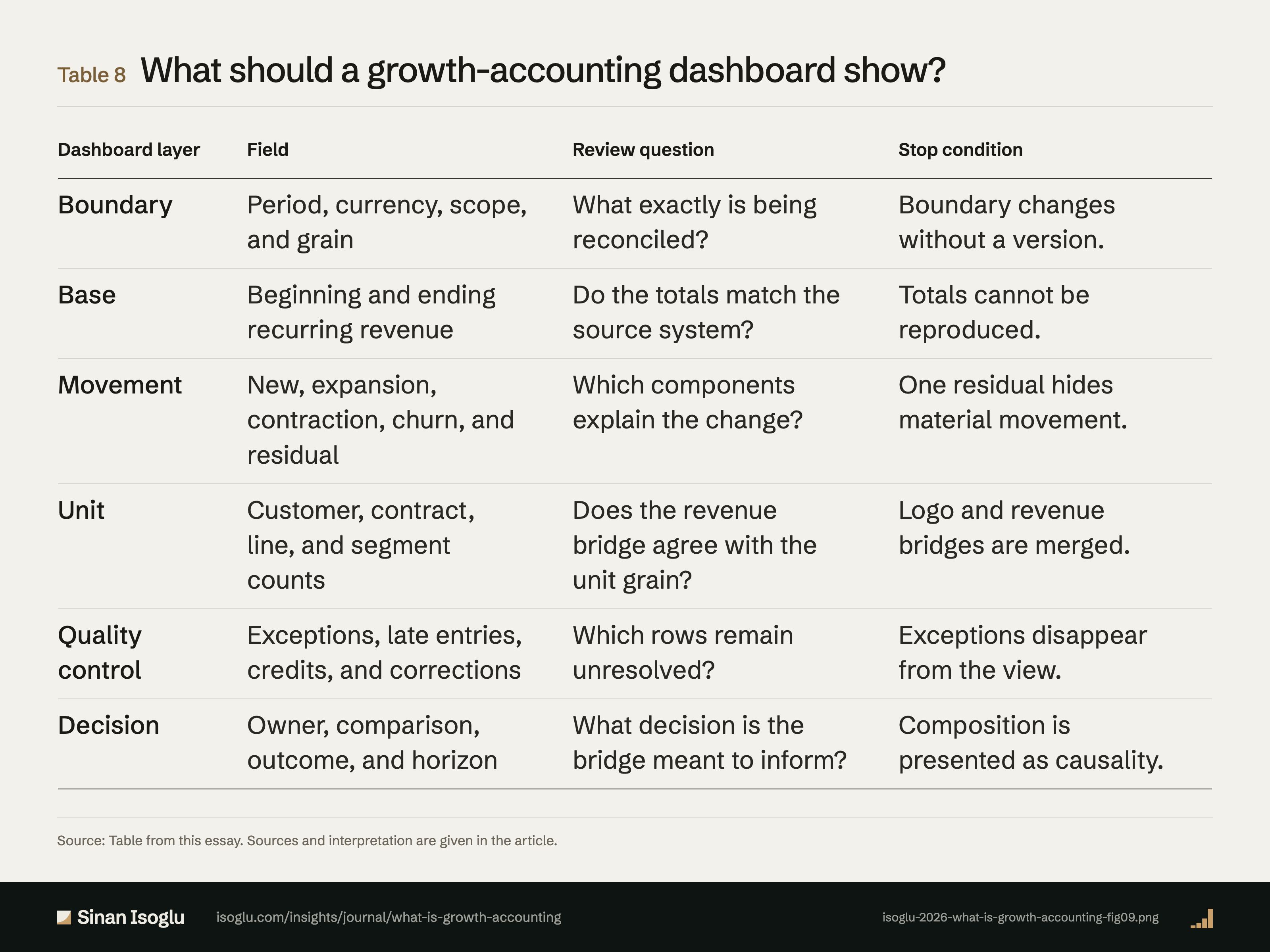
Table 8Table
What should a growth-accounting dashboard show?
What is growth accounting? Separate new, retained, expanded, and lost revenue
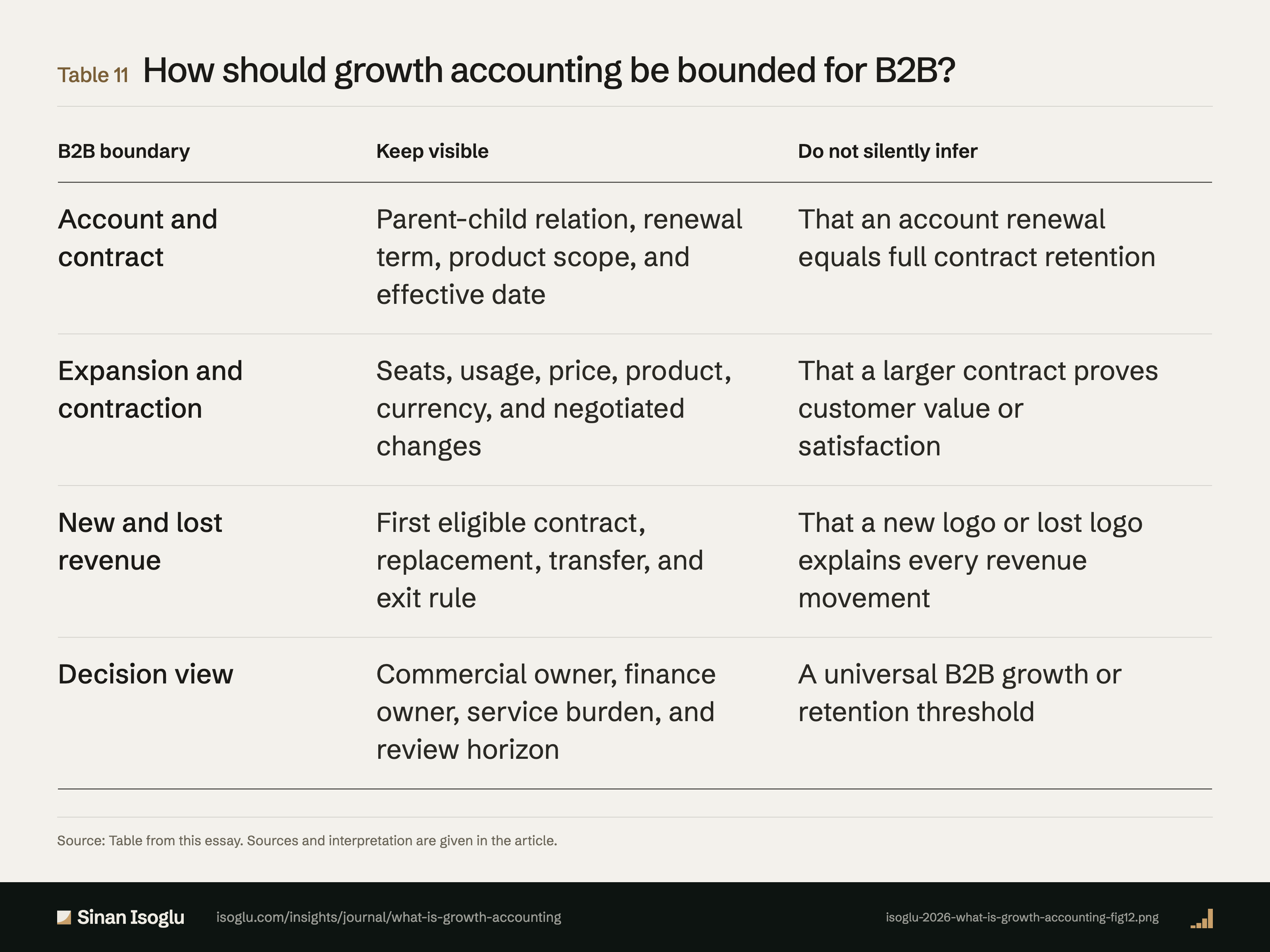
Table 11Table
How should growth accounting be bounded for B2B?
What is growth accounting? Separate new, retained, expanded, and lost revenue
Contact
Bring the question you're working on.
Research, a guest lecture, or a commercial question.