Figure 1From “What is gross revenue retention?”
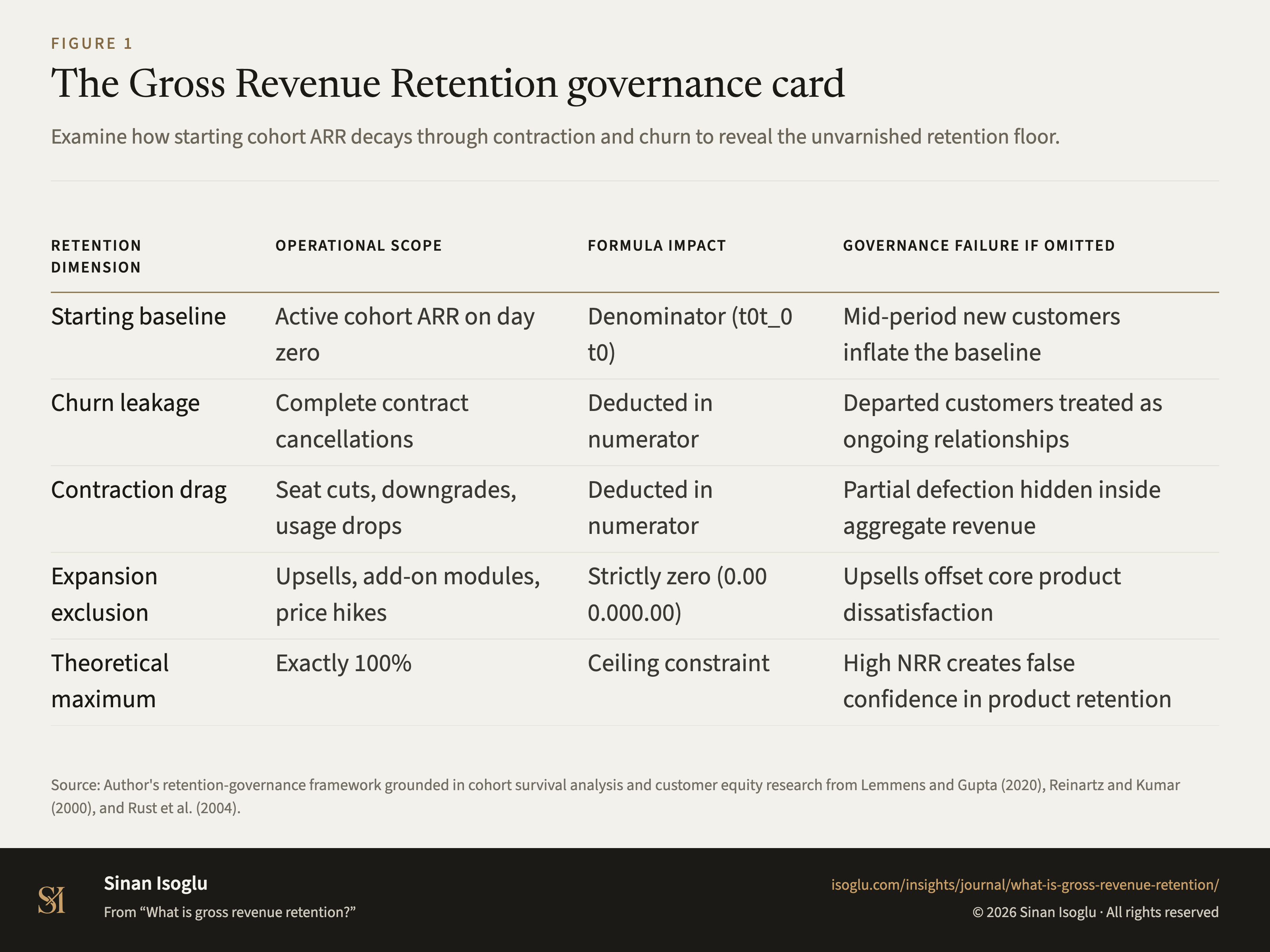
The Gross Revenue Retention governance card
Examine how starting cohort ARR decays through contraction and churn to reveal the unvarnished retention floor.
Figure 1The Gross Revenue Retention governance card
| Retention dimension | Operational scope | Formula impact | Governance failure if omitted |
|---|---|---|---|
| Starting baseline | Active cohort ARR on day zero | Denominator ($t_0$) | Mid-period new customers inflate the baseline |
| Churn leakage | Complete contract cancellations | Deducted in numerator | Departed customers treated as ongoing relationships |
| Contraction drag | Seat cuts, downgrades, usage drops | Deducted in numerator | Partial defection hidden inside aggregate revenue |
| Expansion exclusion | Upsells, add-on modules, price hikes | Strictly zero ($0.00$) | Upsells offset core product dissatisfaction |
| Theoretical maximum | Exactly 100% | Ceiling constraint | High NRR creates false confidence in product retention |
Swipe or scroll horizontally if the table is wider than your screen.
Source: Author's retention-governance framework grounded in cohort survival analysis and customer equity research from Lemmens and Gupta (2020), Reinartz and Kumar (2000), and Rust et al. (2004).
From the essay
Growth that compounds
What is gross revenue retention?
Gross revenue retention measures preserved recurring revenue without expansion. Isolate contraction and churn before expansion masks cohort decay.
Read the essayThis exhibit belongs to an essay: the numbers live here, the argument lives there.
Cite or embed
Related exhibits
Contact
Bring the question you're working on.
Research, a guest lecture, or a commercial question.