Table 3From “What is go-to-market efficiency? The denominator across growth and capacity”
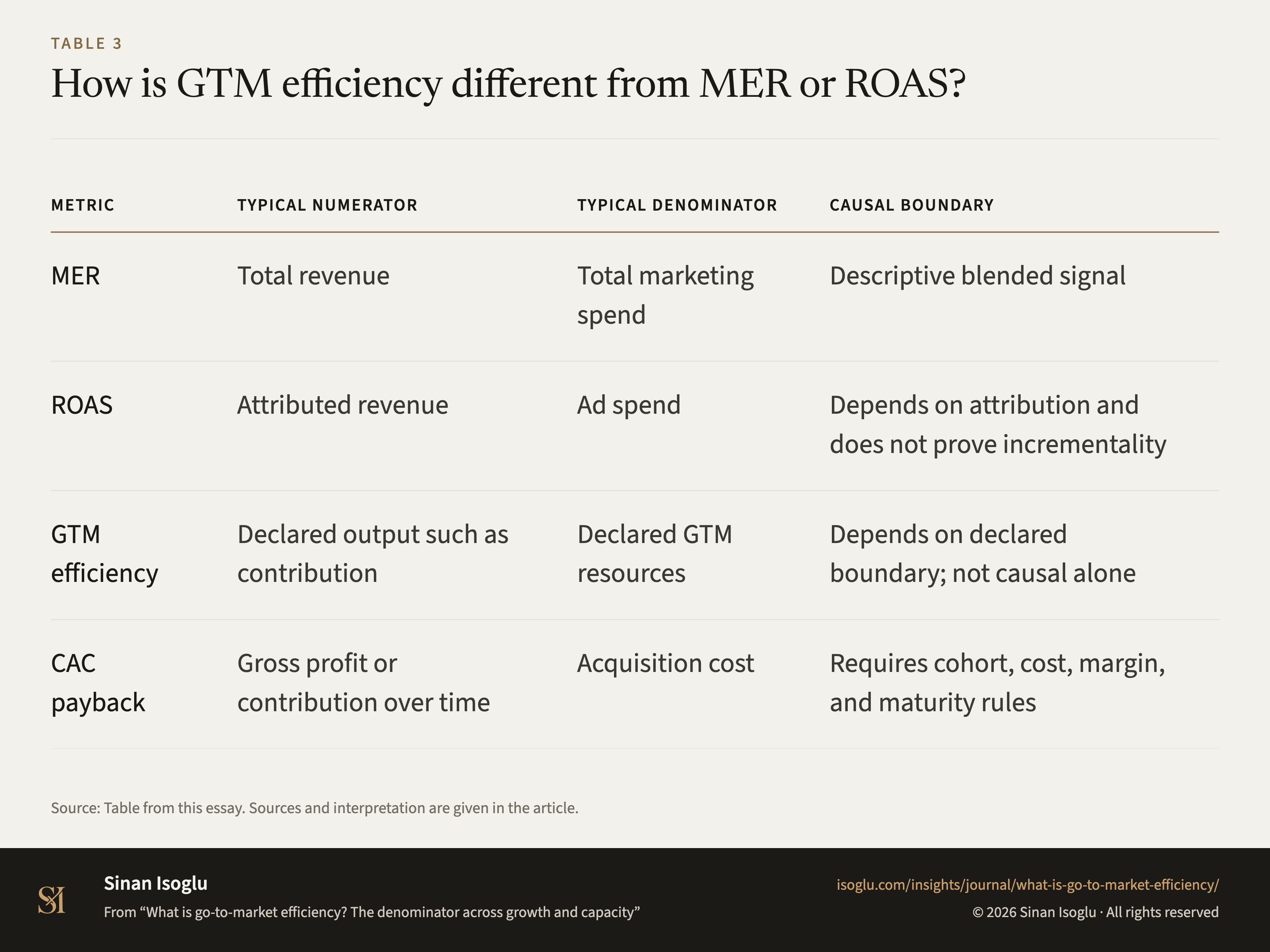
How is GTM efficiency different from MER or ROAS?
Table 3How is GTM efficiency different from MER or ROAS?
| Metric | Typical numerator | Typical denominator | Causal boundary |
|---|---|---|---|
| MER | Total revenue | Total marketing spend | Descriptive blended signal |
| ROAS | Attributed revenue | Ad spend | Depends on attribution and does not prove incrementality |
| GTM efficiency | Declared output such as contribution | Declared GTM resources | Depends on declared boundary; not causal alone |
| CAC payback | Gross profit or contribution over time | Acquisition cost | Requires cohort, cost, margin, and maturity rules |
Swipe or scroll horizontally if the table is wider than your screen.
Source: Table from this essay. Sources and interpretation are given in the article.
From the essay
Growth that compounds
What is go-to-market efficiency? The denominator across growth and capacity
Go-to-market efficiency is a declared output-to-resource ratio. Name output, denominator, maturity, and capacity before comparing motions.
Read the essayThis exhibit belongs to an essay: the numbers live here, the argument lives there.
Cite or embed
Related exhibits
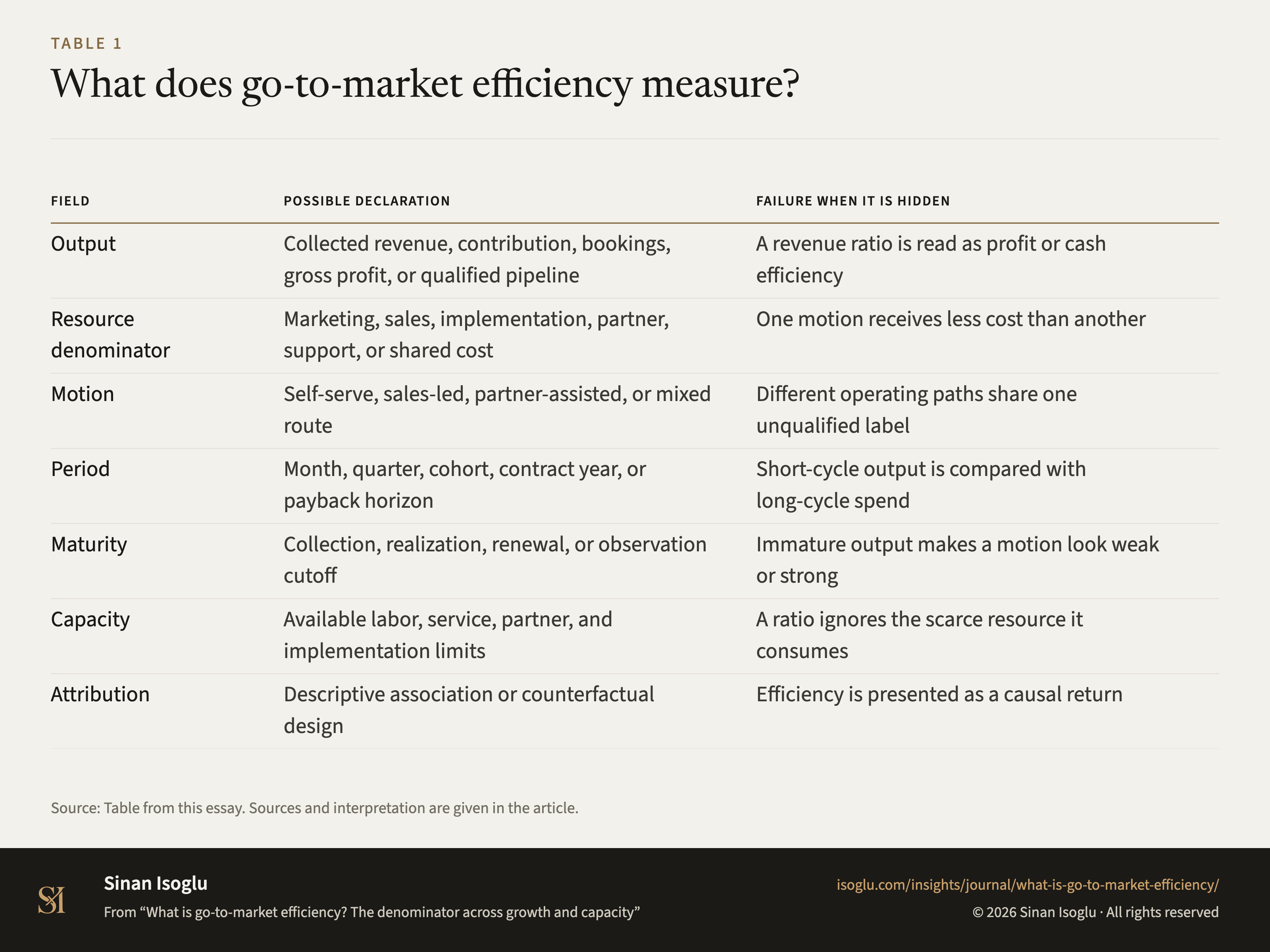
Table 1Table
What does go-to-market efficiency measure?
What is go-to-market efficiency? The denominator across growth and capacity
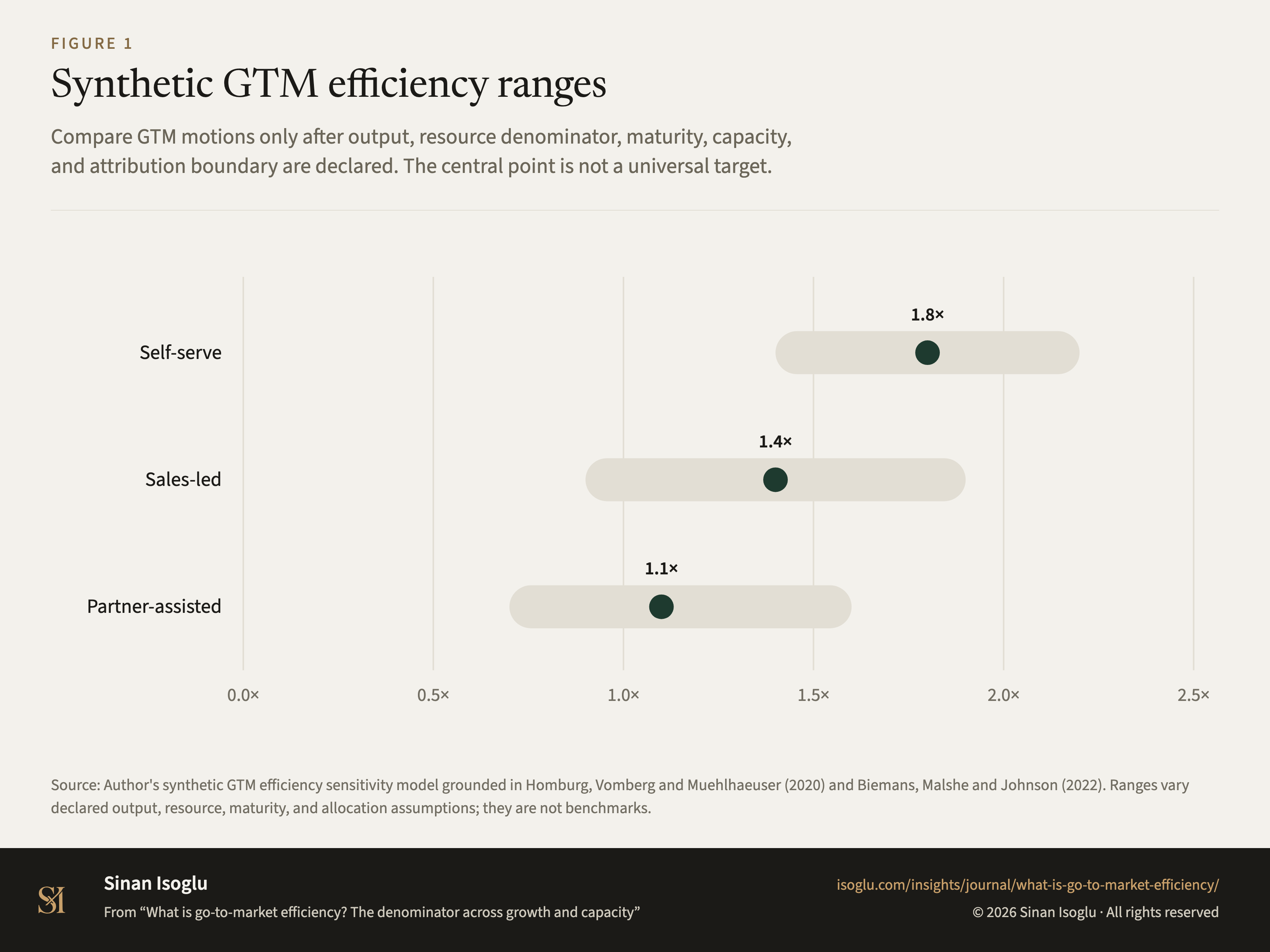
Figure 1Figure
Synthetic GTM efficiency ranges
What is go-to-market efficiency? The denominator across growth and capacity
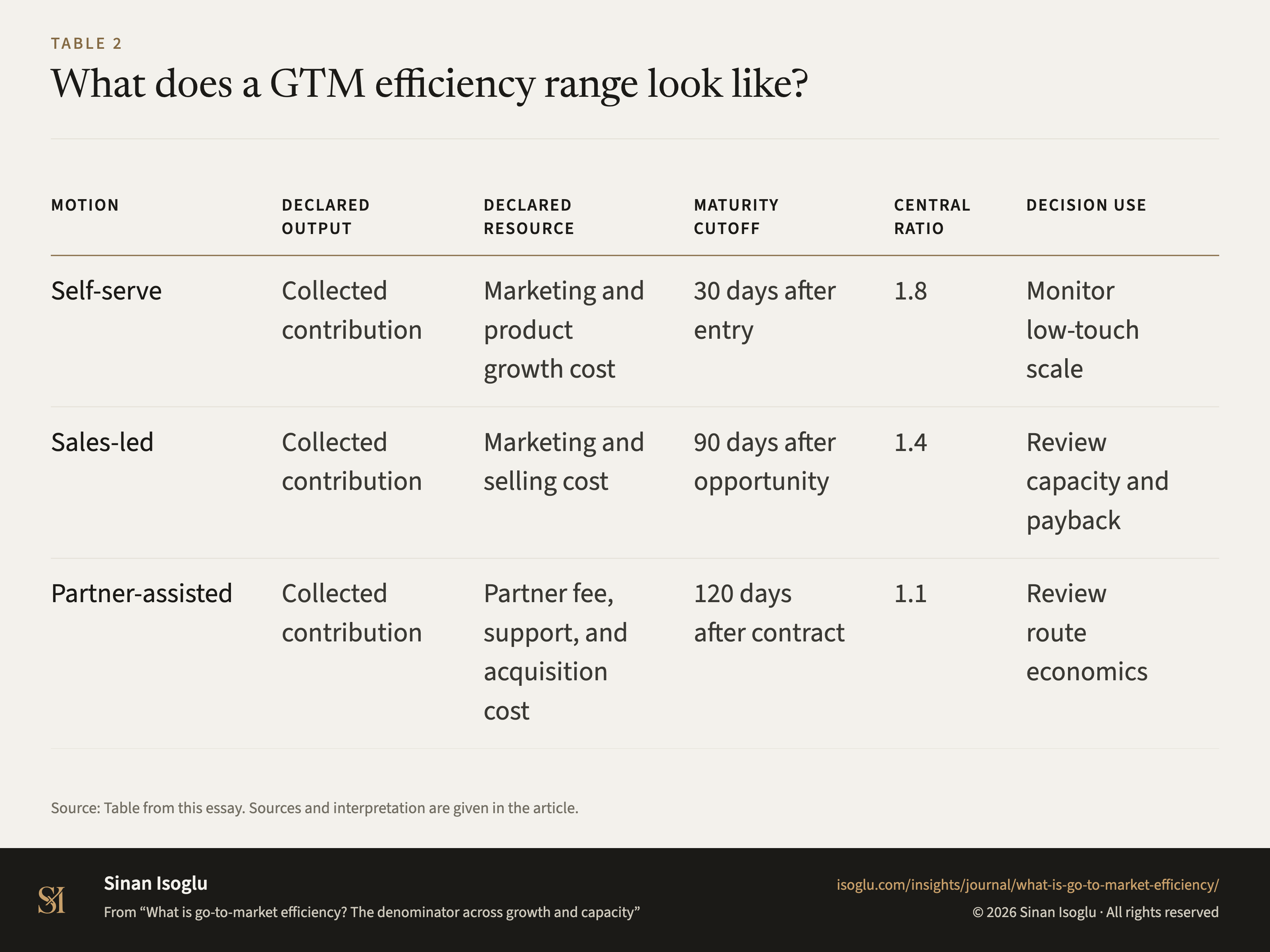
Table 2Table
What does a GTM efficiency range look like?
What is go-to-market efficiency? The denominator across growth and capacity
Contact
Bring the question you're working on.
Research, a guest lecture, or a commercial question.