Table 1From “What is cohort analysis? A stable entry event before a retention curve”
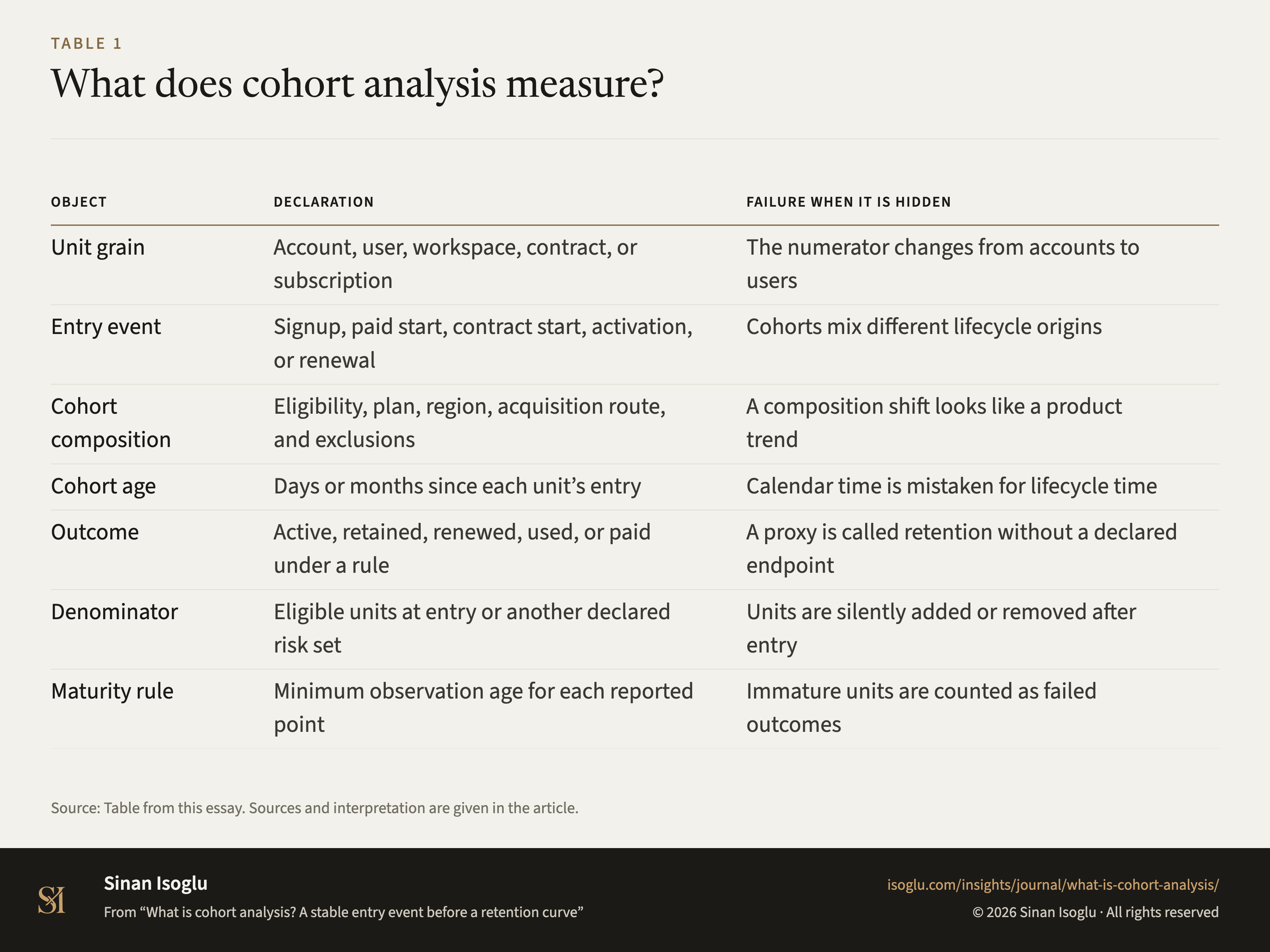
What does cohort analysis measure?
Table 1What does cohort analysis measure?
| Object | Declaration | Failure when it is hidden |
|---|---|---|
| Unit grain | Account, user, workspace, contract, or subscription | The numerator changes from accounts to users |
| Entry event | Signup, paid start, contract start, activation, or renewal | Cohorts mix different lifecycle origins |
| Cohort composition | Eligibility, plan, region, acquisition route, and exclusions | A composition shift looks like a product trend |
| Cohort age | Days or months since each unit's entry | Calendar time is mistaken for lifecycle time |
| Outcome | Active, retained, renewed, used, or paid under a rule | A proxy is called retention without a declared endpoint |
| Denominator | Eligible units at entry or another declared risk set | Units are silently added or removed after entry |
| Maturity rule | Minimum observation age for each reported point | Immature units are counted as failed outcomes |
Swipe or scroll horizontally if the table is wider than your screen.
Source: Table from this essay. Sources and interpretation are given in the article.
From the essay
Growth that compounds
What is cohort analysis? A stable entry event before a retention curve
Cohort analysis aligns units by a declared entry event and age. Define the cohort, outcome, maturity rule, and denominator before reading the curve.
Read the essayThis exhibit belongs to an essay: the numbers live here, the argument lives there.
Cite or embed
Related exhibits
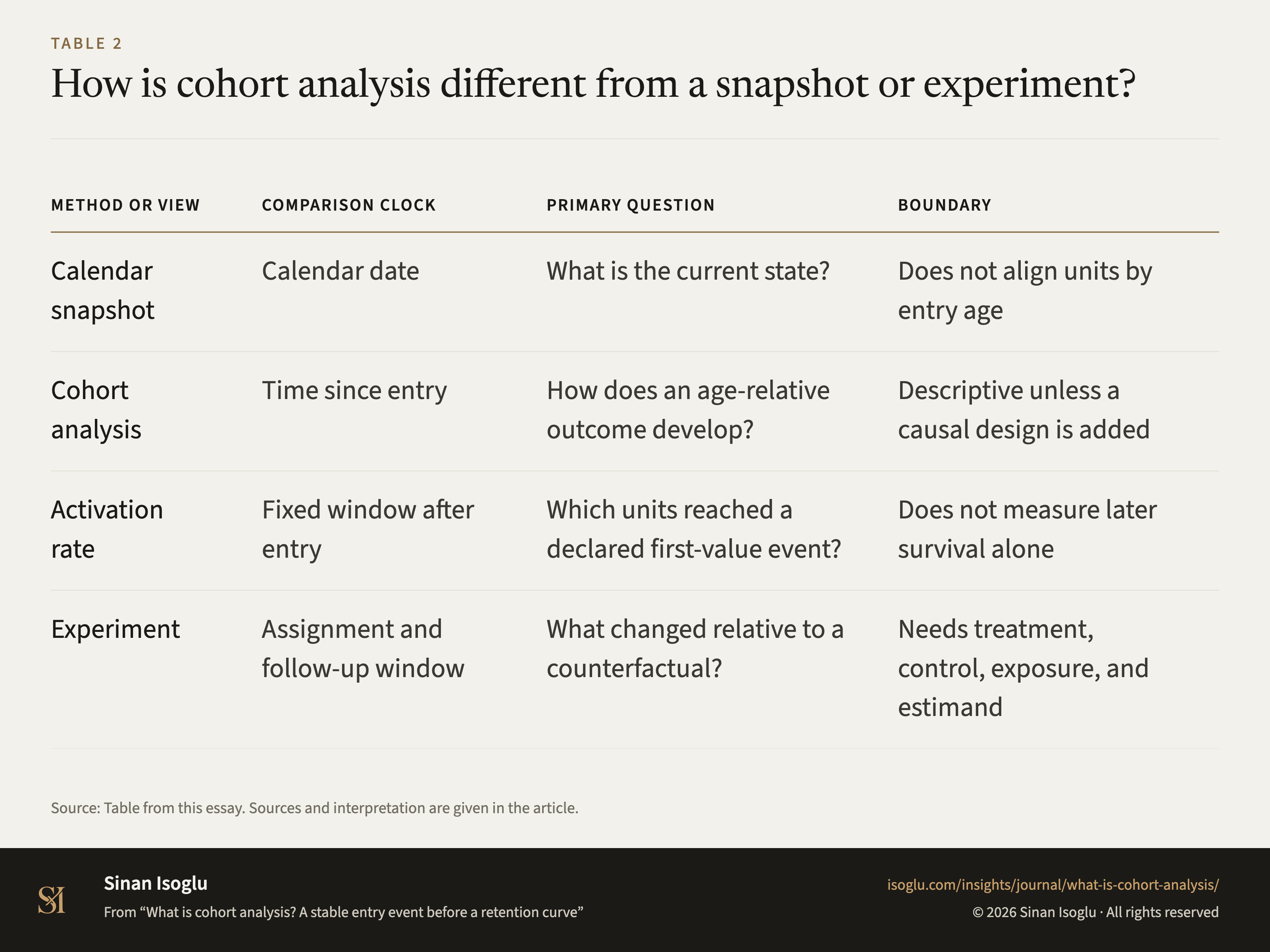
Table 2Table
How is cohort analysis different from a snapshot or experiment?
What is cohort analysis? A stable entry event before a retention curve
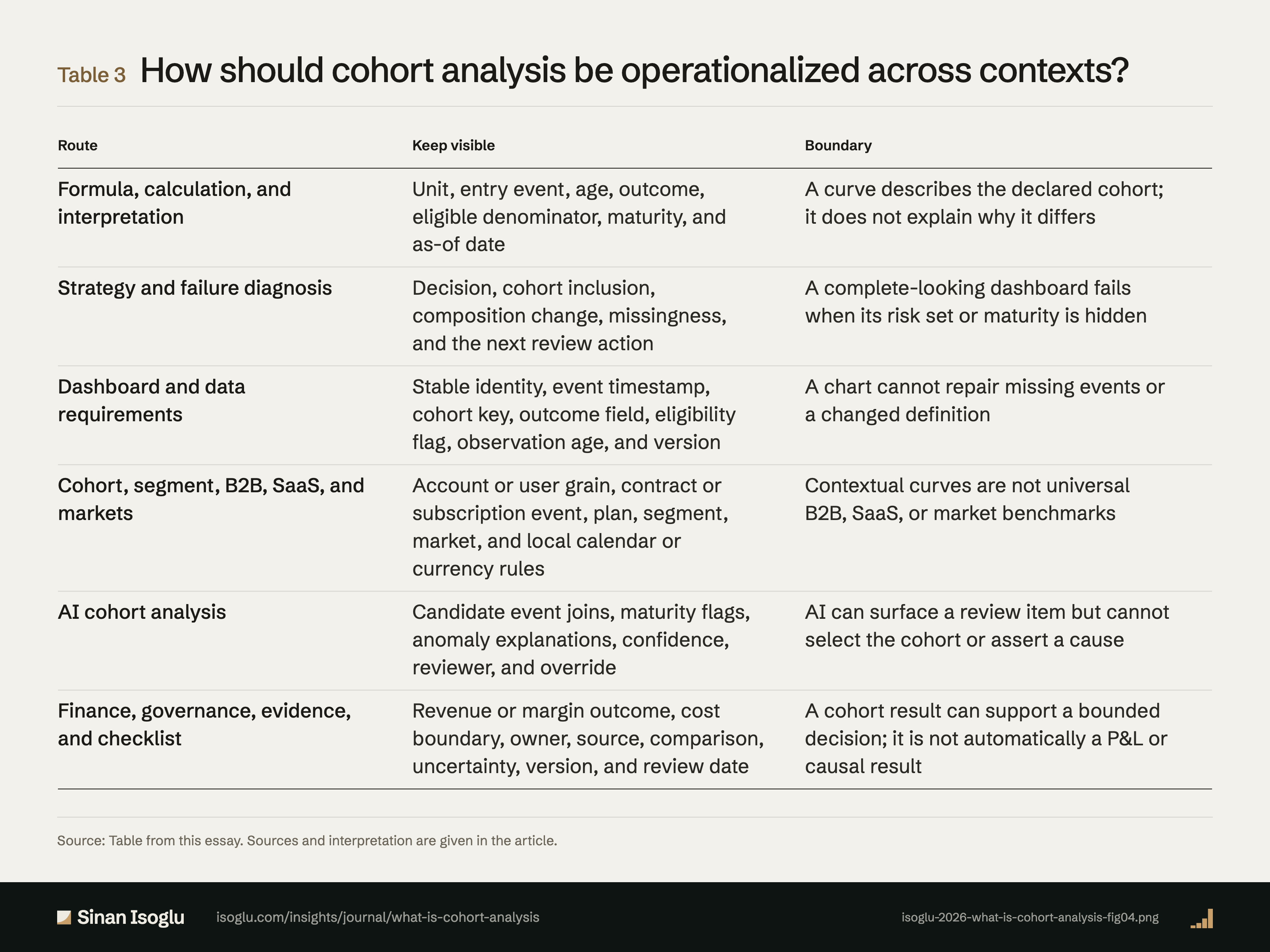
Table 3Table
How should cohort analysis be operationalized across contexts?
What is cohort analysis? A stable entry event before a retention curve
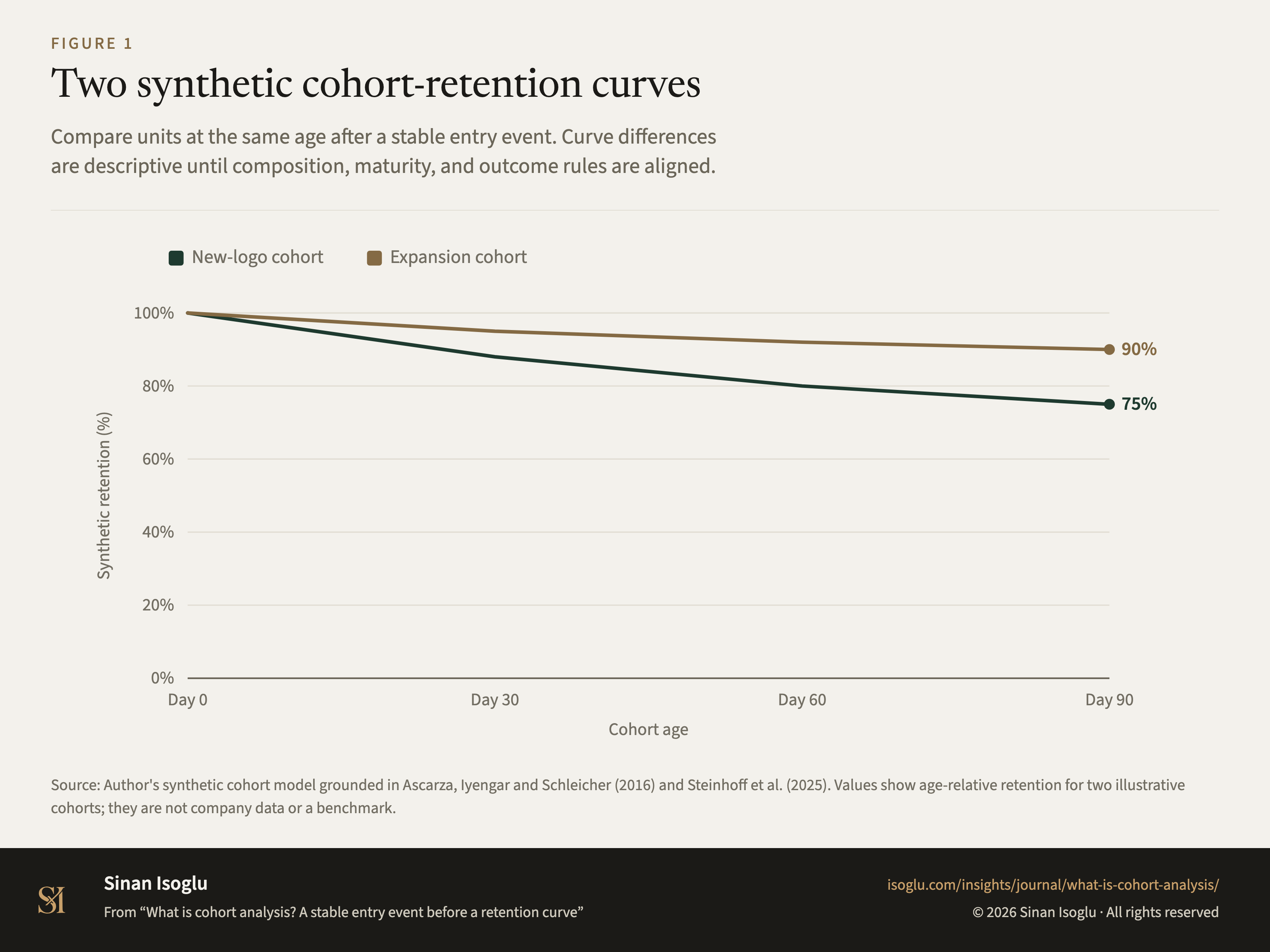
Figure 1Figure
Two synthetic cohort-retention curves
What is cohort analysis? A stable entry event before a retention curve
Contact
Bring the question you're working on.
Research, a guest lecture, or a commercial question.