Table 2From “What is AI demand forecasting? A forecast is a system, not an oracle”
What remains human when AI enters sales forecasting?
Table 2What remains human when AI enters sales forecasting?
| Forecast work | Candidate AI contribution | Human responsibility | Minimum record |
|---|---|---|---|
| Baseline assembly | Combine the declared inputs and produce a versioned estimate. | Confirm the target, unit, population, horizon, and exclusions. | Input snapshot, model version, and cutoff. |
| Exception flagging | Surface unusual movements or missing fields. | Decide whether the exception changes the decision or only the data-quality review. | Flag, reason, reviewer, and disposition. |
| Scenario comparison | Generate alternatives under declared assumptions. | Decide whether the alternatives are comparable and commercially relevant. | Assumptions, comparison, and accepted scenario. |
| Override recommendation | Suggest a change to the baseline or ask for review. | Approve, reject, or amend the change before the actual is known. | Recommendation, override, reason, owner, and timestamp. |
| Post-period review | Reconcile the forecast with the later actual. | Judge whether the process, information boundary, or target definition changed. | Actual, loss function, variance, and review decision. |
Swipe or scroll horizontally if the table is wider than your screen.
Source: Table from this essay. Sources and interpretation are given in the article.
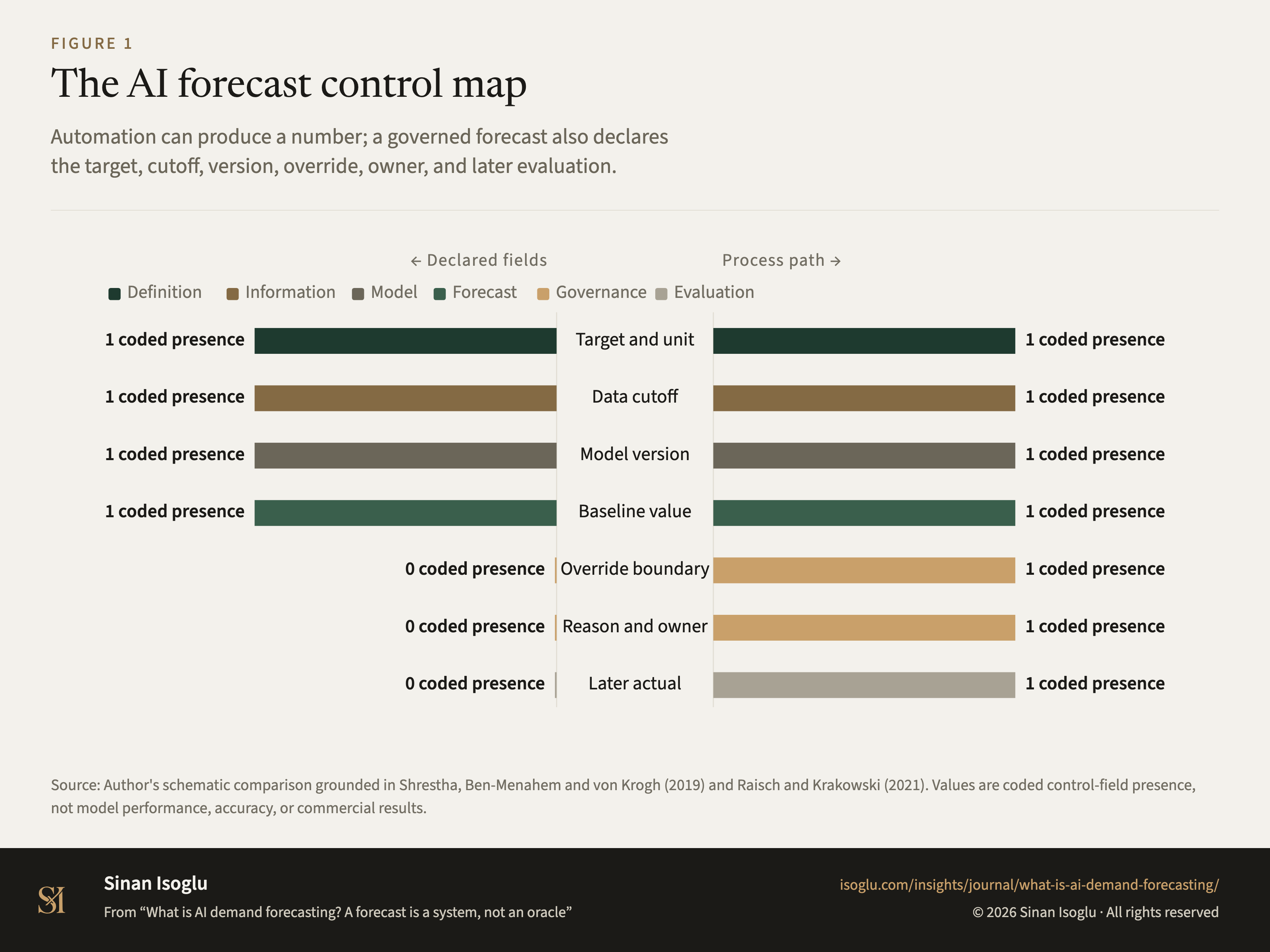
From the essay
Revenue operations & AI
What is AI demand forecasting? A forecast is a system, not an oracle
AI demand forecasting needs a target, horizon, information cutoff, override boundary, and later actual. Automation alone is not forecast governance.
Read the essayThis exhibit belongs to an essay: the numbers live here, the argument lives there.
Cite or embed
Related exhibits
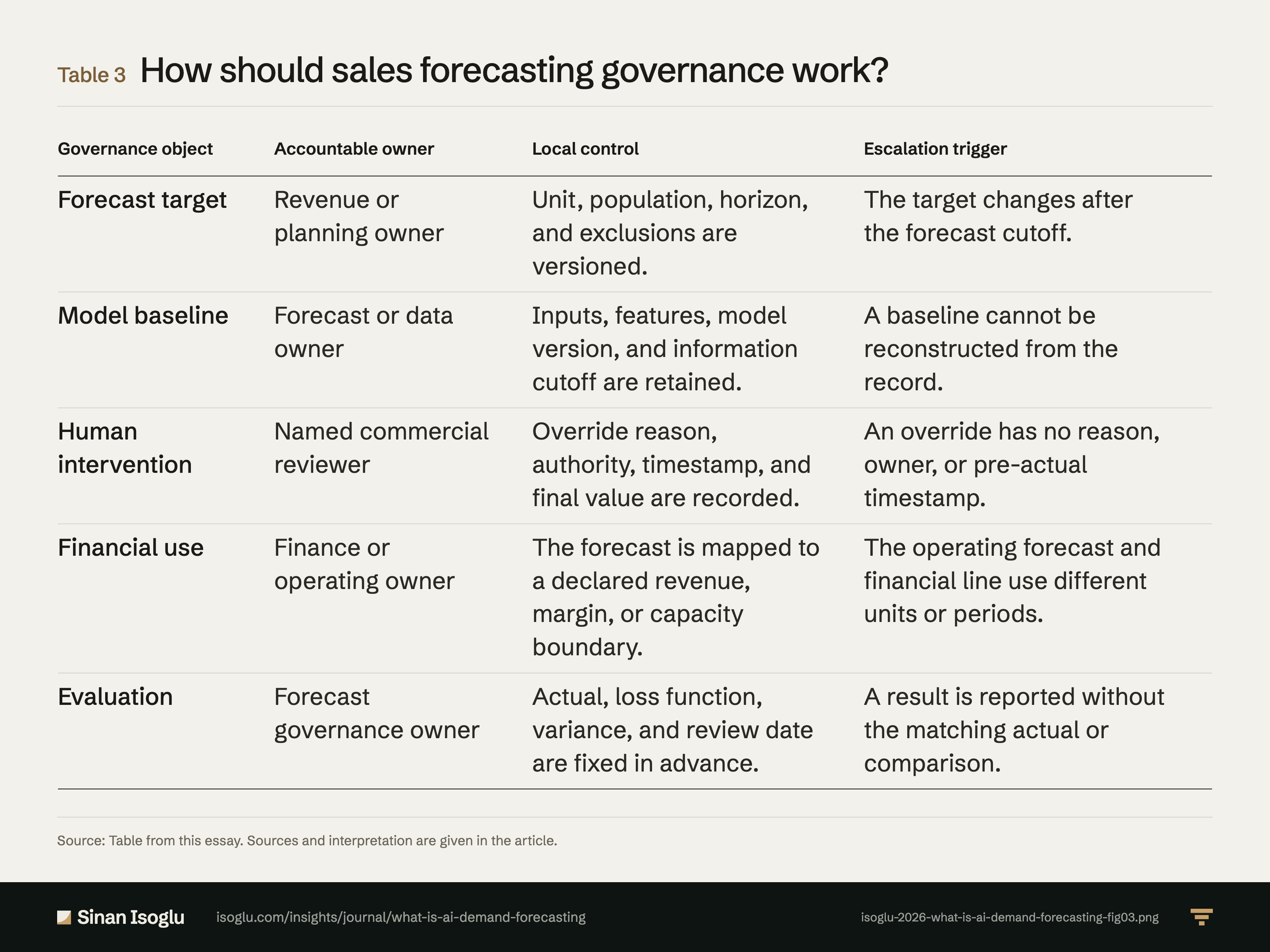
Table 3Table
How should sales forecasting governance work?
What is AI demand forecasting? A forecast is a system, not an oracle
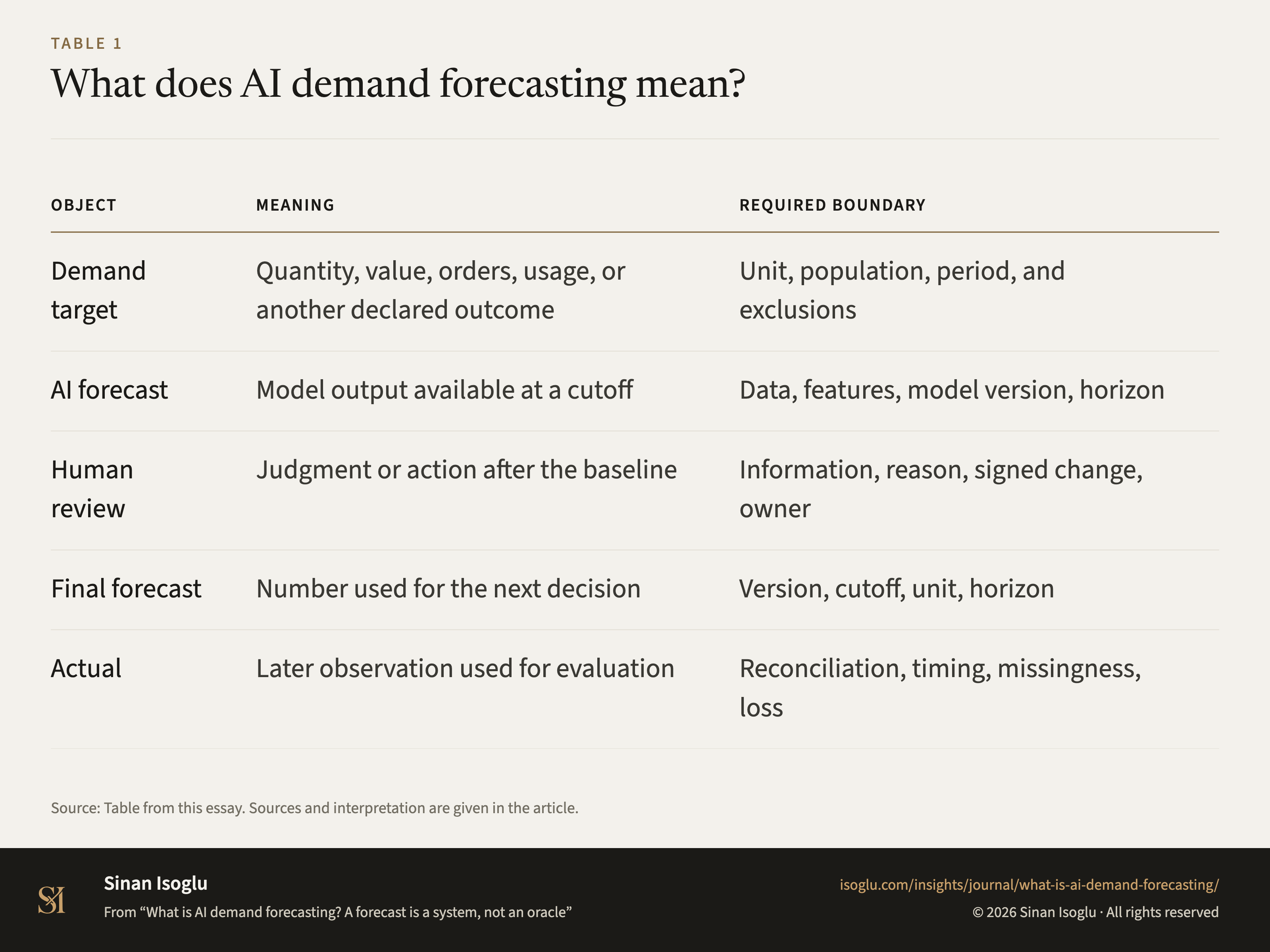
Table 1Table
What does AI demand forecasting mean?
What is AI demand forecasting? A forecast is a system, not an oracle
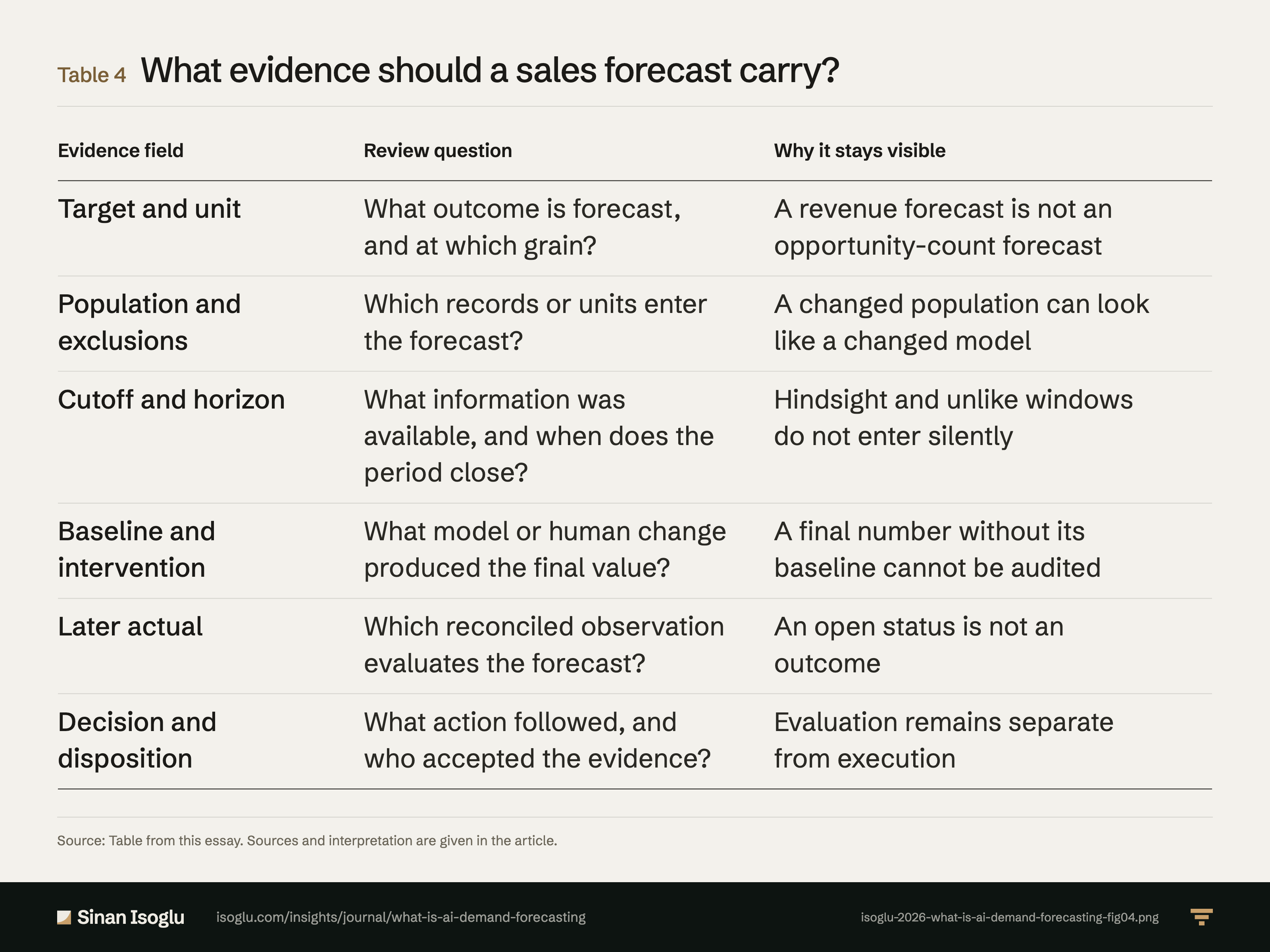
Table 4Table
What evidence should a sales forecast carry?
What is AI demand forecasting? A forecast is a system, not an oracle
Contact
Bring the question you're working on.
Research, a guest lecture, or a commercial question.