Figure 1From “Variable pay is a risk design when effort is hard to observe”
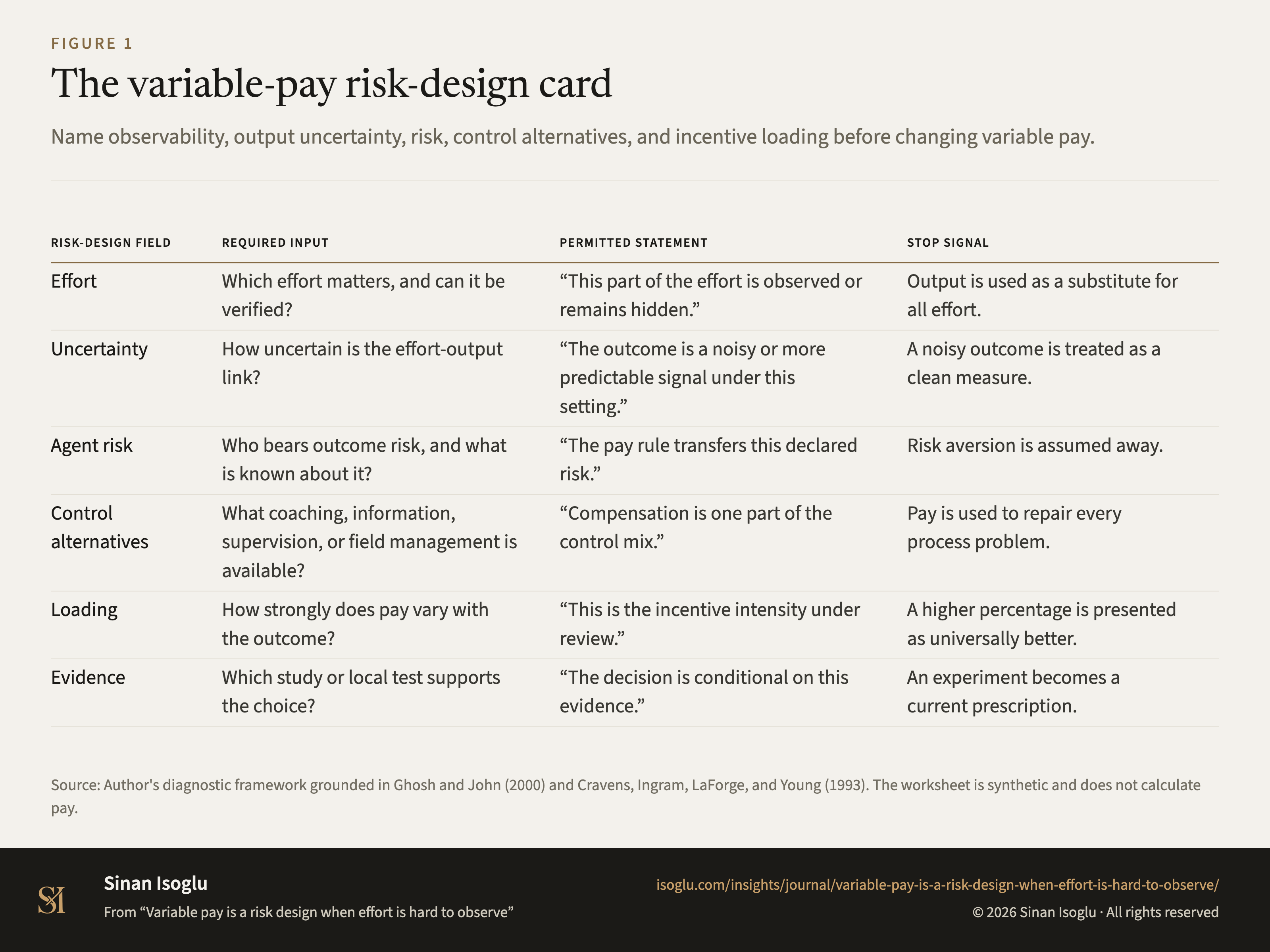
The variable-pay risk-design card
Name observability, output uncertainty, risk, control alternatives, and incentive loading before changing variable pay.
Figure 1The variable-pay risk-design card
| Risk-design field | Required input | Permitted statement | Stop signal |
|---|---|---|---|
| Effort | Which effort matters, and can it be verified? | “This part of the effort is observed or remains hidden.” | Output is used as a substitute for all effort. |
| Uncertainty | How uncertain is the effort-output link? | “The outcome is a noisy or more predictable signal under this setting.” | A noisy outcome is treated as a clean measure. |
| Agent risk | Who bears outcome risk, and what is known about it? | “The pay rule transfers this declared risk.” | Risk aversion is assumed away. |
| Control alternatives | What coaching, information, supervision, or field management is available? | “Compensation is one part of the control mix.” | Pay is used to repair every process problem. |
| Loading | How strongly does pay vary with the outcome? | “This is the incentive intensity under review.” | A higher percentage is presented as universally better. |
| Evidence | Which study or local test supports the choice? | “The decision is conditional on this evidence.” | An experiment becomes a current prescription. |
Swipe or scroll horizontally if the table is wider than your screen.
Source: Author's diagnostic framework grounded in Ghosh and John (2000) and Cravens, Ingram, LaForge, and Young (1993). The worksheet is synthetic and does not calculate pay.
Source and evidence
Each line names a claim related to this exhibit, its source, and how it was checked.
- A GJ00-C1 "we conducted three experiments to investigate three unresolved predictions involving the incentive-insurance trade-off posited in the model", against a literature where "empirical support remains sketchy"Ghosh & John. (2000)
- A GJ00-C2 The first prediction, and the condition it needs: "compensation should be less incentive loaded with greater effort-output uncertainty so as to provide additional insurance to a risk-averse agent", supported "but only when risk-averse agents undertook nonverifiable effort"Ghosh & John. (2000)
- A GJ00-C3 The second prediction failed: "when verifiable effort made incentives moot, as is the case for the second prediction, the model failed to order the data", which is why this is conditional support and not a ruleGhosh & John. (2000)
- A CLY93-C2 The finding runs against the intuition: "the results imply a limited role for incen"tive compensation "in salesforce control systems"Cravens, Ingram, LaForge & Young. (1993)
- A CLY93-C3 And what they call for instead: "they also suggest the need for a proper blend between field sales management and compensation control and identify important avenues for future research"Cravens, Ingram, LaForge & Young. (1993)
Grades: A, verified against the printed page of the primary source · B, primary source, text layer only · C, authoritative secondary · D, reported.
From the essay
Revenue operations & AI
Variable pay is a risk design when effort is hard to observe
When effort is hidden and output is uncertain, incentive intensity is conditional: separate observability, risk, uncertainty, and wider control.
Read the essayThis exhibit belongs to an essay: the numbers live here, the argument lives there.
Cite or embed
Related exhibits
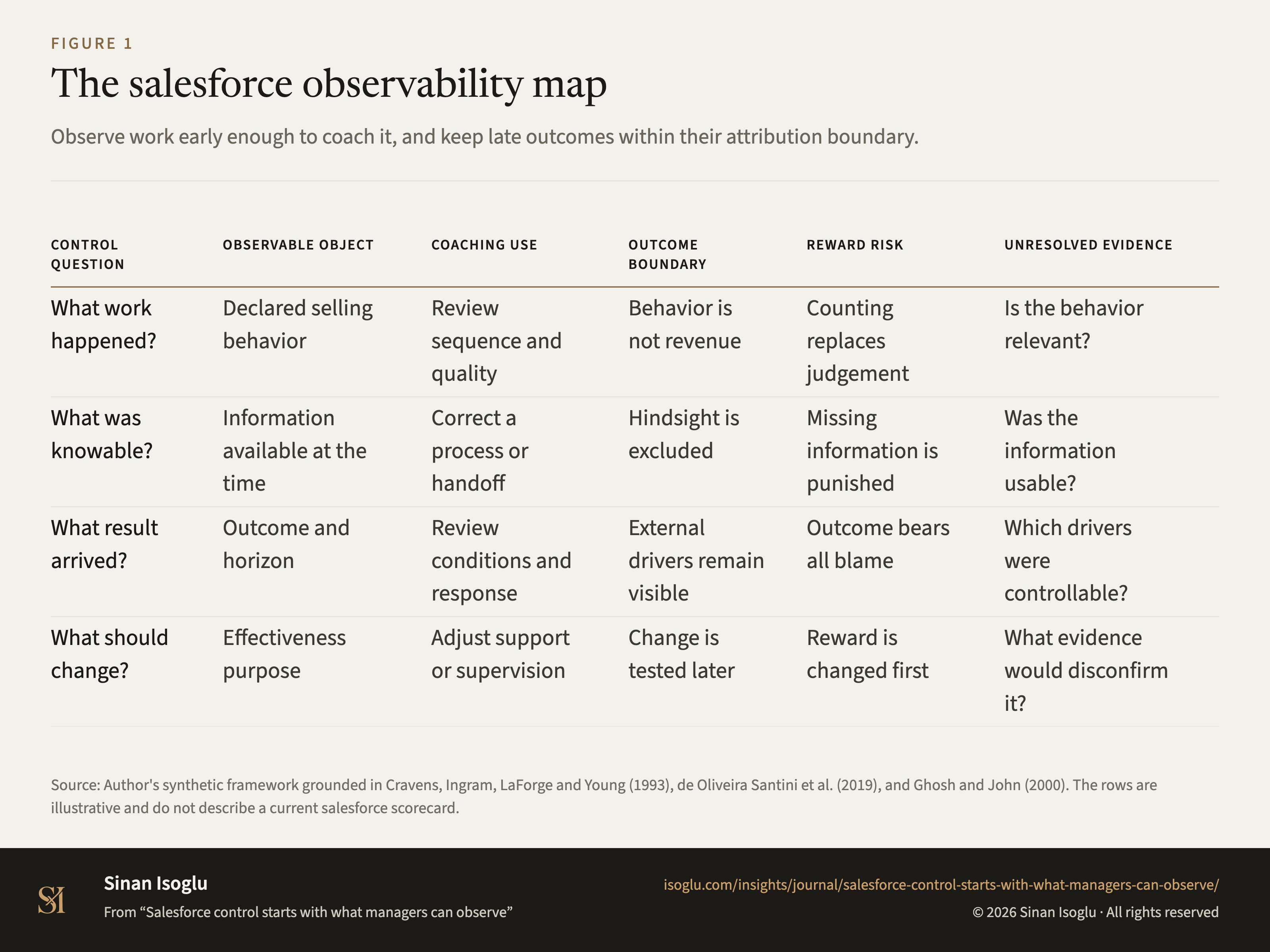
Figure 1Figure
The salesforce observability map
Salesforce control starts with what managers can observe
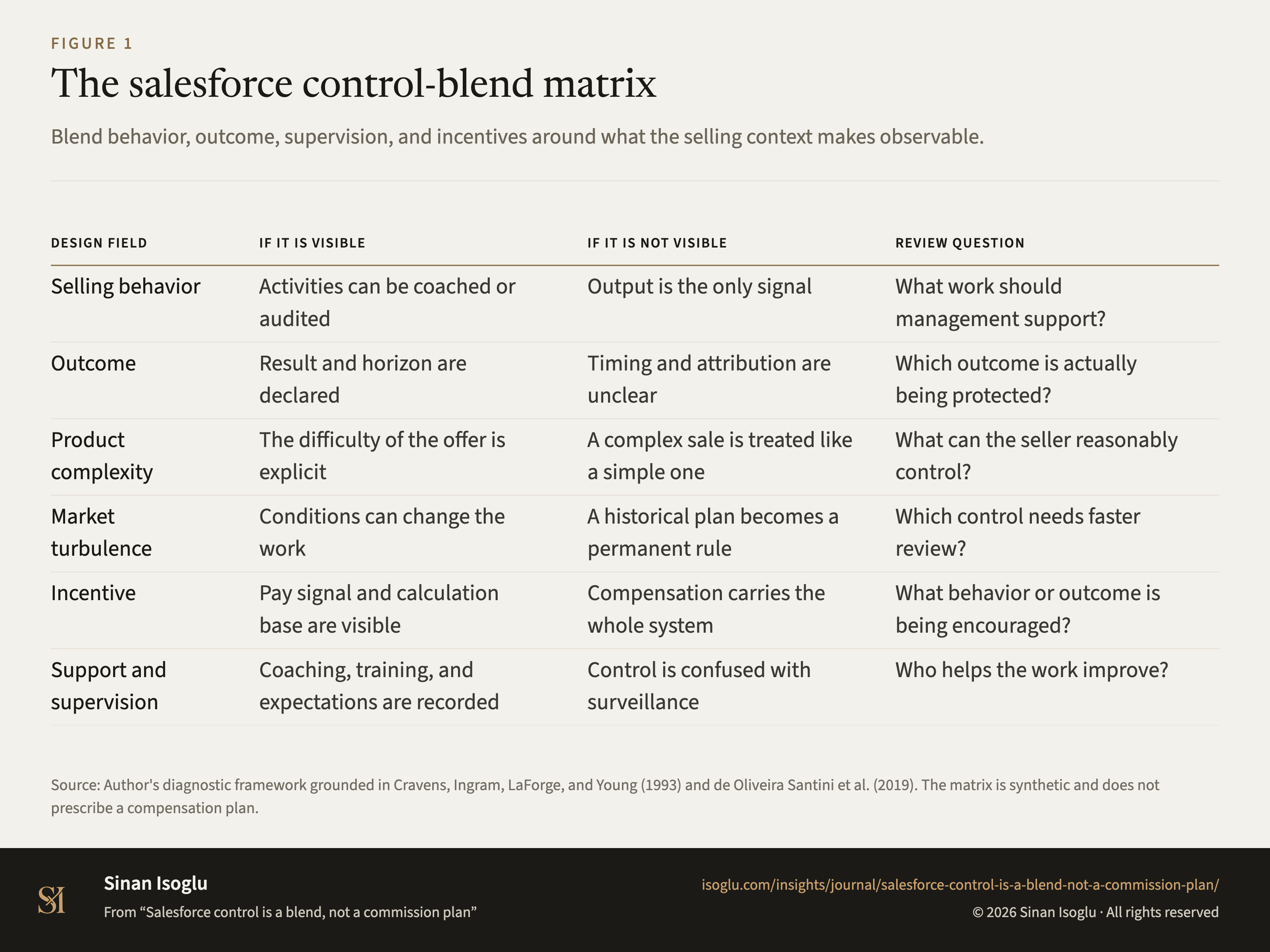
Figure 1Figure
The salesforce control-blend matrix
Salesforce control is a blend, not a commission plan
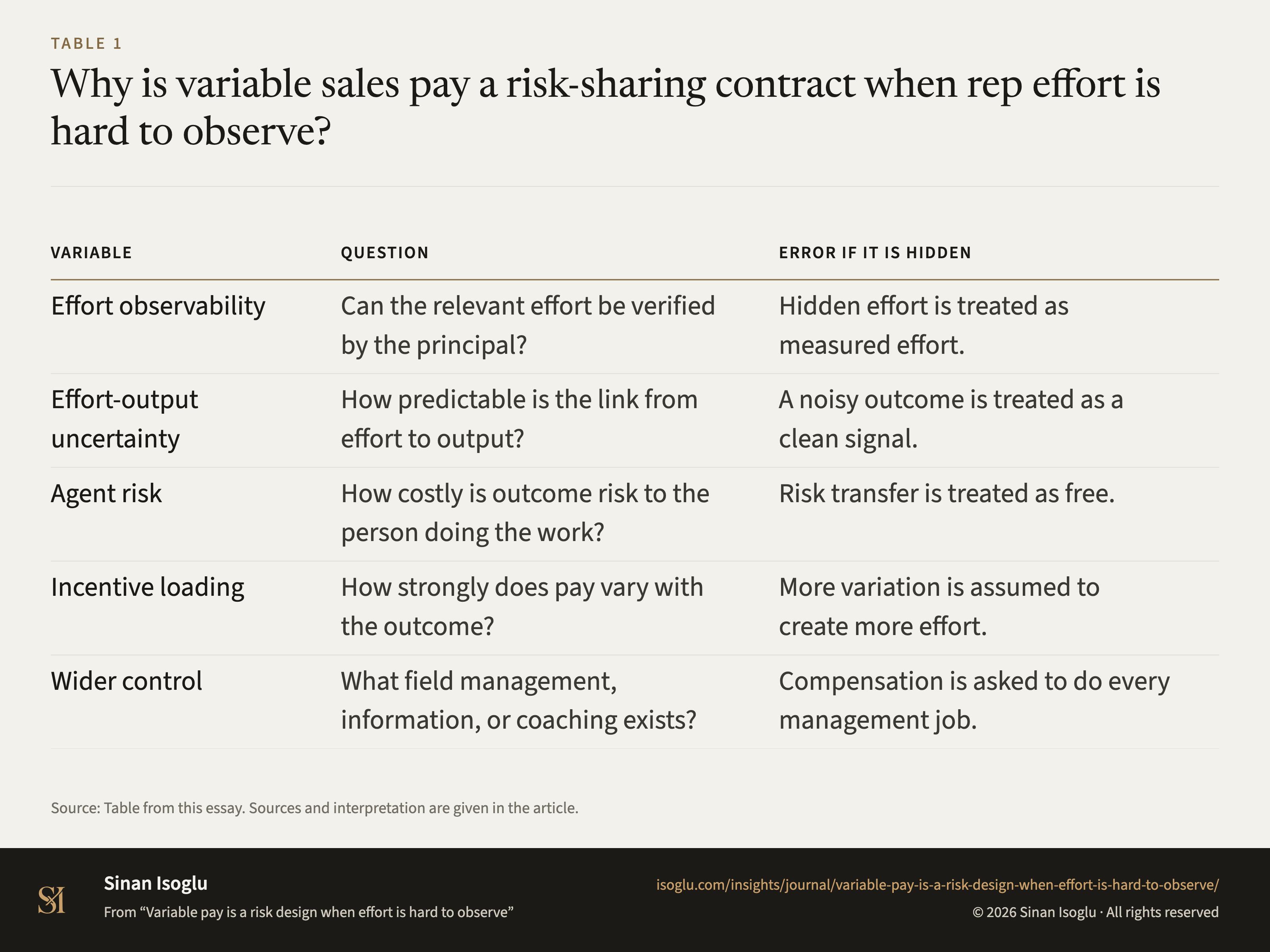
Table 1Table
Why is variable sales pay a risk-sharing contract when rep effort is hard to observe?
Variable pay is a risk design when effort is hard to observe
Contact
Bring the question you're working on.
Research, a guest lecture, or a commercial question.