Figure 1From “Salesforce control starts with what managers can observe”
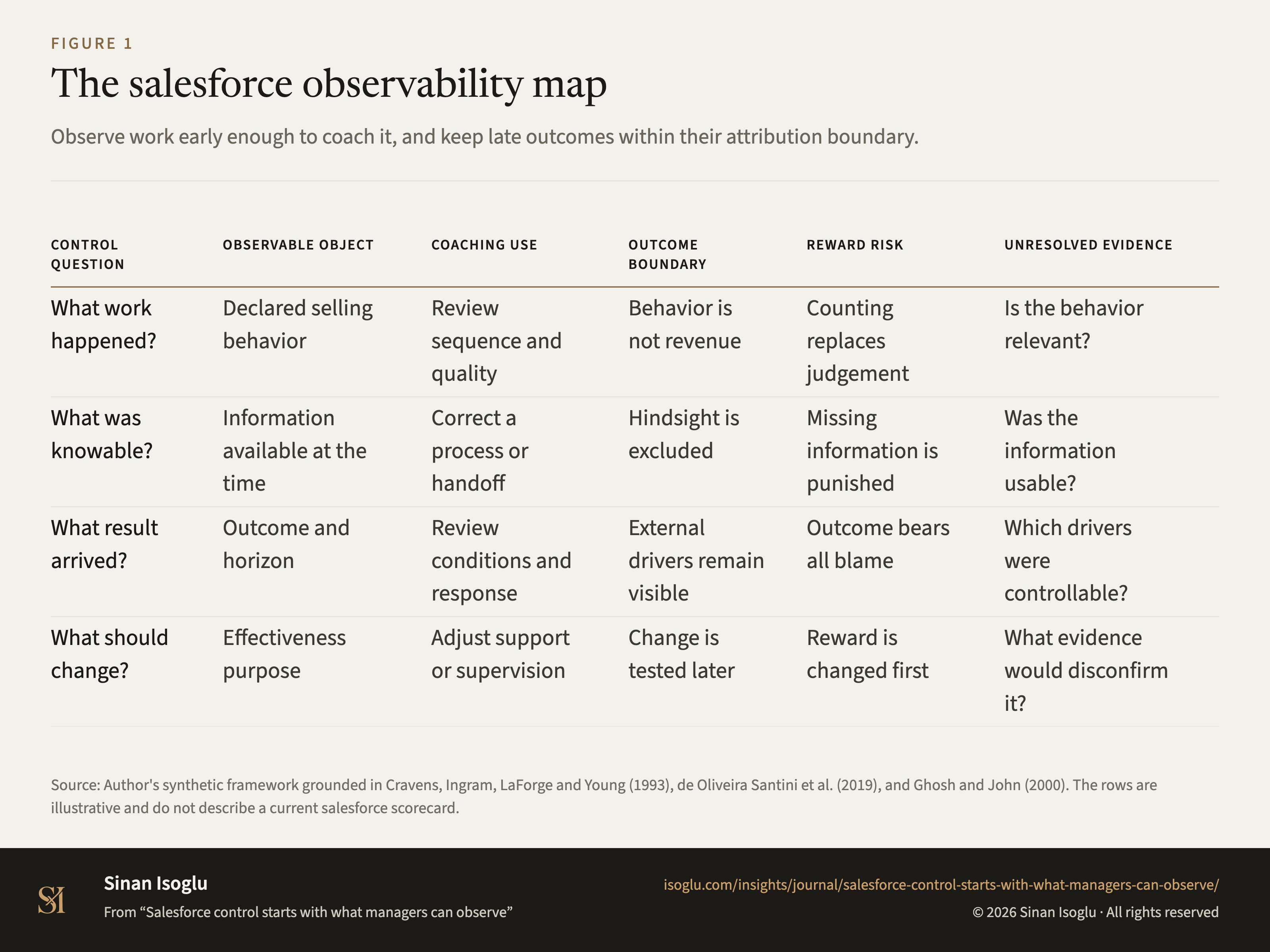
The salesforce observability map
Observe work early enough to coach it, and keep late outcomes within their attribution boundary.
Figure 1The salesforce observability map
| Control question | Observable object | Coaching use | Outcome boundary | Reward risk | Unresolved evidence |
|---|---|---|---|---|---|
| What work happened? | Declared selling behavior | Review sequence and quality | Behavior is not revenue | Counting replaces judgement | Is the behavior relevant? |
| What was knowable? | Information available at the time | Correct a process or handoff | Hindsight is excluded | Missing information is punished | Was the information usable? |
| What result arrived? | Outcome and horizon | Review conditions and response | External drivers remain visible | Outcome bears all blame | Which drivers were controllable? |
| What should change? | Effectiveness purpose | Adjust support or supervision | Change is tested later | Reward is changed first | What evidence would disconfirm it? |
Swipe or scroll horizontally if the table is wider than your screen.
Source: Author's synthetic framework grounded in Cravens, Ingram, LaForge and Young (1993), de Oliveira Santini et al. (2019), and Ghosh and John (2000). The rows are illustrative and do not describe a current salesforce scorecard.
Source and evidence
Each line names a claim related to this exhibit, its source, and how it was checked.
- A CLY93-C1 The design, and it is a test of someone else's propositions: "the authors develop a conceptual model depicting relationships between salesforce control systems, characteris"tics, performance and effectiveness "as a framework for testing the propositions formulated by Anderson and Oliver (1987)", with "a study of 144 diverse sales organizations"Cravens, Ingram, LaForge & Young. (1993)
- A CLY93-C2 The finding runs against the intuition: "the results imply a limited role for incen"tive compensation "in salesforce control systems"Cravens, Ingram, LaForge & Young. (1993)
- A CLY93-C3 And what they call for instead: "they also suggest the need for a proper blend between field sales management and compensation control and identify important avenues for future research"Cravens, Ingram, LaForge & Young. (1993)
- A OSV19-C1 "this paper conducts a meta-analysis based on 104 studies" of sales control systemsde Oliveira Santini, Vieira, Ladeira & Sampaio. (2019)
- A OSV19-C2 The named relationships are the paper's own list: "significant relationships between behaviour- and outcome-based control systems and the complexity of the products, bonuses, financial performance, sales innovation, organizational support and satisfaction with supervisors"de Oliveira Santini, Vieira, Ladeira & Sampaio. (2019)
- A OSV19-C3 Each wins somewhere, and the paper says where: "behaviour-based control systems were the most effective mechanism in turbulent markets and for determining financial performance", while "outcome-based control systems were the most efficient instrument for complex products"de Oliveira Santini, Vieira, Ladeira & Sampaio. (2019)
- A GJ00-C1 "we conducted three experiments to investigate three unresolved predictions involving the incentive-insurance trade-off posited in the model", against a literature where "empirical support remains sketchy"Ghosh & John. (2000)
- A GJ00-C2 The first prediction, and the condition it needs: "compensation should be less incentive loaded with greater effort-output uncertainty so as to provide additional insurance to a risk-averse agent", supported "but only when risk-averse agents undertook nonverifiable effort"Ghosh & John. (2000)
- A GJ00-C3 The second prediction failed: "when verifiable effort made incentives moot, as is the case for the second prediction, the model failed to order the data", which is why this is conditional support and not a ruleGhosh & John. (2000)
Grades: A, verified against the printed page of the primary source · B, primary source, text layer only · C, authoritative secondary · D, reported.
From the essay
Revenue operations & AI
Salesforce control starts with what managers can observe
Salesforce control begins before the result: define observable work, outcome horizon, coaching use, and reward risk before reading a sales number.
Read the essayThis exhibit belongs to an essay: the numbers live here, the argument lives there.
Cite or embed
Related exhibits
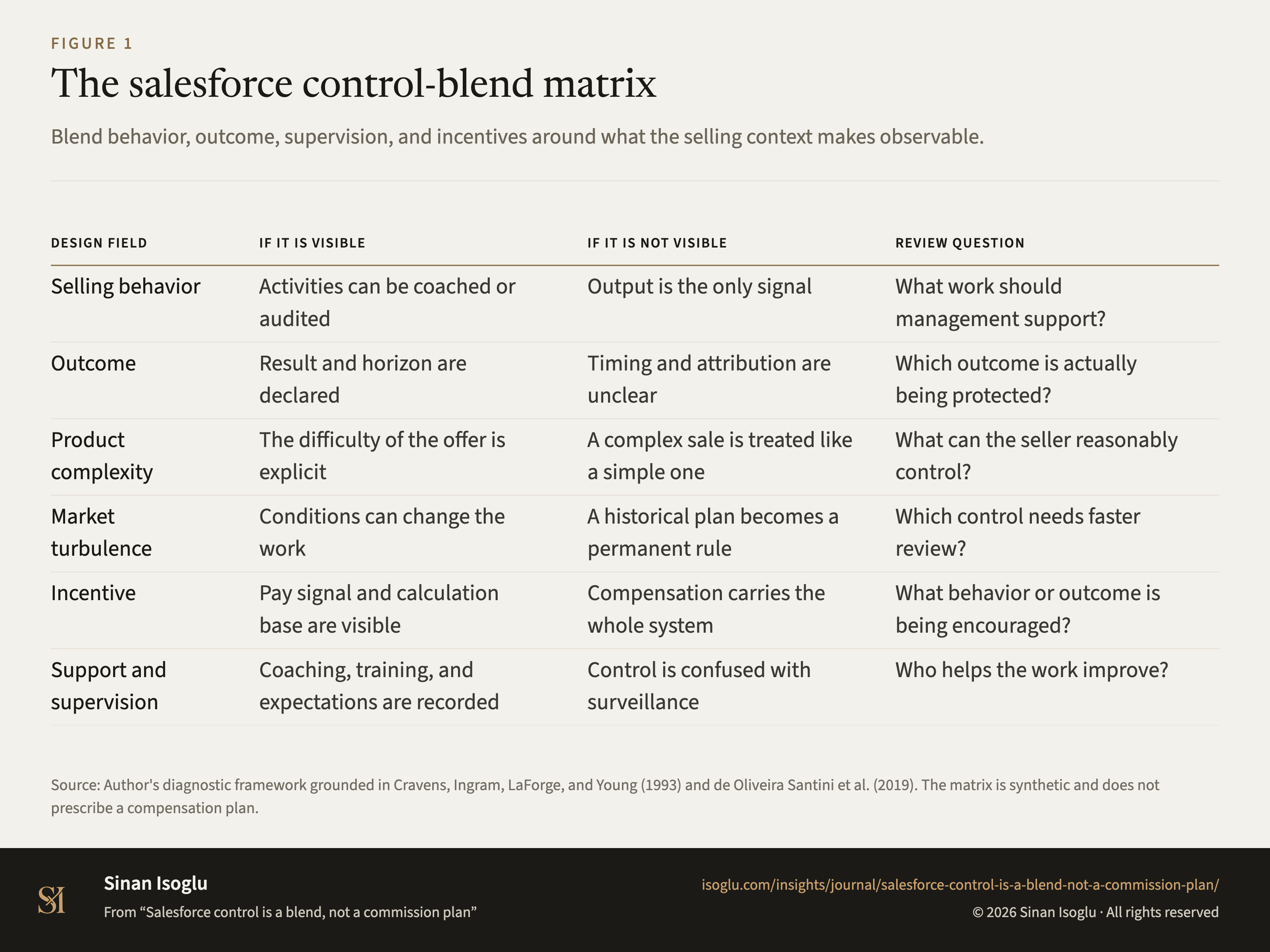
Figure 1Figure
The salesforce control-blend matrix
Salesforce control is a blend, not a commission plan
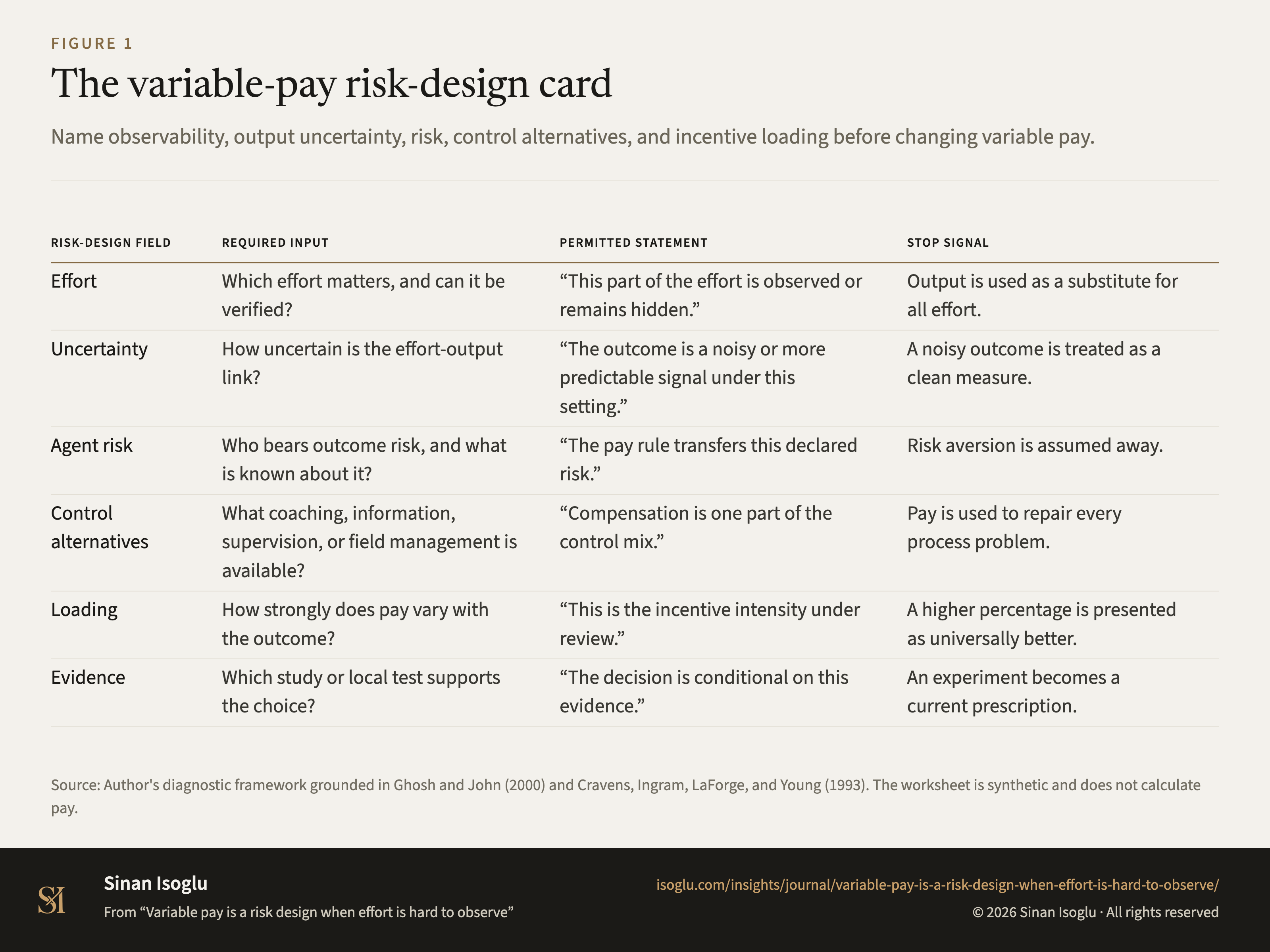
Figure 1Figure
The variable-pay risk-design card
Variable pay is a risk design when effort is hard to observe
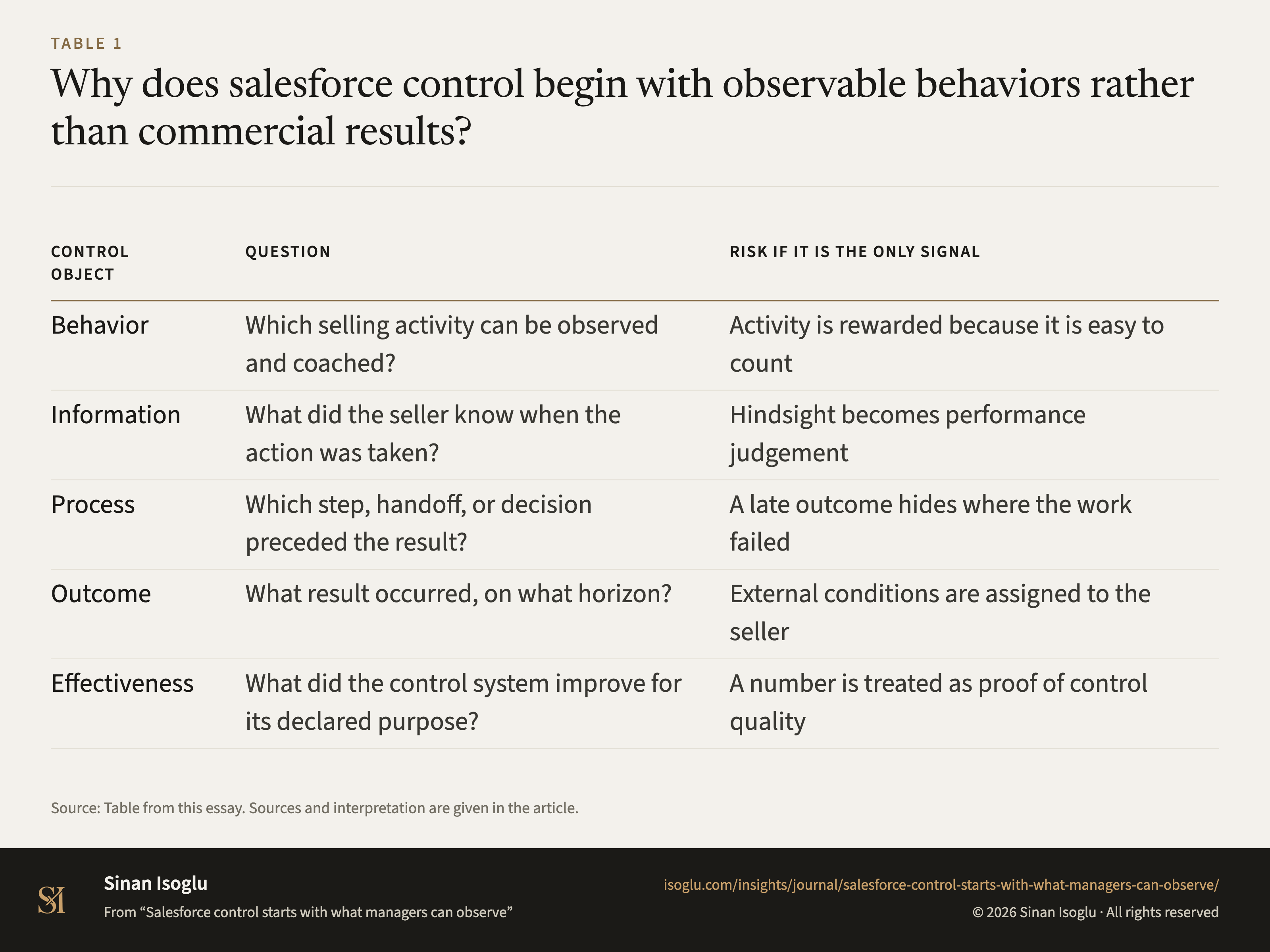
Table 1Table
Why does salesforce control begin with observable behaviors rather than commercial results?
Salesforce control starts with what managers can observe
Contact
Bring the question you're working on.
Research, a guest lecture, or a commercial question.