Table 1From “TAM is not a budget”
The market allocation ledger
A market-size number becomes budget-relevant only after the market, firm, resources, and return are separated.
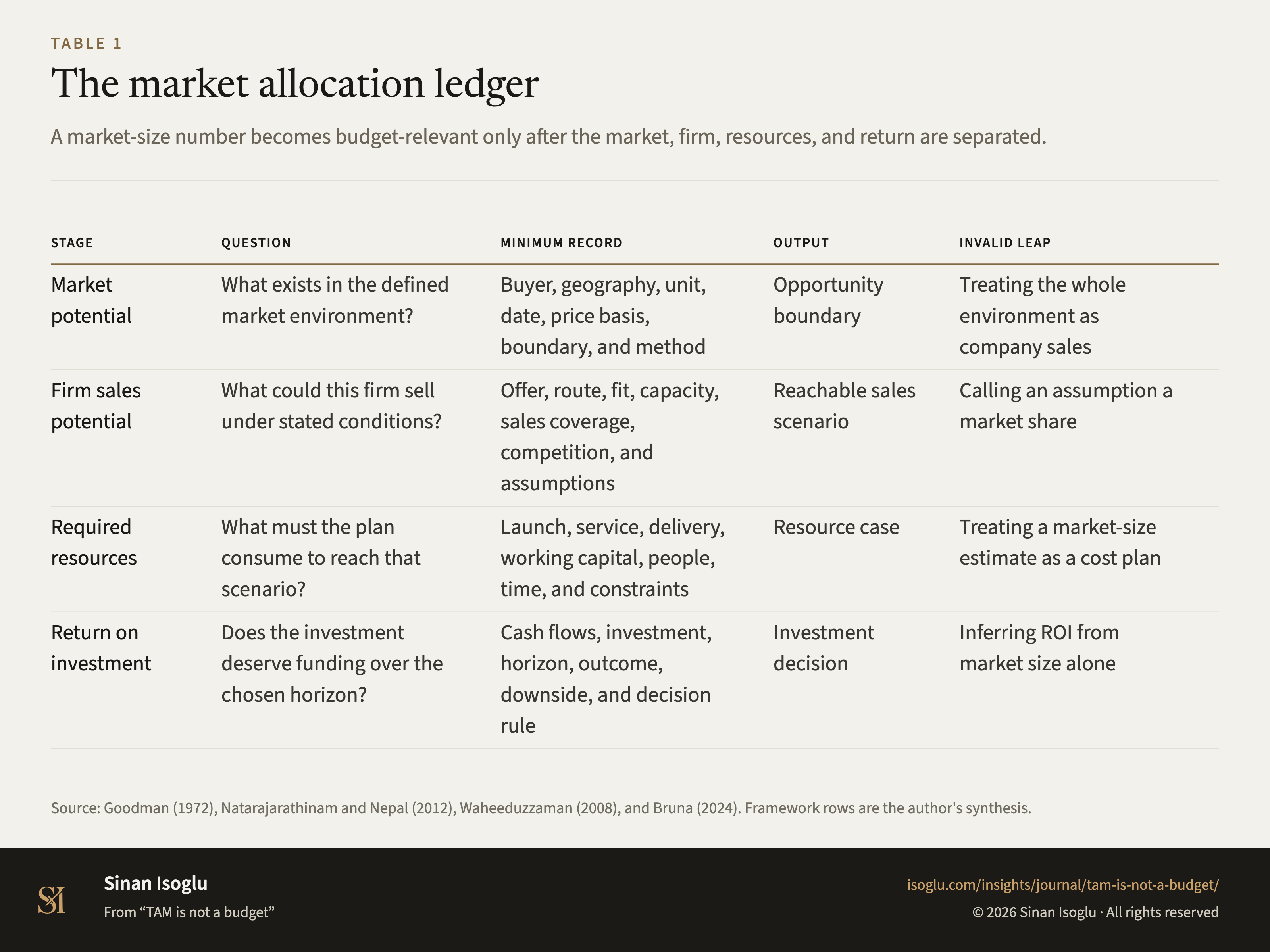
Table 1The market allocation ledger
| Stage | Question | Minimum record | Output | Invalid leap |
|---|---|---|---|---|
| Market potential | What exists in the defined market environment? | Buyer, geography, unit, date, price basis, boundary, and method | Opportunity boundary | Treating the whole environment as company sales |
| Firm sales potential | What could this firm sell under stated conditions? | Offer, route, fit, capacity, sales coverage, competition, and assumptions | Reachable sales scenario | Calling an assumption a market share |
| Required resources | What must the plan consume to reach that scenario? | Launch, service, delivery, working capital, people, time, and constraints | Resource case | Treating a market-size estimate as a cost plan |
| Return on investment | Does the investment deserve funding over the chosen horizon? | Cash flows, investment, horizon, outcome, downside, and decision rule | Investment decision | Inferring ROI from market size alone |
Swipe or scroll horizontally if the table is wider than your screen.
Source: Goodman (1972), Natarajarathinam and Nepal (2012), Waheeduzzaman (2008), and Bruna (2024). Framework rows are the author's synthesis.
Source and evidence
Each line names a claim related to this exhibit, its source, and how it was checked.
- B MSB27-C1 Goodman's own distinction: market potential is a measure "of an environmental state at a point in time (present or future)", whereas "sales forecasts are measures of expectation which are conditional upon inputs of the various marketing decision variables", and "it is usually necessary to rely on proxy data for most of the things a marketer would like to measure"Goodman. (1972)
- B MSB27-C2 The three stages are the paper's own: "The first step assesses the broad market potential of a country; the second step estimates the sales potential for a specific company, and the third step calculates return on investment for the company based on the resources required"Natarajarathinam & Nepal. (2012)
- B MSB27-C3 And each stage carries different conditions: "Each step of the methodology accounts for several external and internal factors", demonstrated on "An example of a fastener manufacturer targeting the Mexican market is used to demonstrate the applic"ation, so it is one worked case and not a formulaNatarajarathinam & Nepal. (2012)
- B MSB27-C4 The four criteria are the paper's own: Table 1 "provides an evaluation of the methods on the basis of four criteria, viz., precision, prediction, price, and pragmatism"Waheeduzzaman. (2008)
- B MSB27-C5 The methodological verdict is the paper's own: "The paper concludes that using a single rule to proxy Internal Market Potential in the same way for any sample is a bad methodology", on "For a sample of European regions, the paper concludes that the literature should be more explicit about historical processes of agglomeration"Bruna. (2024)
- B MSB27-C6 TAM, SAM, and SOM are useful labels only when their market boundary, unit, date, serviceability, and scenario assumptions are explicitAuthor framework in the market-allocation ledger
- B MSB27-C7 A budget decision requires a visible resource requirement, investment horizon, outcome, and downside case after market and firm reach are statedAuthor framework grounded in the cited market-potential sources
Grades: A, verified against the printed page of the primary source · B, primary source, text layer only · C, authoritative secondary · D, reported.
From the essay
Go-to-market strategy
TAM is not a budget
A market-size number marks an opportunity, not a sales forecast. Separate market potential, firm reach, resources, and ROI before funding it.
Read the essayThis exhibit belongs to an essay: the numbers live here, the argument lives there.
Cite or embed
Related exhibits
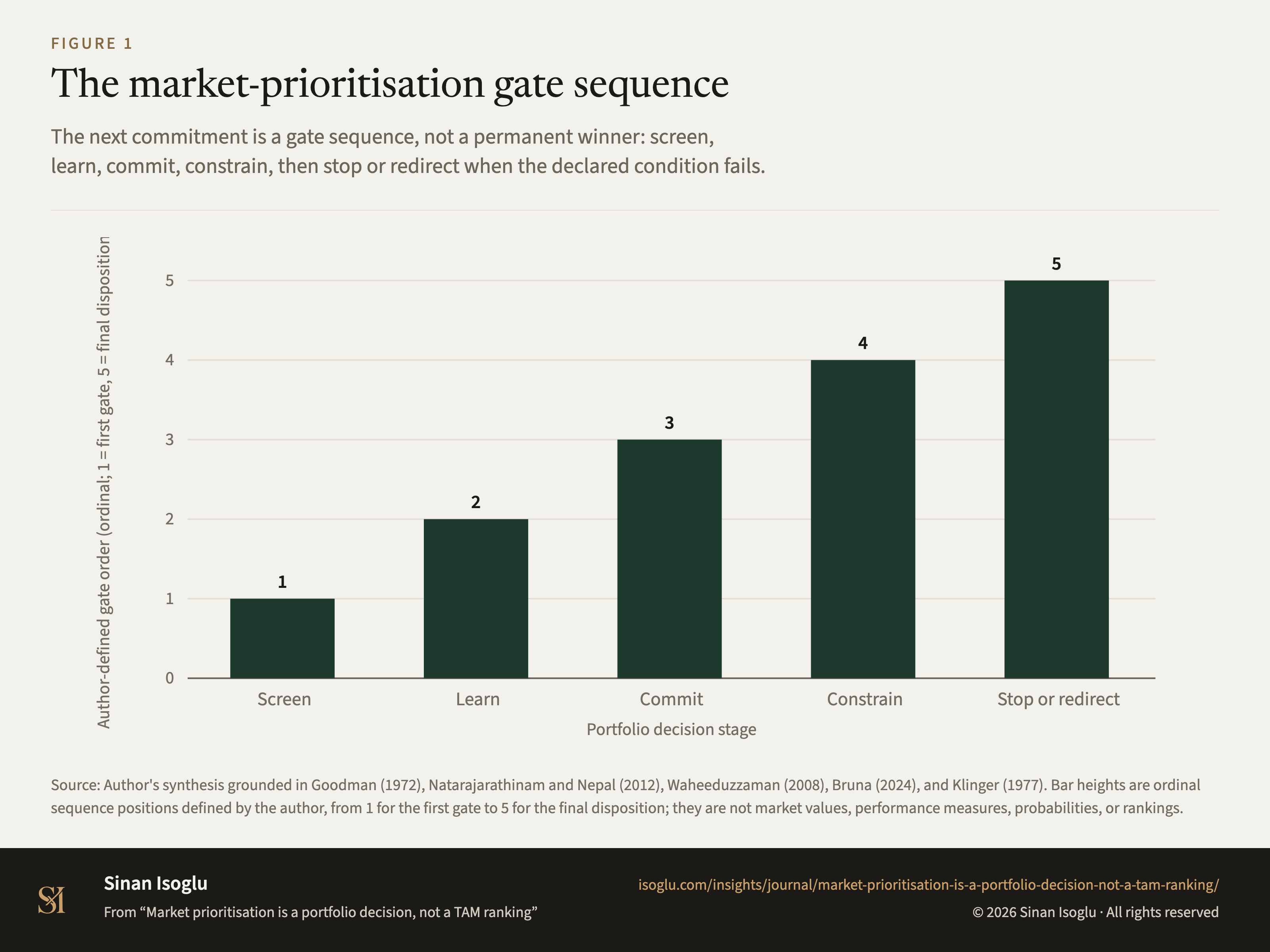
Figure 1Figure
The market-prioritisation gate sequence
Market prioritisation is a portfolio decision, not a TAM ranking
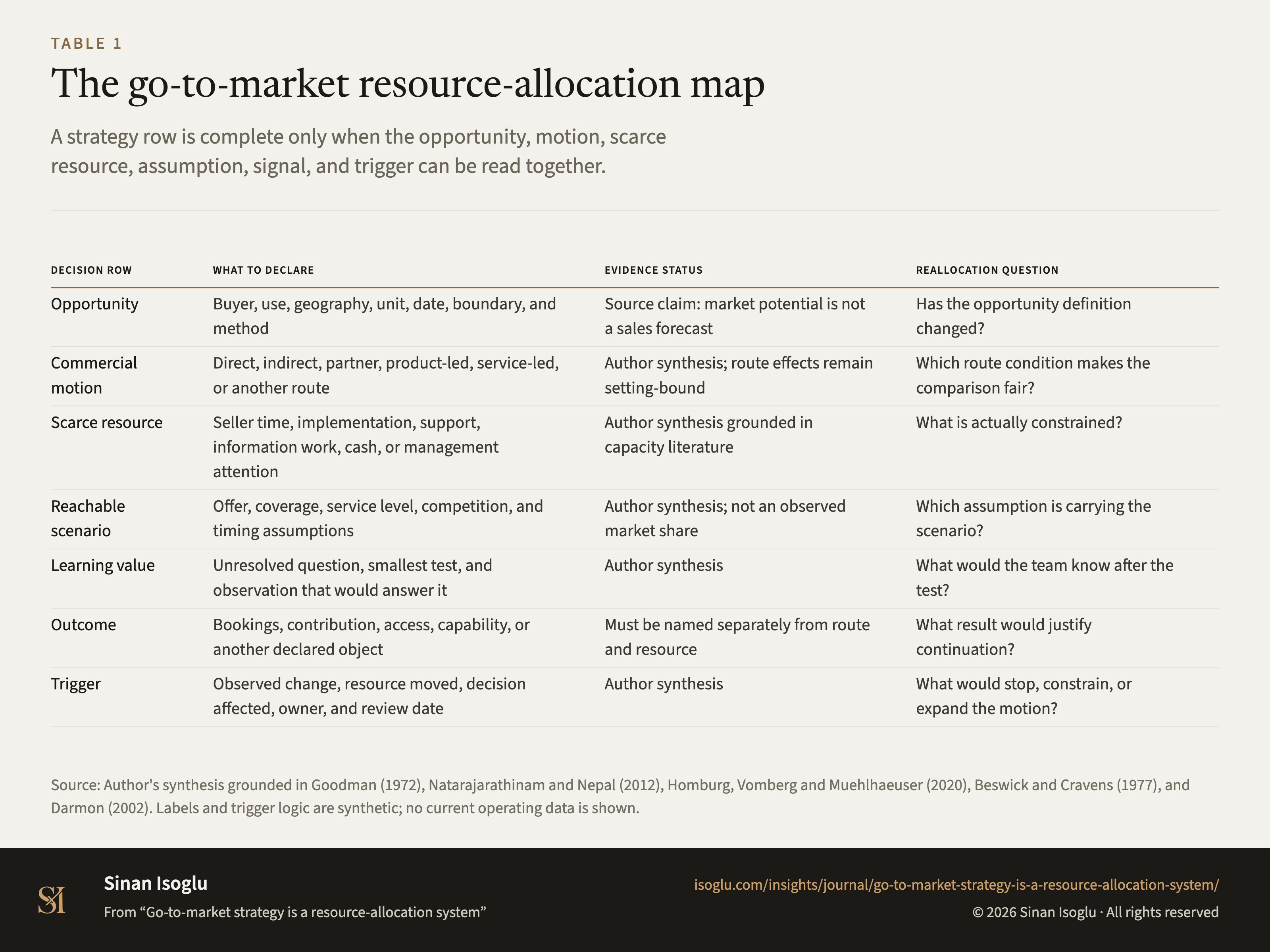
Table 1Table
The go-to-market resource-allocation map
Go-to-market strategy is a resource-allocation system
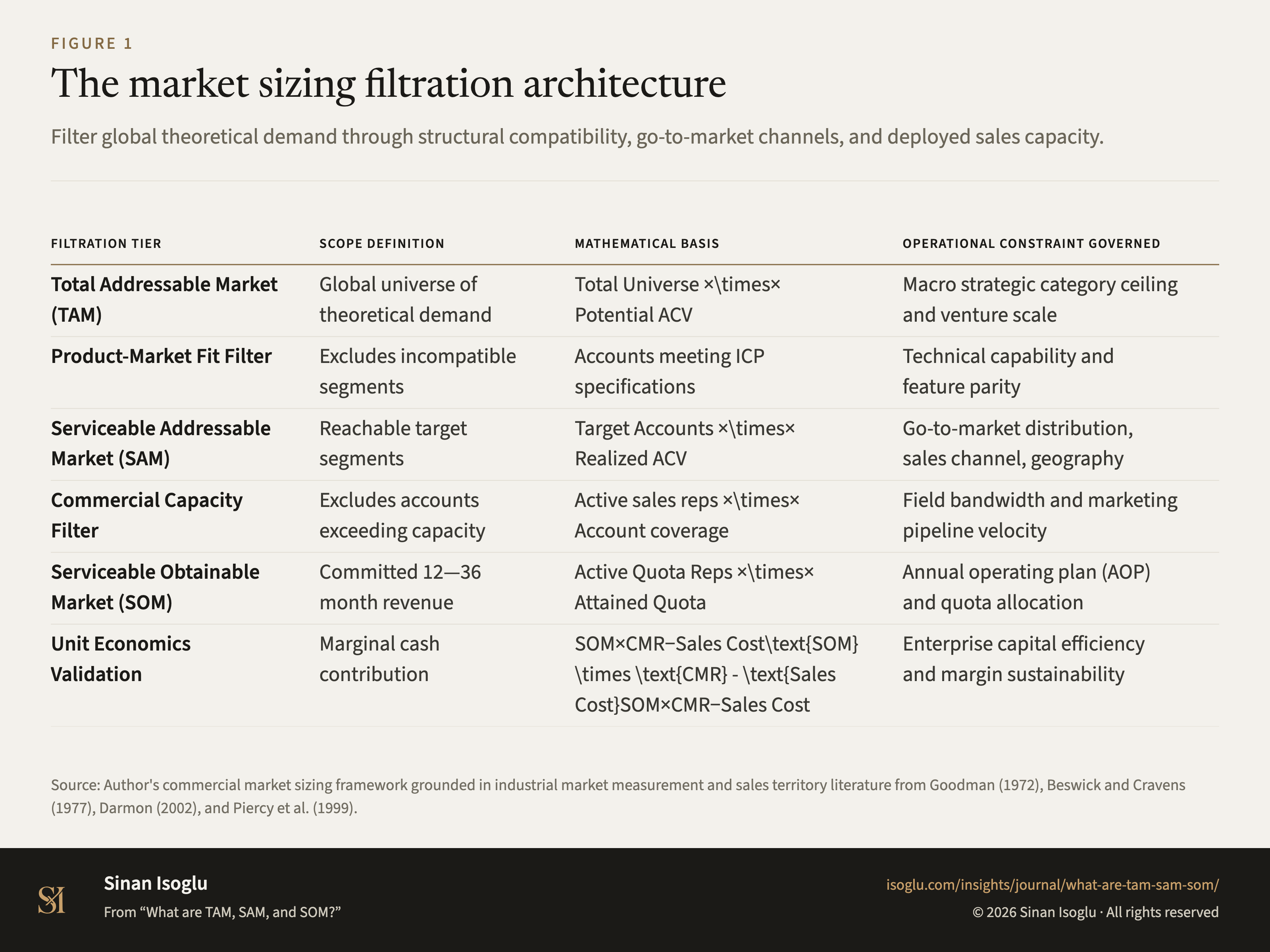
Figure 1Figure
The market sizing filtration architecture
What are TAM, SAM, and SOM?
Contact
Bring the question you're working on.
Research, a guest lecture, or a commercial question.