Tabelle 1Aus „TAM ist kein Budget“
Das Markt- und Budget-Prüfblatt
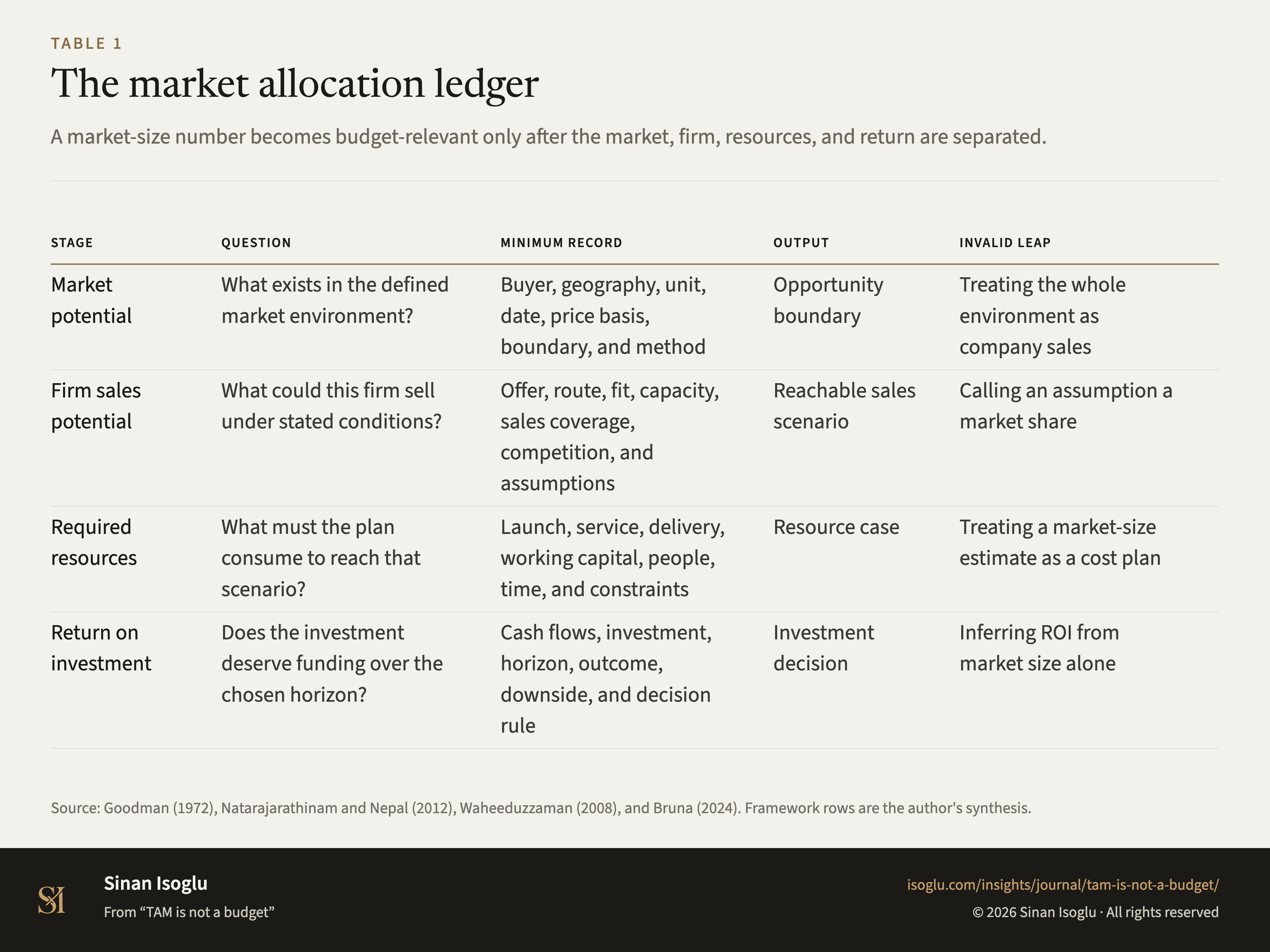
Eine Marktgrößenzahl wird erst nach der Trennung von Markt, Unternehmen, Ressourcen und Rendite budgetrelevant.
Tabelle 1Das Markt- und Budget-Prüfblatt
| Stufe | Frage | Mindestangaben | Ergebnis | Unzulässiger Sprung |
|---|---|---|---|---|
| Marktpotenzial | Was existiert in der abgegrenzten Marktumgebung? | Käufer, Gebiet, Einheit, Zeitpunkt, Preisbasis, Grenze und Methode | Chancenrahmen | Die gesamte Umgebung mit Unternehmensumsatz gleichsetzen |
| Umsatzpotenzial | Was könnte dieses Unternehmen unter bestimmten Bedingungen verkaufen? | Angebot, Vertriebsweg, Passung, Kapazität, Vertriebsabdeckung, Wettbewerb und Annahmen | Erreichbares Umsatzszenario | Eine Annahme als Marktanteil ausgeben |
| Ressourcenbedarf | Was muss der Plan einsetzen, um dieses Szenario zu erreichen? | Markteinführung, Service, Lieferung, Working Capital, Personal, Zeit und Grenzen | Ressourcenbedarf | Aus der Marktgröße einen Kostenplan ableiten |
| Return on Investment | Lohnt sich die Investition über den gewählten Zeitraum? | Zahlungsströme, Investition, Zeitraum, Ergebnis, Abwärtsrisiko und Entscheidungsregel | Investitionsentscheidung | ROI allein aus der Marktgröße ableiten |
Bei breiten Tabellen horizontal wischen oder scrollen.
Quelle: Goodman (1972), Natarajarathinam und Nepal (2012), Waheeduzzaman (2008) und Bruna (2024). Die Zeilen sind eine Synthese des Autors.
Quelle und Evidenz
Jede Zeile nennt eine Aussage zu dieser Abbildung, ihre Quelle und die Art ihrer Prüfung.
- B MSB27-C1 Goodman's own distinction: market potential is a measure "of an environmental state at a point in time (present or future)", whereas "sales forecasts are measures of expectation which are conditional upon inputs of the various marketing decision variables", and "it is usually necessary to rely on proxy data for most of the things a marketer would like to measure"Goodman. (1972)
- B MSB27-C2 The three stages are the paper's own: "The first step assesses the broad market potential of a country; the second step estimates the sales potential for a specific company, and the third step calculates return on investment for the company based on the resources required"Natarajarathinam & Nepal. (2012)
- B MSB27-C3 And each stage carries different conditions: "Each step of the methodology accounts for several external and internal factors", demonstrated on "An example of a fastener manufacturer targeting the Mexican market is used to demonstrate the applic"ation, so it is one worked case and not a formulaNatarajarathinam & Nepal. (2012)
- B MSB27-C4 The four criteria are the paper's own: Table 1 "provides an evaluation of the methods on the basis of four criteria, viz., precision, prediction, price, and pragmatism"Waheeduzzaman. (2008)
- B MSB27-C5 The methodological verdict is the paper's own: "The paper concludes that using a single rule to proxy Internal Market Potential in the same way for any sample is a bad methodology", on "For a sample of European regions, the paper concludes that the literature should be more explicit about historical processes of agglomeration"Bruna. (2024)
- B MSB27-C6 TAM, SAM, and SOM are useful labels only when their market boundary, unit, date, serviceability, and scenario assumptions are explicitAuthor framework in the market-allocation ledger
- B MSB27-C7 A budget decision requires a visible resource requirement, investment horizon, outcome, and downside case after market and firm reach are statedAuthor framework grounded in the cited market-potential sources
Prüfgrade: A, gegen die gedruckte Seite der Primärquelle geprüft · B, Primärquelle, nur Textebene · C, belastbare Sekundärquelle · D, berichtet.
Aus dem Beitrag
Go-to-Market-Strategie
TAM ist kein Budget
Eine Marktgröße beschreibt eine Chance, keine Umsatzprognose. Trennen Sie Marktpotenzial, Umsatzpotenzial, Ressourcen und ROI vor der Budgetfreigabe.
Den Beitrag lesenDiese Abbildung gehört zu einem Essay: Die Zahlen stehen hier, das Argument dort.
Zitieren oder einbetten
Verwandte Abbildungen
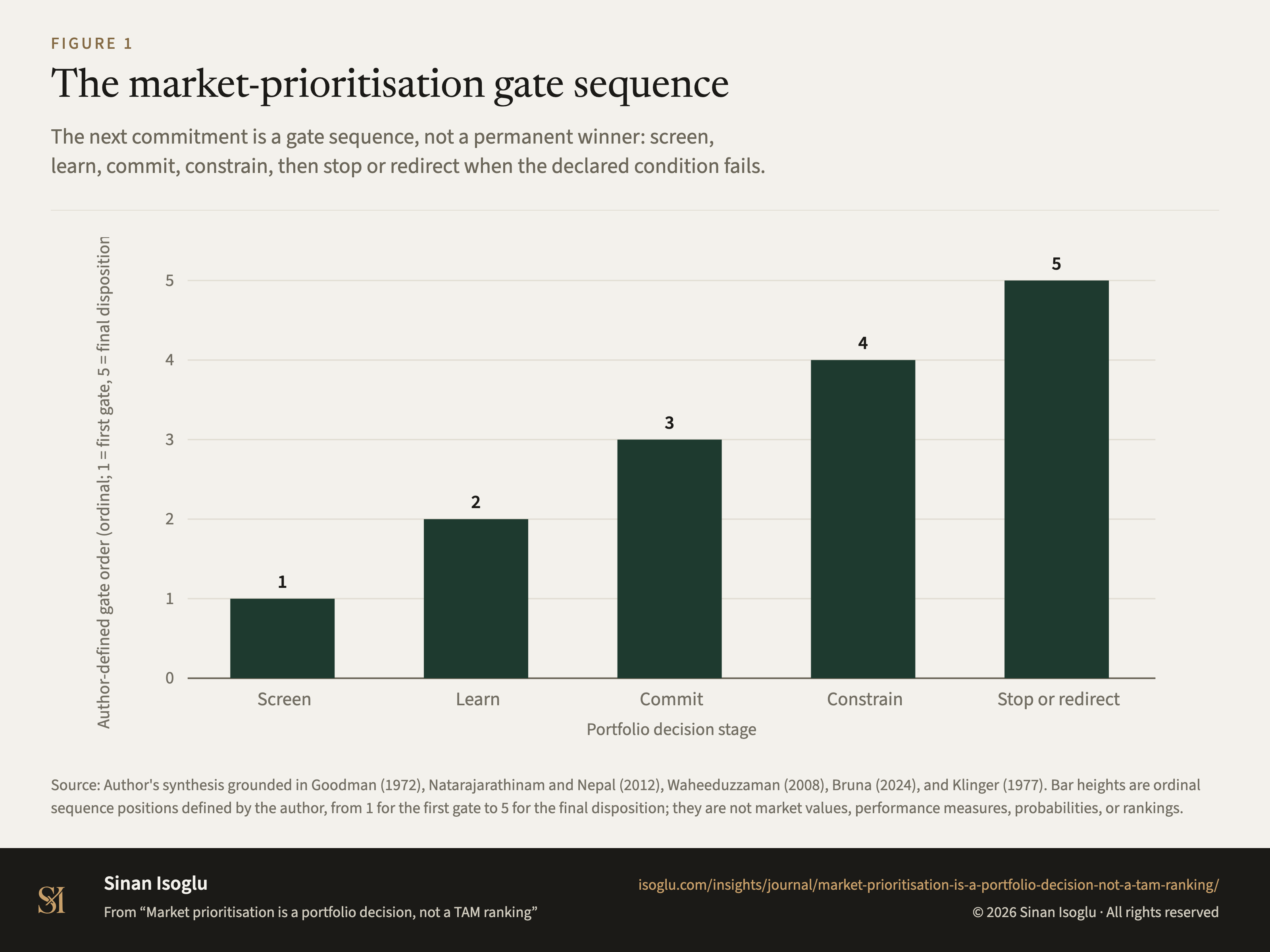
Abbildung 1Grafik
Die Prüfpunktfolge für Marktpriorisierung
Marktpriorisierung ist eine Portfolioentscheidung, kein TAM-Ranking
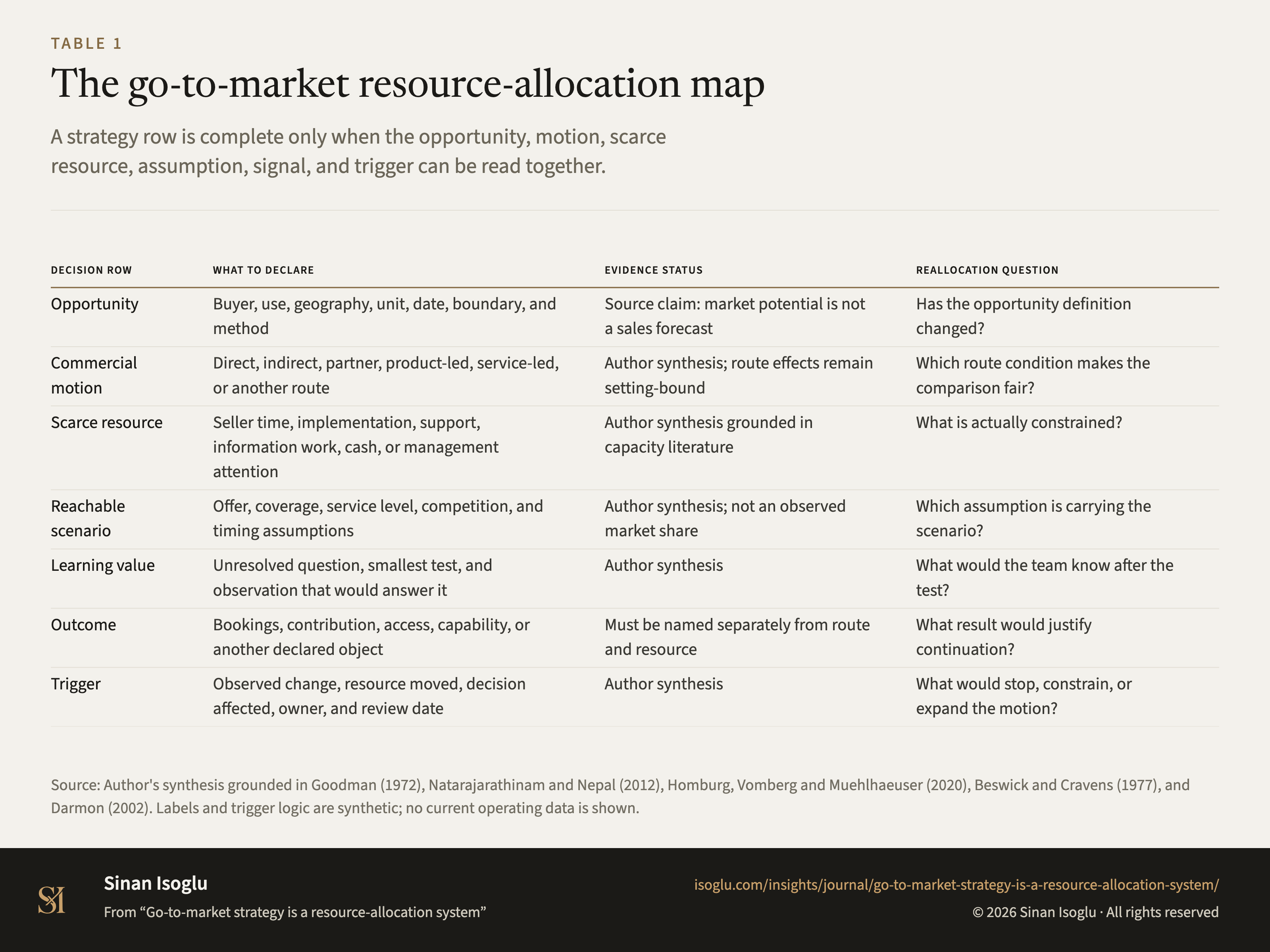
Tabelle 1Tabelle
Die Karte der Go-to-Market-Ressourcenallokation
Eine Go-to-Market-Strategie ist ein Ressourcenallokationssystem
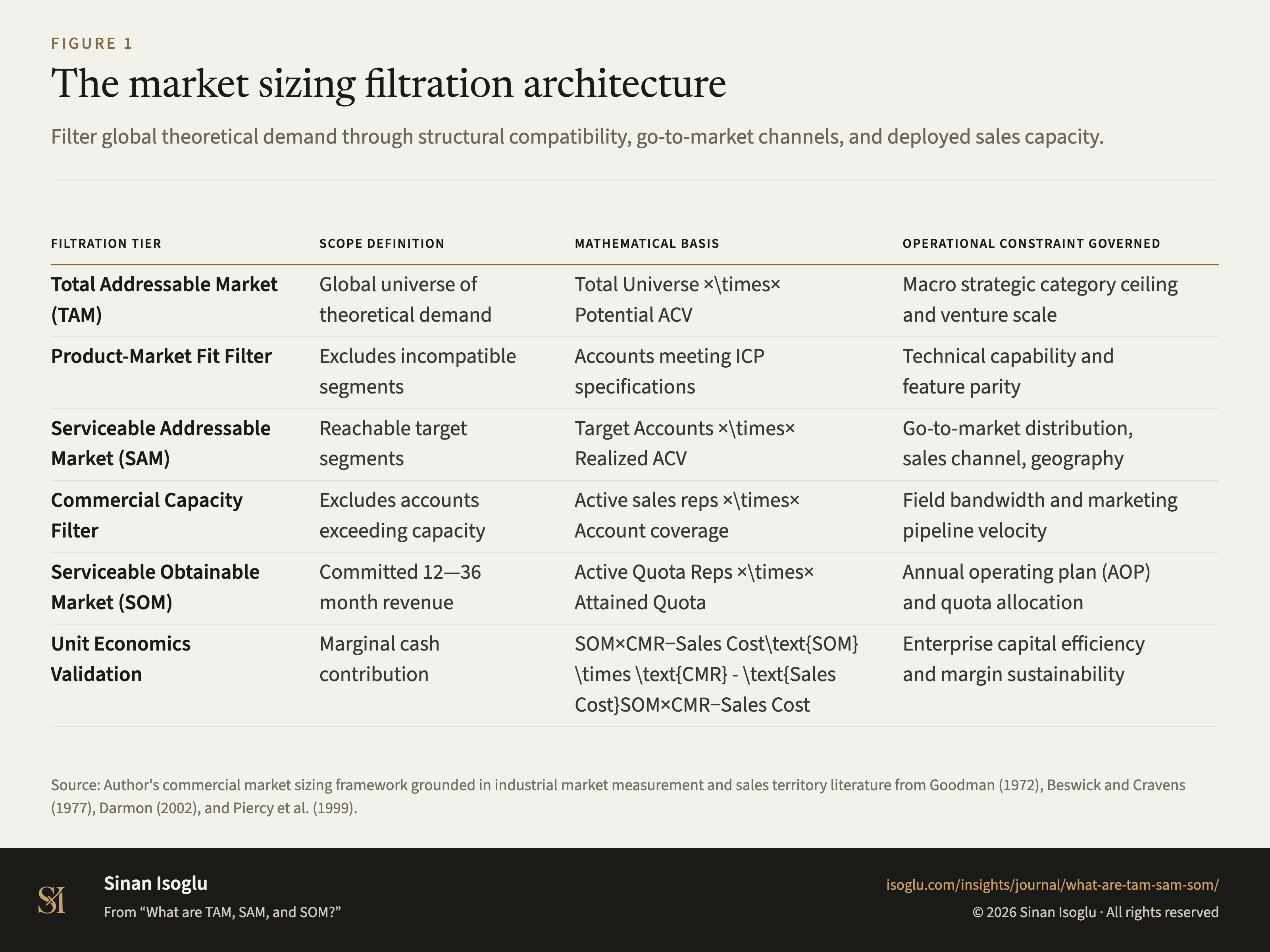
Abbildung 1Grafik
Die mehrstufige Marktpotenzialarchitektur
Was sind TAM, SAM und SOM?
Kontakt
Schicken Sie die Frage, an der Sie arbeiten.
Forschung, ein Gastvortrag oder eine Frage aus der Praxis.