← Every exhibit
Table 1From “The sales tooling minefield, twenty-four years on”
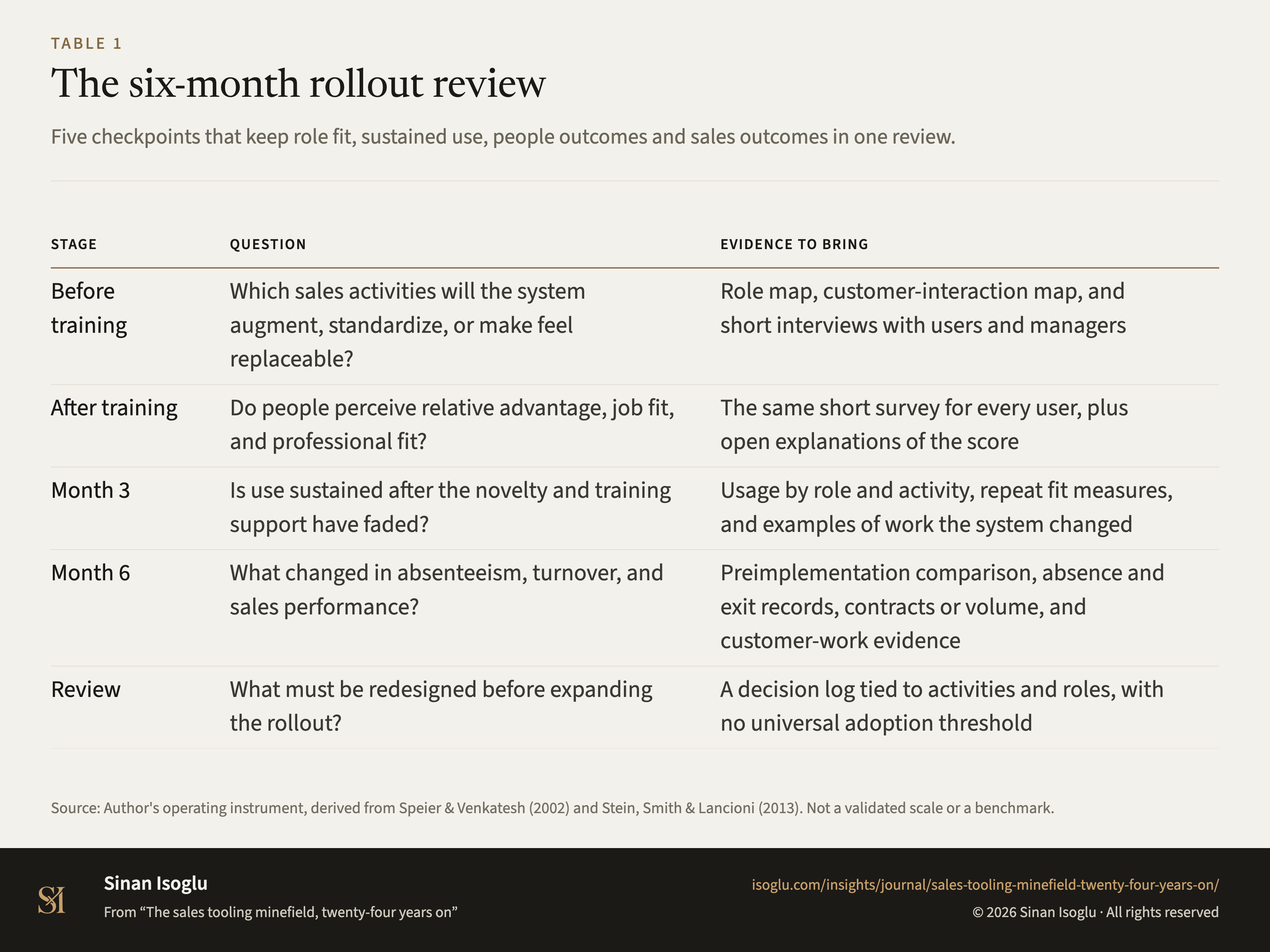
The six-month rollout review
Five checkpoints that keep role fit, sustained use, people outcomes and sales outcomes in one review.
Table 1The six-month rollout review
| Stage | Question | Evidence to bring |
|---|---|---|
| Before training | Which sales activities will the system augment, standardize, or make feel replaceable? | Role map, customer-interaction map, and short interviews with users and managers |
| After training | Do people perceive relative advantage, job fit, and professional fit? | The same short survey for every user, plus open explanations of the score |
| Month 3 | Is use sustained after the novelty and training support have faded? | Usage by role and activity, repeat fit measures, and examples of work the system changed |
| Month 6 | What changed in absenteeism, turnover, and sales performance? | Preimplementation comparison, absence and exit records, contracts or volume, and customer-work evidence |
| Review | What must be redesigned before expanding the rollout? | A decision log tied to activities and roles, with no universal adoption threshold |
Swipe or scroll horizontally if the table is wider than your screen.
Source: Author's operating instrument, derived from Speier & Venkatesh (2002) and Stein, Smith & Lancioni (2013). Not a validated scale or a benchmark.
PNG4:3, 1600 × 1200, with the title, the source line and the attribution set in the image isoglu-2026-sales-tooling-minefield-twenty-four-years-on-fig01.png
From the essay
Revenue operations & AI
The sales tooling minefield, twenty-four years on
One field study found positive reactions after sales force automation training, then rejection six months later. The signal was fit.
Read the essayThis exhibit belongs to an essay: the numbers live here, the argument lives there.
Cite or embed
Related exhibits
Contact
Bring the question you're working on.
Research, a guest lecture, or a commercial question.