Table 1From “Pricing architecture is a system, not a price list”
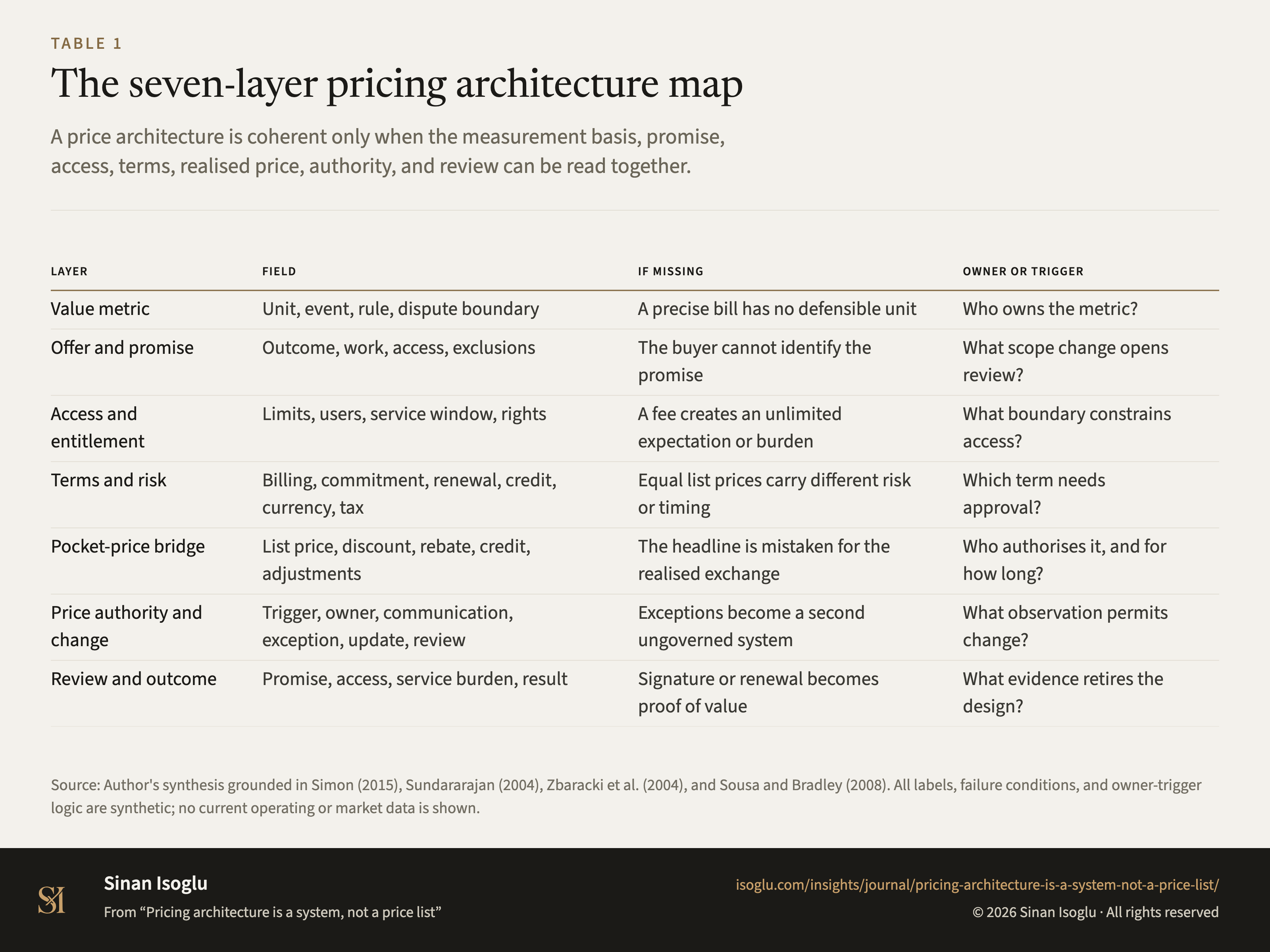
The seven-layer pricing architecture map
A price architecture is coherent only when the measurement basis, promise, access, terms, realised price, authority, and review can be read together.
Table 1The seven-layer pricing architecture map
| Layer | Field | If missing | Owner or trigger |
|---|---|---|---|
| Value metric | Unit, event, rule, dispute boundary | A precise bill has no defensible unit | Who owns the metric? |
| Offer and promise | Outcome, work, access, exclusions | The buyer cannot identify the promise | What scope change opens review? |
| Access and entitlement | Limits, users, service window, rights | A fee creates an unlimited expectation or burden | What boundary constrains access? |
| Terms and risk | Billing, commitment, renewal, credit, currency, tax | Equal list prices carry different risk or timing | Which term needs approval? |
| Pocket-price bridge | List price, discount, rebate, credit, adjustments | The headline is mistaken for the realised exchange | Who authorises it, and for how long? |
| Price authority and change | Trigger, owner, communication, exception, update, review | Exceptions become a second ungoverned system | What observation permits change? |
| Review and outcome | Promise, access, service burden, result | Signature or renewal becomes proof of value | What evidence retires the design? |
Swipe or scroll horizontally if the table is wider than your screen.
Source: Author's synthesis grounded in Simon (2015), Sundararajan (2004), Zbaracki et al. (2004), and Sousa and Bradley (2008). All labels, failure conditions, and owner-trigger logic are synthetic; no current operating or market data is shown.
Source and evidence
Each line names a claim related to this exhibit, its source, and how it was checked.
- B G04-C1 Price is not one number: the book sets out "the many dimensions of prices": bundles, negotiated prices, wholesale, retail and manufacturers' suggested retail pricesSimon (2015), pp. 11-13 · published full text
- B G04-C2 In B2B the list price is a starting point: suppliers use it "at best as guidance or starting point they negotiate intensely over terms and conditions such as discounts payment terms order minimums and on invoice and off invoice rebates"Simon (2015), pp. 12-13 · published full text
- B G04-C3 The two contracts and the cost of metering, in the paper's own words: it analyses optimal pricing "when both unlimited-usage (fixed-fee) pricing and usage-based pricing are feasible and administering usage-based pricing may involve transaction costs"Sundararajan (2004), abstract and pp. 1660-1662 · published full text
- A G04-C5 The cost types, named: "we identify and measure three types of managerial costs information gathering decision making and communication costs and two types of customer costs communication and negotiation costs"zbaracki-etal-2004-price-adjustment-costs · published full text
- A G04-C6 One firm, and the paper says so: the totals are "1 22 of the company s revenue and 20 03 of the company s net margin": a single U.S. industrial manufacturer, not a benchmarkzbaracki-etal-2004-price-adjustment-costs · published full text
- B G04-C7 The design and the measure: "using data collected from over 300 firms price adaptation and export performance were measured at the export venture level and analyzed by way of structural equation modeling"Sousa & Bradley. (2008) · full-text working paper
- B G04-C8 The conclusion is stated as a strategy implication drawn from cross-sectional associations: "We concluded that international pricing strategies should reflect the environmental characteristics of the foreign market"Sousa & Bradley. (2008) · full-text working paper
Grades: A, verified against the printed page of the primary source · B, primary source, text layer only · C, authoritative secondary · D, reported.
From the essay
Pricing & revenue architecture
Pricing architecture is a system, not a price list
A pricing architecture connects the value metric, offer, access, terms, pocket price, authority, change process, and review.
Read the essayThis exhibit belongs to an essay: the numbers live here, the argument lives there.
Cite or embed
Related exhibits
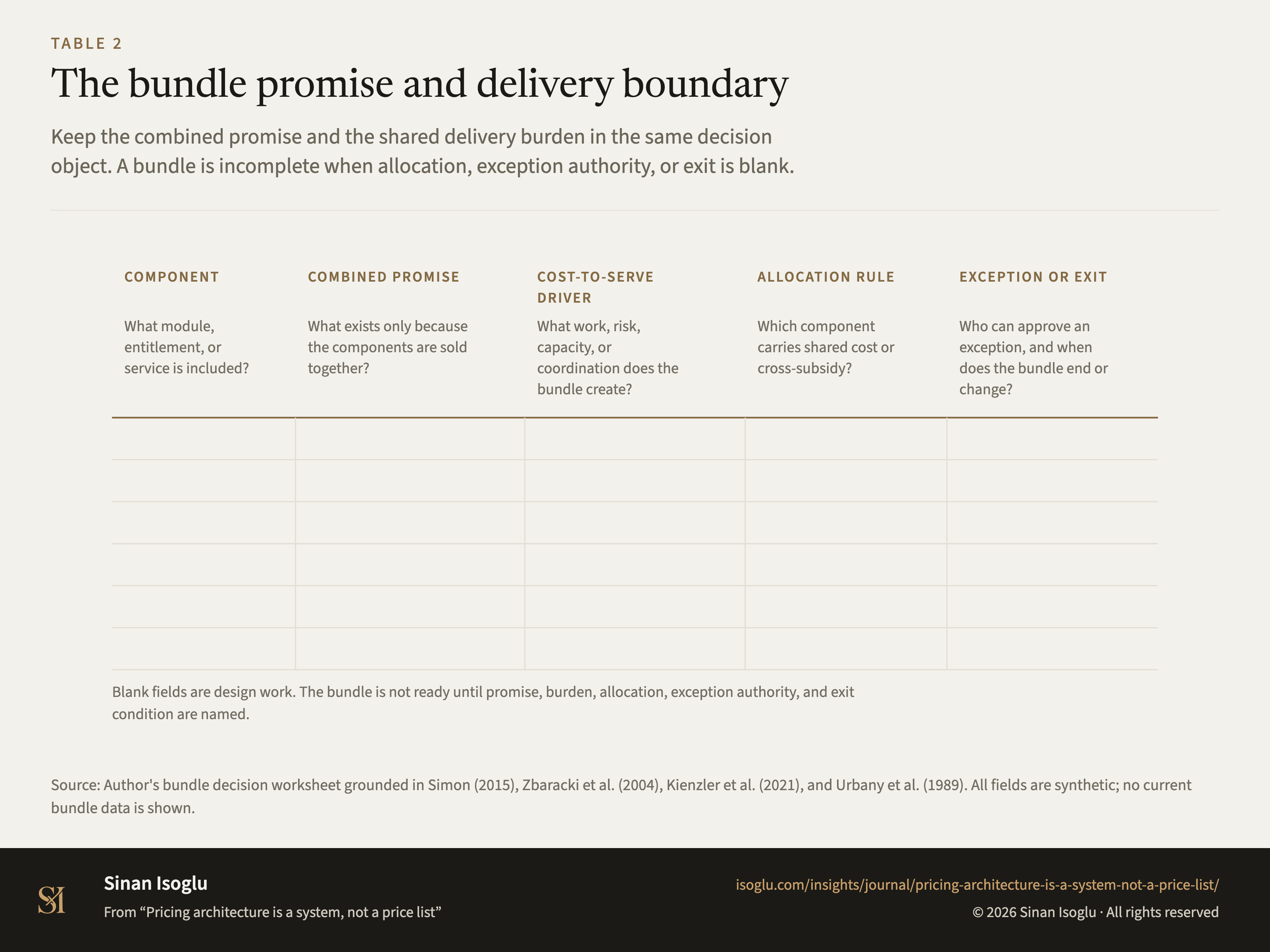
Table 2Table
The bundle promise and delivery boundary
Pricing architecture is a system, not a price list
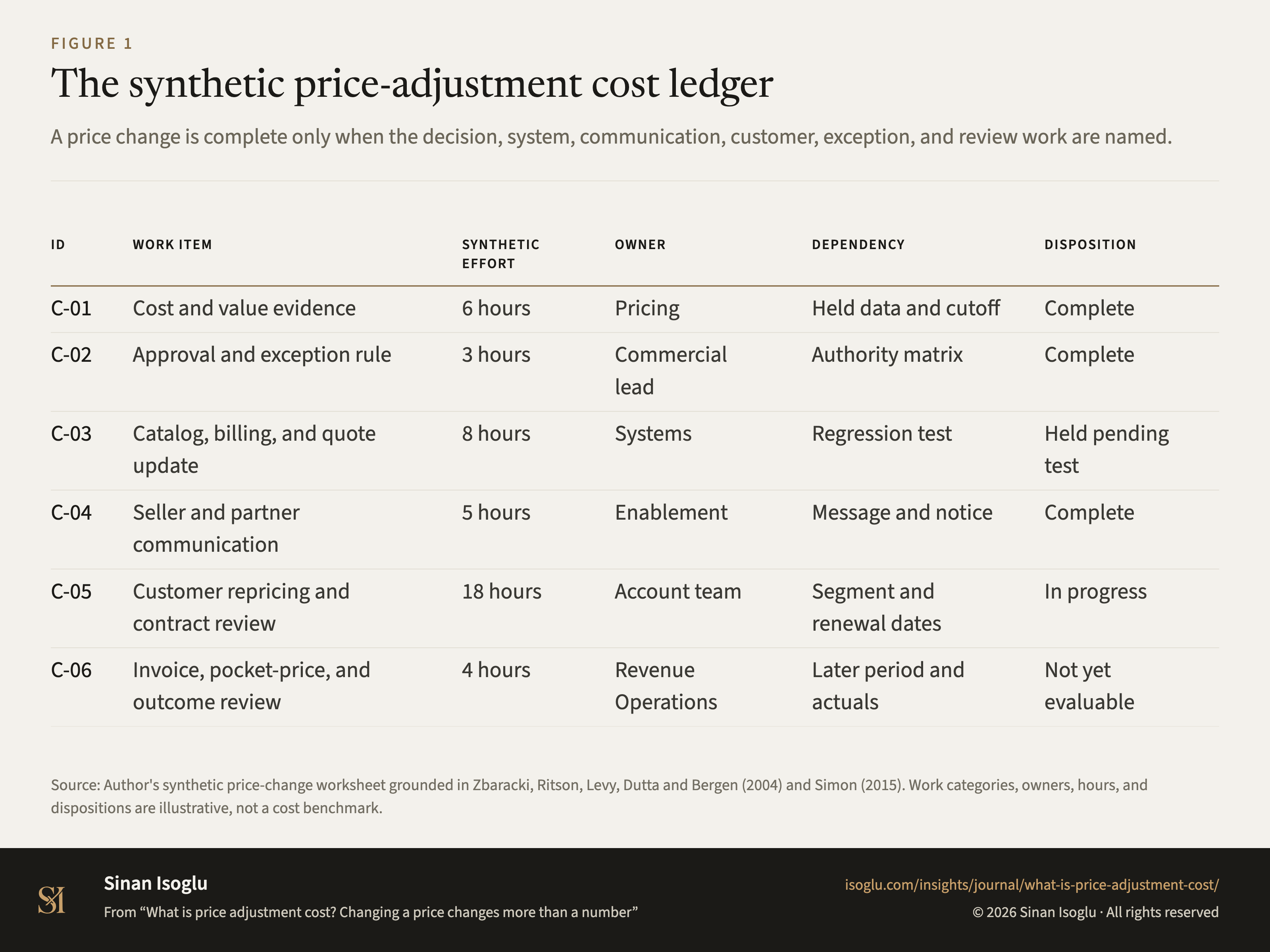
Figure 1Figure
The synthetic price-adjustment cost ledger
What is price adjustment cost? Changing a price changes more than a number
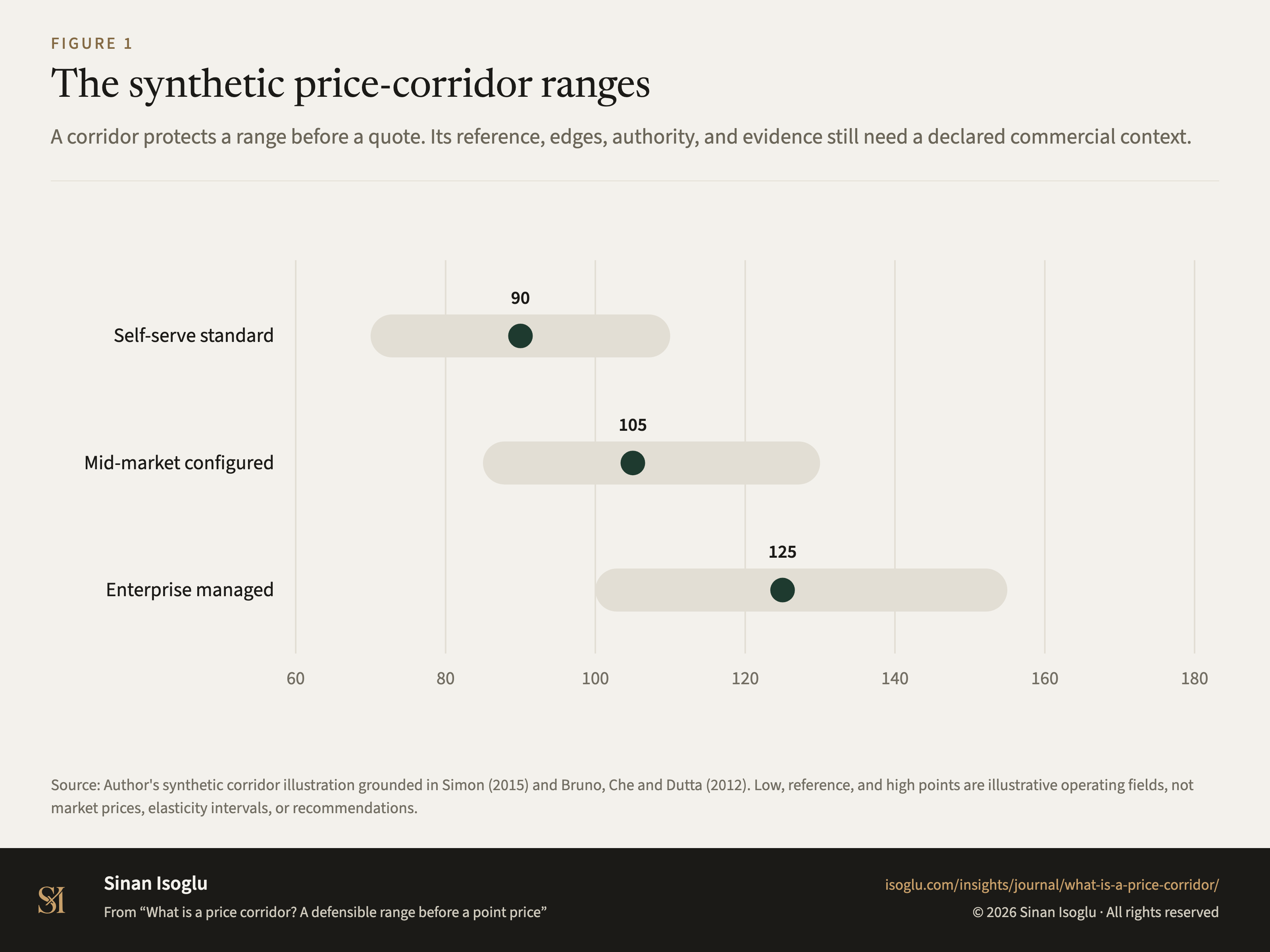
Figure 1Figure
The synthetic price-corridor ranges
What is a price corridor? A defensible range before a point price
Contact
Bring the question you're working on.
Research, a guest lecture, or a commercial question.