Table 1From “Your customer base is priced exactly once: or never”
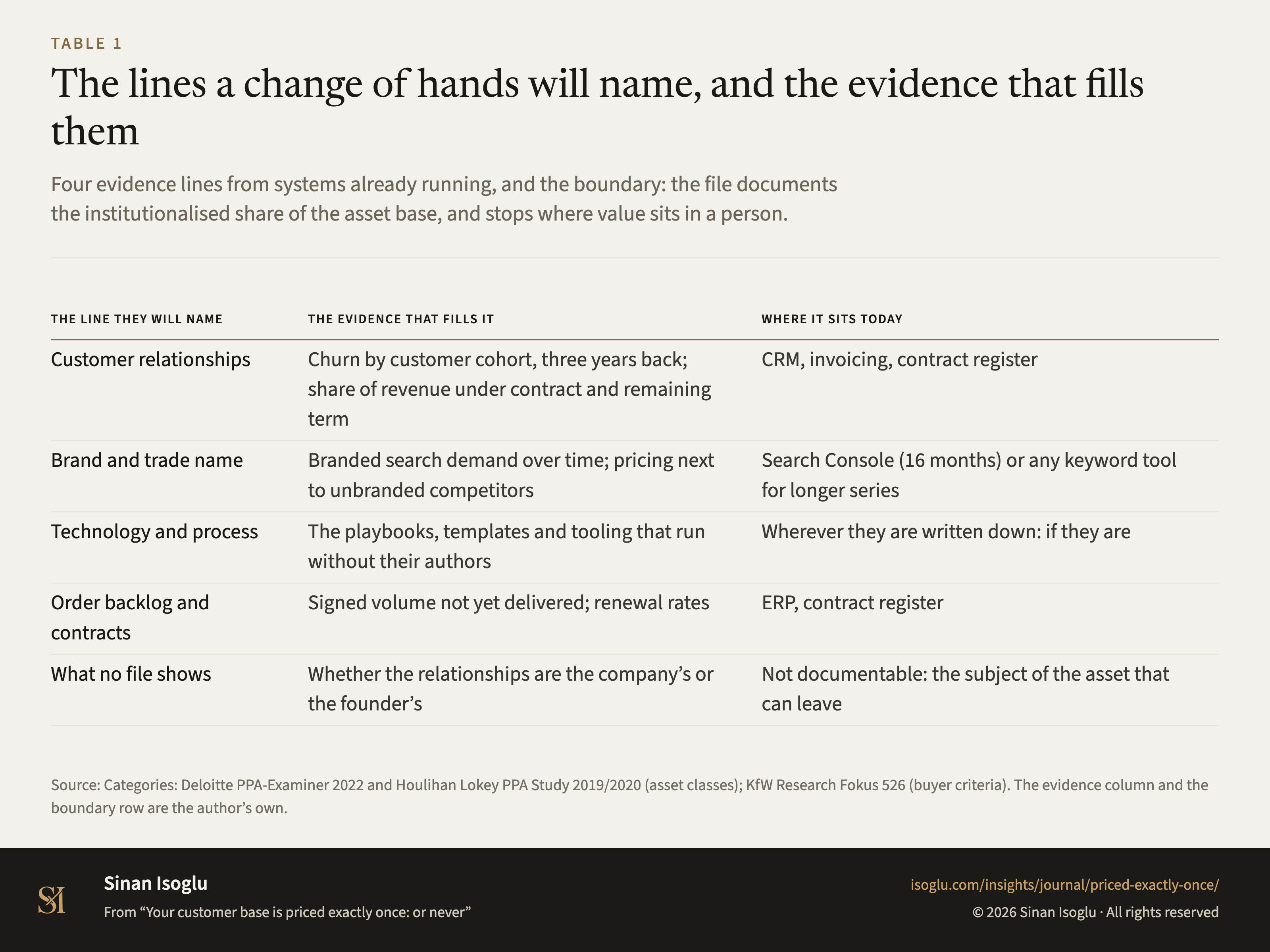
The lines a change of hands will name, and the evidence that fills them
Four evidence lines from systems already running, and the boundary: the file documents the institutionalised share of the asset base, and stops where value sits in a person.
Table 1The lines a change of hands will name, and the evidence that fills them
| The line they will name | The evidence that fills it | Where it sits today |
|---|---|---|
| Customer relationships | Churn by customer cohort, three years back; share of revenue under contract and remaining term | CRM, invoicing, contract register |
| Brand and trade name | Branded search demand over time; pricing next to unbranded competitors | Search Console (16 months) or any keyword tool for longer series |
| Technology and process | The playbooks, templates and tooling that run without their authors | Wherever they are written down: if they are |
| Order backlog and contracts | Signed volume not yet delivered; renewal rates | ERP, contract register |
| What no file shows | Whether the relationships are the company's or the founder's | Not documentable: the subject of the asset that can leave |
Swipe or scroll horizontally if the table is wider than your screen.
Source: Categories: Deloitte PPA-Examiner 2022 and Houlihan Lokey PPA Study 2019/2020 (asset classes); KfW Research Fokus 526 (buyer criteria). The evidence column and the boundary row are the author’s own.
From the essay
Growth that compounds
Your customer base is priced exactly once: or never
Self-built brands and customer lists may not enter your own balance sheet. They are named and priced when the company changes hands: often not even then.
Read the essayThis exhibit belongs to an essay: the numbers live here, the argument lives there.
Cite or embed
Related exhibits

Figure 1Figure
What the books report, and what an acquisition names
Your customer base is priced exactly once: or never

Figure 2Figure
The deal governance audit
The European failure number nobody quotes
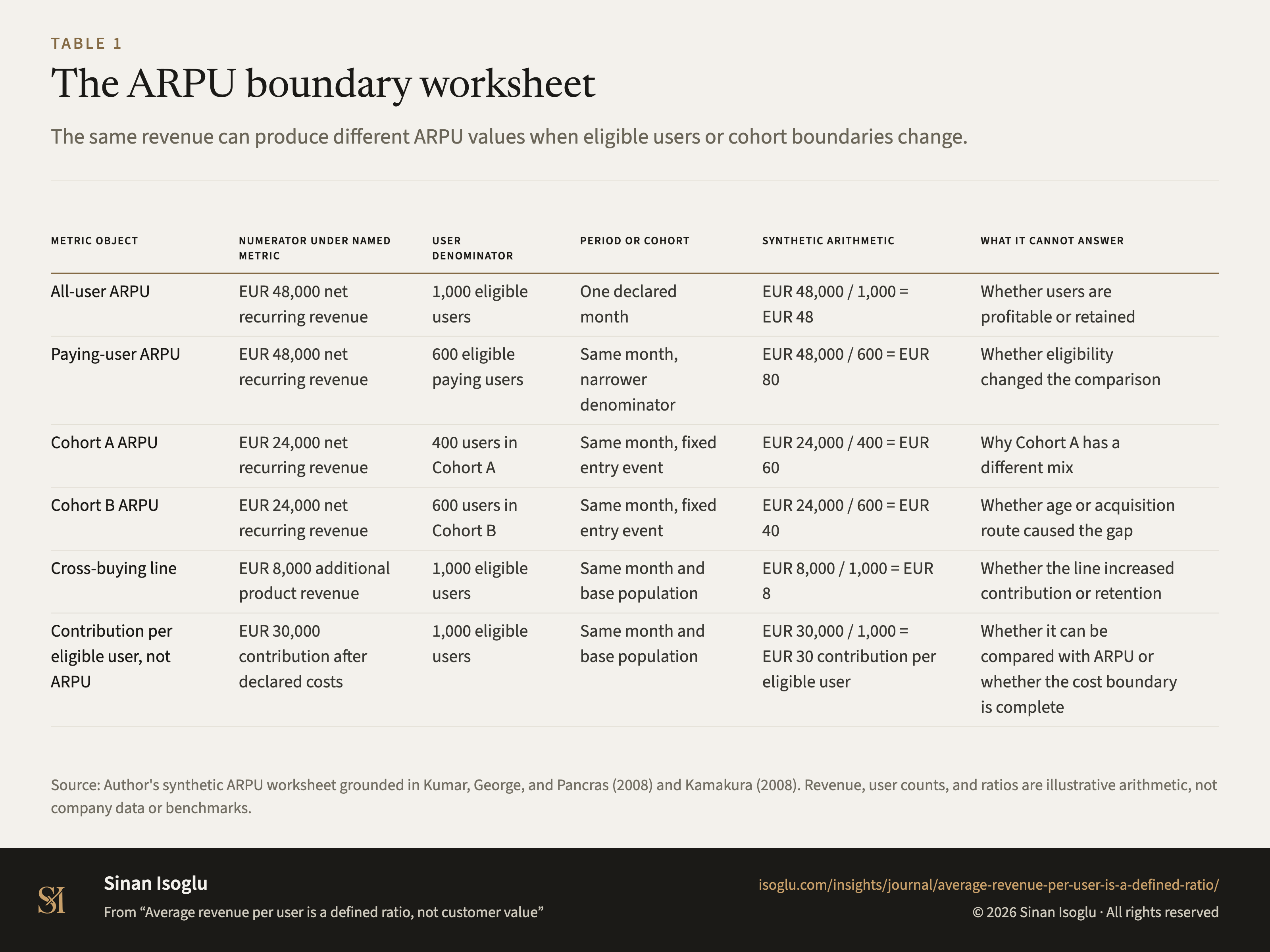
Table 1Table
The ARPU boundary worksheet
Average revenue per user is a defined ratio, not customer value
Contact
Bring the question you're working on.
Research, a guest lecture, or a commercial question.