Table 1From “Price elasticity is not a property of your market”
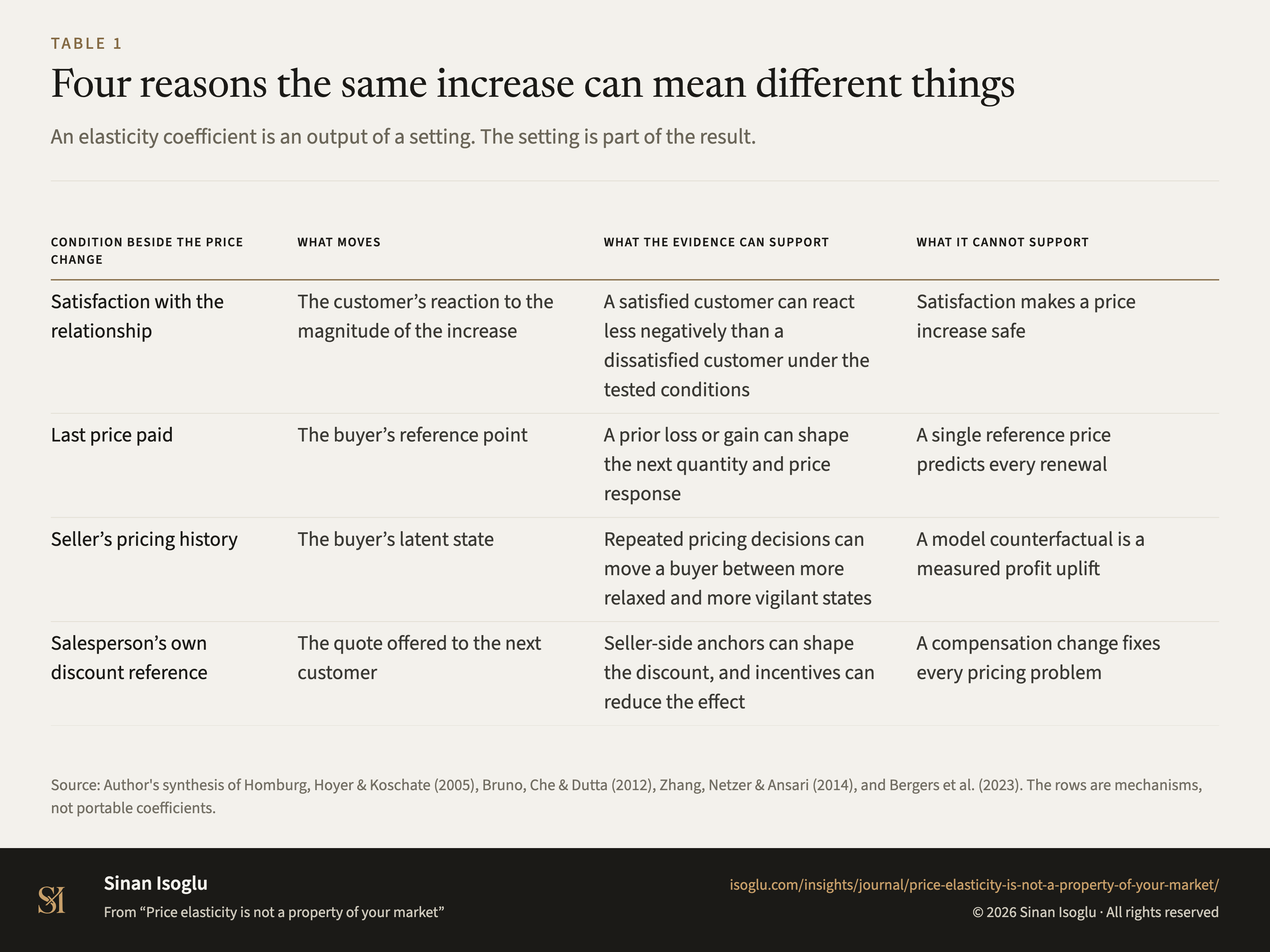
Four reasons the same increase can mean different things
An elasticity coefficient is an output of a setting. The setting is part of the result.
Table 1Four reasons the same increase can mean different things
| Condition beside the price change | What moves | What the evidence can support | What it cannot support |
|---|---|---|---|
| Satisfaction with the relationship | The customer's reaction to the magnitude of the increase | A satisfied customer can react less negatively than a dissatisfied customer under the tested conditions | Satisfaction makes a price increase safe |
| Last price paid | The buyer's reference point | A prior loss or gain can shape the next quantity and price response | A single reference price predicts every renewal |
| Seller's pricing history | The buyer's latent state | Repeated pricing decisions can move a buyer between more relaxed and more vigilant states | A model counterfactual is a measured profit uplift |
| Salesperson's own discount reference | The quote offered to the next customer | Seller-side anchors can shape the discount, and incentives can reduce the effect | A compensation change fixes every pricing problem |
Swipe or scroll horizontally if the table is wider than your screen.
Source: Author's synthesis of Homburg, Hoyer & Koschate (2005), Bruno, Che & Dutta (2012), Zhang, Netzer & Ansari (2014), and Bergers et al. (2023). The rows are mechanisms, not portable coefficients.
From the essay
Pricing & revenue architecture
Price elasticity is not a property of your market
Price elasticity changes with satisfaction, reference prices, incentives and time. Read the conditions around the number before making a pricing decision.
Read the essayThis exhibit belongs to an essay: the numbers live here, the argument lives there.
Cite or embed
Related exhibits
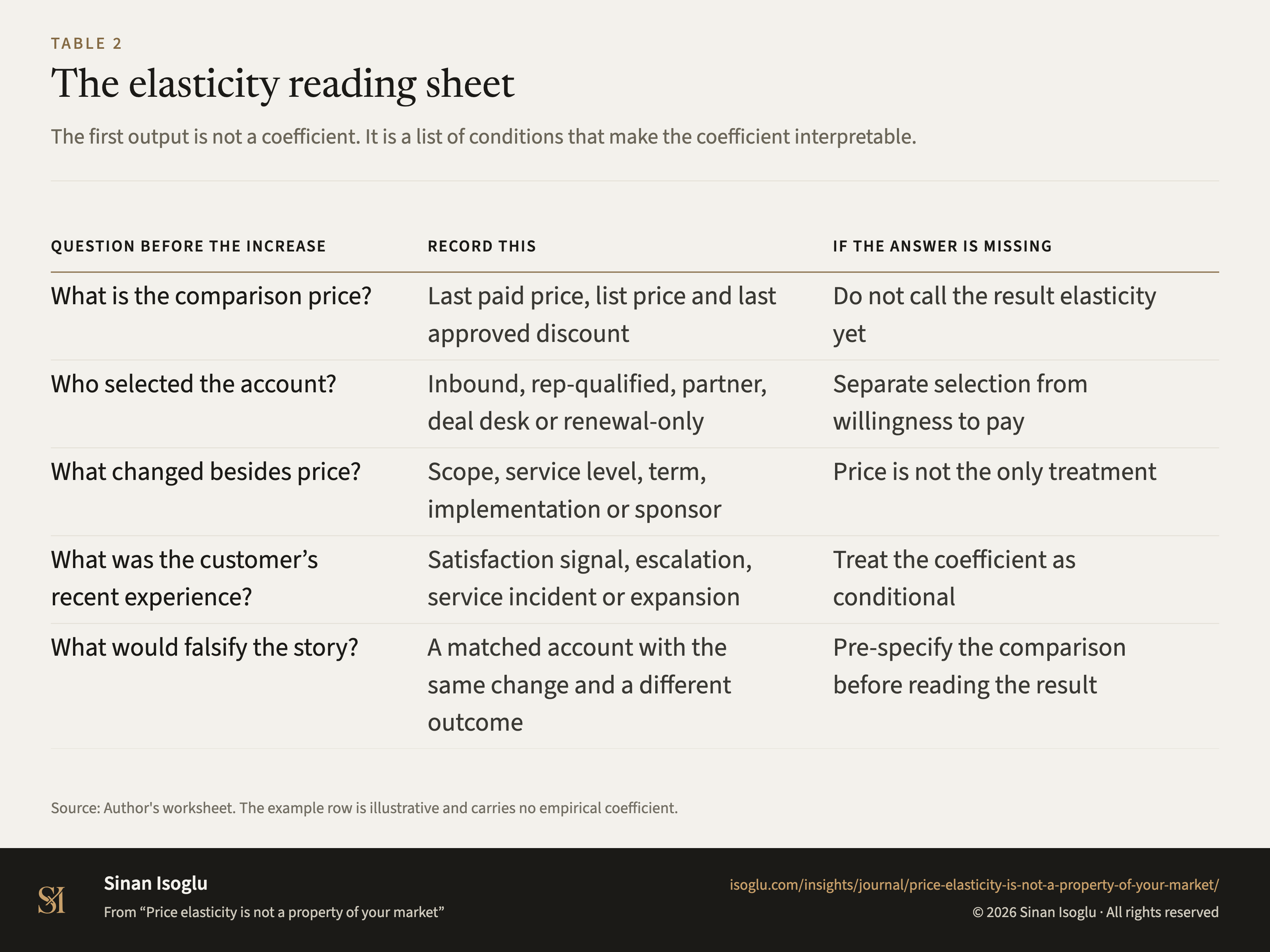
Table 2Table
The elasticity reading sheet
Price elasticity is not a property of your market
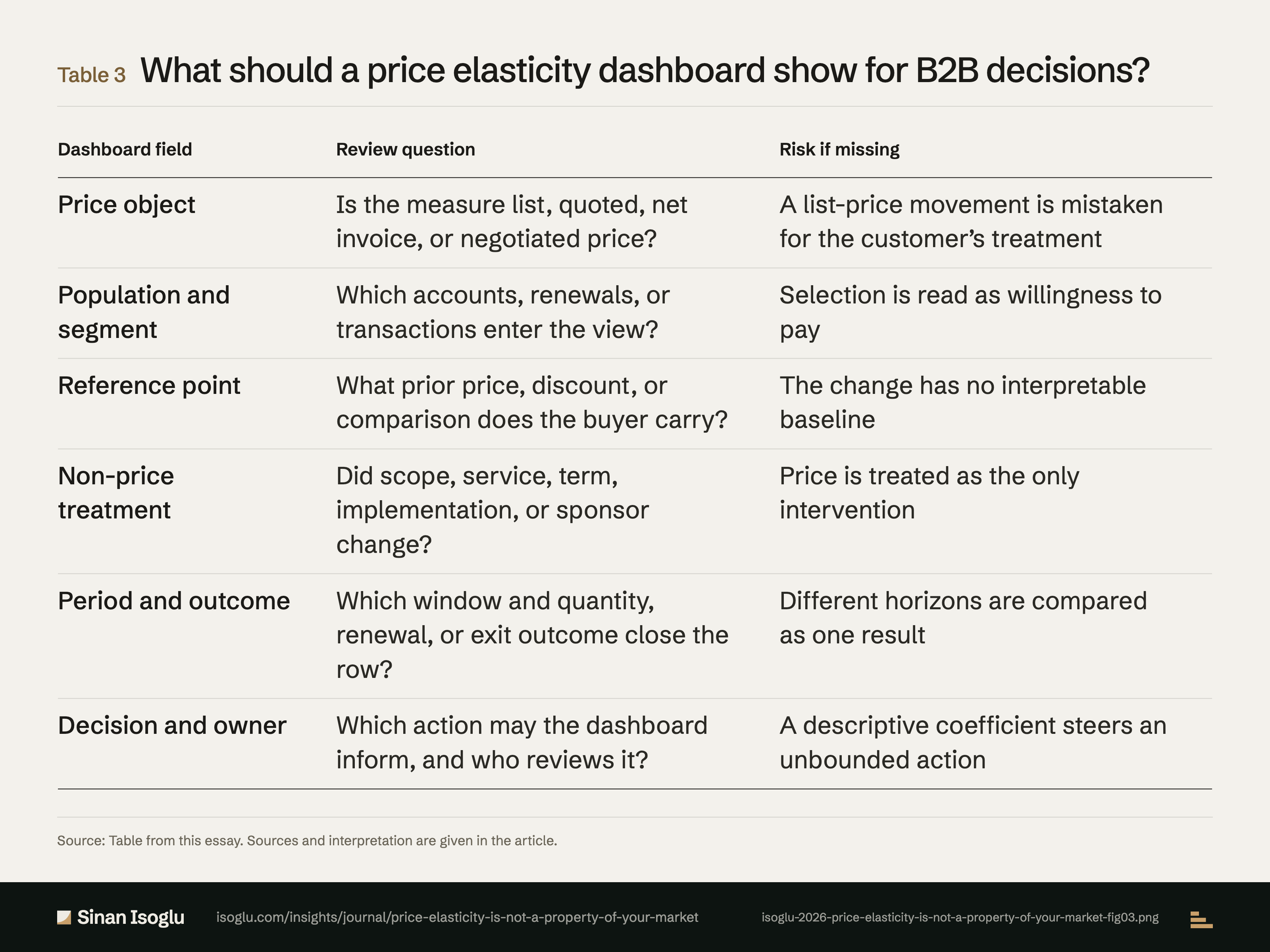
Table 3Table
What should a price elasticity dashboard show for B2B decisions?
Price elasticity is not a property of your market
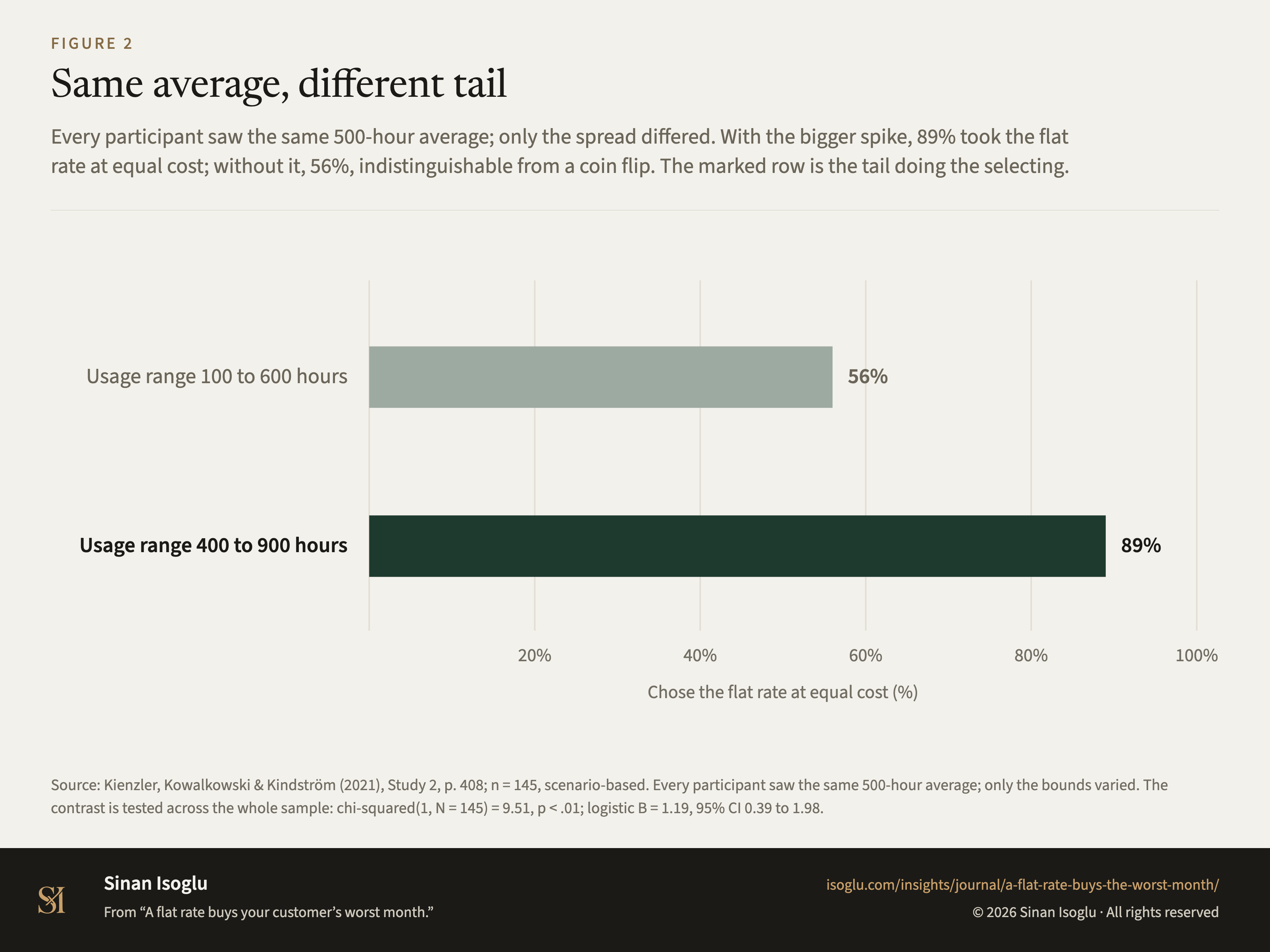
Figure 2Figure
Same average, different tail
A flat rate buys your customer’s worst month.
Contact
Bring the question you're working on.
Research, a guest lecture, or a commercial question.