Table 1From “A segment is real when a decision changes”
The segment-to-decision map
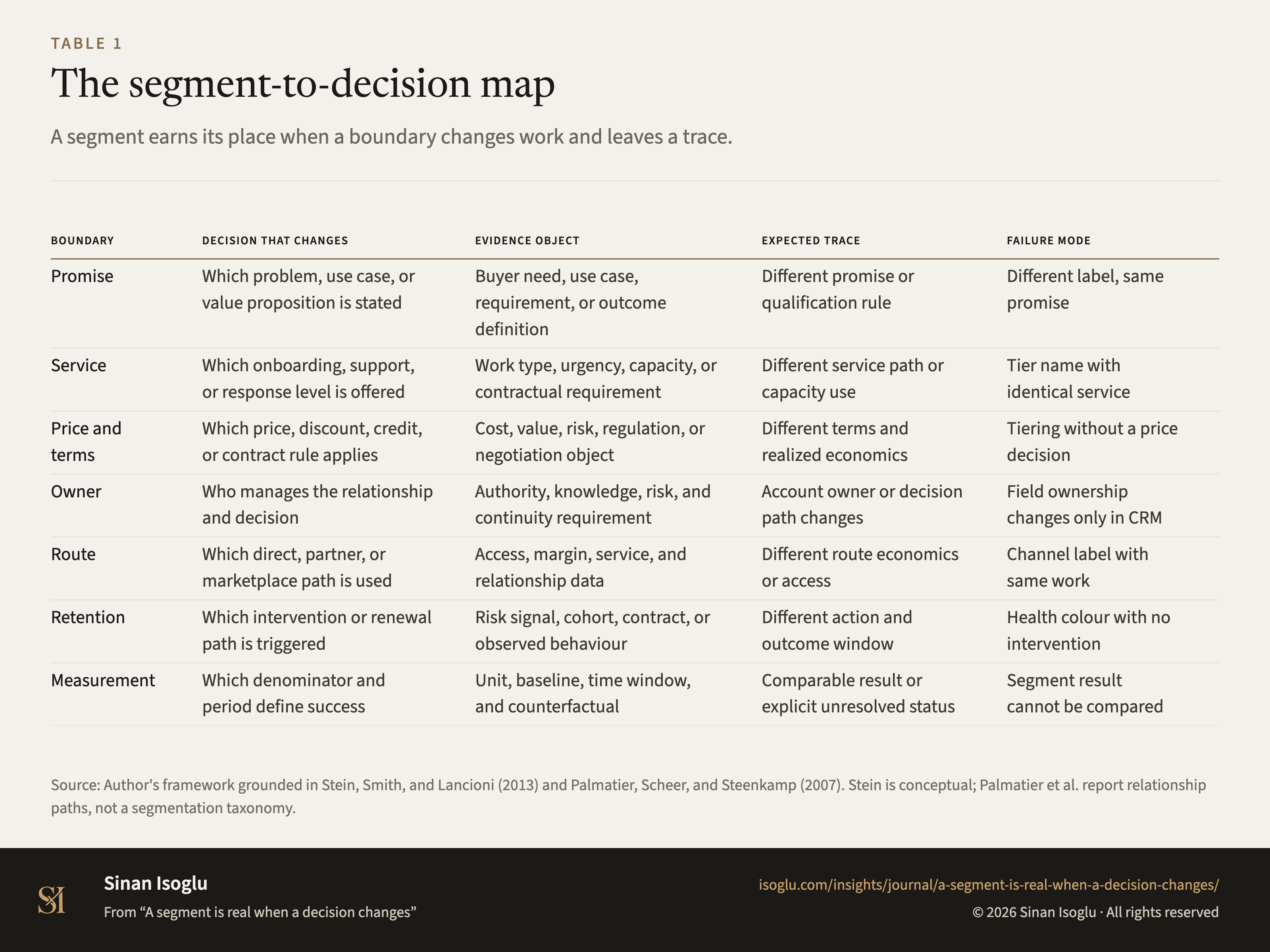
A segment earns its place when a boundary changes work and leaves a trace.
Table 1The segment-to-decision map
| Boundary | Decision that changes | Evidence object | Expected trace | Failure mode |
|---|---|---|---|---|
| Promise | Which problem, use case, or value proposition is stated | Buyer need, use case, requirement, or outcome definition | Different promise or qualification rule | Different label, same promise |
| Service | Which onboarding, support, or response level is offered | Work type, urgency, capacity, or contractual requirement | Different service path or capacity use | Tier name with identical service |
| Price and terms | Which price, discount, credit, or contract rule applies | Cost, value, risk, regulation, or negotiation object | Different terms and realized economics | Tiering without a price decision |
| Owner | Who manages the relationship and decision | Authority, knowledge, risk, and continuity requirement | Account owner or decision path changes | Field ownership changes only in CRM |
| Route | Which direct, partner, or marketplace path is used | Access, margin, service, and relationship data | Different route economics or access | Channel label with same work |
| Retention | Which intervention or renewal path is triggered | Risk signal, cohort, contract, or observed behaviour | Different action and outcome window | Health colour with no intervention |
| Measurement | Which denominator and period define success | Unit, baseline, time window, and counterfactual | Comparable result or explicit unresolved status | Segment result cannot be compared |
Swipe or scroll horizontally if the table is wider than your screen.
Source: Author's framework grounded in Stein, Smith, and Lancioni (2013) and Palmatier, Scheer, and Steenkamp (2007). Stein is conceptual; Palmatier et al. report relationship paths, not a segmentation taxonomy.
Source and evidence
Each line names a claim related to this exhibit, its source, and how it was checked.
- B SSL13-C1 The paper is conceptual and its object is the diffusion of a capability: "The development and diffusion of customer relationship management (CRM) intelligence in business-to-business environments"Stein, Smith & Lancioni. (2013)
- B SSL13-C2 The gap the paper names: management has "neglected to analyze this information across market segments, customer categories, and customer"-firm relationship forms, and its method aims at "an improved understanding of the in-forming process in the firm"'s dealings with clients and "the directionality of customer"-firm decision-makingStein, Smith & Lancioni. (2013)
- A PSS07-C1 The design is dyadic and triadic: "In a study of 362 buyer"-"salesperson dyads using triadic data (from buyer, salesperson, and sales manager)", and the construct is new: "only salesperson-owned loyalty, a newly identified construct, directly affects the more tangible seller financial outcomes of sales growth and selling effectiveness"Palmatier, Scheer & Steenkamp (2007), Table 3
- A PSS07-C2 Stated intention, and the item says its own horizon: buyers "reported that they would try to shift an average of 26% of" their current purchases, the question being whether they would "try to shift to this salesperson"'"s new rep firm over the next 3 years?" Intention, not realised movementPalmatier, Scheer & Steenkamp (2007), appendix and p. 195
- A PSS07-C3 The contrast is between the two loyalties, in the authors' words: "only salesperson-owned loyalty, a newly identified construct, directly affects the more tangible seller financial outcomes of sales growth and selling effectiveness"Palmatier, Scheer & Steenkamp (2007), Table 3
- A PSS07-C4 The paper reports measured firm and interface levers that alter salesperson-owned loyalty and firm-loyalty paths: "Increasing relationship-enhancing activities and value received by the customer builds both salesperson-owned loyalty and loyalty to the selling firm"; the impact is moderated by selling-firm consistency and loyalty-capturing strategiesPalmatier, Scheer & Steenkamp (2007), abstract and Tables 3 and 4
- B B09-C1 A segment is operational only when its boundary changes a promise, service level, price or terms, owner or route, or retention actionAuthor framework grounded in Stein, Smith and Lancioni and customer-relationship evidence
- B B09-C2 A segment label should be tested by the decision it changes and the cost or outcome that moves afterward, not by the label's descriptive appealAuthor framework
Grades: A, verified against the printed page of the primary source · B, primary source, text layer only · C, authoritative secondary · D, reported.
From the essay
Growth that compounds
A segment is real when a decision changes
A segment is operational only when its boundary changes a promise, service, price, owner, route, or retention action, then leaves an observable trace.
Read the essayThis exhibit belongs to an essay: the numbers live here, the argument lives there.
Cite or embed
Related exhibits
Table 1Table
The quota-parent matrix
Quota attainment has more than one parent
Table 1Table
The triadic loyalty decomposition
The retention number is measured from your side of the table
Table 1Table
The objects behind preferred customer treatment
Preferred customer treatment is relative resource allocation
Contact
Bring the question you're working on.
Research, a guest lecture, or a commercial question.