← Every exhibit
Table 1From “Net revenue retention is a cohort definition”
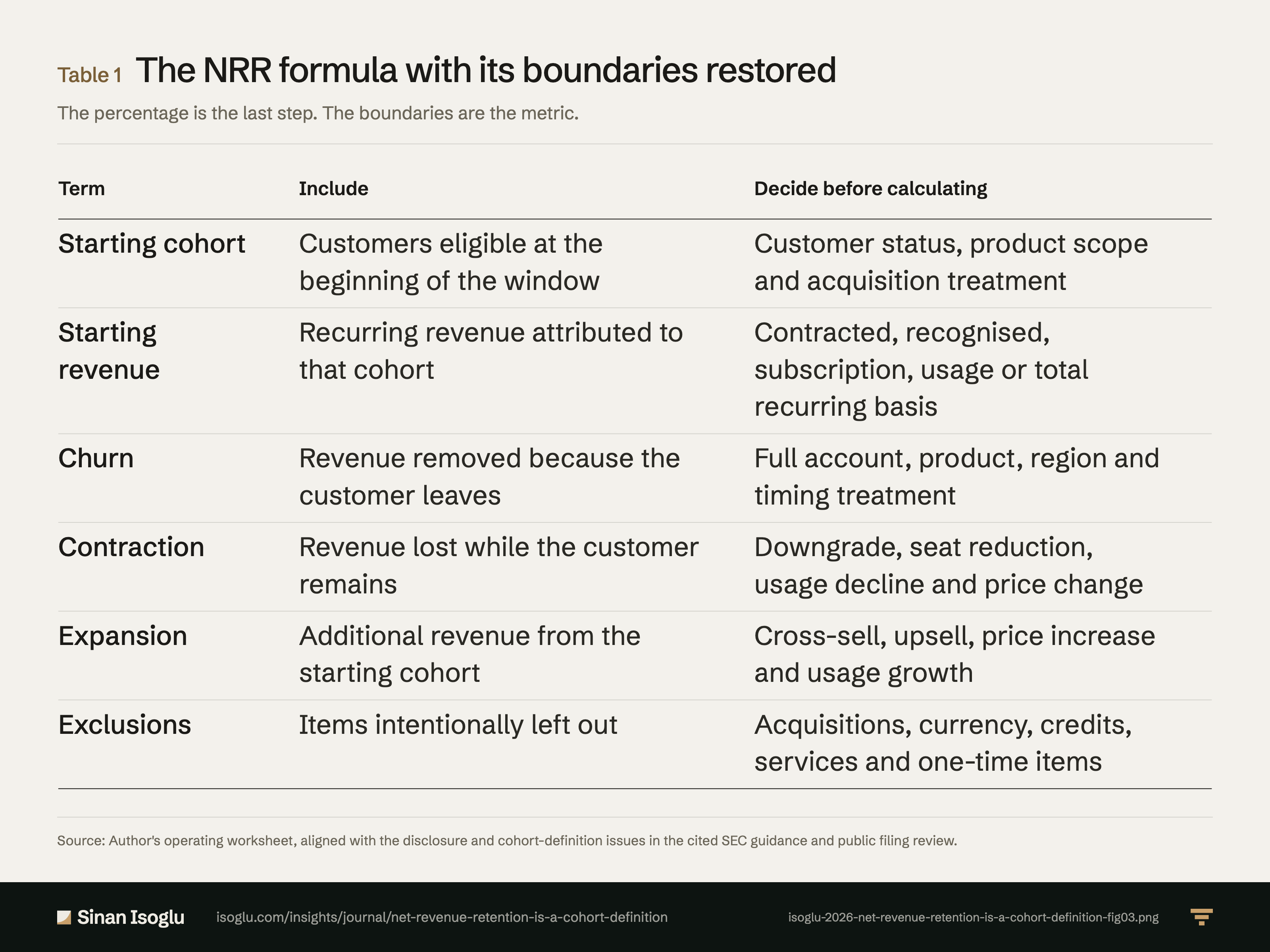
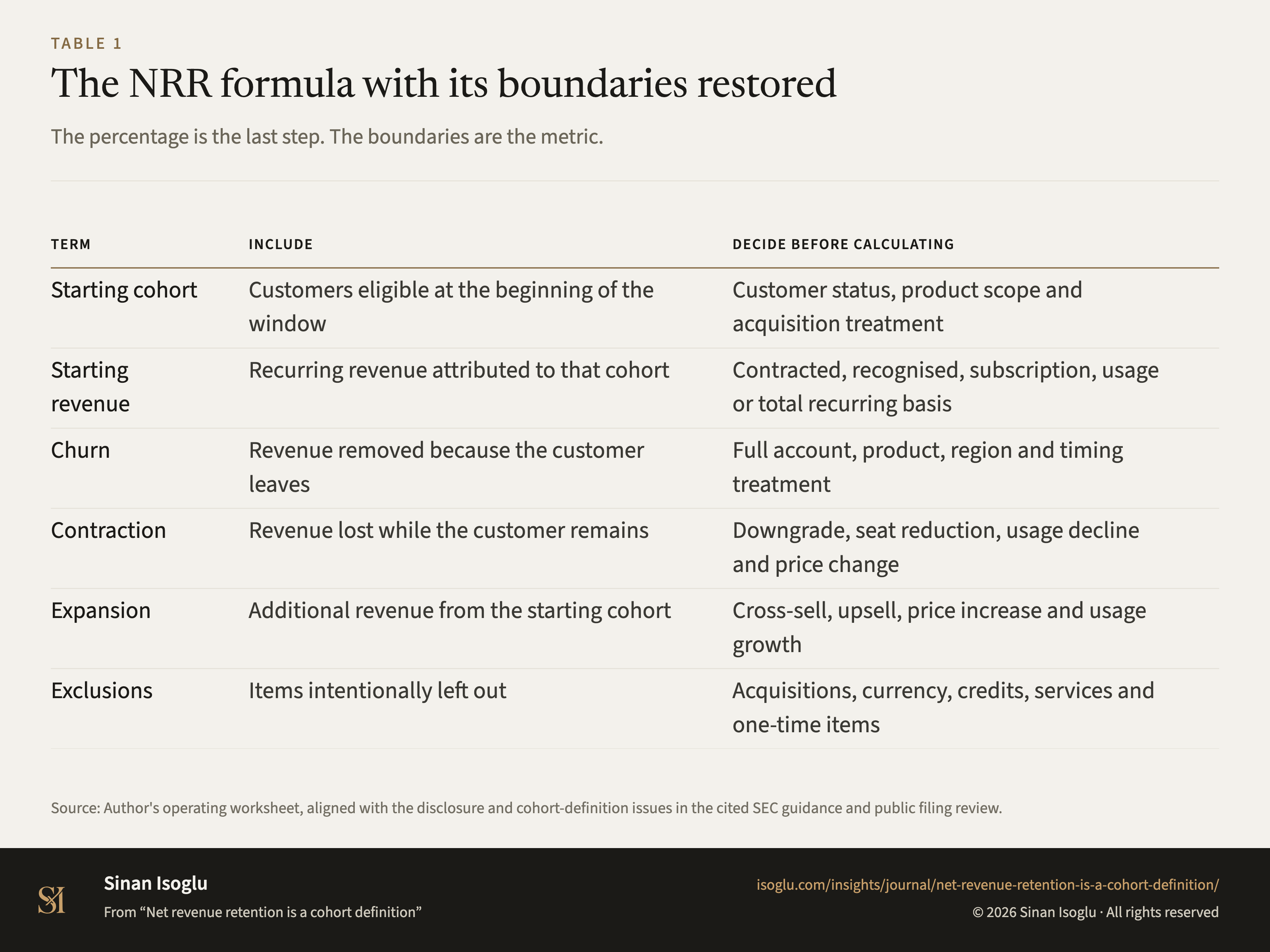
The NRR formula with its boundaries restored
The percentage is the last step. The boundaries are the metric.
Table 1The NRR formula with its boundaries restored
| Term | Include | Decide before calculating |
|---|---|---|
| Starting cohort | Customers eligible at the beginning of the window | Customer status, product scope and acquisition treatment |
| Starting revenue | Recurring revenue attributed to that cohort | Contracted, recognised, subscription, usage or total recurring basis |
| Churn | Revenue removed because the customer leaves | Full account, product, region and timing treatment |
| Contraction | Revenue lost while the customer remains | Downgrade, seat reduction, usage decline and price change |
| Expansion | Additional revenue from the starting cohort | Cross-sell, upsell, price increase and usage growth |
| Exclusions | Items intentionally left out | Acquisitions, currency, credits, services and one-time items |
Swipe or scroll horizontally if the table is wider than your screen.
Source: Author's operating worksheet, aligned with the disclosure and cohort-definition issues in the cited SEC guidance and public filing review.
PNG4:3, 1600 × 1200, with the title, the source line and the attribution set in the image isoglu-2026-net-revenue-retention-is-a-cohort-definition-fig03.png
From the essay
Revenue operations & AI
Net revenue retention is a cohort definition
Net revenue retention is a cohort definition before it is a growth metric. Fix the population, revenue boundary and time window before comparing it.
Read the essayThis exhibit belongs to an essay: the numbers live here, the argument lives there.
Cite or embed
Related exhibits
Contact
Bring the question you're working on.
Research, a guest lecture, or a commercial question.