Table 1From “A public forum is not a market survey”
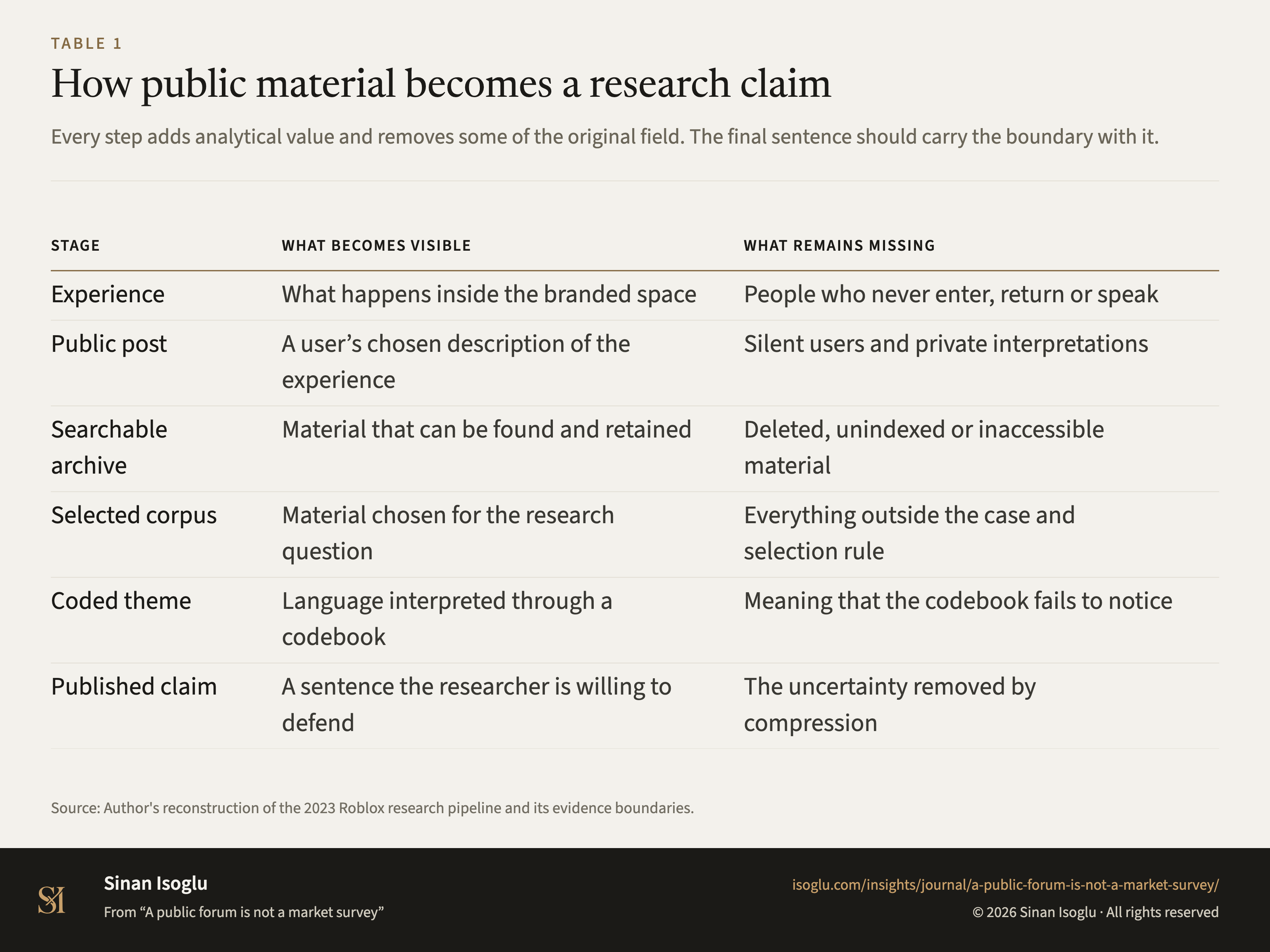
How public material becomes a research claim
Every step adds analytical value and removes some of the original field. The final sentence should carry the boundary with it.
Table 1How public material becomes a research claim
| Stage | What becomes visible | What remains missing |
|---|---|---|
| Experience | What happens inside the branded space | People who never enter, return or speak |
| Public post | A user's chosen description of the experience | Silent users and private interpretations |
| Searchable archive | Material that can be found and retained | Deleted, unindexed or inaccessible material |
| Selected corpus | Material chosen for the research question | Everything outside the case and selection rule |
| Coded theme | Language interpreted through a codebook | Meaning that the codebook fails to notice |
| Published claim | A sentence the researcher is willing to defend | The uncertainty removed by compression |
Swipe or scroll horizontally if the table is wider than your screen.
Source: Author's reconstruction of the 2023 Roblox research pipeline and its evidence boundaries.
Source and evidence
Each line names a claim related to this exhibit, its source, and how it was checked.
- B SI23-C3 The material combined observation with public discussions, reviews, descriptions, profiles and user-generated contentSubmitted Isoglu (2023) bachelor thesis, method and findings
- B SI23-C4 Private or semi-private material, including in-game chat, was excluded and no demographic sample was collectedSubmitted Isoglu (2023) bachelor thesis, ethics and limitations
- B SI23-C10 The study is a purposive qualitative case account and not a representative or causal estimateSubmitted Isoglu (2023) bachelor thesis, method and limitations
- A OR24-C1 Brand polarization is defined by strong feeling at both ends rather than by mixed opinion: "polarization maintains strong emotions at both ends of the spectrum, concurrently attending to the antipodes of brand love and brand hate", and as an outcome it is a brand property: "As an outcome, polarization is a property of a brand, where a polarizing brand causes sharp division into opposing groups of individuals"Osuna et al. (2024)
Grades: A, verified against the printed page of the primary source · B, primary source, text layer only · C, authoritative secondary · D, reported.
From the essay
From the research bench
A public forum is not a market survey
Public community material can reveal how a branded experience is talked about, but visibility, self-selection and ethics decide what it cannot represent.
Read the essayThis exhibit belongs to an essay: the numbers live here, the argument lives there.
Cite or embed
Related exhibits
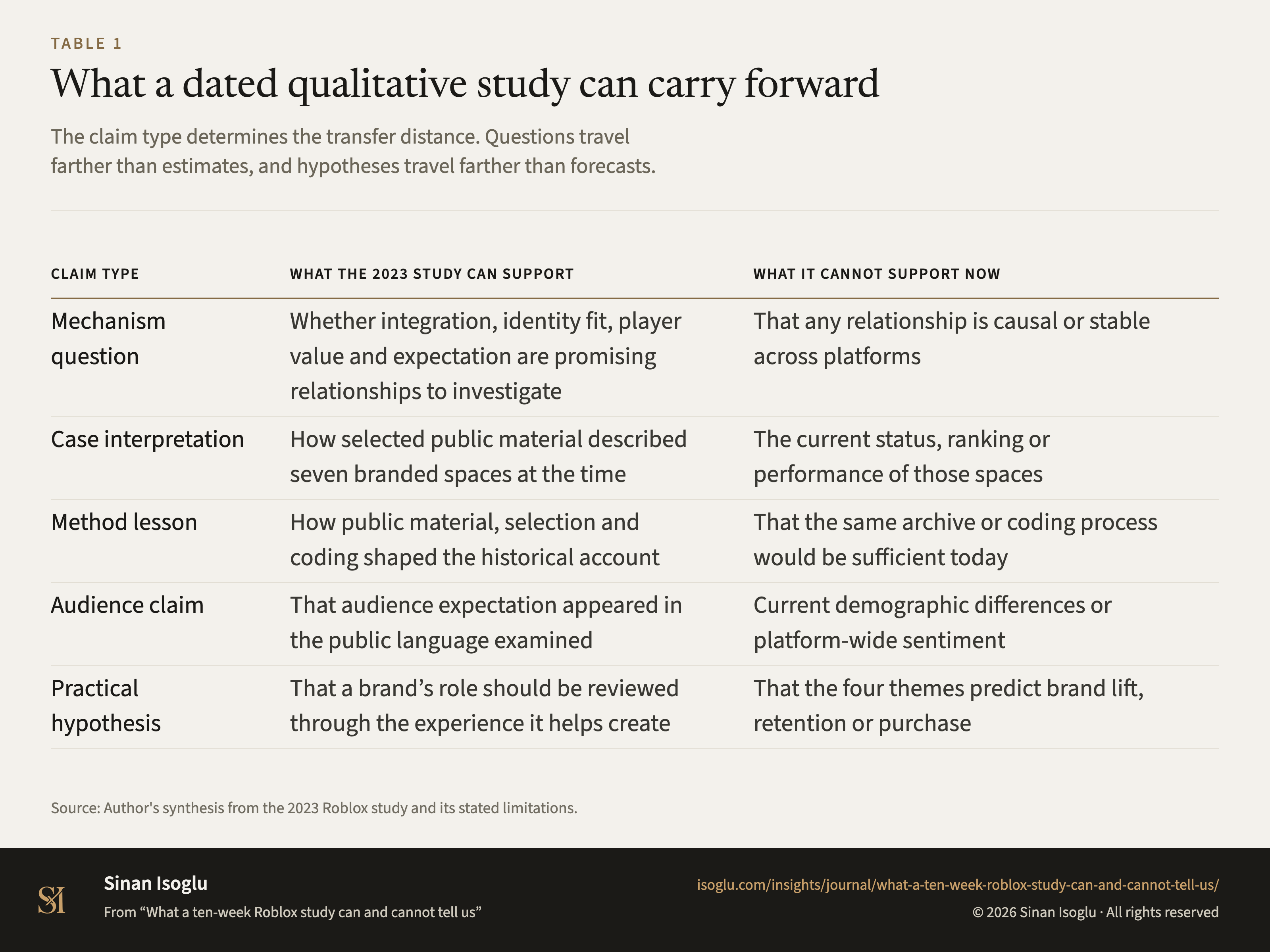
Table 1Table
What a dated qualitative study can carry forward
What a ten-week Roblox study can and cannot tell us
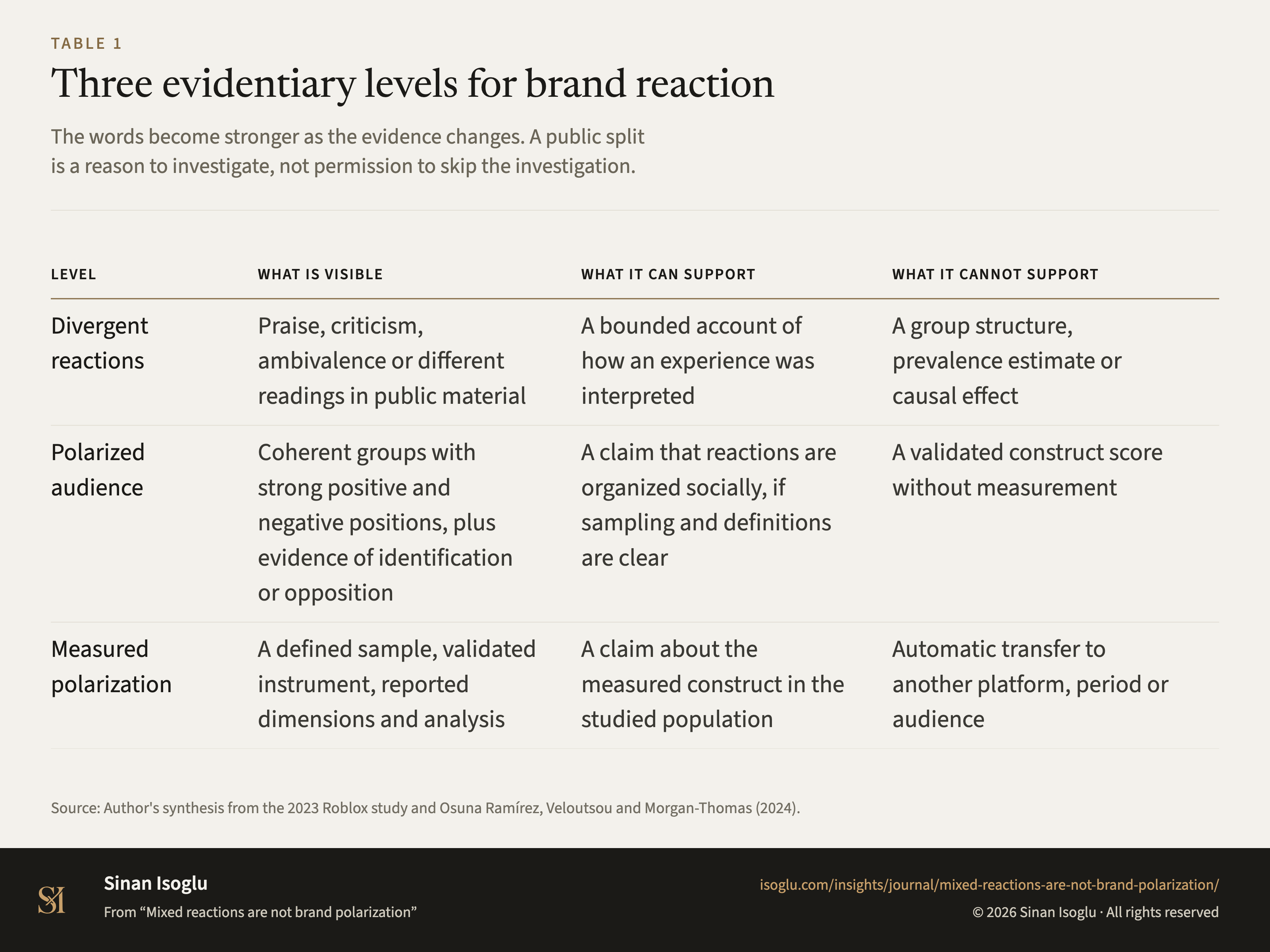
Table 1Table
Three evidentiary levels for brand reaction
Mixed reactions are not brand polarization
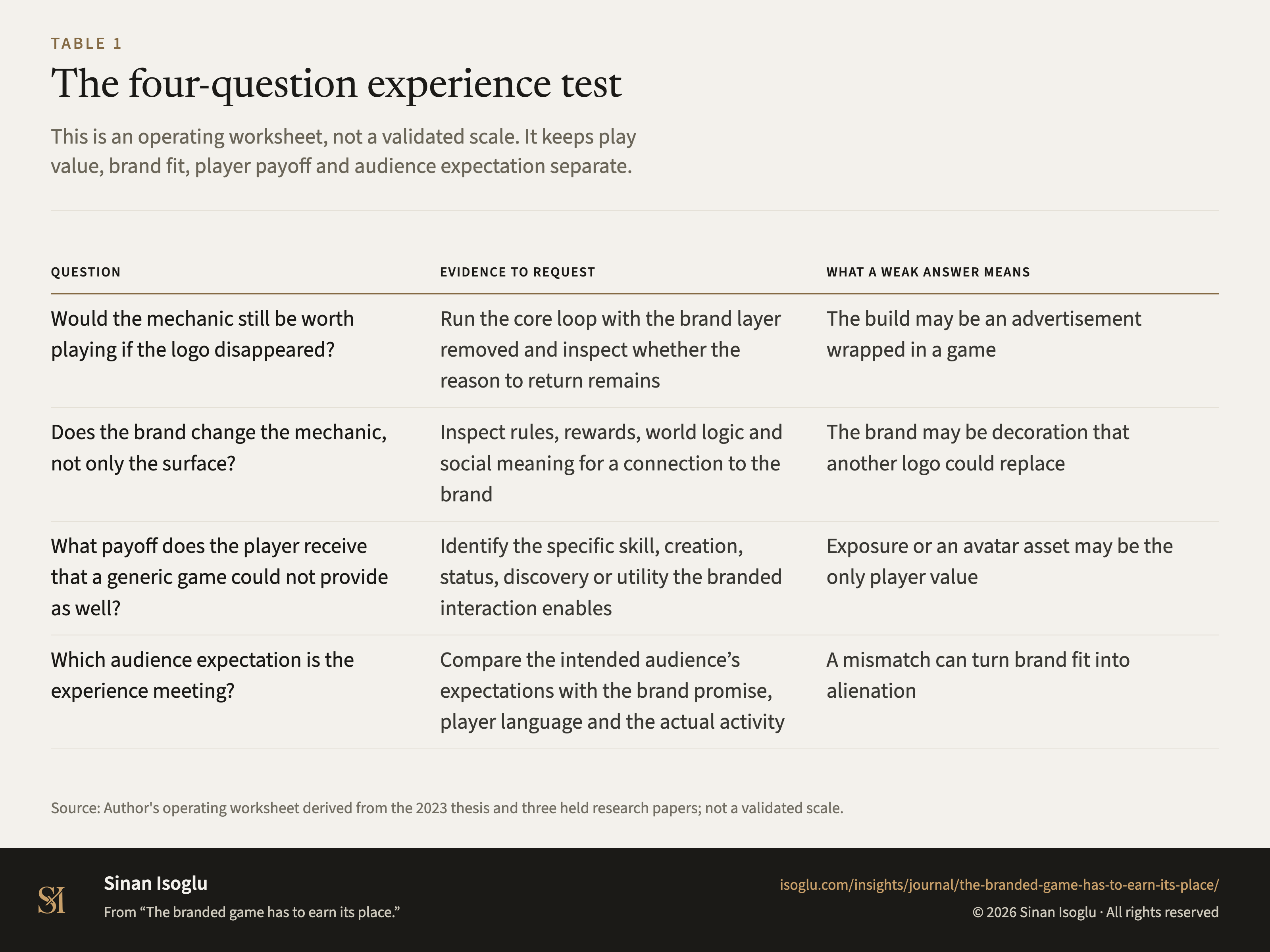
Table 1Table
The four-question experience test
The branded game has to earn its place.
Contact
Bring the question you're working on.
Research, a guest lecture, or a commercial question.