Figure 3From “Measurement invariance before comparing English and German scores”
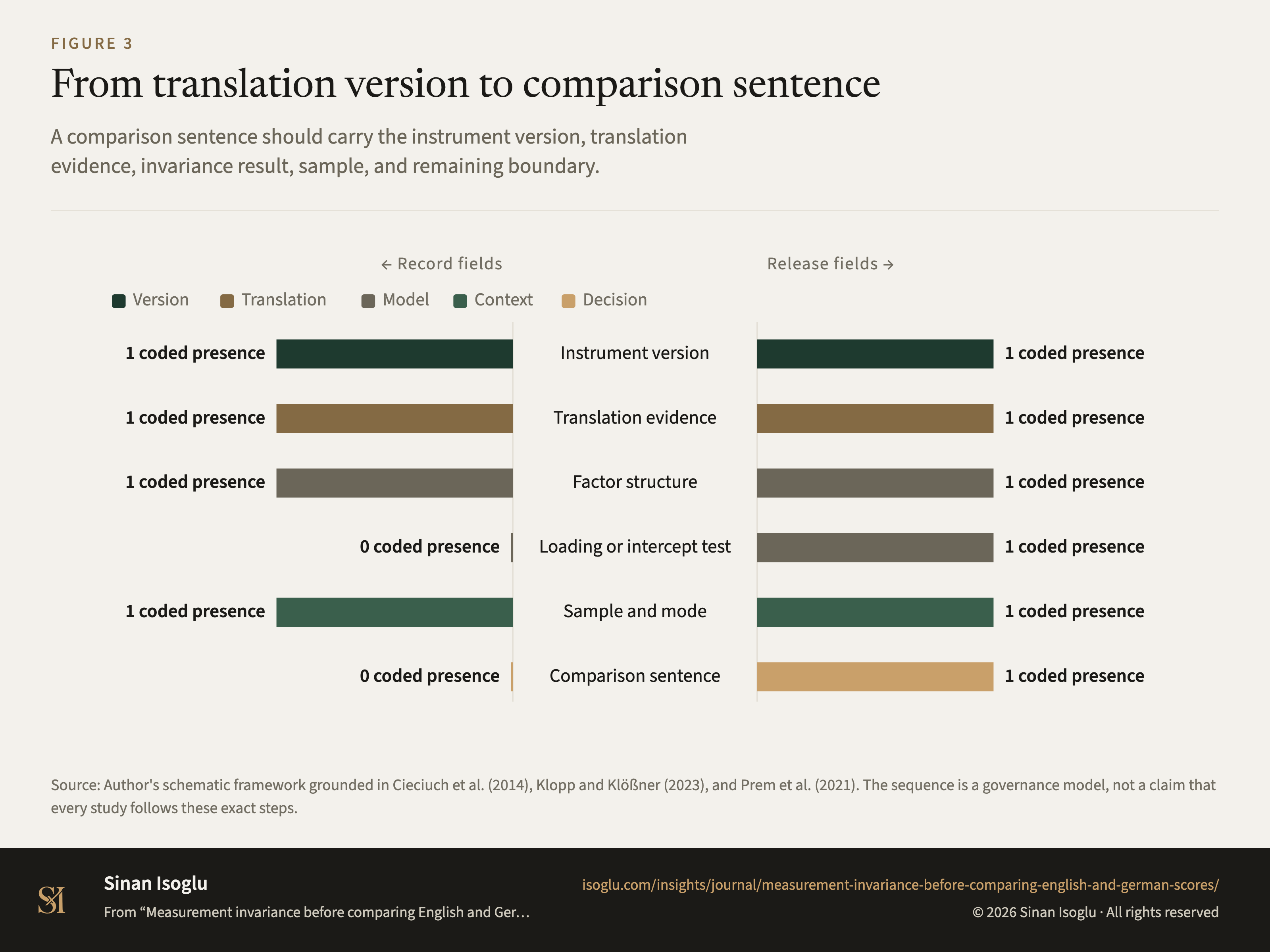
From translation version to comparison sentence
A comparison sentence should carry the instrument version, translation evidence, invariance result, sample, and remaining boundary.
Figure 3From translation version to comparison sentence
Source: Author's schematic framework grounded in Cieciuch et al. (2014), Klopp and Klößner (2023), and Prem et al. (2021). The sequence is a governance model, not a claim that every study follows these exact steps.
Source and evidence
Each line names a claim related to this exhibit, its source, and how it was checked.
- A CDAS14-C3 Establishing invariance in one study does not make an instrument permanently invariant; it should be tested again across groupscieciuch-davidov-2014-exact-approximate-measurement-invariance
- A KK23-C2 In a metric model, scaling restrictions needed for identification must be distinguished from the equality conditions being tested, which is why the paper can show that "it is impossible to test the invariance of the estimated loading of exactly one indicator, because metric MI models aimed at doing so are actually equivalent to the configural model"klopp-klossner-2023-metric-measurement-invariance
- A KK23-C3 When scaling restrictions are placed in one group only, key fit quantities do not depend on the scaling choice: "neither the choice of the scaling method in general nor the choice of a particular referent indicator affects the value of the discrepancy function", under the rule "Apply the scaling restriction in one group only!"klopp-klossner-2023-metric-measurement-invariance
- A PREM21-C2 The researchers translated the German CODE scale into English using native speakers in both languages and a back-translation methodprem-et-al-2021-english-german-code-scale
- A PREM21-C3 The German and English samples were tested sequentially for configural, metric, and scalar invariance, with subscale means treated as comparable under the reported scalar modelprem-et-al-2021-english-german-code-scale
- A PREM21-C5 The reported four-factor and scalar-invariance result is specific to the instrument and samples, with cross-sectional European limitations and a need for validation elsewhereprem-et-al-2021-english-german-code-scale
Grades: A, verified against the printed page of the primary source · B, primary source, text layer only · C, authoritative secondary · D, reported.
From the essay
From the research bench
Measurement invariance before comparing English and German scores
A translated scale is not automatically comparable: configural, metric, and scalar invariance license different cross-language claims.
Read the essayThis exhibit belongs to an essay: the numbers live here, the argument lives there.
Cite or embed
Related exhibits
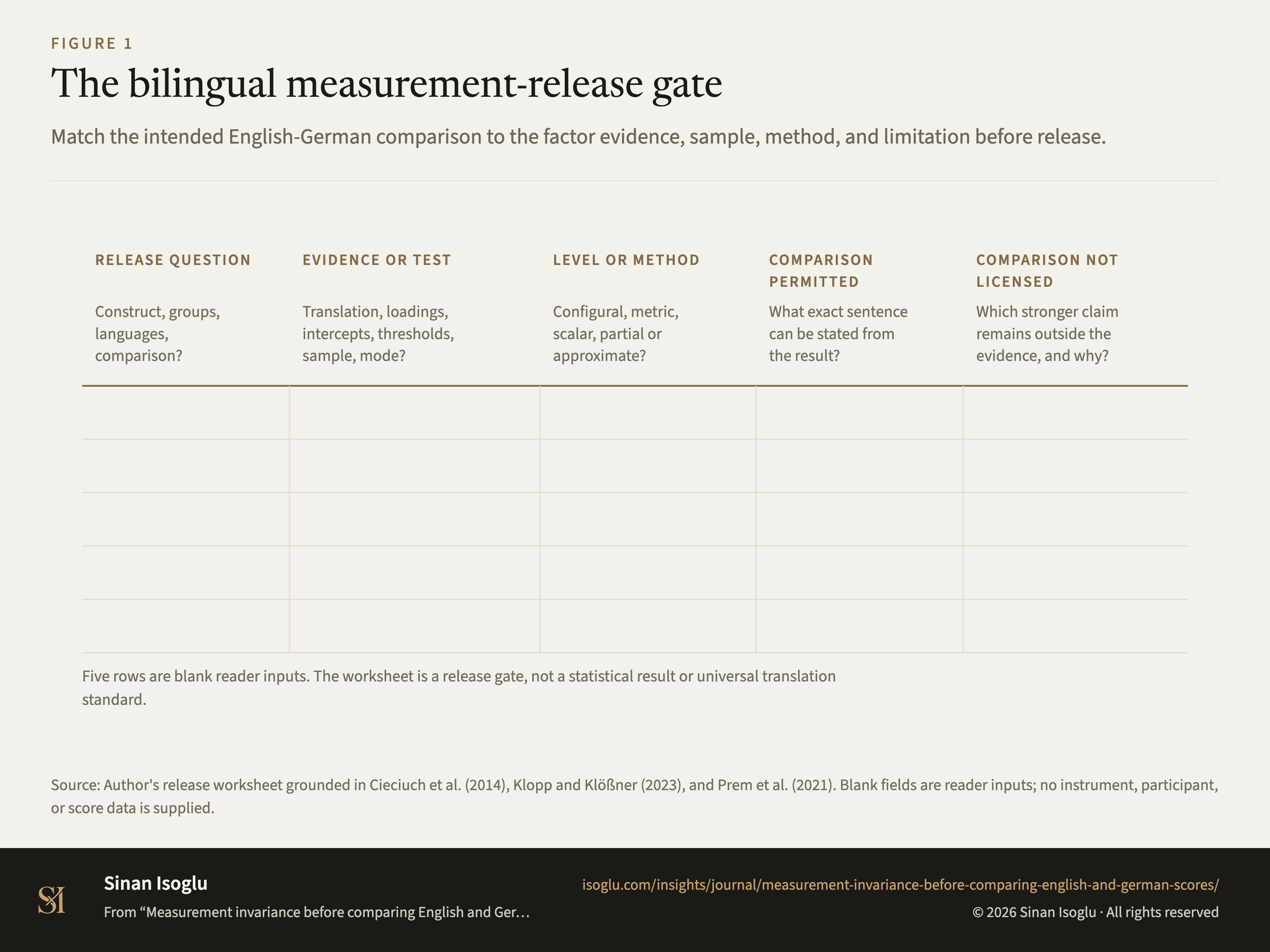
Figure 1Figure
The bilingual measurement-release gate
Measurement invariance before comparing English and German scores
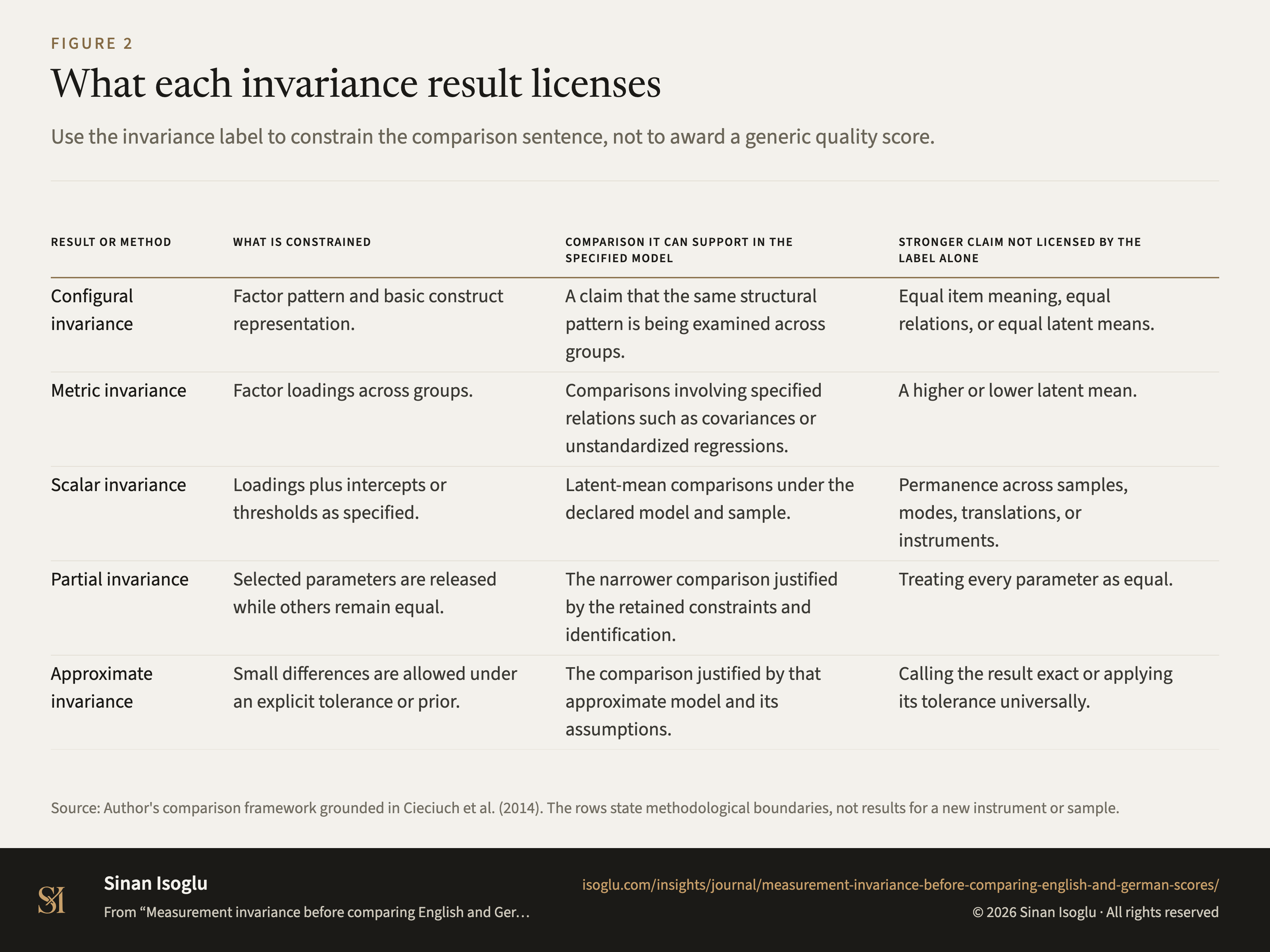
Figure 2Figure
What each invariance result licenses
Measurement invariance before comparing English and German scores
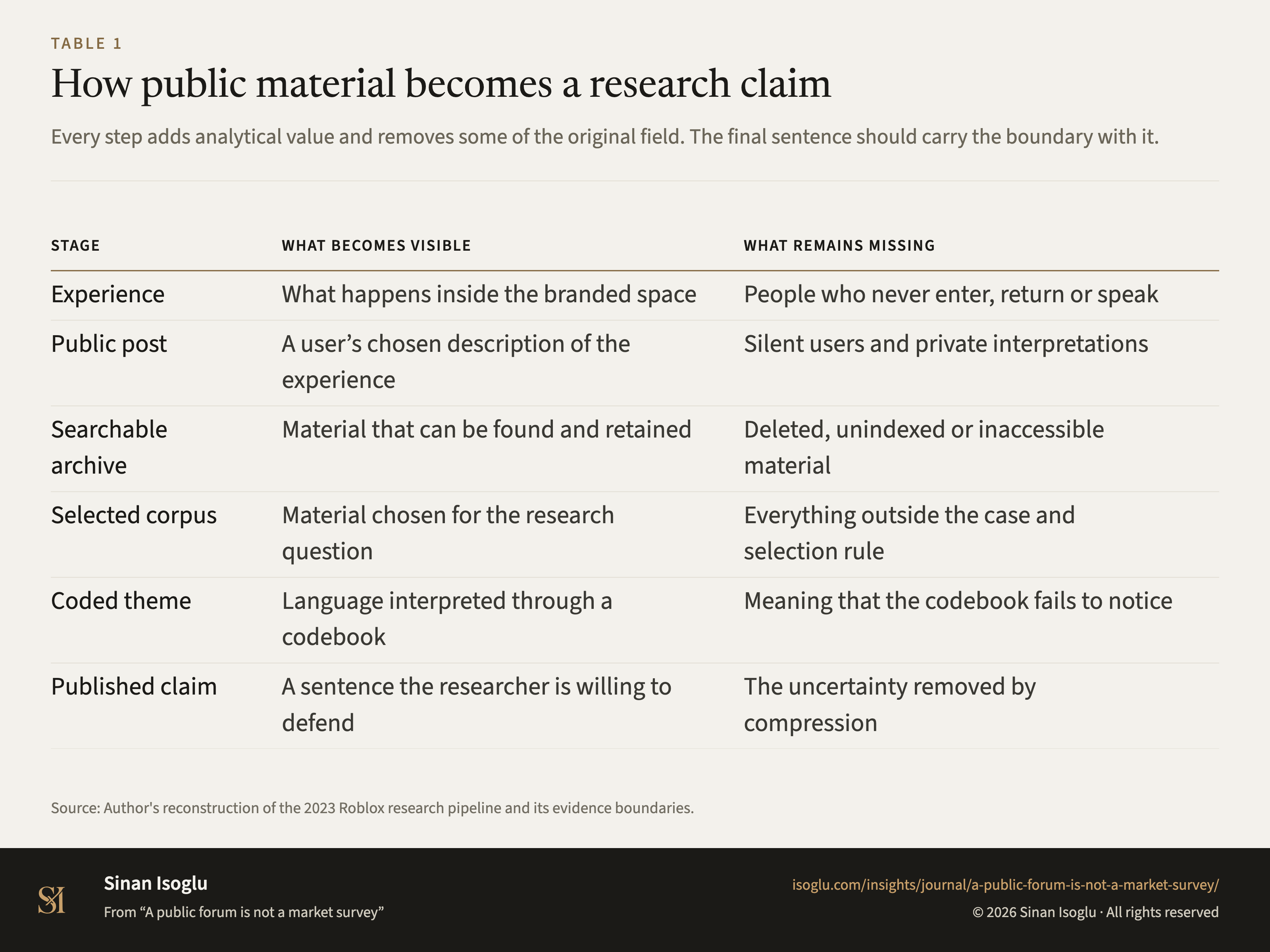
Table 1Table
How public material becomes a research claim
A public forum is not a market survey
Contact
Bring the question you're working on.
Research, a guest lecture, or a commercial question.