← Every exhibit
Table 2From “The LTV:CAC ratio hides the timing”
The ratio review sheet
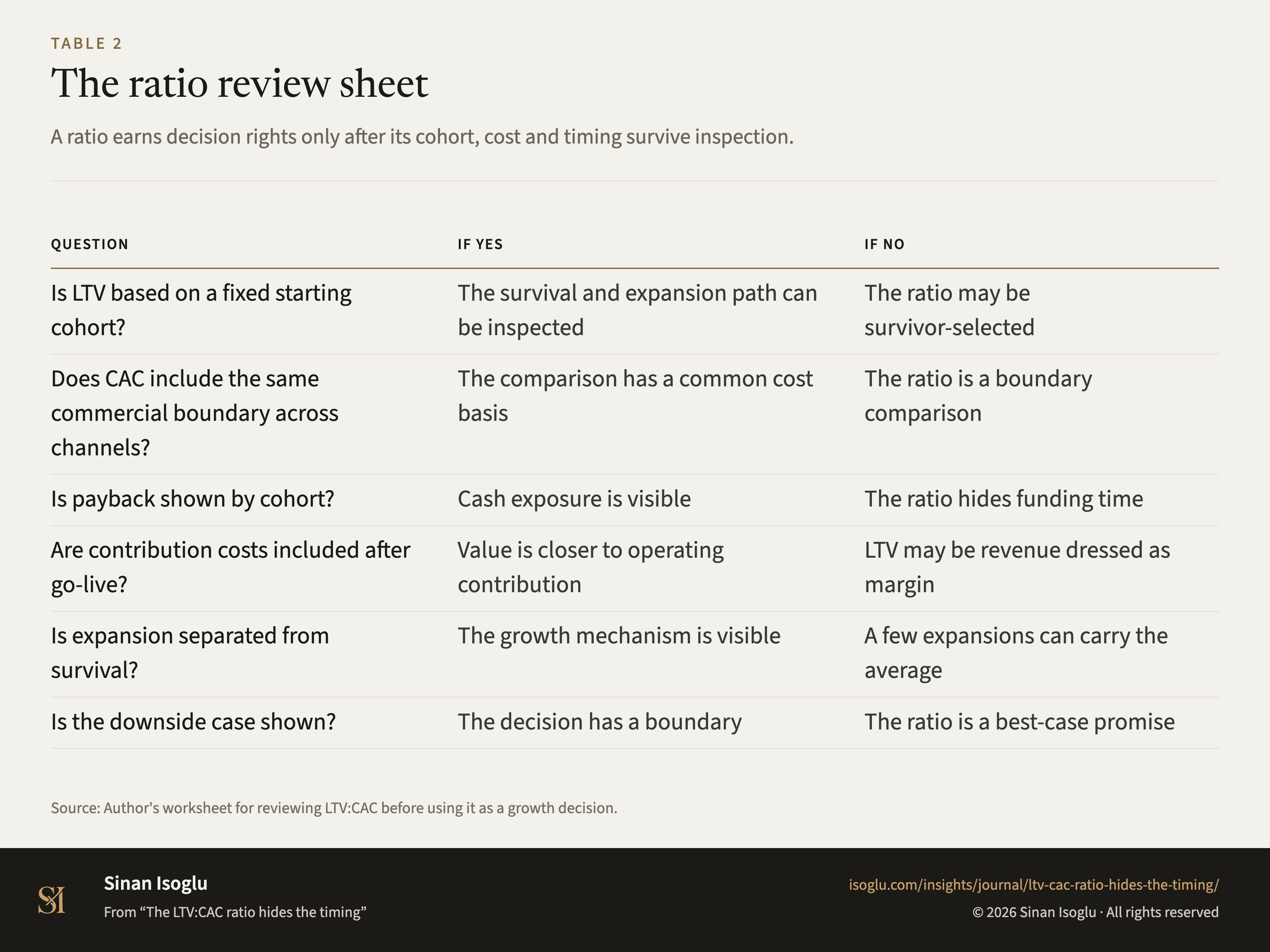
A ratio earns decision rights only after its cohort, cost and timing survive inspection.
Table 2The ratio review sheet
| Question | If yes | If no |
|---|---|---|
| Is LTV based on a fixed starting cohort? | The survival and expansion path can be inspected | The ratio may be survivor-selected |
| Does CAC include the same commercial boundary across channels? | The comparison has a common cost basis | The ratio is a boundary comparison |
| Is payback shown by cohort? | Cash exposure is visible | The ratio hides funding time |
| Are contribution costs included after go-live? | Value is closer to operating contribution | LTV may be revenue dressed as margin |
| Is expansion separated from survival? | The growth mechanism is visible | A few expansions can carry the average |
| Is the downside case shown? | The decision has a boundary | The ratio is a best-case promise |
Swipe or scroll horizontally if the table is wider than your screen.
Source: Author's worksheet for reviewing LTV:CAC before using it as a growth decision.
PNG4:3, 1600 × 1200, with the title, the source line and the attribution set in the image isoglu-2026-ltv-cac-ratio-hides-the-timing-fig02.png
From the essay
Growth that compounds
The LTV:CAC ratio hides the timing
The LTV:CAC ratio compares a forecast with an acquisition cost, but not when cash returns. Put payback, margin and cohort risk beside the ratio.
Read the essayThis exhibit belongs to an essay: the numbers live here, the argument lives there.
Cite or embed
Contact
Bring the question you're working on.
Research, a guest lecture, or a commercial question.