Figure 1From “Long customer relationships can be low-profit”
The relationship-profitability card
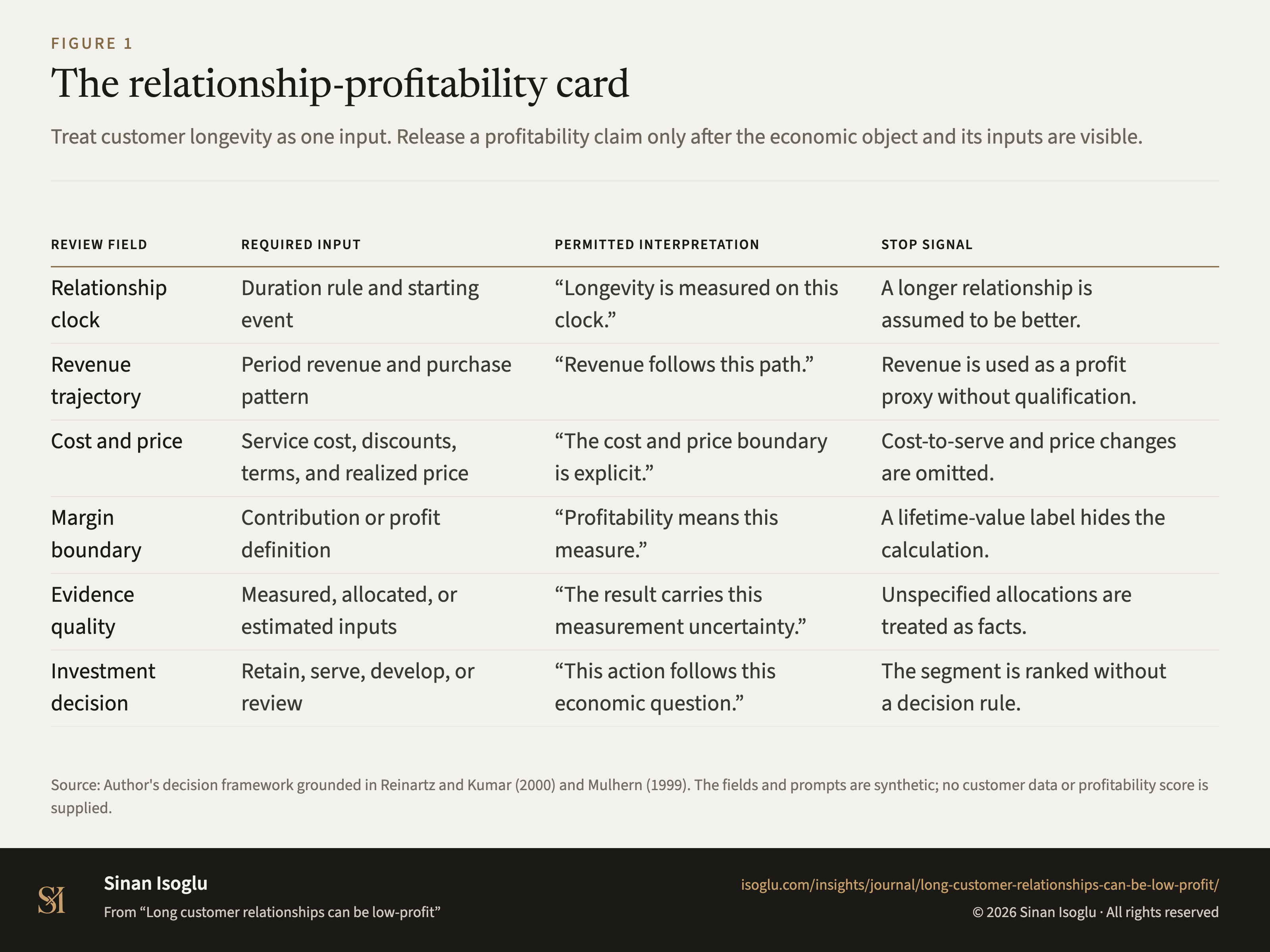
Treat customer longevity as one input. Release a profitability claim only after the economic object and its inputs are visible.
Figure 1The relationship-profitability card
| Review field | Required input | Permitted interpretation | Stop signal |
|---|---|---|---|
| Relationship clock | Duration rule and starting event | “Longevity is measured on this clock.” | A longer relationship is assumed to be better. |
| Revenue trajectory | Period revenue and purchase pattern | “Revenue follows this path.” | Revenue is used as a profit proxy without qualification. |
| Cost and price | Service cost, discounts, terms, and realized price | “The cost and price boundary is explicit.” | Cost-to-serve and price changes are omitted. |
| Margin boundary | Contribution or profit definition | “Profitability means this measure.” | A lifetime-value label hides the calculation. |
| Evidence quality | Measured, allocated, or estimated inputs | “The result carries this measurement uncertainty.” | Unspecified allocations are treated as facts. |
| Investment decision | Retain, serve, develop, or review | “This action follows this economic question.” | The segment is ranked without a decision rule. |
Swipe or scroll horizontally if the table is wider than your screen.
Source: Author's decision framework grounded in Reinartz and Kumar (2000) and Mulhern (1999). The fields and prompts are synthetic; no customer data or profitability score is supplied.
Source and evidence
Each line names a claim related to this exhibit, its source, and how it was checked.
- A RKU00-C1 Four expectations, tested one by one: whether "there exists a strong positive customer lifetime-profitability relationship", whether "profits increase over time", whether "the costs of serving long-life customers are less", and whether "long-life customers pay higher prices"Reinartz & Kumar. (2000)
- A RKU00-C2 The headline result, in the authors' words: "The empirical findings observed in this study challenge all the expectations derived from the literature", and "Long-life customers are not necessarily profitable customers"Reinartz & Kumar. (2000)
- A RKU00-C3 The article evaluates the marketing assumption that long-life customers should always receive disproportionate attention against evidence from a noncontractual setting: "it is not clear whether some of the findings observed in a contractual setting hold good in noncontractual scenarios", so "the main objective of this study is a rigorous and differentiated empirical analysis of the lifetime-profitability relationship in a noncontractual context"Reinartz & Kumar. (2000)
- A MUL99-C1 The paper is METHOD, not an empirical finding, in its own words: "This paper provides a conceptual and methodological foundation for measuring customer profitability" by extending customer-lifetime-value approaches to broader target-marketing applications.Mulhern. (1999)
- A MUL99-C2 Concentration is analysed as a distribution, not asserted as a ratio: "a sharply descending curve for the ordering of customer profit" corresponds to a skewed frequency distribution, and the Lorenz curve's shortcoming is that "it cannot portray percentiles of customers who represent a financial loss to a firm"Mulhern. (1999)
- A MUL99-C3 The paper combines a business-to-business customer-profitability analysis with propositions about determinants of profitability and a future research agenda, in the abstract's own words: "An empirical analysis involving the profitability of customers in a business-to-business marketing context is described, along with research propositions for future work on the determinants of customer profitability"Mulhern. (1999)
Grades: A, verified against the printed page of the primary source · B, primary source, text layer only · C, authoritative secondary · D, reported.
From the essay
Growth that compounds
Long customer relationships can be low-profit
Longevity is a time variable, not proof of profit: review revenue, service cost, price, margin, measurement quality, and investment together.
Read the essayThis exhibit belongs to an essay: the numbers live here, the argument lives there.
Cite or embed
Related exhibits
Contact
Bring the question you're working on.
Research, a guest lecture, or a commercial question.