Abbildung 1Aus „Lange Kundenbeziehungen können wenig profitabel sein“
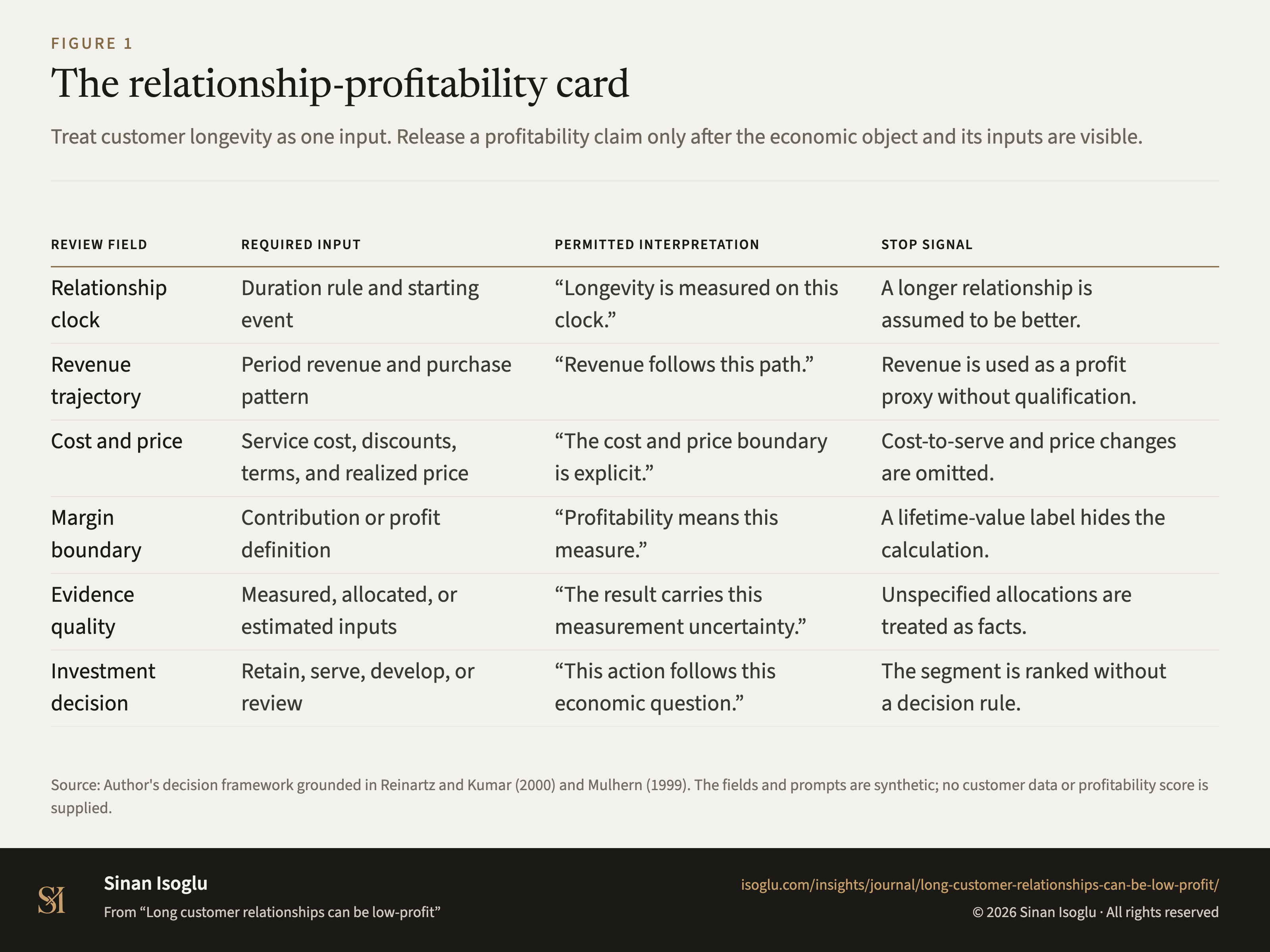
Die Karte für Beziehungsprofitabilität
Behandle Kundenlanglebigkeit als einen Input. Gib eine Profitabilitätsaussage erst frei, wenn Objekt und Inputs sichtbar sind.
Abbildung 1Die Karte für Beziehungsprofitabilität
| Prüffeld | Erforderlicher Input | Zulässige Interpretation | Stoppsignal |
|---|---|---|---|
| Beziehungsuhr | Dauerregel und Startpunkt | „Langlebigkeit wird auf dieser Uhr gemessen.“ | Eine längere Beziehung gilt automatisch als besser. |
| Umsatzverlauf | Periodenumsatz und Kaufmuster | „Umsatz folgt diesem Pfad.“ | Umsatz wird ohne Einschränkung als Profitproxy verwendet. |
| Kosten und Preis | Betreuungskosten, Rabatte, Bedingungen und realisierter Preis | „Kosten- und Preisgrenze sind explizit.“ | Betreuungskosten und Preisänderungen fehlen. |
| Margengrenze | Beitrags- oder Gewinnbegriff | „Profitabilität bedeutet diese Kennzahl.“ | Ein Lifetime-Value-Label verbirgt die Rechnung. |
| Evidenzqualität | Gemessene, verteilte oder geschätzte Inputs | „Das Ergebnis trägt diese Messunsicherheit.“ | Unklare Verteilungen gelten als Fakten. |
| Investitionsentscheidung | Halten, betreuen, entwickeln oder prüfen | „Diese Handlung folgt dieser ökonomischen Frage.“ | Das Segment wird ohne Regel gerankt. |
Bei breiten Tabellen horizontal wischen oder scrollen.
Quelle: Eigener Entscheidungsrahmen auf Grundlage von Reinartz und Kumar (2000) sowie Mulhern (1999). Die Felder und Fragen sind synthetisch; Kunden- oder Profitabilitätsdaten werden nicht geliefert.
Quelle und Evidenz
Jede Zeile nennt eine Aussage zu dieser Abbildung, ihre Quelle und die Art ihrer Prüfung.
- A RKU00-C1 Four expectations, tested one by one: whether "there exists a strong positive customer lifetime-profitability relationship", whether "profits increase over time", whether "the costs of serving long-life customers are less", and whether "long-life customers pay higher prices"Reinartz & Kumar. (2000)
- A RKU00-C2 The headline result, in the authors' words: "The empirical findings observed in this study challenge all the expectations derived from the literature", and "Long-life customers are not necessarily profitable customers"Reinartz & Kumar. (2000)
- A RKU00-C3 The article evaluates the marketing assumption that long-life customers should always receive disproportionate attention against evidence from a noncontractual setting: "it is not clear whether some of the findings observed in a contractual setting hold good in noncontractual scenarios", so "the main objective of this study is a rigorous and differentiated empirical analysis of the lifetime-profitability relationship in a noncontractual context"Reinartz & Kumar. (2000)
- A MUL99-C1 The paper is METHOD, not an empirical finding, in its own words: "This paper provides a conceptual and methodological foundation for measuring customer profitability" by extending customer-lifetime-value approaches to broader target-marketing applications.Mulhern. (1999)
- A MUL99-C2 Concentration is analysed as a distribution, not asserted as a ratio: "a sharply descending curve for the ordering of customer profit" corresponds to a skewed frequency distribution, and the Lorenz curve's shortcoming is that "it cannot portray percentiles of customers who represent a financial loss to a firm"Mulhern. (1999)
- A MUL99-C3 The paper combines a business-to-business customer-profitability analysis with propositions about determinants of profitability and a future research agenda, in the abstract's own words: "An empirical analysis involving the profitability of customers in a business-to-business marketing context is described, along with research propositions for future work on the determinants of customer profitability"Mulhern. (1999)
Prüfgrade: A, gegen die gedruckte Seite der Primärquelle geprüft · B, Primärquelle, nur Textebene · C, belastbare Sekundärquelle · D, berichtet.
Aus dem Beitrag
Wachstum, das sich potenziert
Lange Kundenbeziehungen können wenig profitabel sein
Langlebigkeit ist eine Zeitvariable und kein Profitbeweis: Prüfe Umsatz, Betreuungskosten, Preis, Marge, Messqualität und Investition gemeinsam.
Den Beitrag lesenDiese Abbildung gehört zu einem Essay: Die Zahlen stehen hier, das Argument dort.
Zitieren oder einbetten
Verwandte Abbildungen
Kontakt
Schicken Sie die Frage, an der Sie arbeiten.
Forschung, ein Gastvortrag oder eine Frage aus der Praxis.