Figure 1From “Human and machine should divide the work”
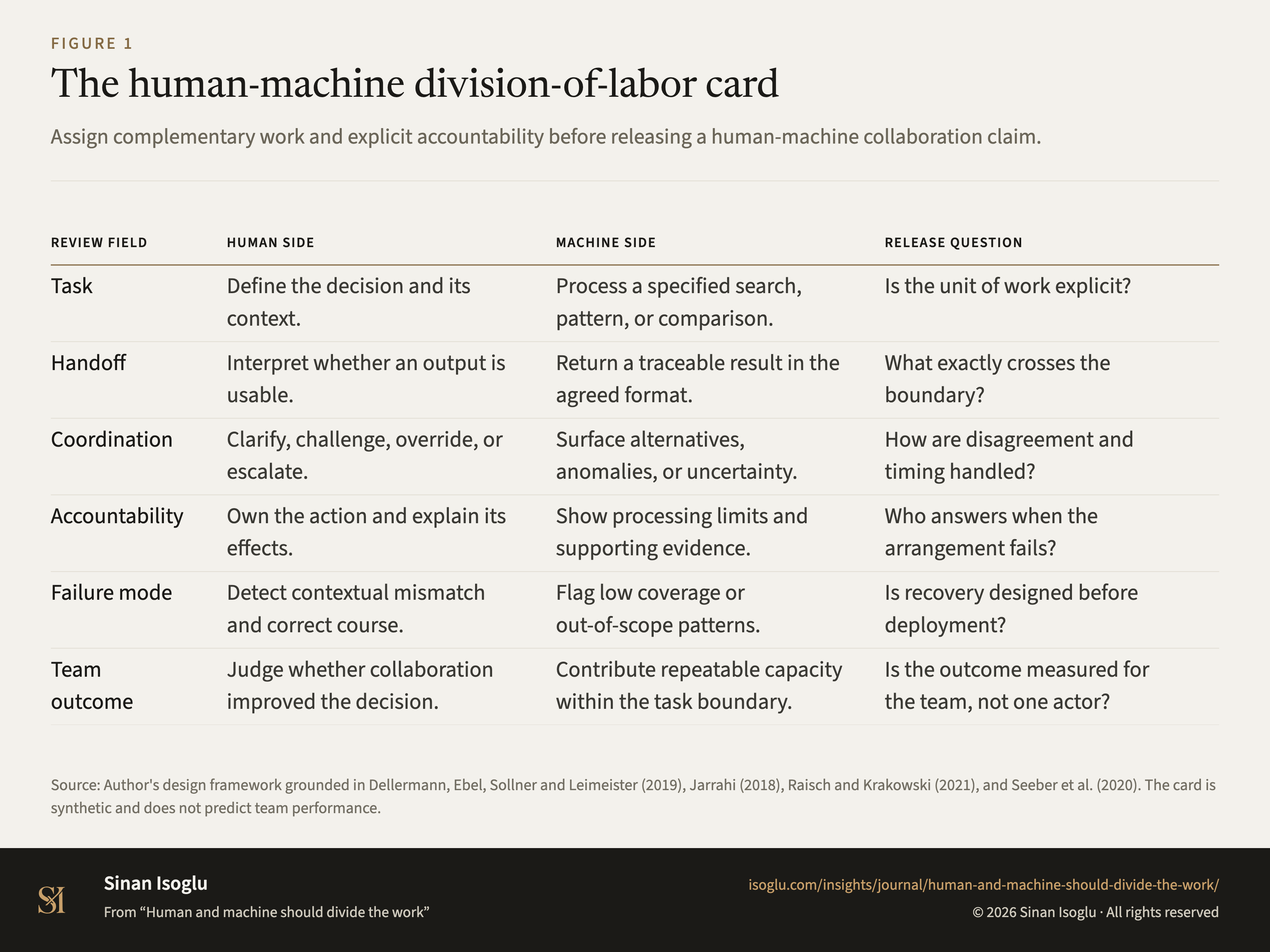
The human-machine division-of-labor card
Assign complementary work and explicit accountability before releasing a human-machine collaboration claim.
Figure 1The human-machine division-of-labor card
| Review field | Human side | Machine side | Release question |
|---|---|---|---|
| Task | Define the decision and its context. | Process a specified search, pattern, or comparison. | Is the unit of work explicit? |
| Handoff | Interpret whether an output is usable. | Return a traceable result in the agreed format. | What exactly crosses the boundary? |
| Coordination | Clarify, challenge, override, or escalate. | Surface alternatives, anomalies, or uncertainty. | How are disagreement and timing handled? |
| Accountability | Own the action and explain its effects. | Show processing limits and supporting evidence. | Who answers when the arrangement fails? |
| Failure mode | Detect contextual mismatch and correct course. | Flag low coverage or out-of-scope patterns. | Is recovery designed before deployment? |
| Team outcome | Judge whether collaboration improved the decision. | Contribute repeatable capacity within the task boundary. | Is the outcome measured for the team, not one actor? |
Swipe or scroll horizontally if the table is wider than your screen.
Source: Author's design framework grounded in Dellermann, Ebel, Sollner and Leimeister (2019), Jarrahi (2018), Raisch and Krakowski (2021), and Seeber et al. (2020). The card is synthetic and does not predict team performance.
Source and evidence
Each line names a claim related to this exhibit, its source, and how it was checked.
- A DEL19-C1 The definition, in the authors' words: "the most likely paradigm for the division of labor between humans and machines in the next decades is Hybrid" Intelligence, a concept that aims "at using the complementary strengths of human intelligence and AI, so that they can perform better than each of the two could separately"Dellermann, Ebel, Sollner & Leimeister. (2019)
- A DEL19-C2 The boundary against collective intelligence, verbatim: "collective intelligence typically refers to large groups of homogenous individuals", whereas "Hybrid Intelligence combines the complementary intelligence of heterogeneous agents"Dellermann, Ebel, Sollner & Leimeister. (2019)
- A DEL19-C3 Why the division of labour is the unit: "humans and computers have complementary capabilities that can be combined to augment each other", and "These complementary strengths of humans and machi"nes lead to two different forms of interplay, with trust, transparency, governance and incentives left as open design issuesDellermann, Ebel, Sollner & Leimeister. (2019)
- A JAR18-C1 Augmentation, not replacement, and the article says so: it "highlights the complementarity of humans and AI", mirroring "the idea of intelligence augmentation which states that AI systems should be designed with the intention of augmenting not replacing human contributions"Jarrahi. (2018)
- A JAR18-C2 The division is drawn on the kind of problem: "with a greater computational information processing capacity and an analytical approach AI can extend humans cognition when addressing complexity whereas humans can still offer a more holistic intuitive approach in dealing with uncertainty and equivocality"Jarrahi. (2018)
- A JAR18-C3 The context is named in the same sentence: decision processes "typically characterized by uncertainty complexity and equivocality", which is what makes the division of labour a task property rather than a ruleJarrahi. (2018)
- A RAI21-C1 The two concepts, defined: "whereas automation implies that machines take over a human task, augmentation means that humans collaborate closely with machines to perform a task"Raisch & Krakowski. (2021)
- A RAI21-C2 "overemphasizing either augmentation or automation fuels reinforcing cycles with negative organizational and societal outcomes"Raisch & Krakowski. (2021)
- A RAI21-C3 "if organizations adopt a broader perspective comprising both automation and augmentation they could deal with the tension and achieve comp"lementarities. A conceptual paper in AMR, so this is argued, not measuredRaisch & Krakowski. (2021)
- A SEE20-C1 A research agenda, and it counts itself: "this paper reports on an international initiative by 65 collaboration scientists to develop a research agenda for exploring the potential risks and benefits of machines as teammates", from "819 research questions"Seeber et al. (2020)
- A SEE20-C2 The structure is three areas and seventeen dualities: "three design areas machine artifact collaboration and institution and 17 dualities significant effects with the potential for benefit or harm"Seeber et al. (2020)
- A SEE20-C3 It is a question set, not a finding: the agenda "offers a structure and archetypal research questions to organize early thought and research in this new" areaSeeber et al. (2020)
Grades: A, verified against the printed page of the primary source · B, primary source, text layer only · C, authoritative secondary · D, reported.
From the essay
From the research bench
Human and machine should divide the work
Human-machine design starts with tasks, handoffs, coordination, and accountability: assign complementary strengths before discussing replacement.
Read the essayThis exhibit belongs to an essay: the numbers live here, the argument lives there.
Cite or embed
Related exhibits
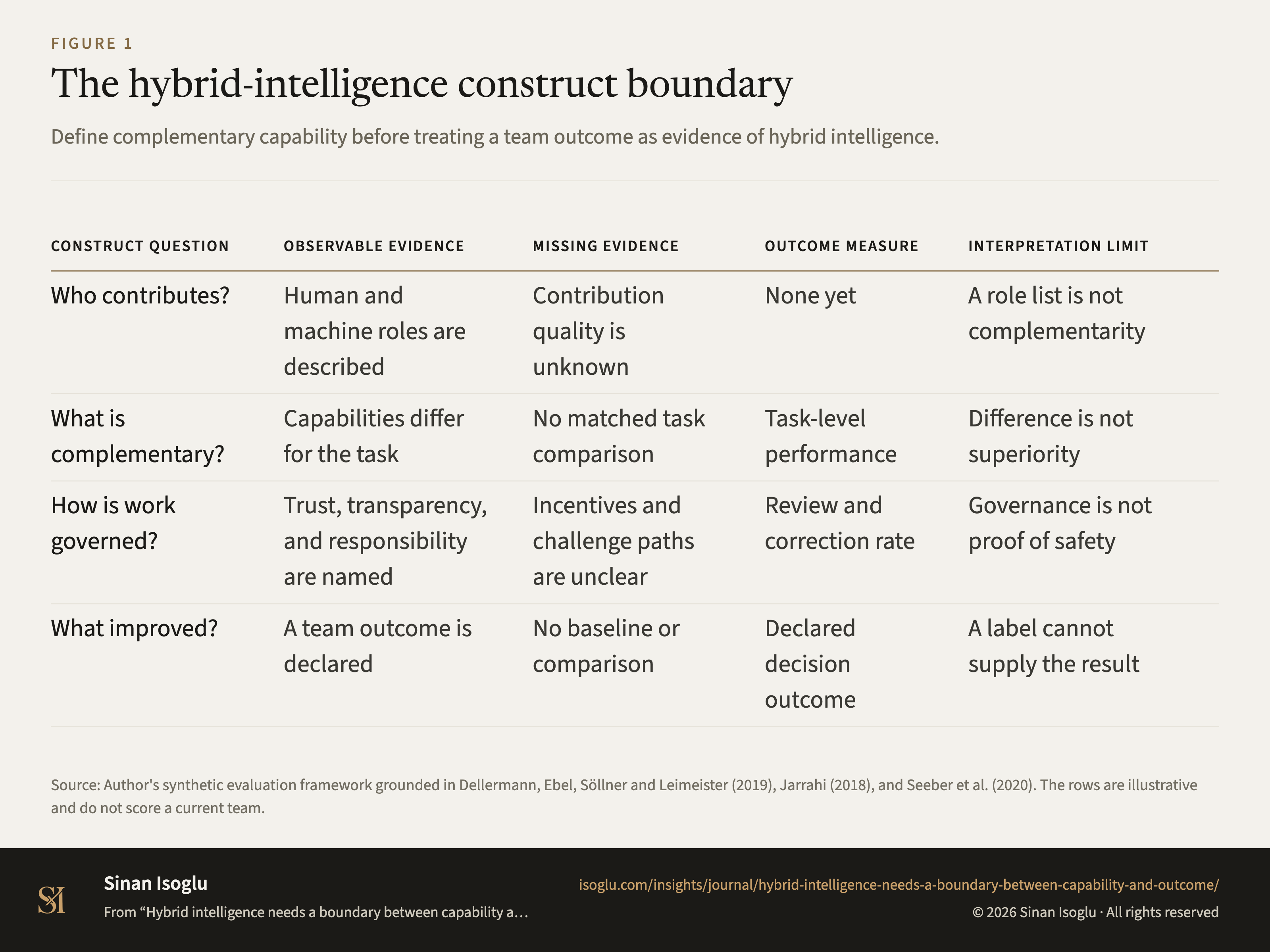
Figure 1Figure
The hybrid-intelligence construct boundary
Hybrid intelligence needs a boundary between capability and outcome
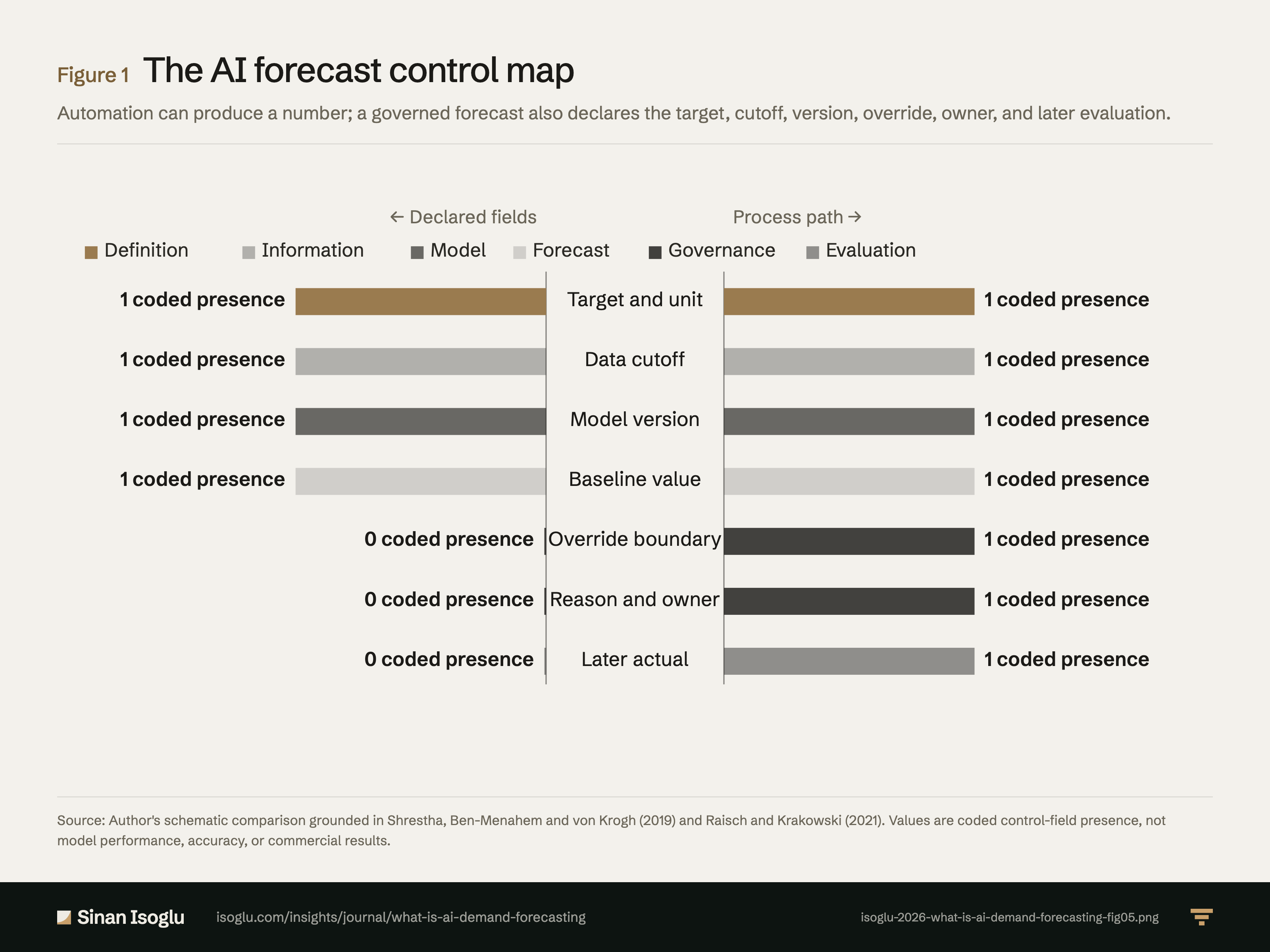
Figure 1Figure
The AI forecast control map
What is AI demand forecasting? A forecast is a system, not an oracle
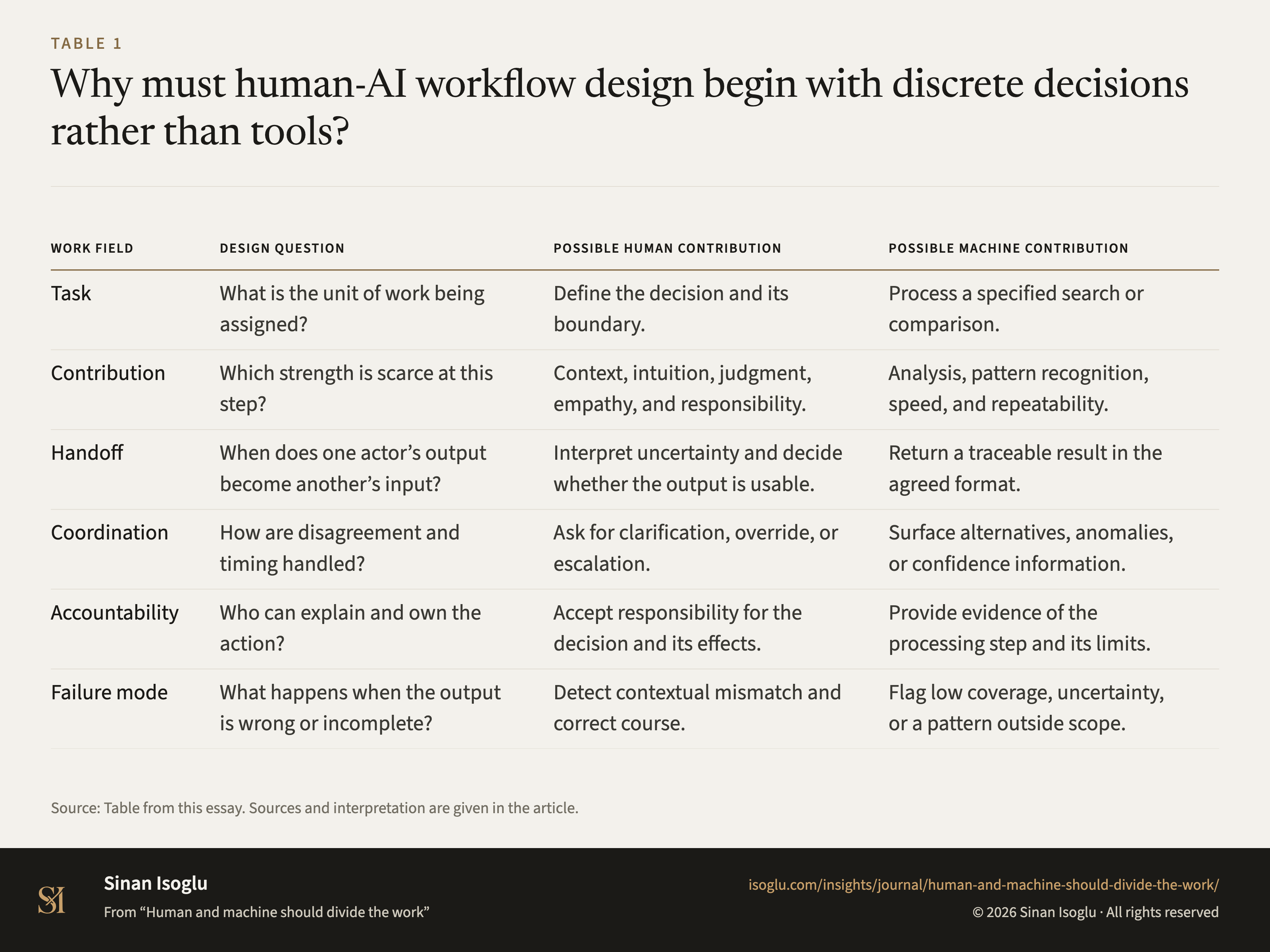
Table 1Table
Why must human-AI workflow design begin with discrete decisions rather than tools?
Human and machine should divide the work
Contact
Bring the question you're working on.
Research, a guest lecture, or a commercial question.