Table 2From “Every growth budget is a gross number”
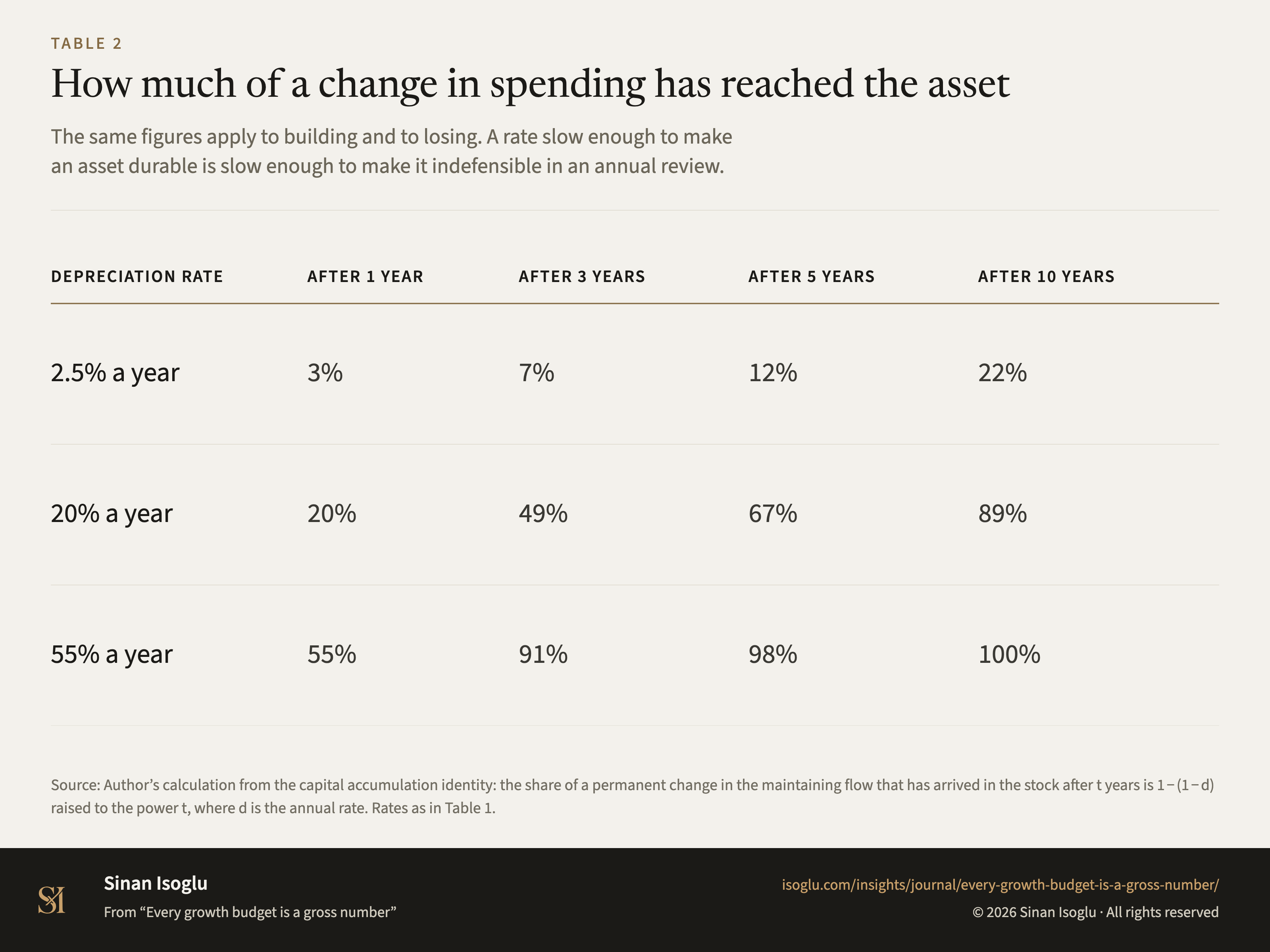
How much of a change in spending has reached the asset
The same figures apply to building and to losing. A rate slow enough to make an asset durable is slow enough to make it indefensible in an annual review.
Table 2How much of a change in spending has reached the asset
| Depreciation rate | After 1 year | After 3 years | After 5 years | After 10 years |
|---|---|---|---|---|
| 2.5% a year | 3% | 7% | 12% | 22% |
| 20% a year | 20% | 49% | 67% | 89% |
| 55% a year | 55% | 91% | 98% | 100% |
Swipe or scroll horizontally if the table is wider than your screen.
Source: Author’s calculation from the capital accumulation identity: the share of a permanent change in the maintaining flow that has arrived in the stock after t years is 1 − (1 − d) raised to the power t, where d is the annual rate. Rates as in Table 1.
Source and evidence
Each line names a claim related to this exhibit, its source, and how it was checked.
- A BDG12-C1 The 2.5% rate measures decay of one year's consumption experiences in brand preference, not advertising capitalBronnenberg, Dube & Gentzkow (2012), p. 2474
- A EPW24-C1 The organisational-capital depreciation rate is assumed rather than estimated, which is why the paper's own contrast is with the estimated R&D rate: "The results of our parameter estimation imply an average 33% annual depreciation rate for R&D versus 23% for BEA R&D depreciation rates where industry coverage is available"Ewens, Peters & Wang (2019, revised 2023), note to Table 1
- A BDS22-C2 They adopt a 55% annual advertising-capital depreciation rate from Corrado et al. (2016)Bronnenberg, Dube & Syverson (2022), section II
Grades: A, verified against the printed page of the primary source · B, primary source, text layer only · C, authoritative secondary · D, reported.
From the essay
Growth that compounds
Every growth budget is a gross number
A budget records what will be spent. It does not record what wears out as you spend it, and only the second number says whether the year added anything.
Read the essayThis exhibit belongs to an essay: the numbers live here, the argument lives there.
Cite or embed
Related exhibits
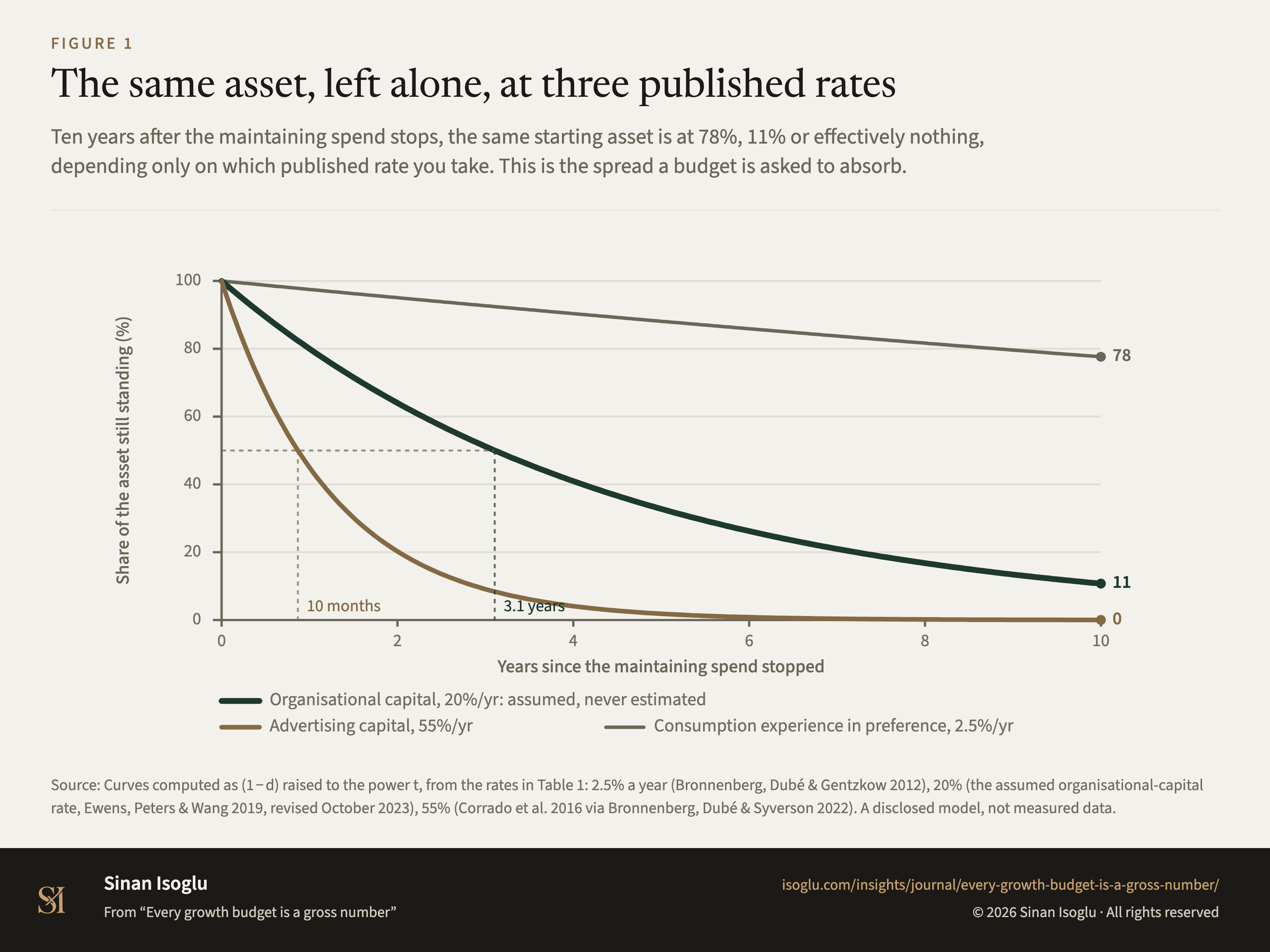
Figure 1Figure
The same asset, left alone, at three published rates
Every growth budget is a gross number
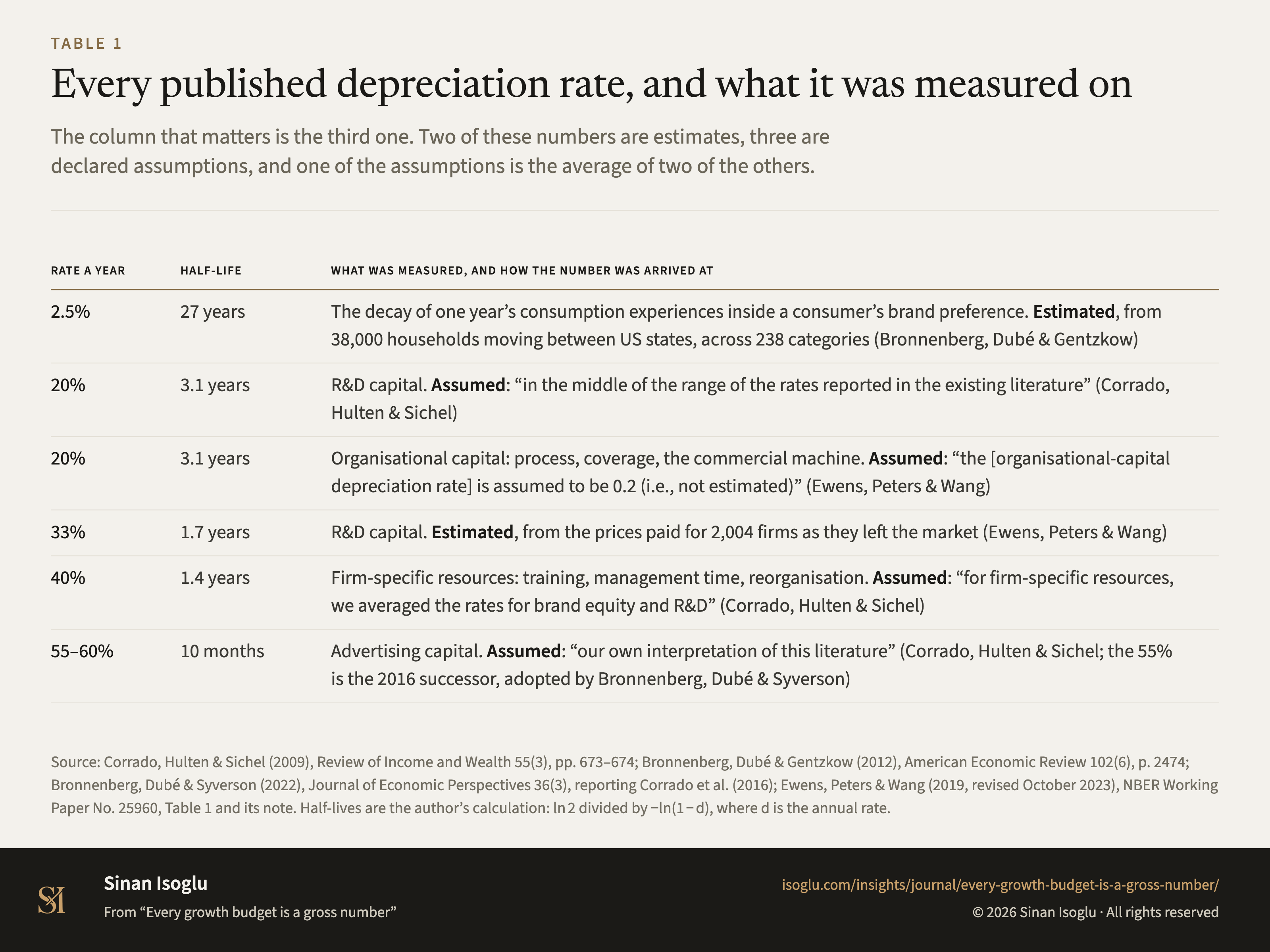
Table 1Table
Every published depreciation rate, and what it was measured on
Every growth budget is a gross number
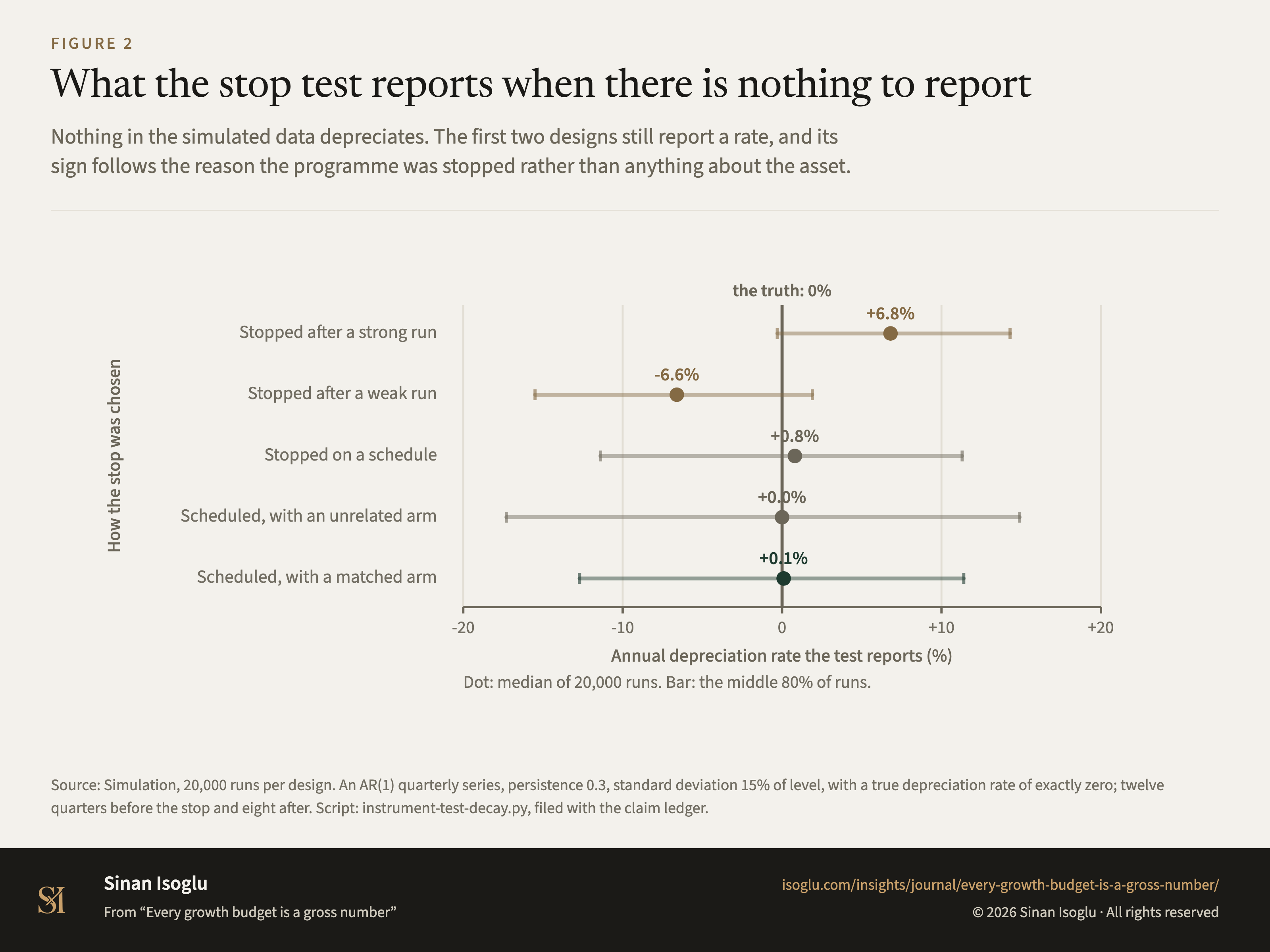
Figure 2Figure
What the stop test reports when there is nothing to report
Every growth budget is a gross number
Contact
Bring the question you're working on.
Research, a guest lecture, or a commercial question.