Table 1From “Business case control is a living decision loop”
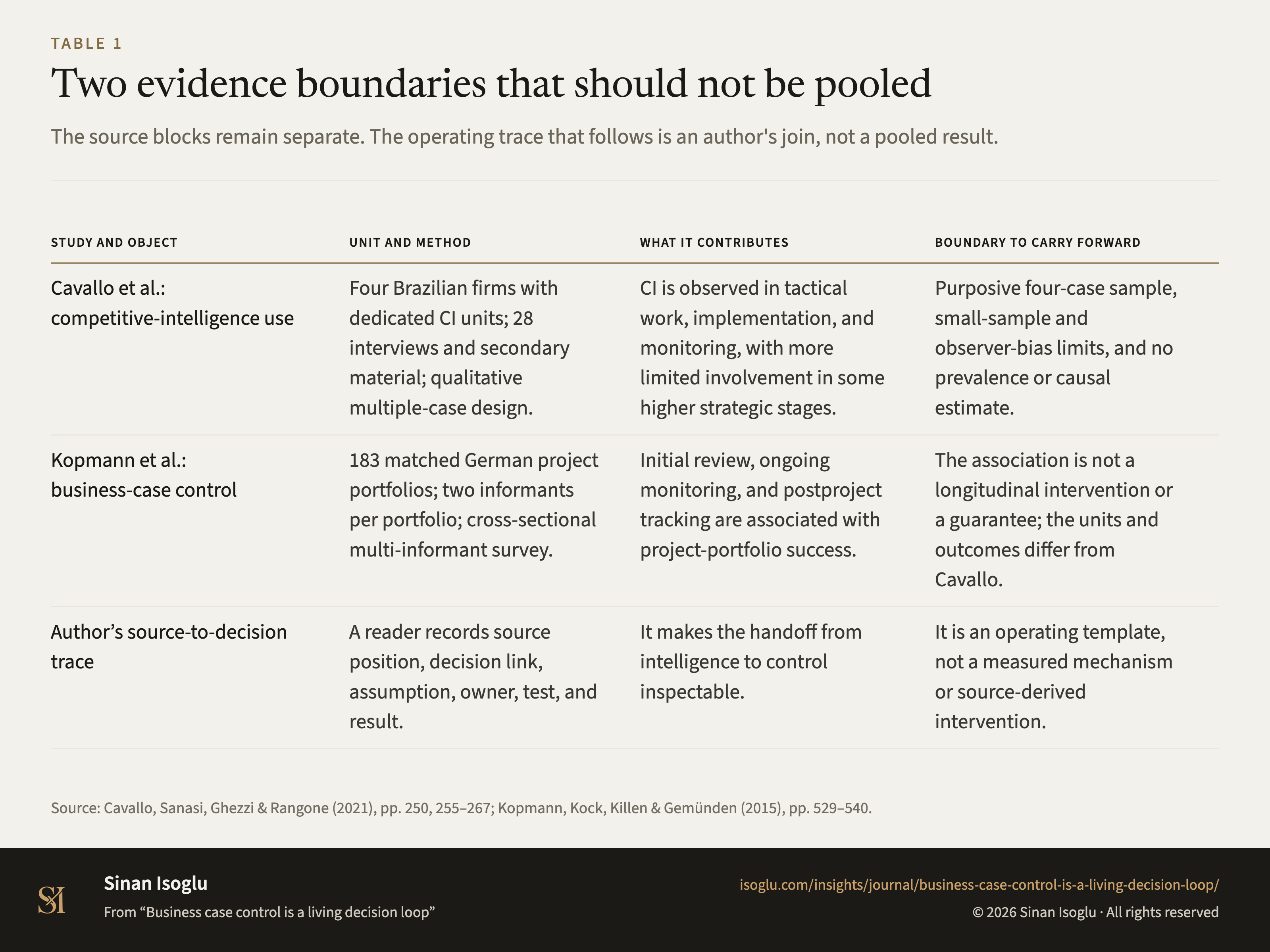
Two evidence boundaries that should not be pooled
The source blocks remain separate. The operating trace that follows is an author's join, not a pooled result.
Table 1Two evidence boundaries that should not be pooled
| Study and object | Unit and method | What it contributes | Boundary to carry forward |
|---|---|---|---|
| Cavallo et al.: competitive-intelligence use | Four Brazilian firms with dedicated CI units; 28 interviews and secondary material; qualitative multiple-case design. | CI is observed in tactical work, implementation, and monitoring, with more limited involvement in some higher strategic stages. | Purposive four-case sample, small-sample and observer-bias limits, and no prevalence or causal estimate. |
| Kopmann et al.: business-case control | 183 matched German project portfolios; two informants per portfolio; cross-sectional multi-informant survey. | Initial review, ongoing monitoring, and postproject tracking are associated with project-portfolio success. | The association is not a longitudinal intervention or a guarantee; the units and outcomes differ from Cavallo. |
| Author's source-to-decision trace | A reader records source position, decision link, assumption, owner, test, and result. | It makes the handoff from intelligence to control inspectable. | It is an operating template, not a measured mechanism or source-derived intervention. |
Swipe or scroll horizontally if the table is wider than your screen.
Source: Cavallo, Sanasi, Ghezzi & Rangone (2021), pp. 250, 255–267; Kopmann, Kock, Killen & Gemünden (2015), pp. 529–540.
Source and evidence
Each line names a claim related to this exhibit, its source, and how it was checked.
- A CSR21-C1 The design is four cases, and the paper says so: "a multiple case study has been performed related to four companies located in Brazil that adopted CI practices within dedicated business units to inform and support strategic decision-making"Cavallo, Sanasi, Ghezzi & Rangone (2021), pp. 255-256
- A CSR21-C2 The tension the study reports, verbatim: CI practices, "despite their strategic relevance and diffusion, are still extensively adopted for tactical use"Cavallo, Sanasi, Ghezzi & Rangone (2021), p. 250
- A CSR21-C3 What the study delivers is descriptive: "The authors provide detailed empirical evidence on the connection and use of CI practices throughout each stage of the strategy formulation process"Cavallo, Sanasi, Ghezzi & Rangone (2021), pp. 264-267
- A CSR21-C4 The authors bound their own generalisation: "This study is not free of limitations. First, the small sample size could limit the generalization and relevance of our findings; and second, the observer bias typical of qualitative studies"Cavallo, Sanasi, Ghezzi & Rangone (2021), p. 267
- A KKKG15-C1 The three elements and the association: "We identify three elements of a business case control at the portfolio level": "the initial review, the ongoing mon""itoring during the project execution, and the postproject tracking until the business case is realized": and "Based on a cross-industry sample of 183 firms, we find that the business case control is positively related to the project portfolio success"Kopmann, Kock, Killen & Gemünden (2015), p. 529
- A KKKG15-C2 The construct is those three parts: "the initial review, the ongoing mon""itoring during the project execution, and the postproject tracking until the business case is realized"Kopmann, Kock, Killen & Gemünden (2015), pp. 531-532
- A KKKG15-C3 Monitoring is where a decision can still change: "the ongoing monitoring of the business case enables manage"ment to act early, which "may involve adjusting project scope or urgency" or cancelling projects for alternativesKopmann, Kock, Killen & Gemünden (2015), p. 532
- A KKKG15-C5 The authors caution that formal controls may limit creativity and strain innovation in some portfolio environmentsKopmann, Kock, Killen & Gemünden (2015), p. 540
Grades: A, verified against the printed page of the primary source · B, primary source, text layer only · C, authoritative secondary · D, reported.
From the essay
From the research bench
Business case control is a living decision loop
Competitive intelligence matters after approval only when a source, decision, assumption, owner, test, and result stay linked through the portfolio loop.
Read the essayThis exhibit belongs to an essay: the numbers live here, the argument lives there.
Cite or embed
Related exhibits
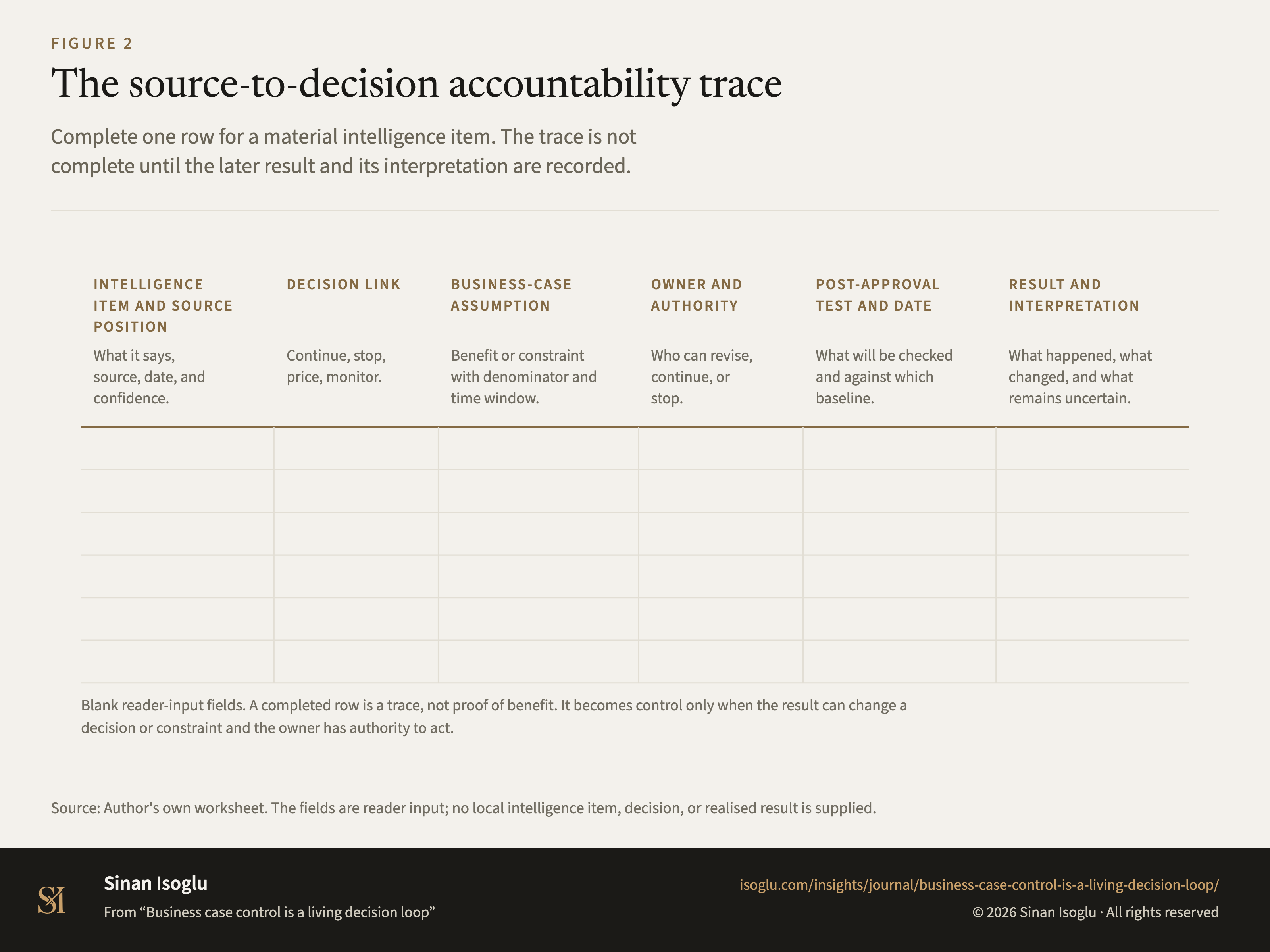
Figure 2Figure
The source-to-decision accountability trace
Business case control is a living decision loop
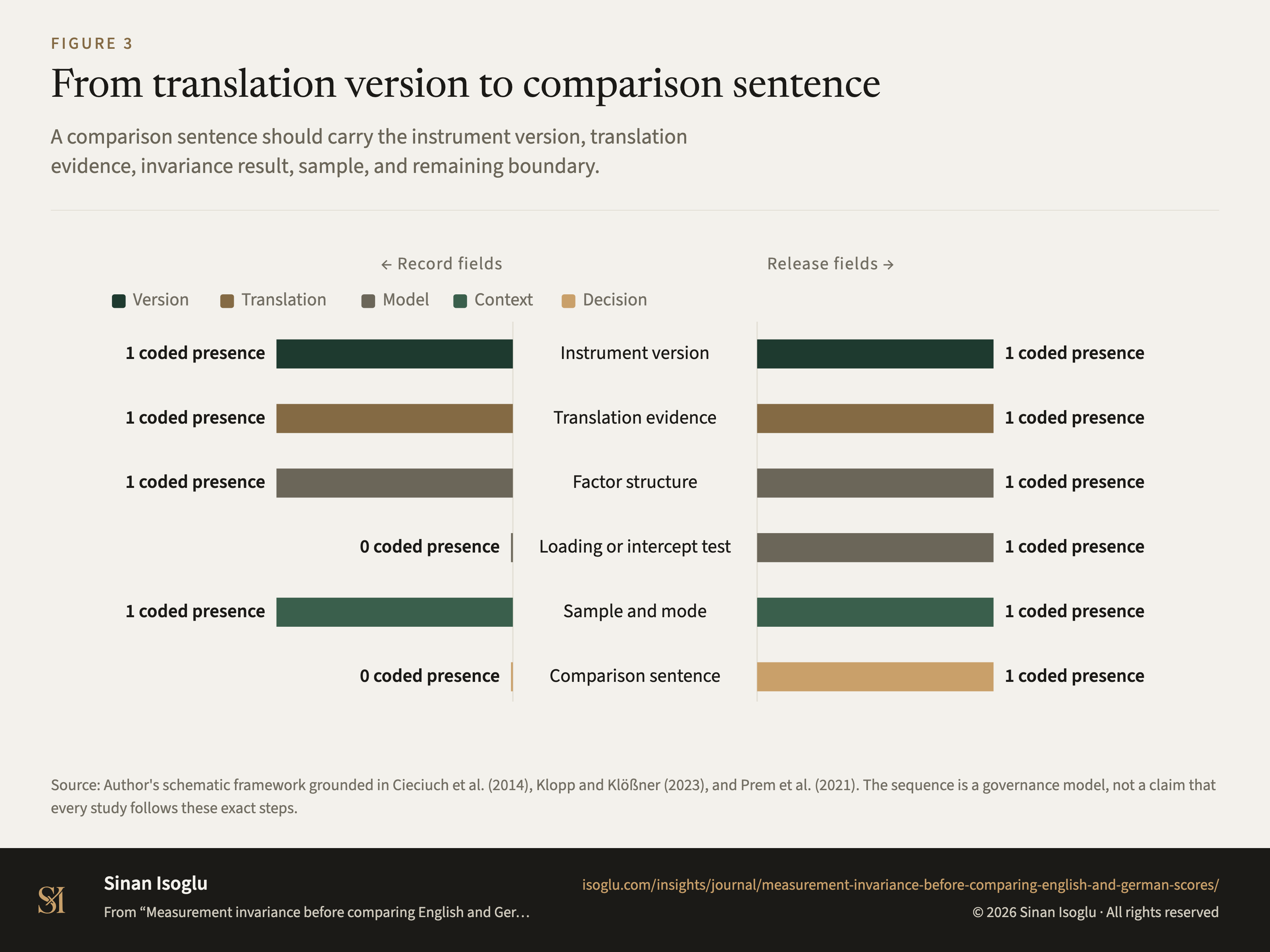
Figure 3Figure
From translation version to comparison sentence
Measurement invariance before comparing English and German scores
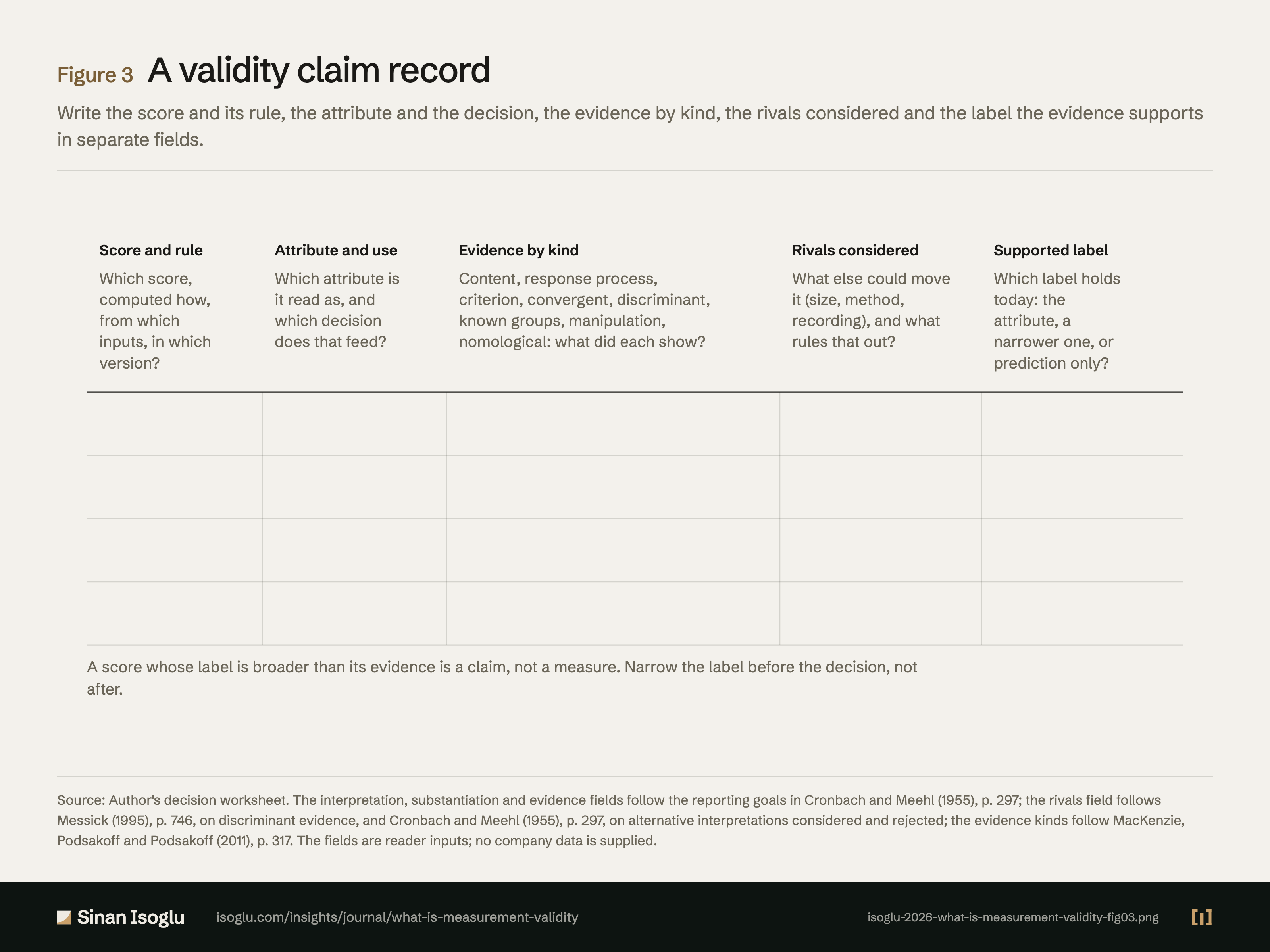
Figure 3Figure
A validity claim record
What is measurement validity?
Contact
Bring the question you're working on.
Research, a guest lecture, or a commercial question.