Figure 1From “Algorithm trust changes with the task”
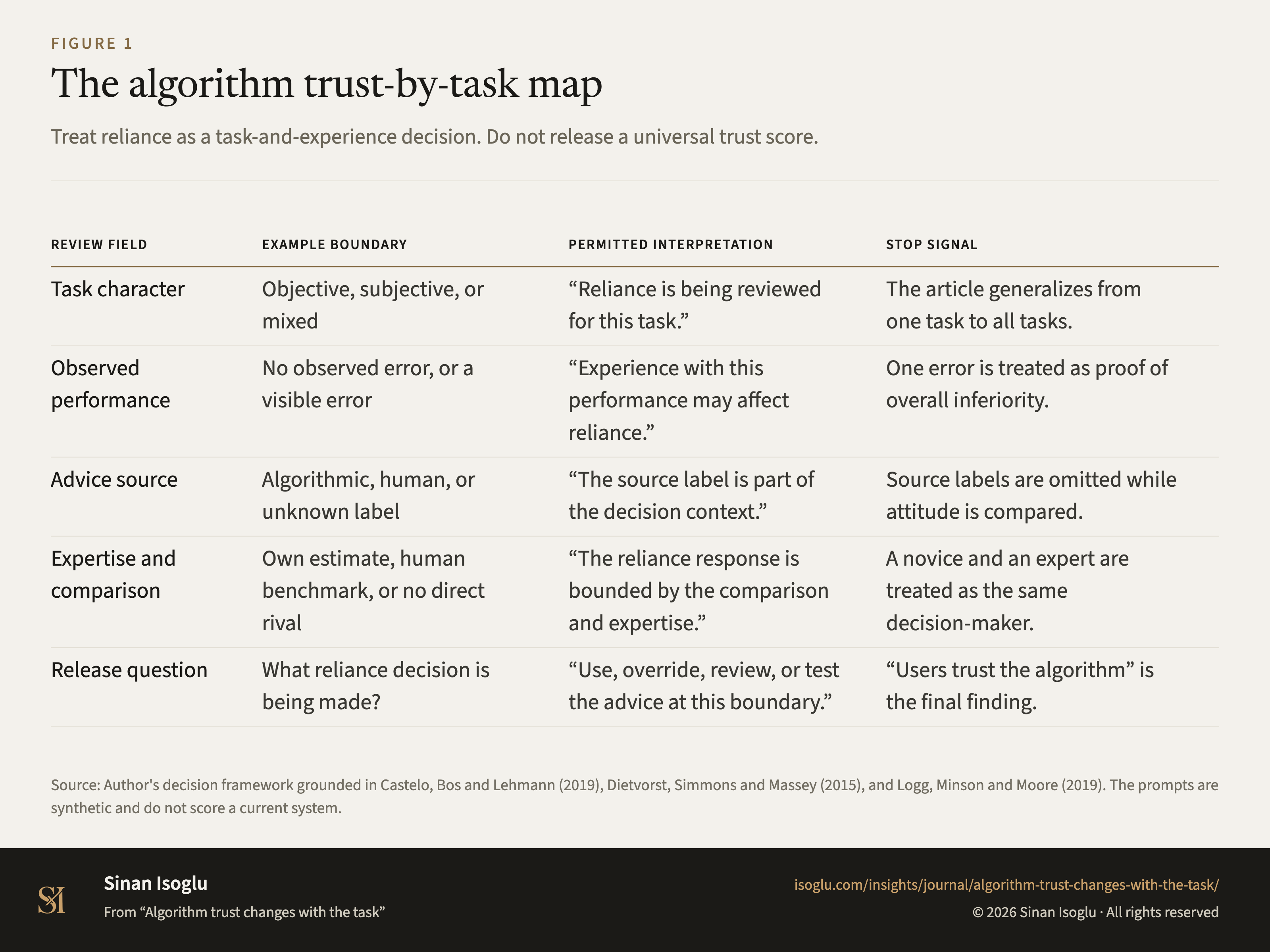
The algorithm trust-by-task map
Treat reliance as a task-and-experience decision. Do not release a universal trust score.
Figure 1The algorithm trust-by-task map
| Review field | Example boundary | Permitted interpretation | Stop signal |
|---|---|---|---|
| Task character | Objective, subjective, or mixed | “Reliance is being reviewed for this task.” | The article generalizes from one task to all tasks. |
| Observed performance | No observed error, or a visible error | “Experience with this performance may affect reliance.” | One error is treated as proof of overall inferiority. |
| Advice source | Algorithmic, human, or unknown label | “The source label is part of the decision context.” | Source labels are omitted while attitude is compared. |
| Expertise and comparison | Own estimate, human benchmark, or no direct rival | “The reliance response is bounded by the comparison and expertise.” | A novice and an expert are treated as the same decision-maker. |
| Release question | What reliance decision is being made? | “Use, override, review, or test the advice at this boundary.” | “Users trust the algorithm” is the final finding. |
Swipe or scroll horizontally if the table is wider than your screen.
Source: Author's decision framework grounded in Castelo, Bos and Lehmann (2019), Dietvorst, Simmons and Massey (2015), and Logg, Minson and Moore (2019). The prompts are synthetic and do not score a current system.
Source and evidence
Each line names a claim related to this exhibit, its source, and how it was checked.
- A CBL19-C1 Across four online laboratory studies with more than 1,400 participants and two online field studies with more than 56,000, reliance moved with perceived task character: "They find that algorithms are trusted and relied on less for tasks that seem subjective (vs. objective) in nature"Castelo, Bos & Lehmann. (2019)
- A CBL19-C2 Consumers trusted and used algorithms less for tasks perceived as subjective than for tasks perceived as objective.Castelo, Bos & Lehmann. (2019)
- A CBL19-C3 And the perception is malleable: "increasing a task"'"s perceived objectivity increases trust in and use of algorithms for that task"Castelo, Bos & Lehmann. (2019)
- A DSM15-C1 The aversion is triggered by observation, in the authors' words: "We show that people are especially averse to algorithmic forecasters after seeing them perform, even when they see them outperform a human forecaster", across "In 5 studies, participants either saw an algorithm make forecasts, a human make forecasts, both, or neither"Dietvorst, Simmons & Massey. (2015)
- A DSM15-C2 Participants lost confidence in an algorithm more quickly than in a human after the two made the same mistake, even when the algorithm had outperformed the human.Dietvorst, Simmons & Massey. (2015)
- A DSM15-C3 The mechanism they give: "This is because people more quickly lose confidence in algorithmic than human forecasters after seeing them make the same mistake"Dietvorst, Simmons & Massey. (2015)
- A LMM19-C1 The opposite finding, and its comparison: "results from six experiments show that lay people adhere more to advice when they think it comes from an algorithm than from a person", including "forecasts about the popularity of songs and romantic attraction"Logg, Minson & Moore. (2019)
- A LMM19-C2 Algorithm appreciation appeared in numeric estimates and forecasts, including song popularity and romantic attraction judgments.Logg, Minson & Moore. (2019)
- A LMM19-C3 And its limits, in the same abstract: "Algorithm appreciation persisted when advice appeared jointly or separately", but weakened when "people chose between an algorithm"'s estimate and their own, or when participants had forecasting expertiseLogg, Minson & Moore. (2019)
Grades: A, verified against the printed page of the primary source · B, primary source, text layer only · C, authoritative secondary · D, reported.
From the essay
From the research bench
Algorithm trust changes with the task
Algorithm trust is task-dependent: review objectivity, observed error, advice source, expertise, and reliance before calling a system trusted.
Read the essayThis exhibit belongs to an essay: the numbers live here, the argument lives there.
Cite or embed
Related exhibits
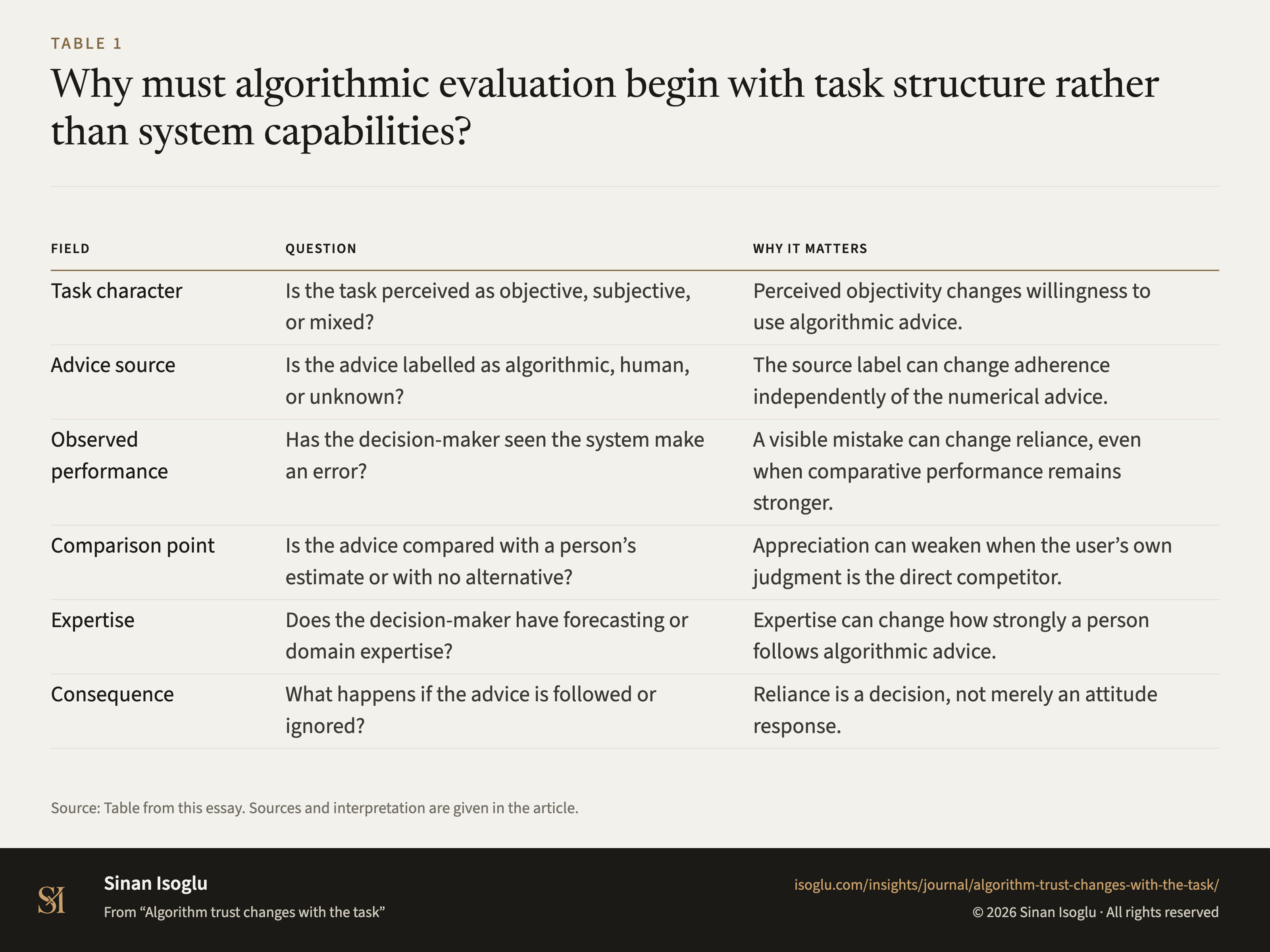
Table 1Table
Why must algorithmic evaluation begin with task structure rather than system capabilities?
Algorithm trust changes with the task
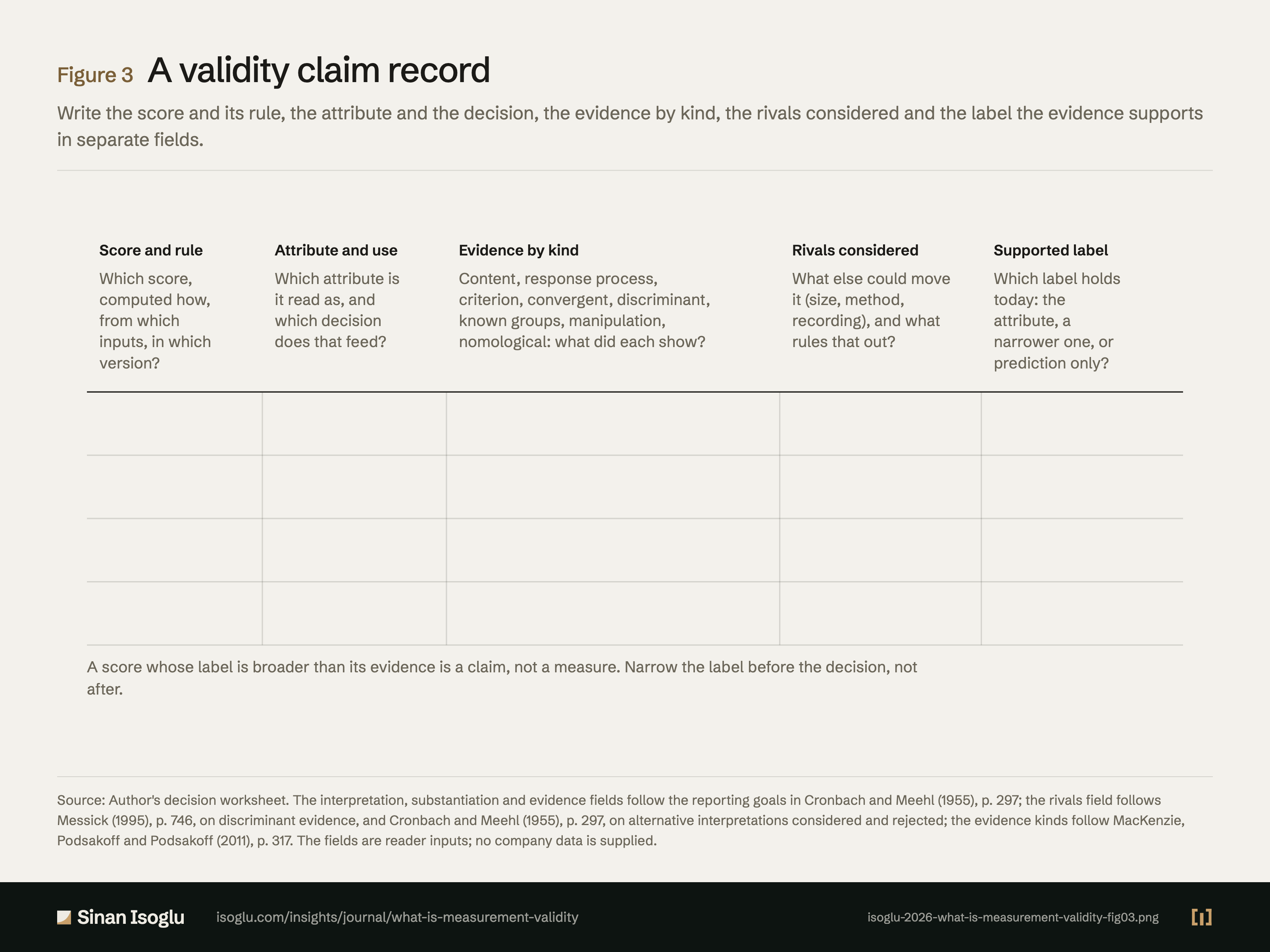
Figure 3Figure
A validity claim record
What is measurement validity?
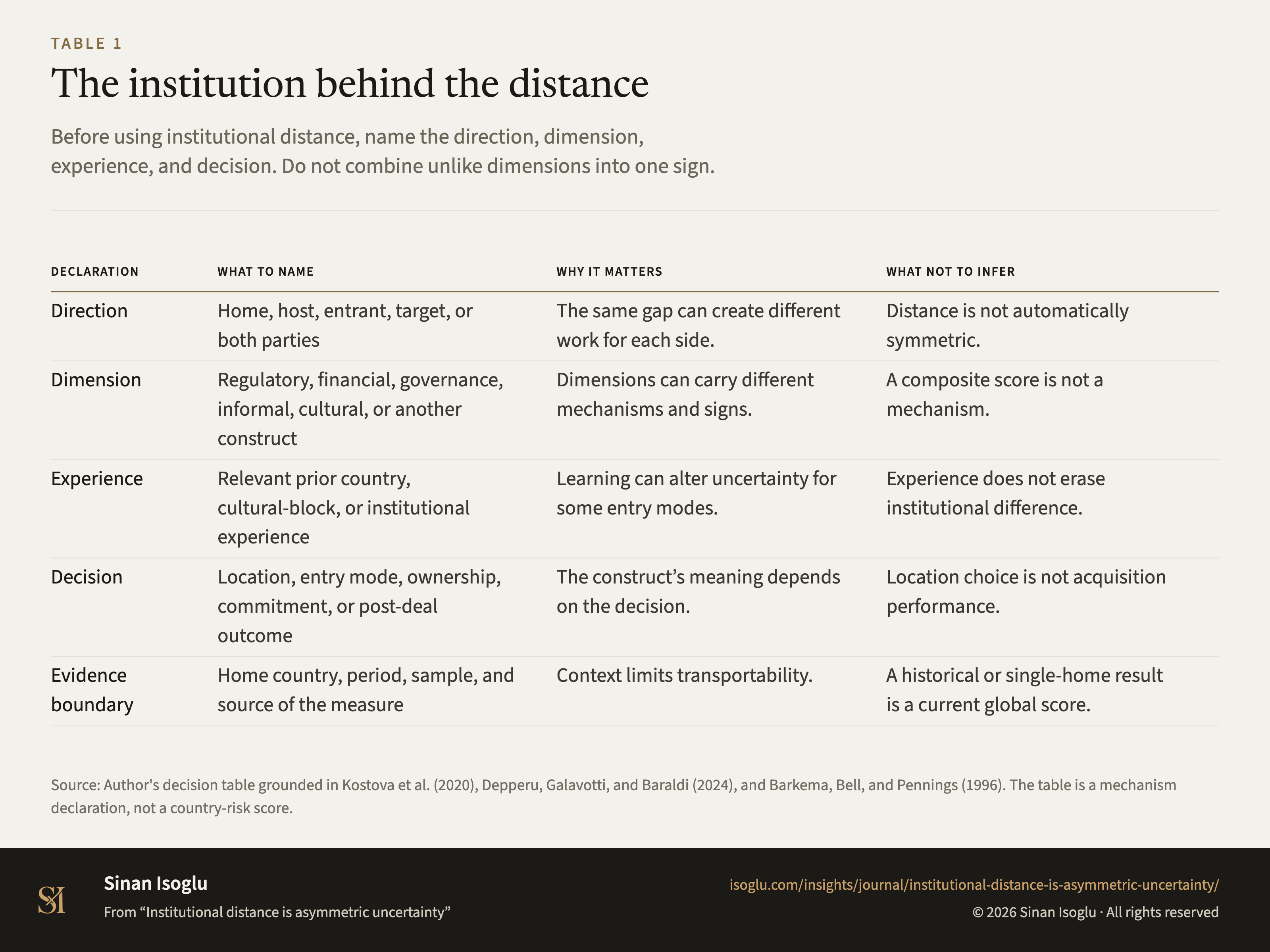
Table 1Table
The institution behind the distance
Institutional distance is asymmetric uncertainty
Contact
Bring the question you're working on.
Research, a guest lecture, or a commercial question.