Table 1From “Institutional distance is asymmetric uncertainty”
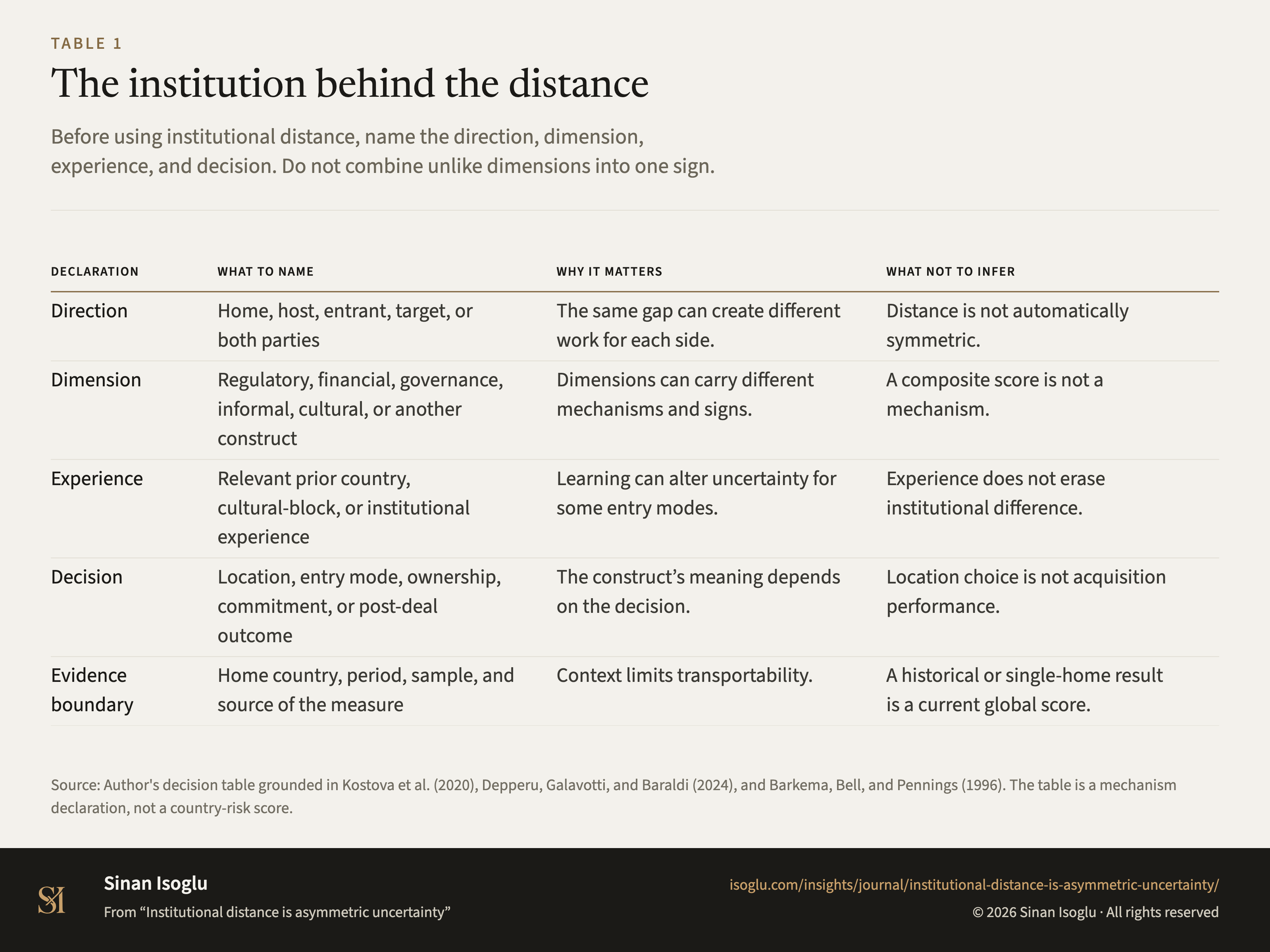
The institution behind the distance
Before using institutional distance, name the direction, dimension, experience, and decision. Do not combine unlike dimensions into one sign.
Table 1The institution behind the distance
| Declaration | What to name | Why it matters | What not to infer |
|---|---|---|---|
| Direction | Home, host, entrant, target, or both parties | The same gap can create different work for each side. | Distance is not automatically symmetric. |
| Dimension | Regulatory, financial, governance, informal, cultural, or another construct | Dimensions can carry different mechanisms and signs. | A composite score is not a mechanism. |
| Experience | Relevant prior country, cultural-block, or institutional experience | Learning can alter uncertainty for some entry modes. | Experience does not erase institutional difference. |
| Decision | Location, entry mode, ownership, commitment, or post-deal outcome | The construct's meaning depends on the decision. | Location choice is not acquisition performance. |
| Evidence boundary | Home country, period, sample, and source of the measure | Context limits transportability. | A historical or single-home result is a current global score. |
Swipe or scroll horizontally if the table is wider than your screen.
Source: Author's decision table grounded in Kostova et al. (2020), Depperu, Galavotti, and Baraldi (2024), and Barkema, Bell, and Pennings (1996). The table is a mechanism declaration, not a country-risk score.
From the essay
From the research bench
Institutional distance is asymmetric uncertainty
Entry direction, institutional quality, and prior experience change what distance means. Separate the mechanism before assigning a country risk.
Read the essayThis exhibit belongs to an essay: the numbers live here, the argument lives there.
Cite or embed
Contact
Bring the question you're working on.
Research, a guest lecture, or a commercial question.