Figure 1From “ABM selection is not personalization”
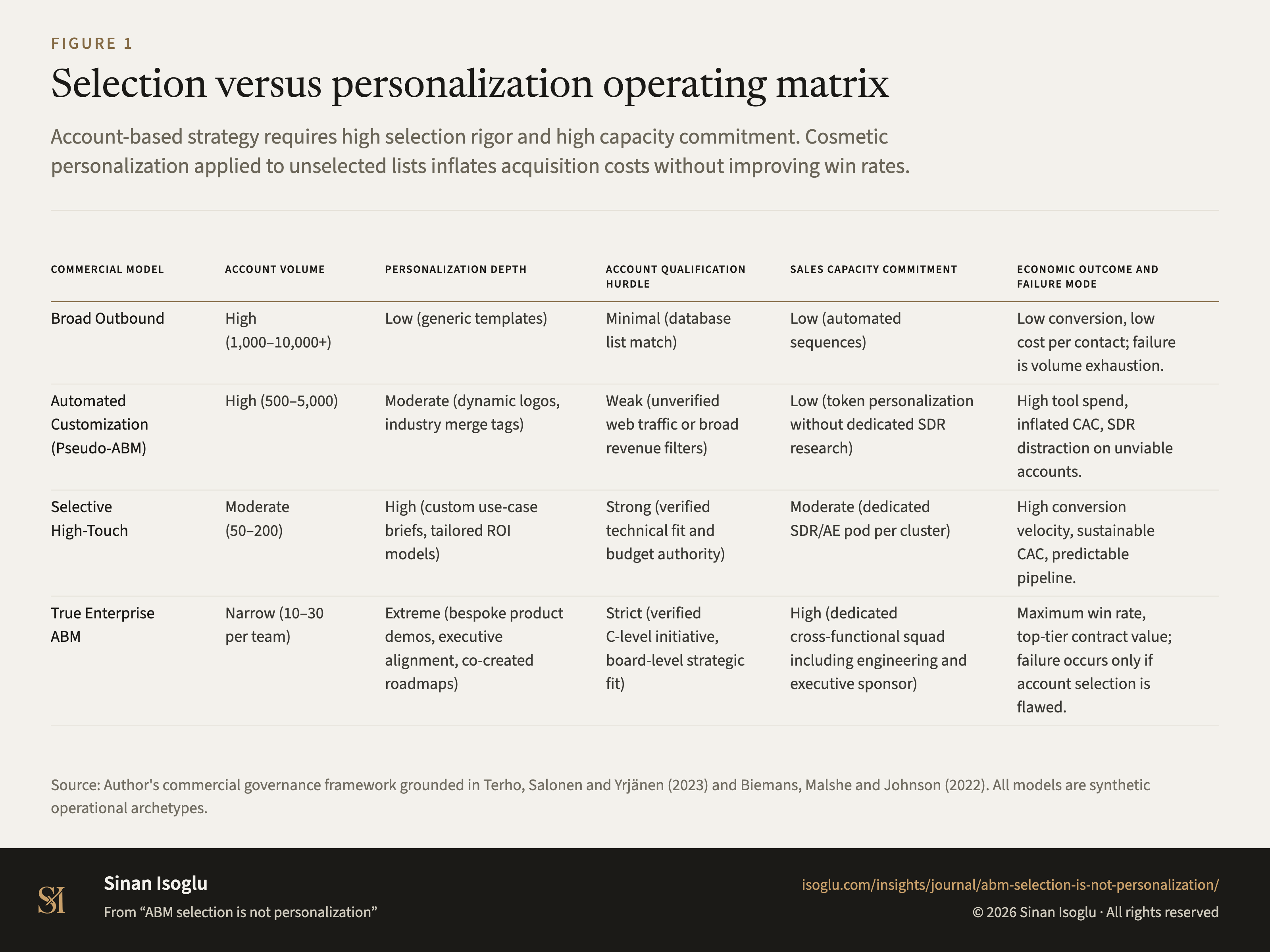
Selection versus personalization operating matrix
Account-based strategy requires high selection rigor and high capacity commitment. Cosmetic personalization applied to unselected lists inflates acquisition costs without improving win rates.
Figure 1Selection versus personalization operating matrix
| Commercial model | Account volume | Personalization depth | Account qualification hurdle | Sales capacity commitment | Economic outcome and failure mode |
|---|---|---|---|---|---|
| Broad Outbound | High (1,000–10,000+) | Low (generic templates) | Minimal (database list match) | Low (automated sequences) | Low conversion, low cost per contact; failure is volume exhaustion. |
| Automated Customization (Pseudo-ABM) | High (500–5,000) | Moderate (dynamic logos, industry merge tags) | Weak (unverified web traffic or broad revenue filters) | Low (token personalization without dedicated SDR research) | High tool spend, inflated CAC, SDR distraction on unviable accounts. |
| Selective High-Touch | Moderate (50–200) | High (custom use-case briefs, tailored ROI models) | Strong (verified technical fit and budget authority) | Moderate (dedicated SDR/AE pod per cluster) | High conversion velocity, sustainable CAC, predictable pipeline. |
| True Enterprise ABM | Narrow (10–30 per team) | Extreme (bespoke product demos, executive alignment, co-created roadmaps) | Strict (verified C-level initiative, board-level strategic fit) | High (dedicated cross-functional squad including engineering and executive sponsor) | Maximum win rate, top-tier contract value; failure occurs only if account selection is flawed. |
Swipe or scroll horizontally if the table is wider than your screen.
Source: Author's commercial governance framework grounded in Terho, Salonen and Yrjänen (2023) and Biemans, Malshe and Johnson (2022). All models are synthetic operational archetypes.
Source and evidence
Each line names a claim related to this exhibit, its source, and how it was checked.
- A TSY23-C1 "the sales development processes relating to lead research engagement and handover are conducted in four distinct application contexts" to qualify leads for the outside salesforceTerho, Salonen & Yrjänen. (2023)
- A TSY23-C2 The evidence is qualitative and small: "the authors adopted a qualitative field-study approach and interviewed 13 people from eight firms", so the higher research intensity of account-based development is a reported pattern and not a measured effectTerho, Salonen & Yrjänen. (2023)
- A BMJ22-C1 The review's own count: "we identify 73 articles" about the sales-marketing interface, published 1990 through 2021Biemans, Malshe & Johnson. (2022)
Grades: A, verified against the printed page of the primary source · B, primary source, text layer only · C, authoritative secondary · D, reported.
From the essay
Go-to-market strategy
ABM selection is not personalization
Personalization tailors content to a recipient; ABM selection chooses where to commit scarce sales capacity and which accounts to actively exclude.
Read the essayThis exhibit belongs to an essay: the numbers live here, the argument lives there.
Cite or embed
Related exhibits
Figure 1Figure
Account-based resource allocation matrix
Account-based marketing is resource allocation
Figure 1Figure
The synthetic marketing-to-sales handoff contract
What is a marketing-to-sales handoff? The interface where attribution breaks
Figure 1Figure
The Revenue Operations commercial architecture
What is RevOps?
Contact
Bring the question you're working on.
Research, a guest lecture, or a commercial question.