Tabelle 1Aus „Ein Segment ist real, wenn sich eine Entscheidung ändert“
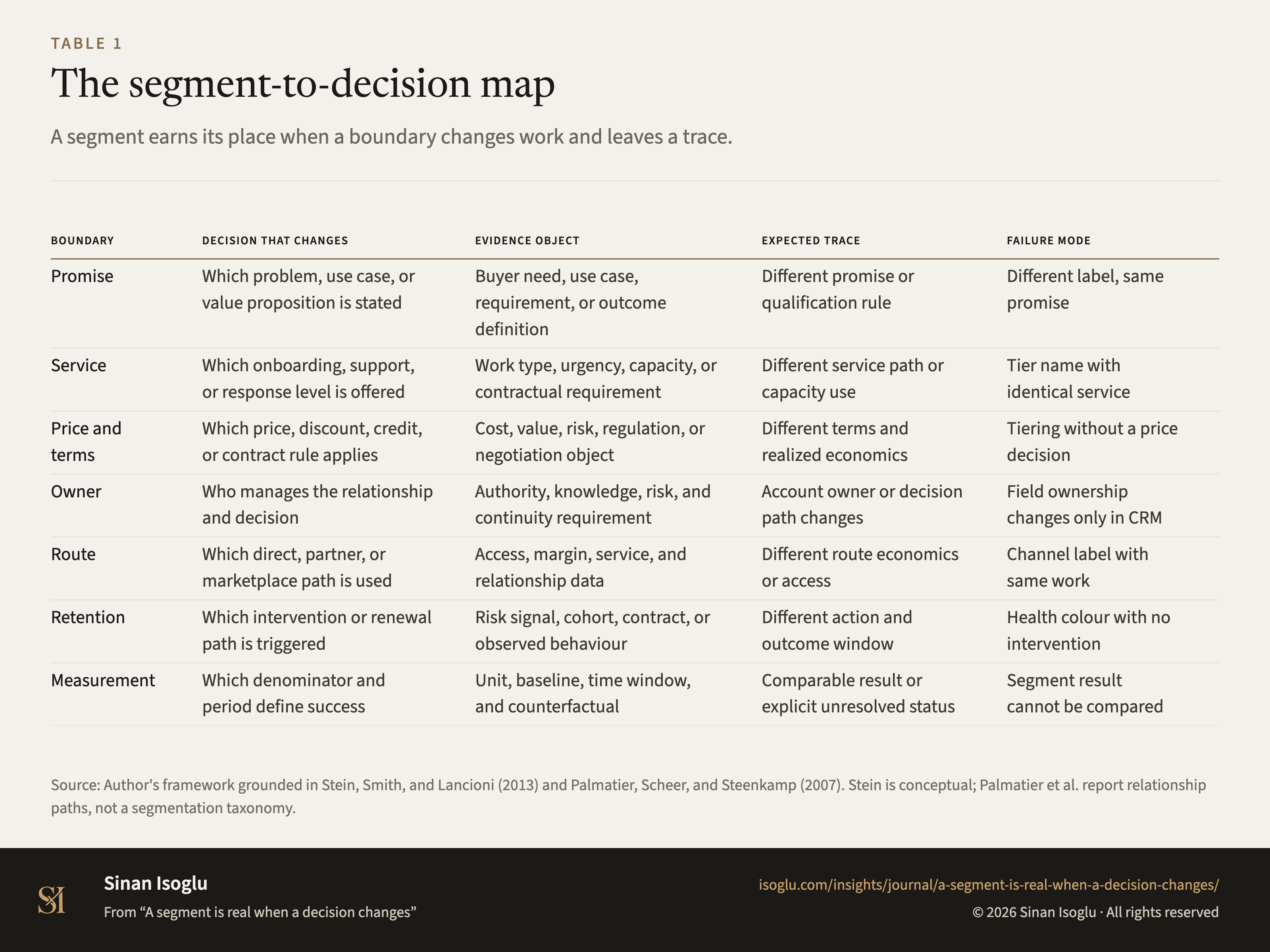
Die Segment-zu-Entscheidung-Karte
Ein Segment verdient seinen Platz, wenn eine Grenze Arbeit ändert und eine Spur hinterlässt.
Tabelle 1Die Segment-zu-Entscheidung-Karte
| Grenze | Geänderte Entscheidung | Evidenzobjekt | Erwartete Spur | Fehlerbild |
|---|---|---|---|---|
| Versprechen | Welches Problem, welcher Anwendungsfall oder Wert genannt wird | Bedarf, Anwendungsfall, Anforderung oder Ergebnisdefinition | Anderes Versprechen oder andere Qualifikationsregel | Anderes Label, dasselbe Versprechen |
| Service | Welche Onboarding-, Support- oder Reaktionsstufe gilt | Arbeitsart, Dringlichkeit, Kapazität oder Vertragspflicht | Anderer Servicepfad oder Kapazitätsverbrauch | Stufenname bei identischem Service |
| Preis und Konditionen | Welche Preis-, Rabatt-, Kredit- oder Vertragsregel gilt | Kosten, Wert, Risiko, Regulierung oder Verhandlung | Andere Konditionen und realisierte Ökonomie | Stufen ohne Preisentscheidung |
| Eigentümer | Wer Beziehung und Entscheidung führt | Autorität, Wissen, Risiko und Kontinuität | Eigentümer oder Entscheidungsweg ändert sich | Nur CRM-Eigentümer wird geändert |
| Route | Welcher direkte, Partner- oder Marktplatzweg gilt | Zugang, Marge, Service und Beziehungsdaten | Andere Routenökonomie oder anderer Zugang | Kanalname bei identischer Arbeit |
| Retention | Welche Intervention oder Verlängerungsroute startet | Risikosignal, Kohorte, Vertrag oder beobachtetes Verhalten | Andere Aktion und Ergebniszeitraum | Health-Farbe ohne Intervention |
| Messung | Welcher Nenner und Zeitraum Erfolg definieren | Einheit, Basiswert, Zeitraum und Gegenfaktum | Vergleichbares Ergebnis oder offener Status | Segmentergebnis ist nicht vergleichbar |
Bei breiten Tabellen horizontal wischen oder scrollen.
Quelle: Eigener Rahmen auf Basis von Stein, Smith und Lancioni (2013) sowie Palmatier, Scheer und Steenkamp (2007). Stein ist konzeptionell; Palmatier et al. berichten Beziehungspfade, keine Segmenttaxonomie.
Quelle und Evidenz
Jede Zeile nennt eine Aussage zu dieser Abbildung, ihre Quelle und die Art ihrer Prüfung.
- B SSL13-C1 The paper is conceptual and its object is the diffusion of a capability: "The development and diffusion of customer relationship management (CRM) intelligence in business-to-business environments"Stein, Smith & Lancioni. (2013)
- B SSL13-C2 The gap the paper names: management has "neglected to analyze this information across market segments, customer categories, and customer"-firm relationship forms, and its method aims at "an improved understanding of the in-forming process in the firm"'s dealings with clients and "the directionality of customer"-firm decision-makingStein, Smith & Lancioni. (2013)
- A PSS07-C1 The design is dyadic and triadic: "In a study of 362 buyer"-"salesperson dyads using triadic data (from buyer, salesperson, and sales manager)", and the construct is new: "only salesperson-owned loyalty, a newly identified construct, directly affects the more tangible seller financial outcomes of sales growth and selling effectiveness"Palmatier, Scheer & Steenkamp (2007), Table 3
- A PSS07-C2 Stated intention, and the item says its own horizon: buyers "reported that they would try to shift an average of 26% of" their current purchases, the question being whether they would "try to shift to this salesperson"'"s new rep firm over the next 3 years?" Intention, not realised movementPalmatier, Scheer & Steenkamp (2007), appendix and p. 195
- A PSS07-C3 The contrast is between the two loyalties, in the authors' words: "only salesperson-owned loyalty, a newly identified construct, directly affects the more tangible seller financial outcomes of sales growth and selling effectiveness"Palmatier, Scheer & Steenkamp (2007), Table 3
- A PSS07-C4 The paper reports measured firm and interface levers that alter salesperson-owned loyalty and firm-loyalty paths: "Increasing relationship-enhancing activities and value received by the customer builds both salesperson-owned loyalty and loyalty to the selling firm"; the impact is moderated by selling-firm consistency and loyalty-capturing strategiesPalmatier, Scheer & Steenkamp (2007), abstract and Tables 3 and 4
- B B09-C1 A segment is operational only when its boundary changes a promise, service level, price or terms, owner or route, or retention actionAuthor framework grounded in Stein, Smith and Lancioni and customer-relationship evidence
- B B09-C2 A segment label should be tested by the decision it changes and the cost or outcome that moves afterward, not by the label's descriptive appealAuthor framework
Prüfgrade: A, gegen die gedruckte Seite der Primärquelle geprüft · B, Primärquelle, nur Textebene · C, belastbare Sekundärquelle · D, berichtet.
Aus dem Beitrag
Wachstum, das sich potenziert
Ein Segment ist real, wenn sich eine Entscheidung ändert
Ein Segment ist operativ, wenn seine Grenze Versprechen, Service, Preis, Eigentümer, Route oder Retention ändert und eine Spur hinterlässt.
Den Beitrag lesenDiese Abbildung gehört zu einem Essay: Die Zahlen stehen hier, das Argument dort.
Zitieren oder einbetten
Verwandte Abbildungen
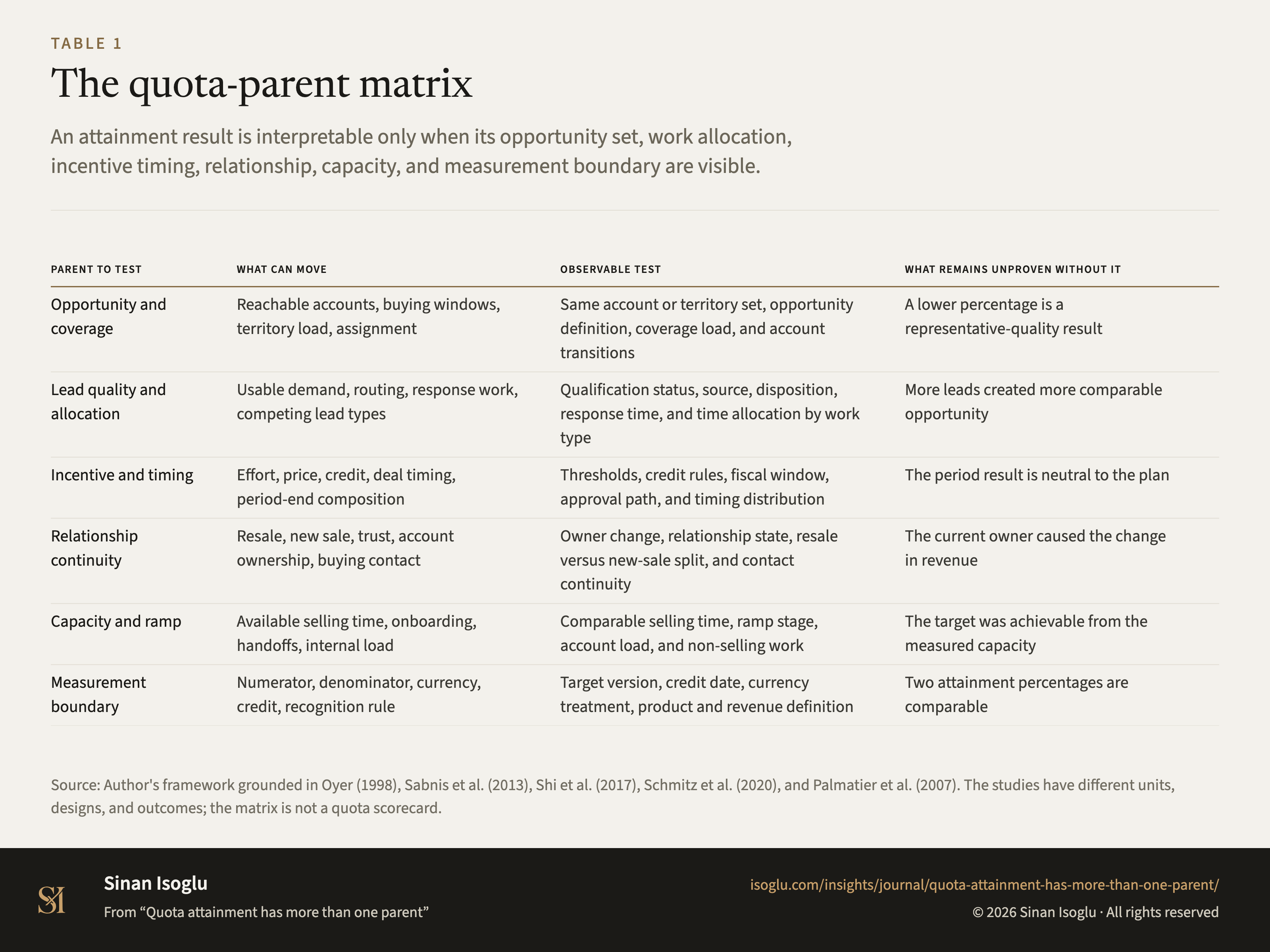
Tabelle 1Tabelle
Die Ursachenmatrix der Quotenerreichung
Quotenerreichung hat mehr als eine Ursache
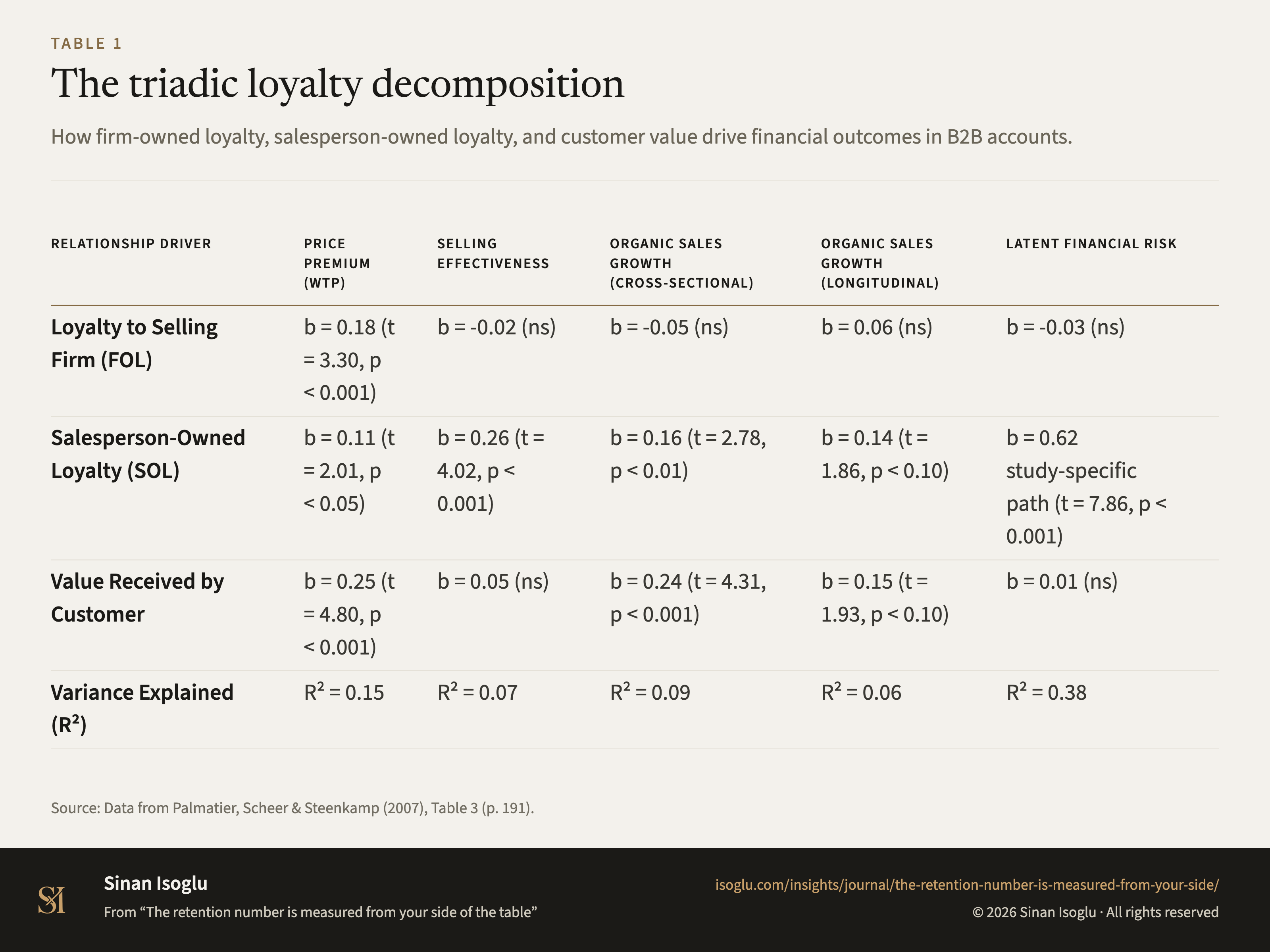
Tabelle 1Tabelle
Die triadische Zerlegung der Kundenbindung
Die Bindungsquote wird von Ihrer Seite aus gemessen
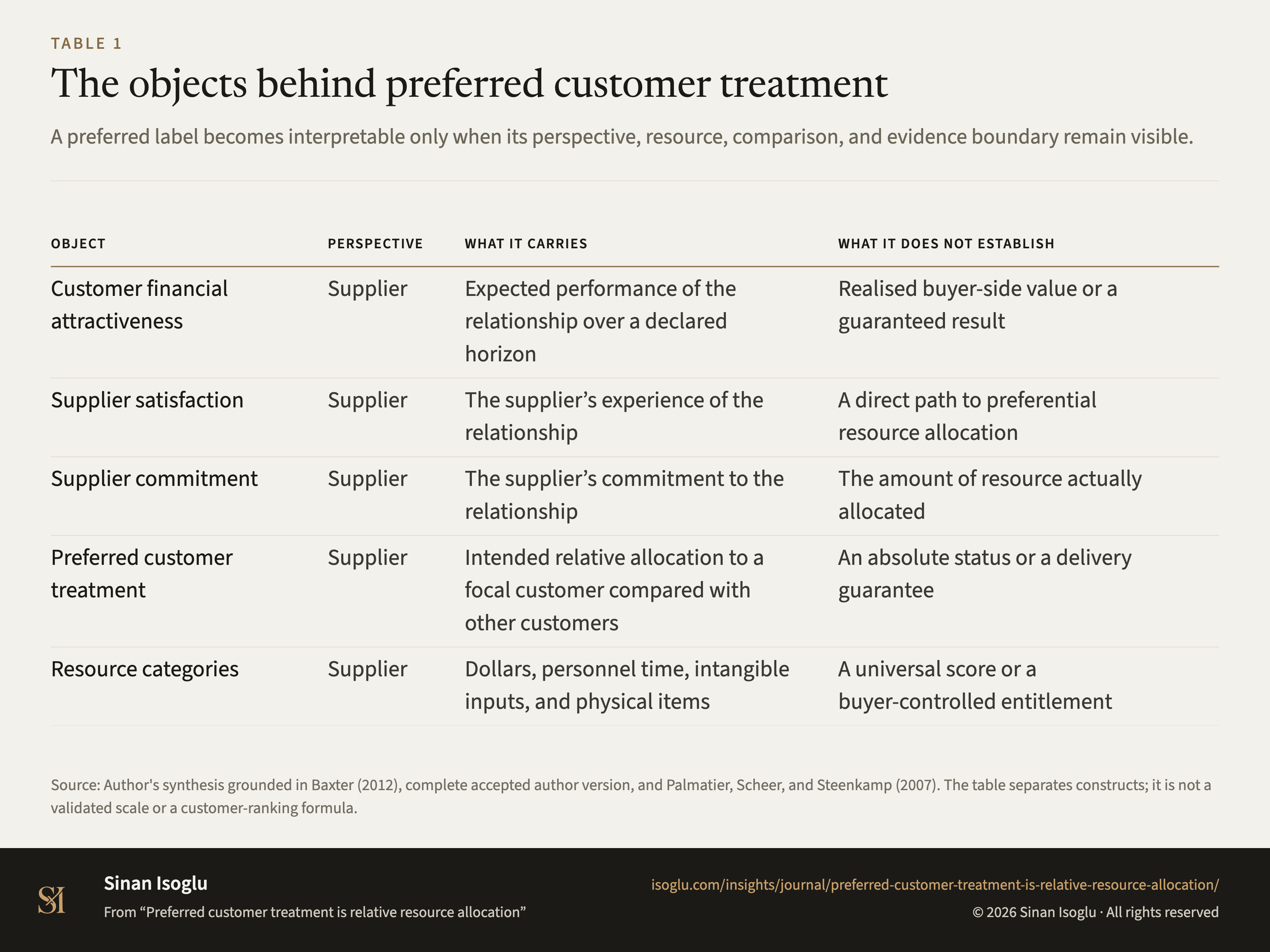
Tabelle 1Tabelle
Die Objekte hinter bevorzugter Kundenbehandlung
Bevorzugte Kundenbehandlung ist eine Ressourcenentscheidung
Kontakt
Schicken Sie die Frage, an der Sie arbeiten.
Forschung, ein Gastvortrag oder eine Frage aus der Praxis.