Table 1From “A renewal is not proof you prevented churn”
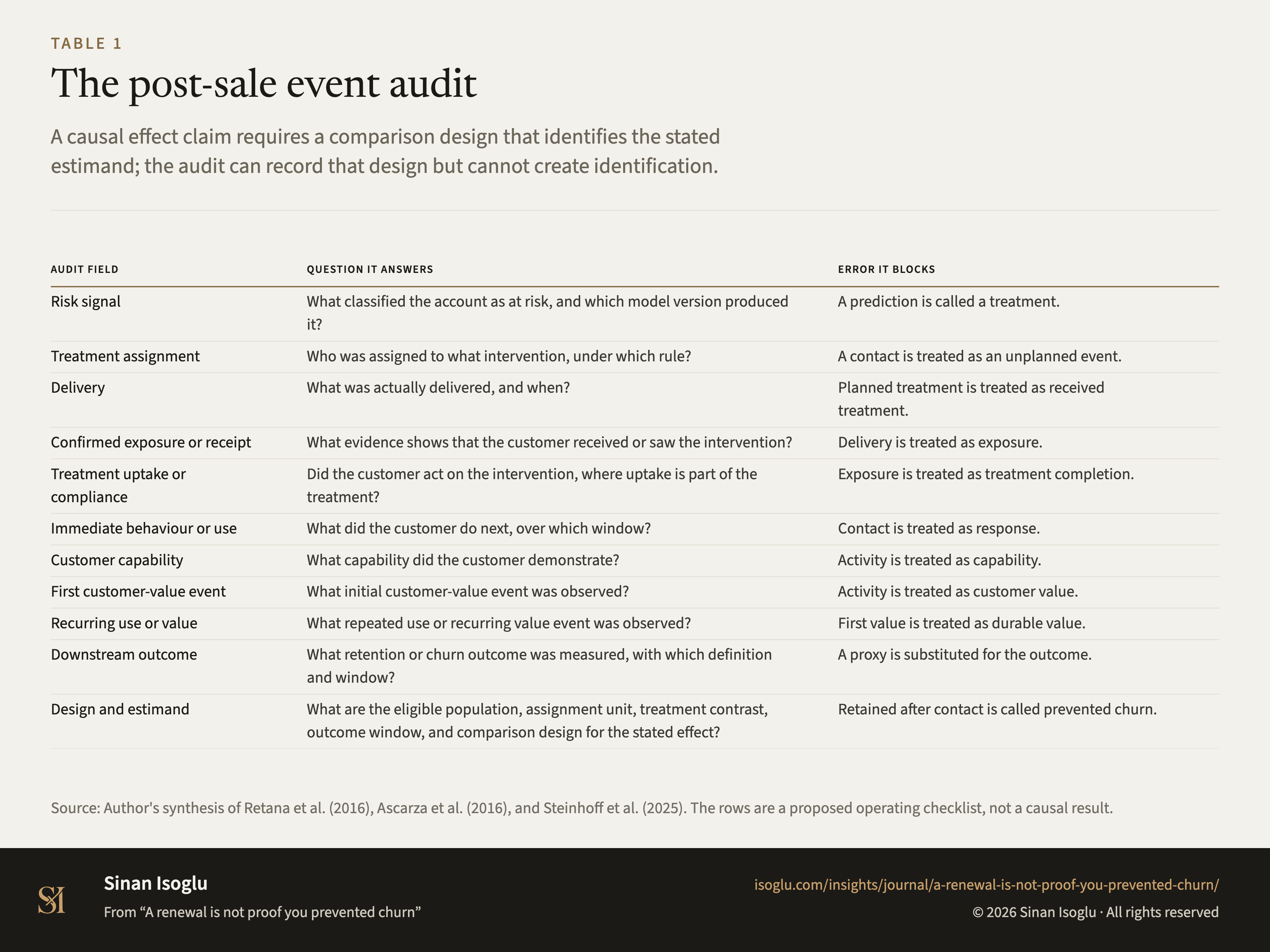
The post-sale event audit
A causal effect claim requires a comparison design that identifies the stated estimand; the audit can record that design but cannot create identification.
Table 1The post-sale event audit
| Audit field | Question it answers | Error it blocks |
|---|---|---|
| Risk signal | What classified the account as at risk, and which model version produced it? | A prediction is called a treatment. |
| Treatment assignment | Who was assigned to what intervention, under which rule? | A contact is treated as an unplanned event. |
| Delivery | What was actually delivered, and when? | Planned treatment is treated as received treatment. |
| Confirmed exposure or receipt | What evidence shows that the customer received or saw the intervention? | Delivery is treated as exposure. |
| Treatment uptake or compliance | Did the customer act on the intervention, where uptake is part of the treatment? | Exposure is treated as treatment completion. |
| Immediate behaviour or use | What did the customer do next, over which window? | Contact is treated as response. |
| Customer capability | What capability did the customer demonstrate? | Activity is treated as capability. |
| First customer-value event | What initial customer-value event was observed? | Activity is treated as customer value. |
| Recurring use or value | What repeated use or recurring value event was observed? | First value is treated as durable value. |
| Downstream outcome | What retention or churn outcome was measured, with which definition and window? | A proxy is substituted for the outcome. |
| Design and estimand | What are the eligible population, assignment unit, treatment contrast, outcome window, and comparison design for the stated effect? | Retained after contact is called prevented churn. |
Swipe or scroll horizontally if the table is wider than your screen.
Source: Author's synthesis of Retana et al. (2016), Ascarza et al. (2016), and Steinhoff et al. (2025). The rows are a proposed operating checklist, not a causal result.
Source and evidence
Each line names a claim related to this exhibit, its source, and how it was checked.
- B PV1R-C1 A post-sale audit should distinguish signal, treatment assignment, immediate behavior, downstream retention or usage, and the counterfactualAuthor framework grounded in the cited field experiments and operating corpus
- A PV1R-C2 The design, verbatim: "out of 2,673 customers who adopted the service during the experiment 366 received a service intervention", in a major public-cloud provider's 2011 field experimentRetana, Forman and Wu (2016), printed pp. 34, 47, and 49
- A PV1R-C3 "whereas only 6.4% of customers in the control group left the company during the first three months after the campaign, 10.0% did so in the treatment group": a randomised wireless-provider field experimentAscarza, Iyengar and Schleicher (2016), printed pp. 48-52
- B PV1R-C4 The study is scoped to one stage: "the impact of add-on bundling on customer retention during the onboarding stage, using multiple methods", and it opens on the tension that maximising add-ons at acquisition "might conflict with goals to achieve long-term retention of customers". Onboarding and post-onboarding can therefore show different relationshipsSteinhoff, Kim, Kanuri and Palmatier (2025), version-of-record pp. 1468-1475
- B PV1R-C5 A public operating metric can be classified as provider activity, customer capability, first value, recurring value, or post-intervention outcomeAuthor coding of the frozen post-sale operating corpus
- B PV1R-C7 The event dictionary is a bounded operationalization of the audit, not a causal resultAuthor framework grounded in the cited sources
Grades: A, verified against the printed page of the primary source · B, primary source, text layer only · C, authoritative secondary · D, reported.
From the essay
Revenue operations & AI
A renewal is not proof you prevented churn
A renewal after contact does not prove prevention. Separate risk, treatment, behaviour, value, outcome, and counterfactual before calling an account saved.
Read the essayThis exhibit belongs to an essay: the numbers live here, the argument lives there.
Cite or embed
Contact
Bring the question you're working on.
Research, a guest lecture, or a commercial question.