Table 1From “A new-product forecast needs more than one method”
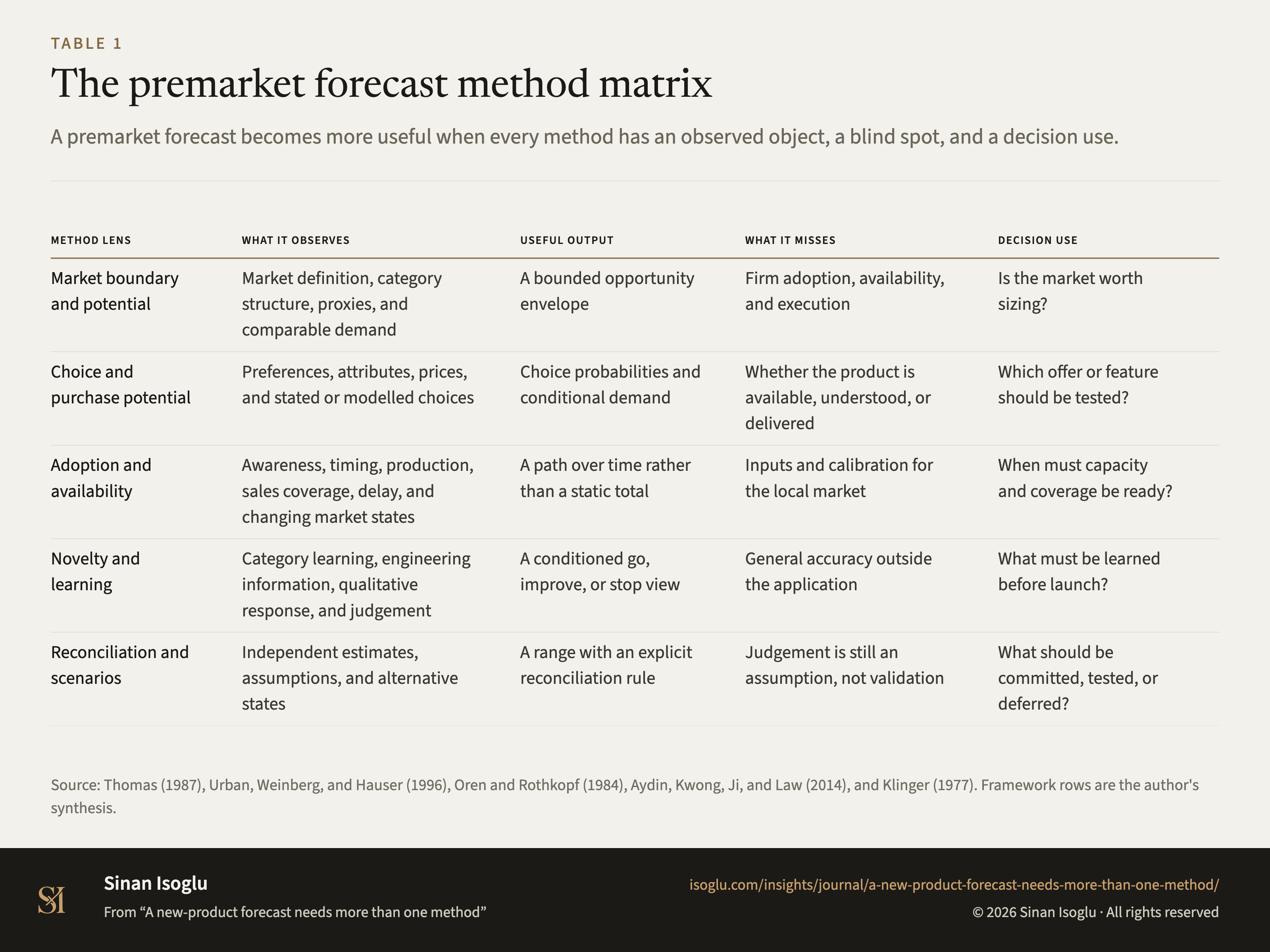
The premarket forecast method matrix
A premarket forecast becomes more useful when every method has an observed object, a blind spot, and a decision use.
Table 1The premarket forecast method matrix
| Method lens | What it observes | Useful output | What it misses | Decision use |
|---|---|---|---|---|
| Market boundary and potential | Market definition, category structure, proxies, and comparable demand | A bounded opportunity envelope | Firm adoption, availability, and execution | Is the market worth sizing? |
| Choice and purchase potential | Preferences, attributes, prices, and stated or modelled choices | Choice probabilities and conditional demand | Whether the product is available, understood, or delivered | Which offer or feature should be tested? |
| Adoption and availability | Awareness, timing, production, sales coverage, delay, and changing market states | A path over time rather than a static total | Inputs and calibration for the local market | When must capacity and coverage be ready? |
| Novelty and learning | Category learning, engineering information, qualitative response, and judgement | A conditioned go, improve, or stop view | General accuracy outside the application | What must be learned before launch? |
| Reconciliation and scenarios | Independent estimates, assumptions, and alternative states | A range with an explicit reconciliation rule | Judgement is still an assumption, not validation | What should be committed, tested, or deferred? |
Swipe or scroll horizontally if the table is wider than your screen.
Source: Thomas (1987), Urban, Weinberg, and Hauser (1996), Oren and Rothkopf (1984), Aydin, Kwong, Ji, and Law (2014), and Klinger (1977). Framework rows are the author's synthesis.
Source and evidence
Each line names a claim related to this exhibit, its source, and how it was checked.
- B NPM27-C1 The three steps are Thomas's own: "defining a concept of market potential for the new product", independent operationalisations, and reconciliation. The reason he gives for the plurality: "Multiple methods help to ensure that what is measured is due to the phenomenon under study and not the method"Thomas. (1987)
- B NPM27-C2 The decision the forecast serves is three-way in the paper's own words: whether "the really-new product would be a viable business ven"ture, whether to plan improvements, or whether "the firm should stop development", and it is reached because "the authors describe how one firm combines managerial judgment and state"-of-the-art market measurementUrban, Weinberg & Hauser. (1996)
- B NPM27-C3 One case, and a named one: "the authors describe how one firm combines managerial judgment and state"-of-the-art market measurement to decide whether "the really-new product would be a viable business ven"tureUrban, Weinberg & Hauser. (1996)
- B NPM27-C4 The path is enumerated in the paper: "This model accounts for differ""ences in customer awareness of different products, for differences in product announcement dates, for differences in product availability, for differences in marketing efforts, for customer inertia and for customer purchasing delays", applied in "a system developed for market analysis of high speed nonimpact computer printers"Oren & Rothkopf. (1984)
- B NPM27-C5 The uncertainty the fuzzy model preserves is in the survey data itself: "a high degree of fuzziness always exists in the data obtained from conjoint surveys", and "ignorance of the fuzziness would lead to the over-estimation of market demands"Aydin, Kwong, Ji & Law. (2014)
- B NPM27-C6 The effort depends on the product: "depending upon the type, age (well-established vs. new product), and use of the product involved, the approaches and avenues to be employed, and the data to be established may differ markedly from one product to another", and "the extent of research effort required is guided by an industrial product typology which is applied to an eight step approach"Klinger. (1977)
- B NPM27-C7 A method matrix can assign each method an observed object, useful output, blind spot, and decision useAuthor framework in the premarket method matrix
- B NPM27-C8 The evidence does not show that adding methods always improves forecast accuracy; it supports explicit purpose, reconciliation, and boundary conditionsAuthor boundary grounded in the cited premarket sources
Grades: A, verified against the printed page of the primary source · B, primary source, text layer only · C, authoritative secondary · D, reported.
From the essay
From the research bench
A new-product forecast needs more than one method
When a product has no history, one precise number hides the uncertainty. Combine independent methods around a defined decision and show what each misses.
Read the essayThis exhibit belongs to an essay: the numbers live here, the argument lives there.
Cite or embed
Contact
Bring the question you're working on.
Research, a guest lecture, or a commercial question.