Figure 1From “What is claim entailment? Does the source support the sentence?”
The synthetic claim-to-evidence audit
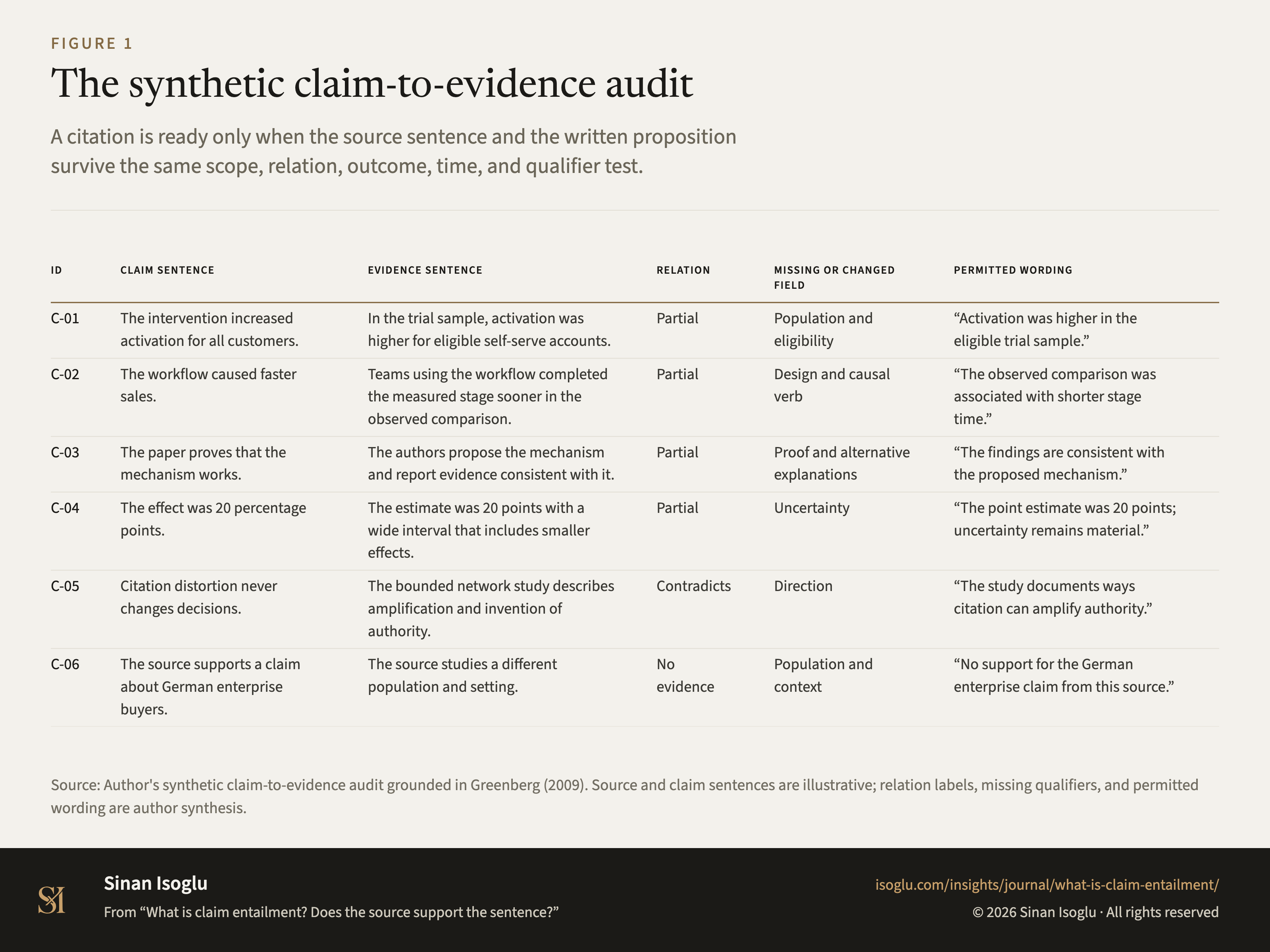
A citation is ready only when the source sentence and the written proposition survive the same scope, relation, outcome, time, and qualifier test.
Figure 1The synthetic claim-to-evidence audit
| ID | Claim sentence | Evidence sentence | Relation | Missing or changed field | Permitted wording |
|---|---|---|---|---|---|
| C-01 | The intervention increased activation for all customers. | In the trial sample, activation was higher for eligible self-serve accounts. | Partial | Population and eligibility | “Activation was higher in the eligible trial sample.” |
| C-02 | The workflow caused faster sales. | Teams using the workflow completed the measured stage sooner in the observed comparison. | Partial | Design and causal verb | “The observed comparison was associated with shorter stage time.” |
| C-03 | The paper proves that the mechanism works. | The authors propose the mechanism and report evidence consistent with it. | Partial | Proof and alternative explanations | “The findings are consistent with the proposed mechanism.” |
| C-04 | The effect was 20 percentage points. | The estimate was 20 points with a wide interval that includes smaller effects. | Partial | Uncertainty | “The point estimate was 20 points; uncertainty remains material.” |
| C-05 | Citation distortion never changes decisions. | The bounded network study describes amplification and invention of authority. | Contradicts | Direction | “The study documents ways citation can amplify authority.” |
| C-06 | The source supports a claim about German enterprise buyers. | The source studies a different population and setting. | No evidence | Population and context | “No support for the German enterprise claim from this source.” |
Swipe or scroll horizontally if the table is wider than your screen.
Source: Author's synthetic claim-to-evidence audit grounded in Greenberg (2009). Source and claim sentences are illustrative; relation labels, missing qualifiers, and permitted wording are author synthesis.
Source and evidence
Each line names a claim related to this exhibit, its source, and how it was checked.
- A GRN09-C1 The stated outcome measures are "Citation bias, amplification, and invention, and their effects on determining authority", in a complete citation network about one biomedical belief. These are mechanisms that can create unfounded authorityGreenberg (2009), abstract and discussion
- A GRN09-C3 The evidence base is one network: "The network contained 242 papers and 675 citations addressing the belief". Within it, citation alone can convert a hypothesis into a statement presented as factGreenberg (2009), abstract and discussion
- B R04-OWN-C1 Claim entailment asks whether the evidence supports the proposition as written, including subject, population, setting, treatment or association, outcome, direction, magnitude, time, and qualifiersAuthor framework grounded in GRN09-C1 to GRN09-C3
- B R04-OWN-C4 A partial-entailment verdict should identify the missing population, condition, direction, magnitude, outcome, or time qualifierAuthor operating framework
- B R04-OWN-C7 The six-row claim audit uses synthetic claim and evidence sentences and does not represent a published author's wording or an automated entailment scoreAuthor synthetic object
- B R04-OWN-C9 Entailment review should preserve the source sentence, locator, claim sentence, relation, missing qualifier, and permitted wordingAuthor framework
Grades: A, verified against the printed page of the primary source · B, primary source, text layer only · C, authoritative secondary · D, reported.
From the essay
From the research bench
What is claim entailment? Does the source support the sentence?
Claim entailment tests whether a source supports the exact sentence beside its citation. Check scope, direction, magnitude, time, and conditions.
Read the essayThis exhibit belongs to an essay: the numbers live here, the argument lives there.
Cite or embed
Related exhibits
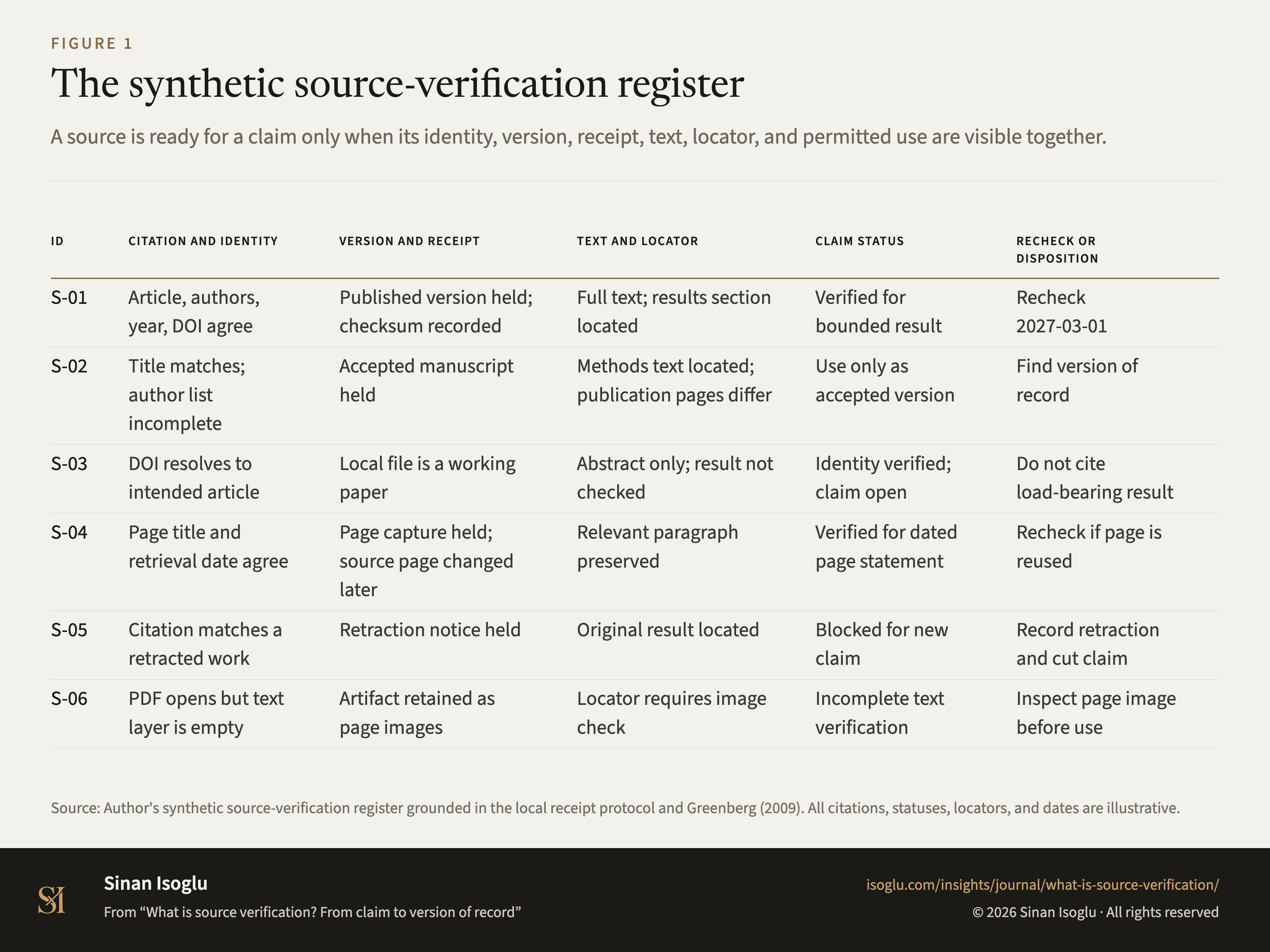
Figure 1Figure
The synthetic source-verification register
What is source verification? From claim to version of record
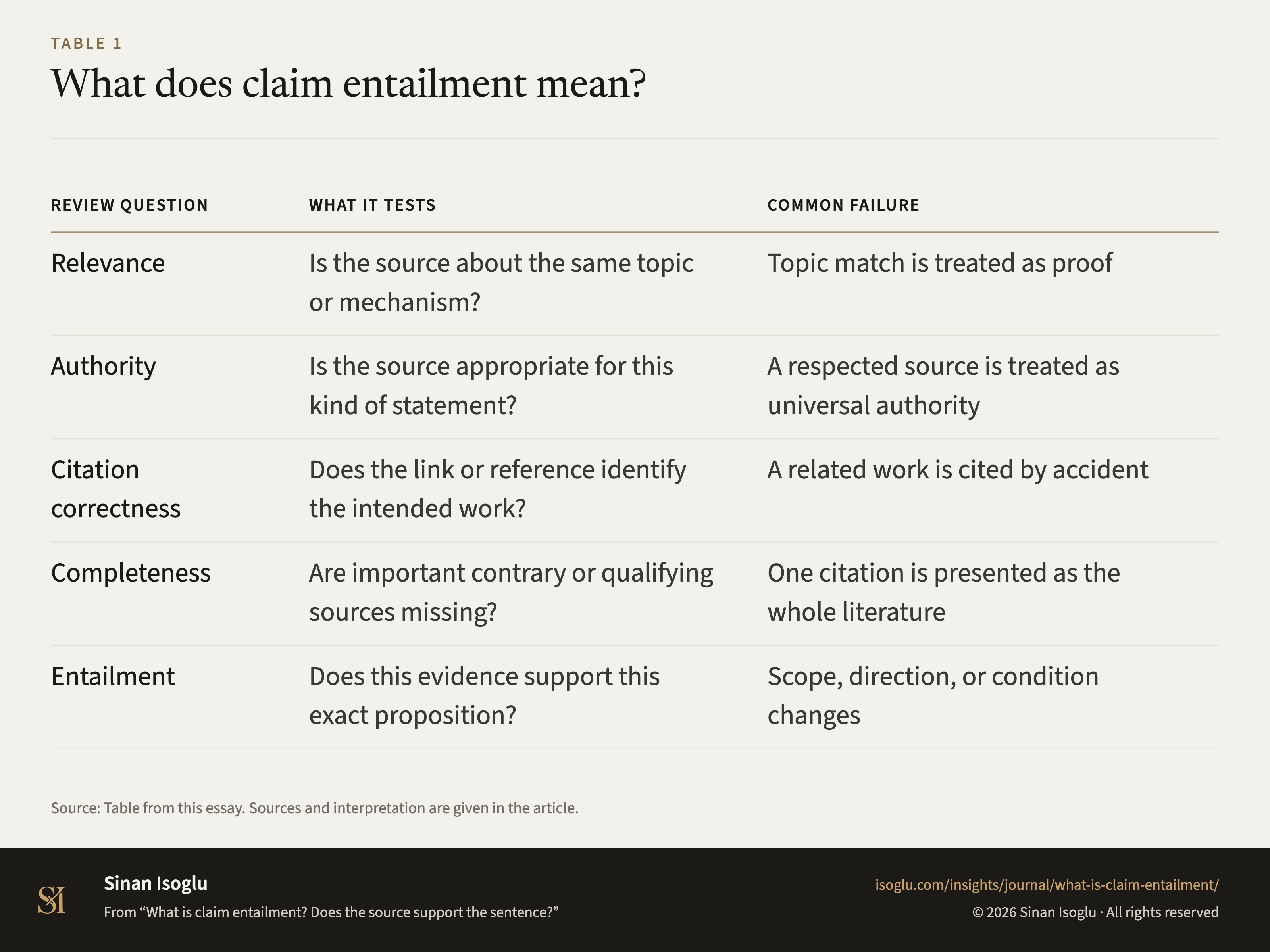
Table 1Table
What does claim entailment mean?
What is claim entailment? Does the source support the sentence?
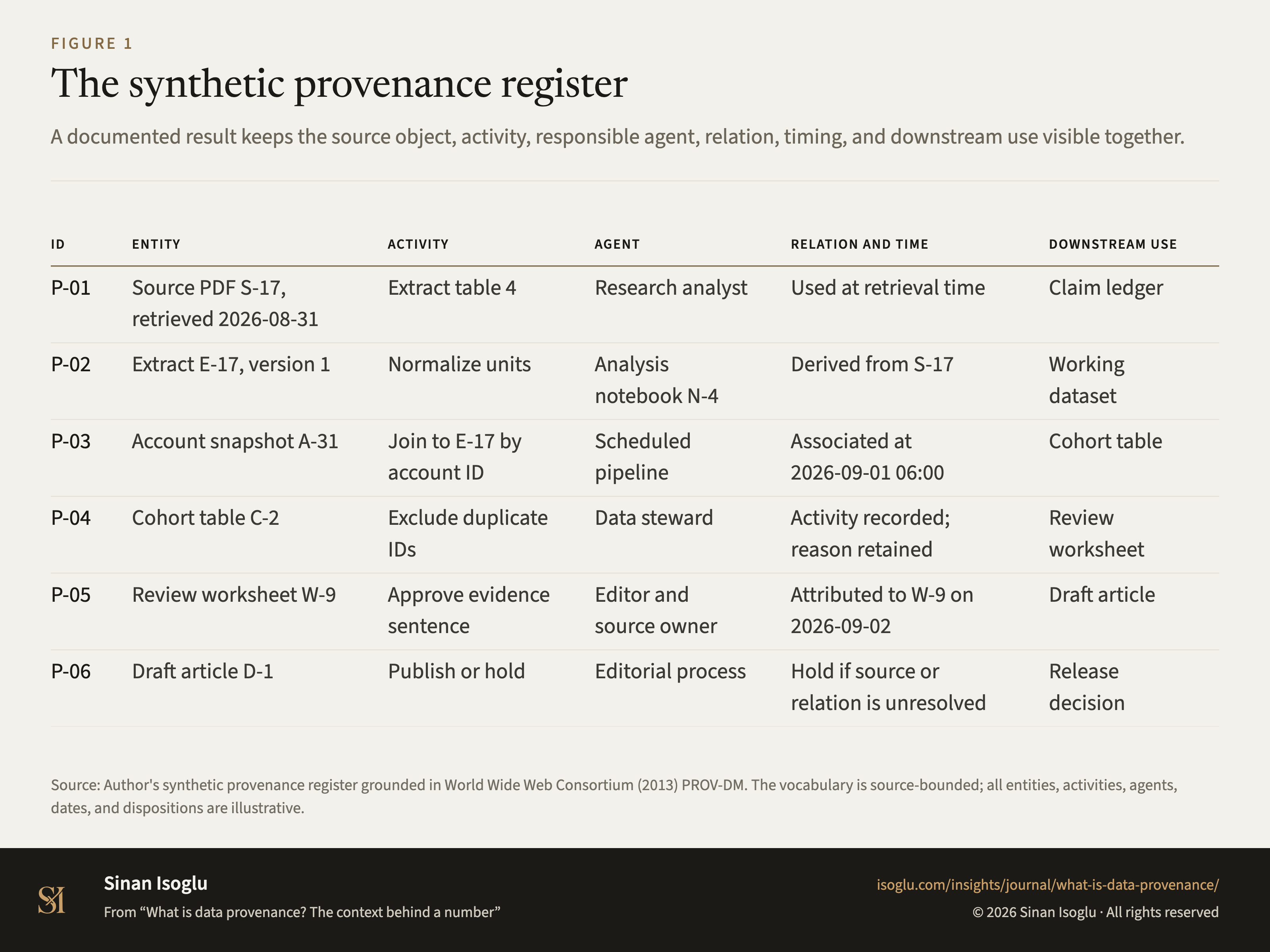
Figure 1Figure
The synthetic provenance register
What is data provenance? The context behind a number
Contact
Bring the question you're working on.
Research, a guest lecture, or a commercial question.