Figure 1From “What is marketing efficiency ratio (MER)? A blended signal, not a causal answer”
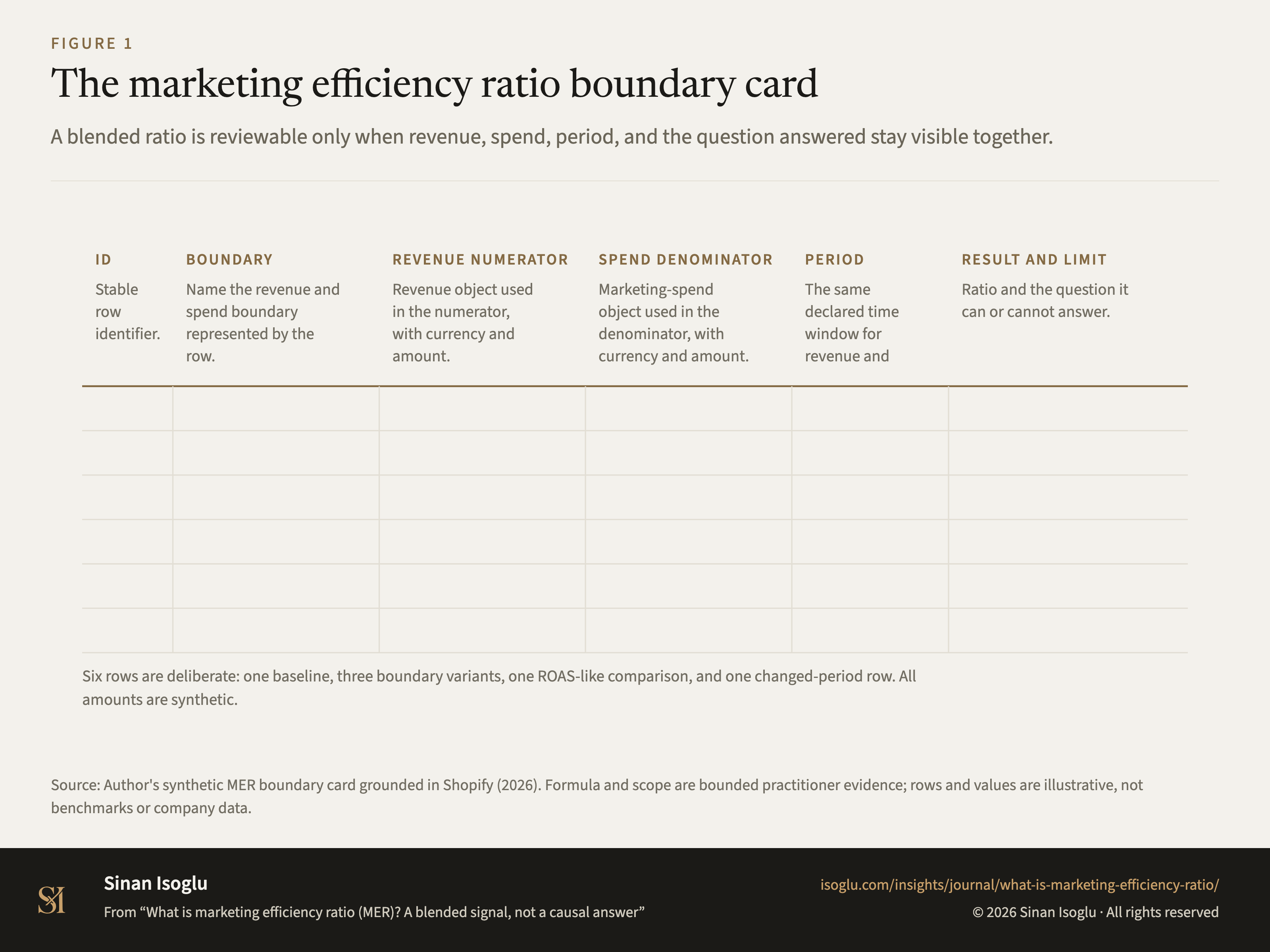
The marketing efficiency ratio boundary card
A blended ratio is reviewable only when revenue, spend, period, and the question answered stay visible together.
Figure 1The marketing efficiency ratio boundary card
Source: Author's synthetic MER boundary card grounded in Shopify (2026). Formula and scope are bounded practitioner evidence; rows and values are illustrative, not benchmarks or company data.
Source and evidence
Each line names a claim related to this exhibit, its source, and how it was checked.
- C SH26-C1 Shopify defines marketing efficiency ratio as a blended comparison of total revenue with total marketing spend, also called blended ROASShopify (2026), MER guide
- C SH26-C2 Shopify presents MER as total revenue divided by total marketing spend, with a worked 200,000 divided by 50,000 example equaling 4Shopify (2026), MER guide
- C SH26-C3 Shopify says MER comparisons require consistent revenue and spend definitions and periods, and distinguishes total-marketing MER from campaign or channel ROASShopify (2026), MER guide
Grades: A, verified against the printed page of the primary source · B, primary source, text layer only · C, authoritative secondary · D, reported.
From the essay
Growth that compounds
What is marketing efficiency ratio (MER)? A blended signal, not a causal answer
Marketing efficiency ratio is total revenue divided by total marketing spend for a declared period. Keep the numerator and denominator visible.
Read the essayThis exhibit belongs to an essay: the numbers live here, the argument lives there.
Cite or embed
Related exhibits
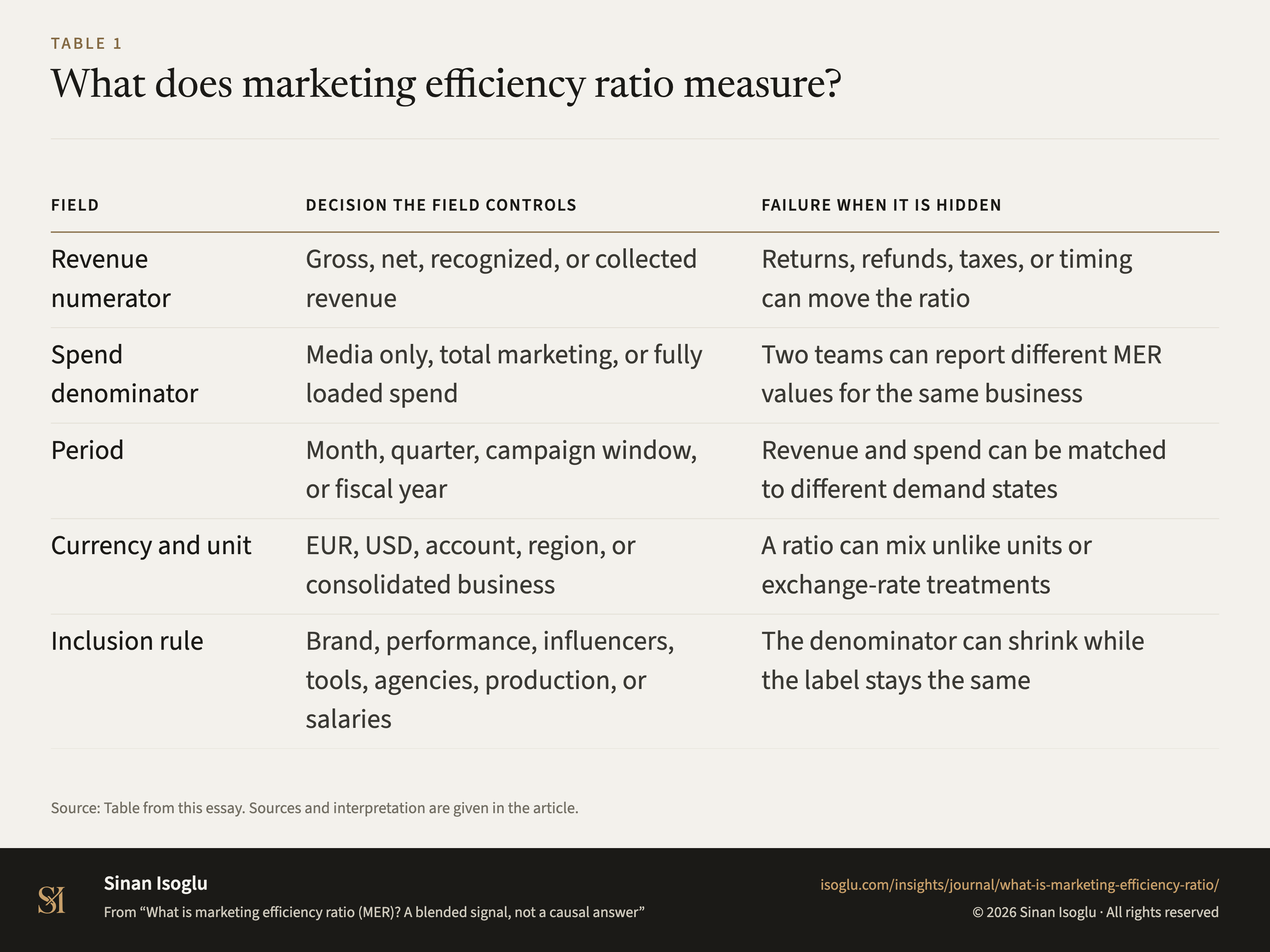
Table 1Table
What does marketing efficiency ratio measure?
What is marketing efficiency ratio (MER)? A blended signal, not a causal answer
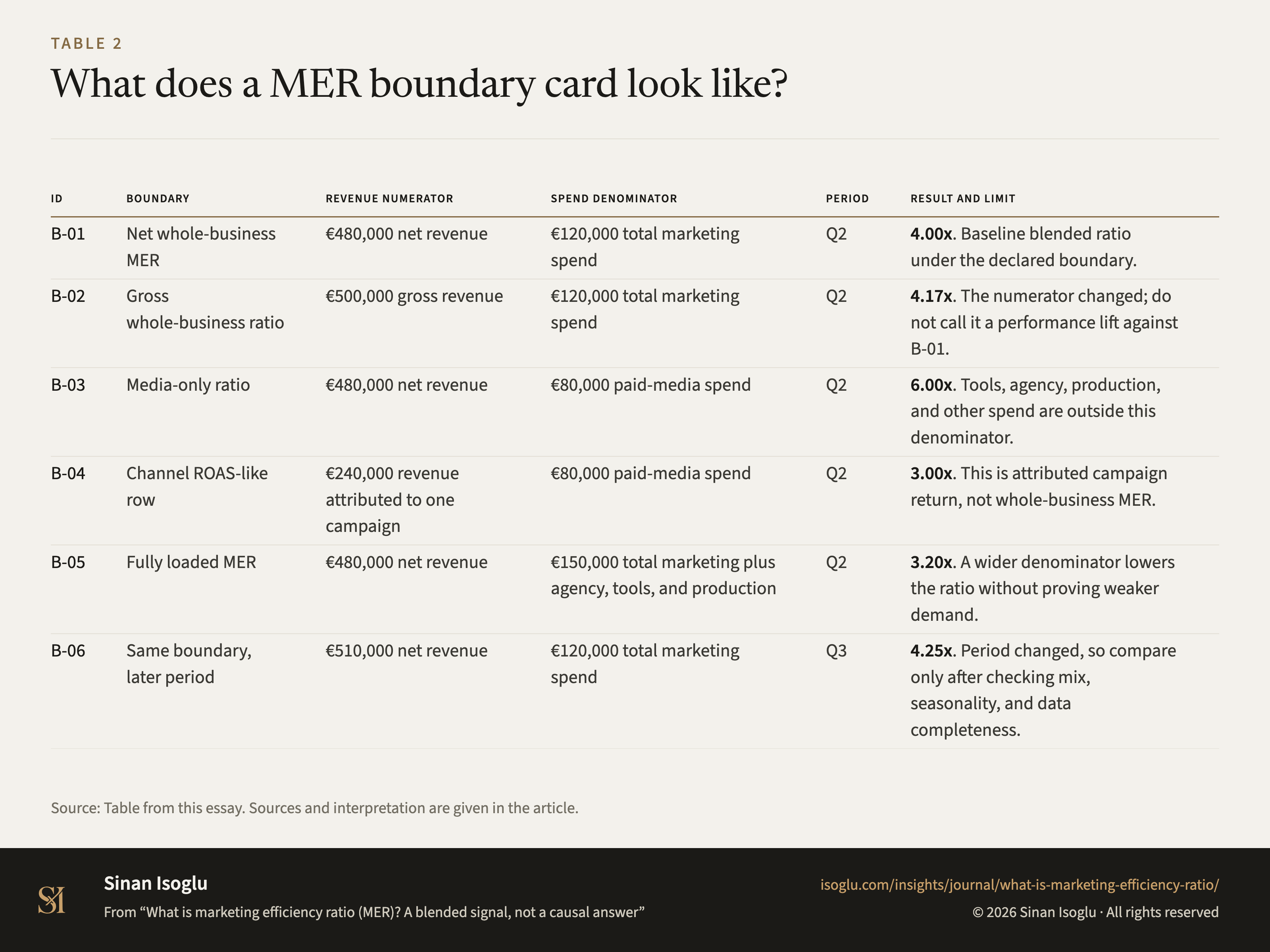
Table 2Table
What does a MER boundary card look like?
What is marketing efficiency ratio (MER)? A blended signal, not a causal answer
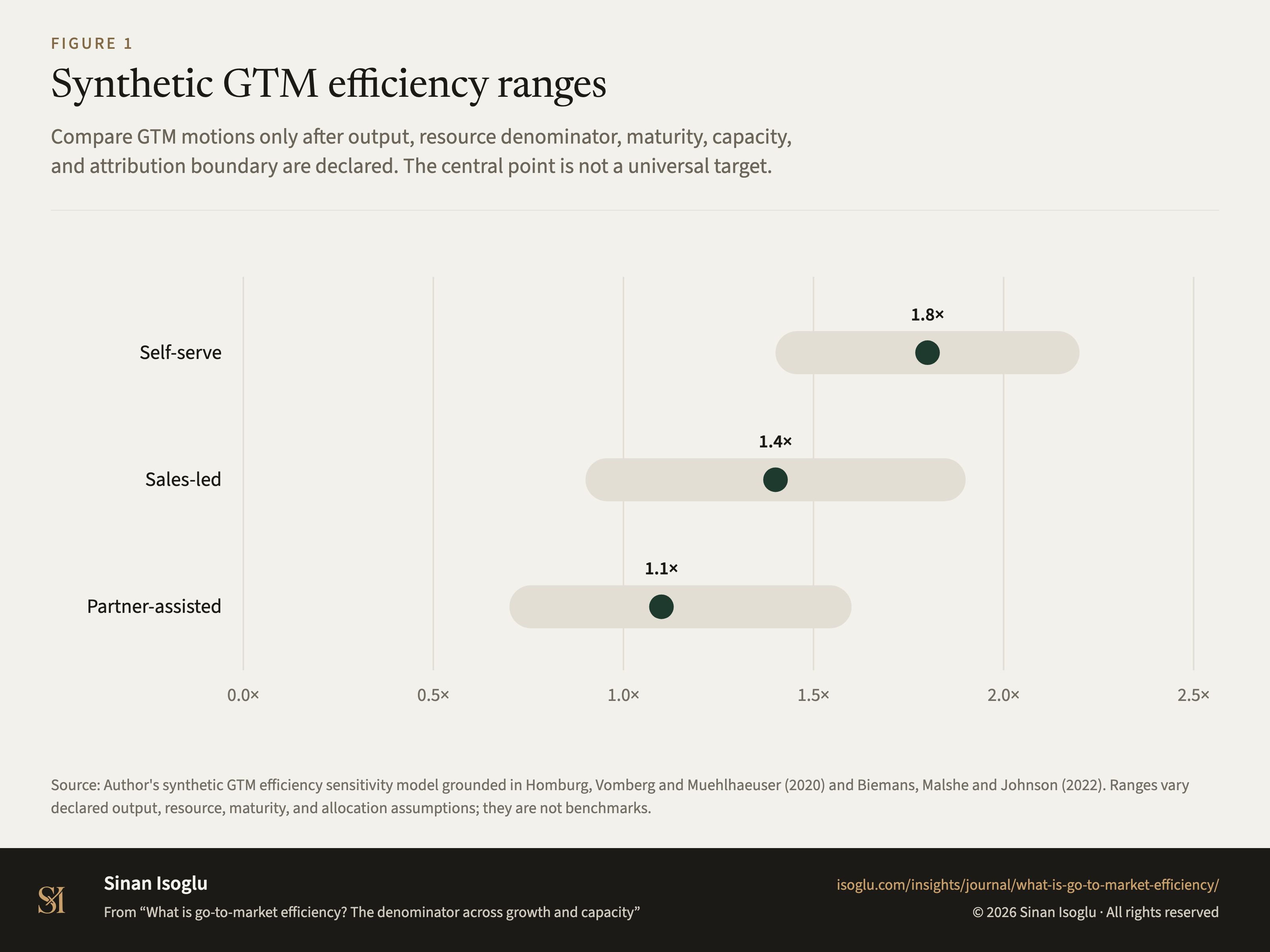
Figure 1Figure
Synthetic GTM efficiency ranges
What is go-to-market efficiency? The denominator across growth and capacity
Contact
Bring the question you're working on.
Research, a guest lecture, or a commercial question.